ERPNext, Odoo and Zoho are three names that come up when an Indian plant looks for an ERP. We implement ERPNext at Metageeks, so you should read this with that in mind. We do not sell Odoo or Zoho, and what we say about them comes from their own pricing, help and documentation pages, linked where used. Prices are as shown at the time of writing and will change.
TL;DR
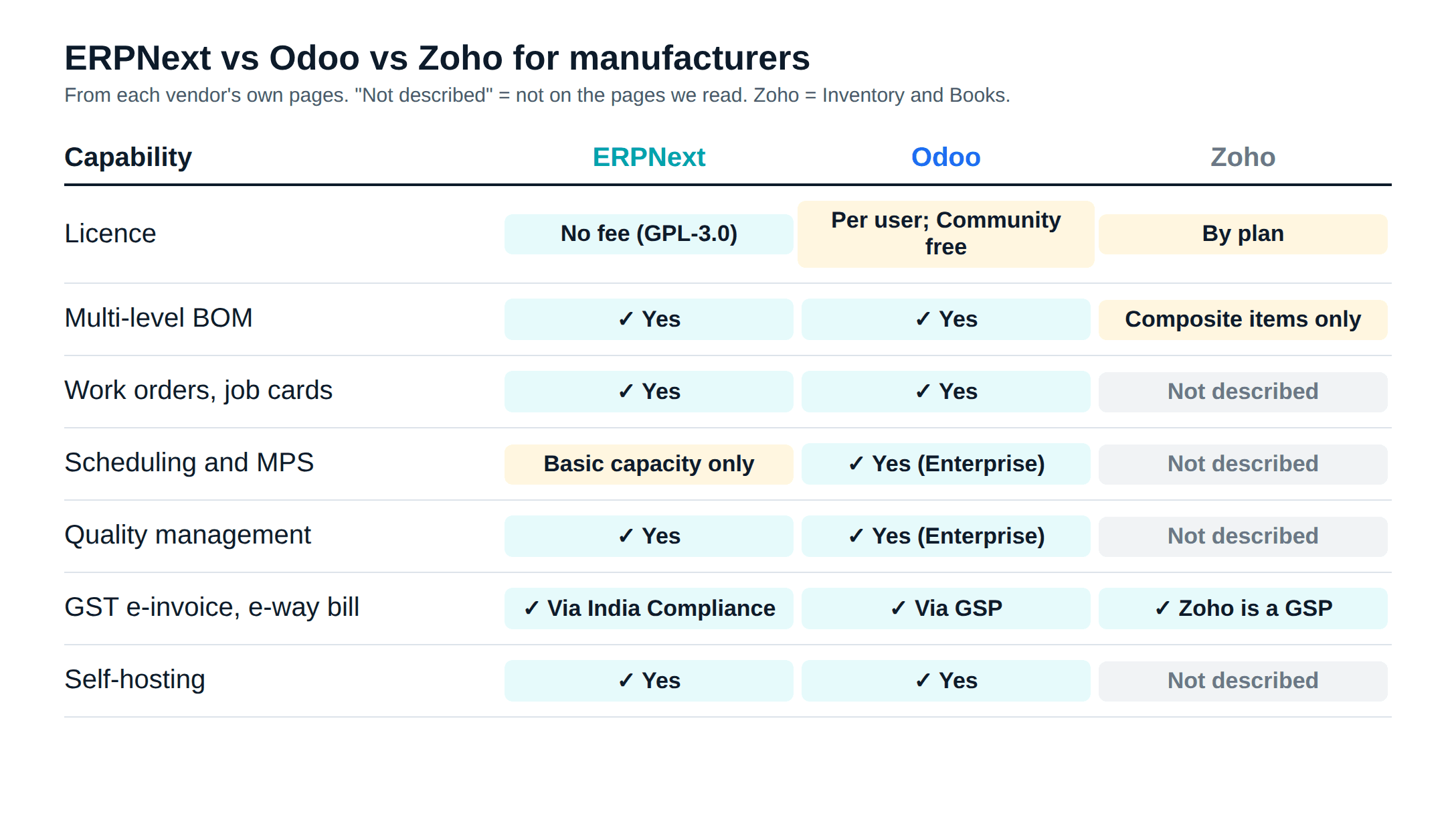
- ERPNext has no licence fee. Odoo charges per user per month, and some of its manufacturing features are Enterprise-only. Zoho charges by plan.
- Zoho does not sell a manufacturing ERP under its own name. For stock and accounts it sells Zoho Inventory and Zoho Books; a manufacturing ERP would be built on its Zoho Creator platform.
- Odoo documents the deepest planning tools of the three, including finite-capacity scheduling and a Master Production Schedule. ERPNext documents basic capacity planning and no schedule optimiser.
- All three handle GST e-invoicing and e-way bills. The difference is how: built in, through a configured GSP, or through an add-on app.
- Pick based on your plant's process and who will support it.
The short answer by plant type
These suggestions come from reading the vendors' documentation. They are not rules.
- A plant with simple recipes and a stock-and-accounts problem. Zoho Inventory with Zoho Books may be enough. Composite items cover assemblies, and Books alone has the lowest list price of the three for 25 users, though Books has no manufacturing features of its own.
- A job shop or process plant that needs BOMs, work orders, job cards and quality checks, and wants to own its data. ERPNext fits, and it has no per-user cost as headcount grows. We cover how it applies to food and beverage plants and plastics manufacturers separately.
- A plant that wants advanced planning (finite-capacity scheduling, MPS) and a polished shop floor app, and accepts per-user pricing. Odoo Enterprise documents more here than the other two.
- A plant with an in-house developer and unusual processes. All three can be customised; ERPNext and Odoo Community are open source, and Zoho's route is Creator.
Licence and five-year cost
The licence models differ, so list prices alone mislead.
ERPNext is open source under GPL-3.0. There is no licence fee and no per-user charge. You pay for hosting, implementation and support. Frappe Cloud, the managed host, listed Sites plans from $5 a month (Rs 410) at the time of writing; a plant with real load will probably need more than the entry plan.
Odoo has a free Community edition (LGPL) and a proprietary Enterprise edition. Odoo's India pricing page has a yearly and a monthly billing toggle, and each plan card shows a large discounted price beside a struck-through regular price, with a note that the discount is valid for 12 months on the initial users ordered. At the time of writing, per user per month:
- One App Free: Rs 0.
- Standard, billed yearly: Rs 580 for the first 12 months, then Rs 725. Billed monthly: Rs 760, then Rs 950.
- Custom, billed yearly: Rs 1,080 for the first 12 months, then Rs 1,350. Billed monthly: Rs 1,350, then Rs 1,690.
- Light User: Rs 195.
Custom adds Studio, and its card lists Odoo.sh hosting (not included in the price, per the page) and, on yearly billing, on-premise.
Zoho prices by plan, not by edition. Zoho Books listed Standard at Rs 749 a month for 3 users, and Ultimate at Rs 7,999 a month on annual billing (Rs 9,599 billed monthly) with 25 users included. It showed composite items and advanced inventory from the Elite plan, and extra users at Rs 150 a month each. Zoho Inventory listed Standard from Rs 999 (3 users) up to Enterprise at Rs 7,499 (10 users) on annual billing, and its pricing page lists composite items on the Free plan as well as the paid plans.
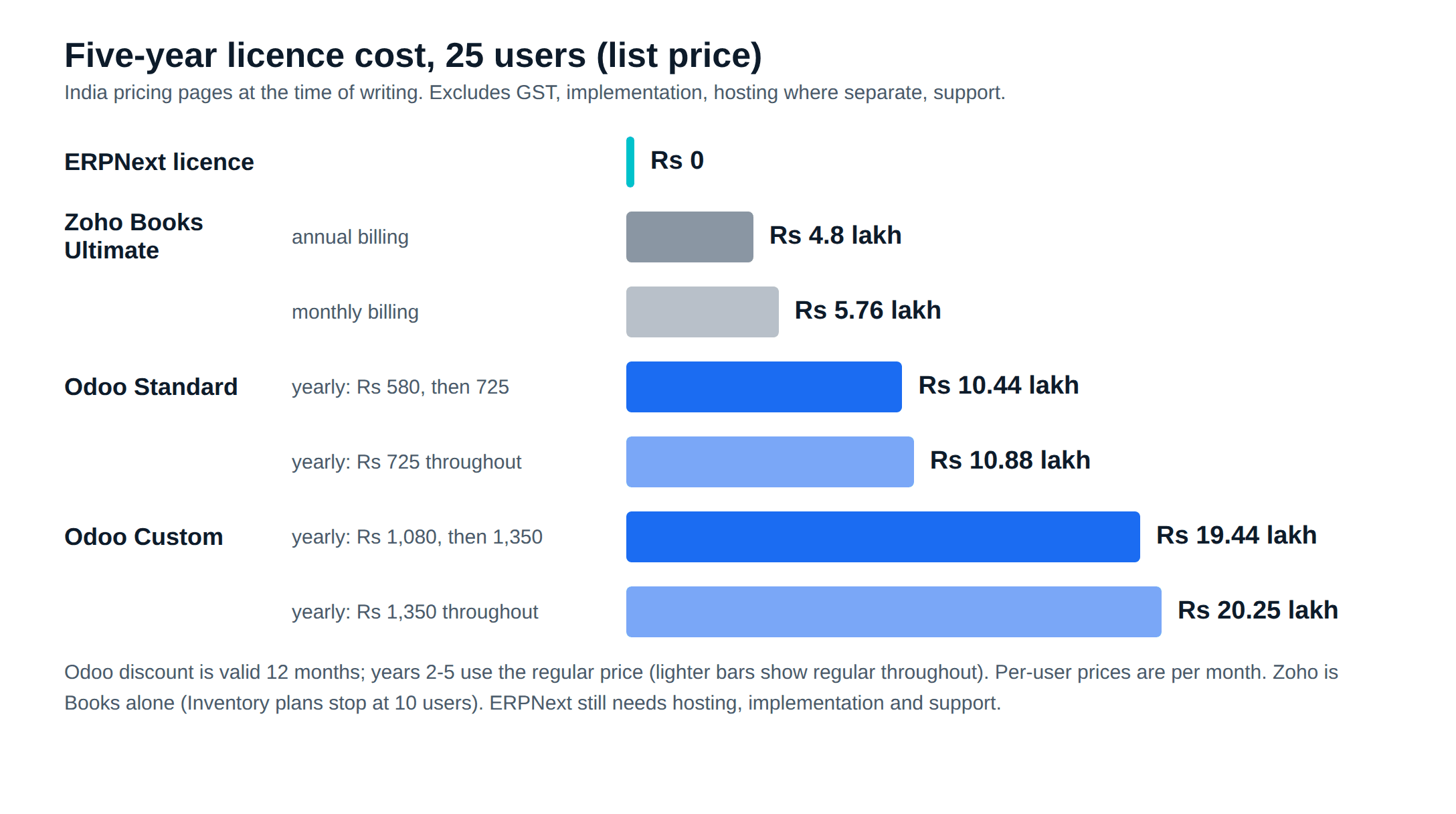
This is an illustration, not a quote. Assume 25 users for 60 months, list prices only, no GST, implementation, training, custom work or support. We use yearly billing for Odoo and annual billing for Zoho, so the two are comparable. Because Odoo's discount is valid for 12 months, we show two cases: the discounted price in year one and the regular price in years two to five, and the regular price for all five years.
| Option | Assumption (per user per month) | Five years |
|---|---|---|
| ERPNext, licence | No licence fee | Rs 0 |
| Odoo Standard, billed yearly | Rs 580 in year one, then Rs 725 | Rs 10.44 lakh |
| Odoo Standard, billed yearly | Rs 725 throughout | Rs 10.88 lakh |
| Odoo Custom, billed yearly | Rs 1,080 in year one, then Rs 1,350 | Rs 19.44 lakh |
| Odoo Custom, billed yearly | Rs 1,350 throughout | Rs 20.25 lakh |
| Zoho Books Ultimate, billed annually | Rs 7,999 a month, 25 users included | Rs 4.8 lakh |
Billed monthly, the same Odoo cases come to Rs 13.68 and 14.25 lakh for Standard (Rs 760 then Rs 950, or Rs 950 throughout) and Rs 24.33 and 25.35 lakh for Custom (Rs 1,350 then Rs 1,690, or Rs 1,690 throughout). Zoho Books Ultimate billed monthly is Rs 9,599 a month, or Rs 5.76 lakh over five years. Zoho Inventory's listed plans stop at 10 users, so the Zoho figure is Books alone, which has no manufacturing features of its own. Odoo's price grows with each added user; ERPNext's licence line does not. ERPNext's real cost sits in hosting, implementation and support, which our ERPNext implementation cost guide sets out with sources.
Manufacturing depth
ERPNext. The project page describes manufacturing that tracks material consumption, shows capacity planning and handles subcontracting. The documentation covers multi-level BOMs, Work Orders, Job Cards per operation, routings, quality inspection and a Production Plan that explodes BOMs into material requests. Capacity planning is basic: workstation hours, holidays and a capacity figure, with no optimiser to sequence jobs. We walk through the chain in production planning, BOM and MRP in ERPNext.
Odoo. Odoo's manufacturing documentation covers multi-level BOMs, work centers, work order dependencies, subcontracting, by-products, scrap, unbuild, lot and serial tracking, a Master Production Schedule, OEE reporting and a Shop Floor control panel. Its manufacturing page describes finite-capacity planning on Gantt charts. The editions page says Community lacks Shopfloor, scheduling, PLM, Quality and Maintenance. So the depth above is largely an Enterprise story.
Zoho. Zoho does not sell a manufacturing ERP under its own name that we could find. For stock it sells Zoho Inventory, where composite items come in two types: Assemblies, which consume components and create a finished good, and Kits, which bundle items for sale. That help page does not describe work orders or routings. For deeper manufacturing, Zoho's own Creator use-case page shows a custom app with BOMs and work orders built on its low-code platform. That is a build, not a packaged product.
GST, e-invoicing and e-way bills
Zoho Books is the most direct. Its e-invoicing page says e-invoicing is available on every paid plan and that Zoho is a recognised GST Suvidha Provider, so invoices go to the IRP without another GSP. E-way bills can be generated from Zoho Books, and the IRN and QR code are returned by the IRP.
Odoo ships India localization modules for accounting, e-invoicing, e-way bills and GST reports (GSTR-1, 2B, 3B), plus TDS/TCS. E-invoicing and e-way bills use a configured GSP, which the documentation names, and you register on the NIC portal and enter API credentials. The documentation does not state which edition each module needs, so confirm that with Odoo before you commit.
ERPNext covers it through the open-source India Compliance app, which includes e-invoice and e-way bill integration with the NIC portal and GST return tools. Its page says some automation needs GST API access, which has a cost through an India Compliance account.
So compliance does not separate them. What differs is who your GSP is, who holds the credentials and who you call when the portal rejects an invoice. E-invoicing thresholds and rules change, so check the current rules for your turnover.
Hosting and data ownership
- ERPNext: self-host with Docker or Bench, or use Frappe Cloud, per the project page. Either way the database is yours to back up and move.
- Odoo: Odoo Online is included in Standard. Per the pricing page, Odoo.sh is listed on Custom, on-premise appears there on yearly billing, and Community can be self-hosted under its open-source licence. Upgrades are included in the plans.
- Zoho: a hosted service. We did not find a self-hosted option on the pages we read.
For a plant, ownership means two practical things: can you take a full copy of the database, and can someone other than the vendor fix a problem? Self-hosted ERPNext and Odoo answer yes to both. With a hosted-only product, ask the vendor in writing what export you get and in what format.
Customising for your process
ERPNext is built on the Frappe Framework, and customisations such as custom fields, print formats and workflows can be made in the interface or in code. Odoo Studio does similar work but is Enterprise only per the editions page, while Community can be extended in code. Zoho extends through Creator, its low-code platform, which runs on Zoho's hosting.
Code customisation adds to the work of each major upgrade on any of these. Prefer configuration over code, and write each custom change down.
Which to choose
Work through this checklist before you pick.
- List your real processes: BOM levels, job work, batch tracking, quality checks, scheduling needs. Mark what is essential.
- Run a trial of each shortlisted product with one real BOM, one purchase-to-pay cycle and one GST invoice through to e-invoice.
- Ask each vendor or implementer for a written scope and a five-year cost for your user count, with every exclusion listed.
- Ask in writing what data export you get and who holds the GSP credentials.
- Ask who will support it after go-live, and what that costs.
If you are leaning towards ERPNext, our ERPNext implementation starts with discovery and a written scope. We are an independent ERPNext implementer, and we will tell you if one of the other two fits your plant better. If you are moving off Tally first, read ERPNext vs Tally.
Frequently asked questions
Is Odoo or ERPNext cheaper for a small Indian manufacturer?+
On licence cost, ERPNext, because it has none. Odoo charges per user per month, and Odoo's India pricing page showed Standard at Rs 725 per user per month on yearly billing, with Rs 580 for the first 12 months, at the time of writing. The licence is only part of the bill: ERPNext still needs hosting, implementation and support, and Odoo still needs implementation. Compare quotes for the same written scope, not licence lines.
Does Zoho have an ERP for manufacturing?+
Not under that name that we could find. Zoho sells Zoho Inventory and Zoho Books for stock and accounts, and Zoho Creator, a low-code platform. Zoho's own use-case page shows Creator being used to build a manufacturing ERP with BOMs and work orders. Zoho Inventory's help page on composite items describes assemblies but not work orders or routings.
Do all three handle GST e-invoicing and e-way bills?+
Yes. Zoho Books generates both and Zoho is a GST Suvidha Provider. Odoo has e-invoicing and e-way bill modules that connect through a configured GSP. ERPNext does it through the open-source India Compliance app, where some automation needs paid GST API access.
Can I move from one of these to another later?+
Yes, but plan for a migration project, not an export button. We have not tested each product's import tools for this post, so ask each vendor or implementer what carries over and what has to be rebuilt. A system you can host yourself helps, because you hold the whole database.
Free PDF
The 2026 AI Development Rate Sheet
Build, agent, RAG and consulting rates by tier, in one PDF, so you can check a quote before you sign it.

Written by
Pankaj Kumar
Founder · Metageeks Technologies
Metageeks builds software and AI products for growing businesses. Every build is scoped in writing before it starts, and you see progress every week. We write about what holds up once it reaches production.
Connect on LinkedInThe AI Build Brief
Ship AI that holds up in production.
Practical playbooks on how to build, price and ship AI features, in one short email every other week.