A customer rings to say a pack from last Tuesday tastes off. Which lot was it, which flour went in, and who else received that lot? In a food plant those three questions arrive together, and the answer lives in a register, an Excel sheet and the storekeeper's memory. This guide covers what an ERP for food manufacturing in India does about it, using ERPNext, for the owner, plant head or QA lead of a 20-60 person plant making snacks, dairy, spices or beverages.
TL;DR
- FSSAI's recall guidelines ask for batch codes, lot numbers and traceability from raw material to finished good. They name no software, so you choose the tool.
- ERPNext ships batch numbers with expiry dates, a shelf-life field, expiry-based batch selection, quality inspections, percentage-based recipes with process loss, and a stock ledger of every movement.
- ERPNext records batches on every stock transaction through Serial and Batch Bundles, and can pick batches by FIFO, LIFO or expiry. Whether the trace from finished lot back to supplier lots works for your plant is something to prove on a test site.
- Run a mock recall on the test site with real data. If you cannot list every dispatch of one lot in minutes, fix the setup before go-live.
What a food plant needs that a trading company does not
A trader buys, stores and sells. A food plant also transforms, and each step adds a record someone may need later.
- Lots, not just items. Flour is not one stock figure. It is lot A from supplier X and lot B from supplier Y, each with its own date and quality result.
- Expiry. Stock has a clock on it. A pack that expires in two weeks is worth less than one that expires in six months.
- Recipes with loss. A recipe says 100 kg in, but frying, drying or filling loses some. Costing that ignores the loss is wrong from day one.
- Quality gates. Incoming material and finished goods get checked, and the result has to stay attached to the lot.
- A recall list. If one lot is implicated, you need every account that received it, quickly.
FSSAI's own guidelines for food recall shape the last point. They say food business operators covered by regulation 7 of the Food Safety and Standards (Food Recall Procedure) Regulations, 2017 must have an up-to-date recall plan, and that to recall effectively the operator should keep distribution records covering supplier and distributor names, date of purchase of raw material, batch code, lot number and complete traceability from raw material to finished good. Regulation 7 applies to specific categories of operator, so check with your licensing authority or consultant which applies to your licence. The guidelines also describe a step to prepare a lot-specific distribution list with account names, addresses and contacts. That is a records problem, and records are what an ERP is for.
If you are still choosing a system, our ERPNext vs Tally comparison covers the first decision, our ERPNext implementation page covers how we approach food and beverage plants, and the cost guide covers the price side.
Batch and lot numbers from supplier to dispatch
In ERPNext, batches start on the Item. The Item documentation says that ticking Has Batch No reveals the batch number, expiry date and retain-sample options. It also lists an option to create new batches automatically and a batch number series, which is a prefix applied to batch numbers. For a plant that prefers its own lot code format, the prefix is where you start.
The batch-wise inventory guide describes the flow: on receiving stock you create a new batch or pick an existing one, and when delivering a batch item the guide says you name the batch. Stock then reports by batch in the Batch-wise Balance History report under Stock, Standard Reports.
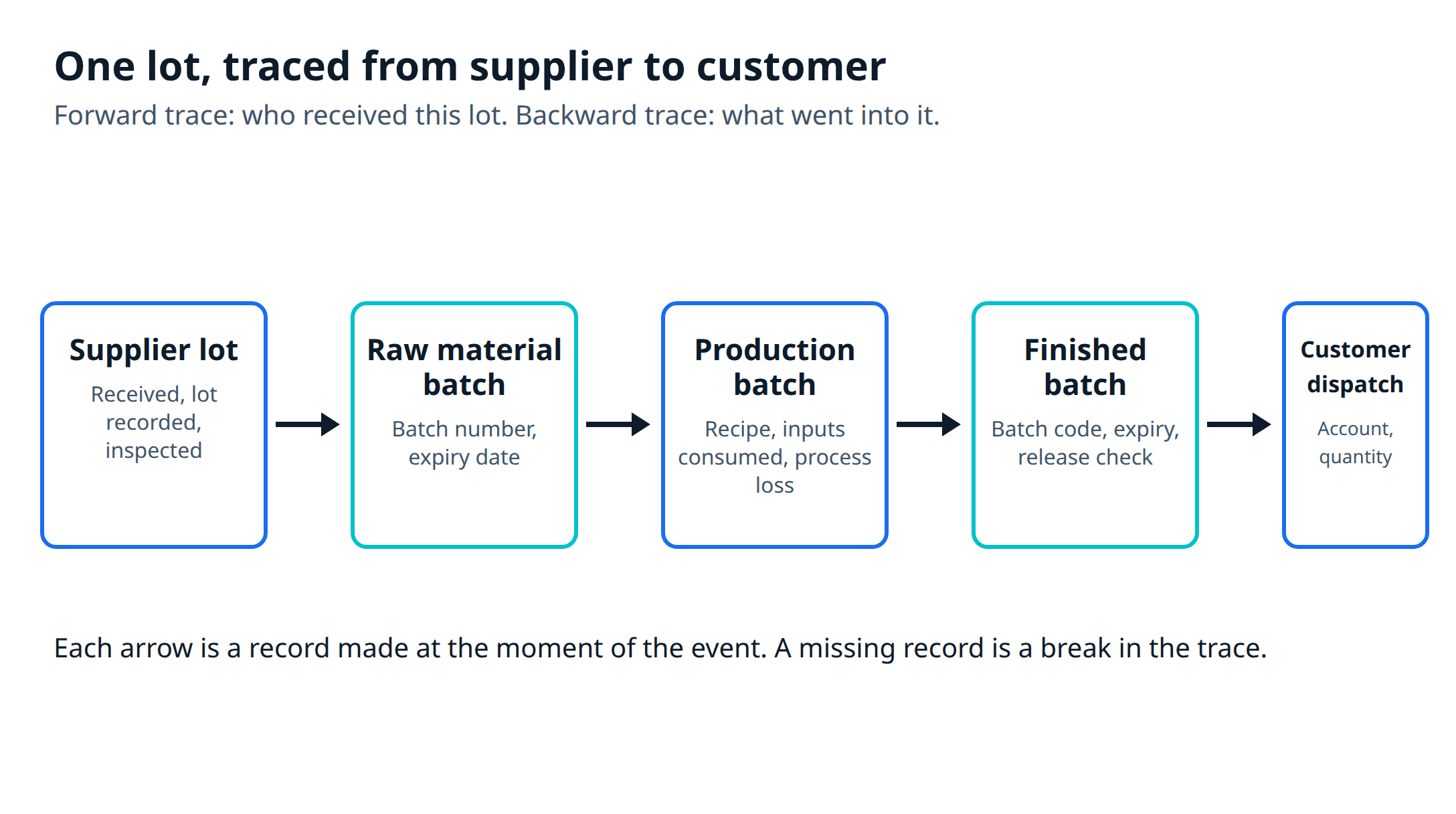
Read the figure left to right for a forward trace (which customers got this lot) and right to left for a backward trace (which supplier lot went into this complaint). Each arrow is a record someone has to make at the moment of the event.
The documents above confirm that batches exist and that receipts and deliveries carry them. The Work Order documentation says a Manufacture stock entry consumes the raw materials and creates the finished goods, but it does not describe a batch genealogy report. The Serial and Batch Bundle documentation says each stock transaction needs its own Serial and Batch Bundle, and a Manufacture entry is a stock transaction, so the raw material batches consumed and the finished batch produced are both recorded on the entry. We found no page that describes a ready-made report joining them. Walking from a finished lot back to its supplier lots, and forward to dispatch, is what the mock recall below should check.
The Stock Ledger report is the backbone: the documentation says it keeps track of stock movements, covering inward and outward transactions from manufacturing, purchasing, selling and stock transfers. Every movement leaves a line. That is why a trace is possible at all, and why entering stock outside the system breaks it.
Expiry and near-expiry stock
Expiry sits on the batch. The Batch documentation says a batch with an expiry date shows Not Expired until that date and Expired after it. The Item documentation adds Shelf Life in Days, the number of days after which a batch becomes unusable, which gives you a default to work from.
Two limits are worth knowing before you promise anything to the floor.
First, picking. The Serial and Batch Bundle documentation says that, using the Serial and Batch Selector, the user can pick batches by a FIFO, LIFO or Expiry method, and that outward bundles can be created automatically if the Auto Create Serial and Batch Bundle For Outward option is enabled in Stock Settings. So expiry-order picking exists. Test it on a delivery with two lots of different expiry, and agree the picking routine with stores before go-live.
Second, near-expiry reporting is a report habit, not an alarm. Frappe's inventory control guide points to the Stock Ageing report for seeing which stock is getting old. Decide who looks at it, how often, and what happens to stock under, say, 30 days of life. Discount, redirect to a different channel, or write off. The system shows you the stock. The routine is yours.
For beverages and dairy, where shelf life is short, run that review more often than weekly.
Recipes as BOMs, with process loss
A recipe in ERPNext is a Bill of Materials. The BOM documentation supports percentage-based formulation: each row's quantity is derived as percentage divided by 100, times the output quantity. Its example is a 200 kg output with coriander at 40 percent giving 80 kg and chilli at 35 percent giving 70 kg. That suits masala blends, flour mixes and beverage bases, where the recipe is a ratio and the batch size changes.
Loss has its own handling. The same page says that if the scrap item is the same as the item being manufactured, it is set as a Process Loss item and its quantity is subtracted from the manufactured quantity. Operations are available too, and the documentation describes them as useful for tracking the costing of the operations performed, each with a workstation, hourly rate and time.
A typical 30-person plant making a spice blend might assume a 2 percent loss in grinding and 1 percent in filling. Those numbers are an assumption for illustration, not a benchmark. Your own trial runs set them. Weigh input and output on three or four real batches, put the observed loss in the BOM, and revisit it after a month of production. A BOM that hides a 5 percent loss makes every costed margin look better than it is.
A recipe is also commercial IP, so decide who may view and edit BOMs before go-live.
How a BOM feeds the production plan and the purchase list is covered in our guide to production planning, BOM and MRP in ERPNext.
Quality checks at receipt and dispatch
ERPNext's Quality Inspection documentation describes templates holding parameters and acceptance criteria, which can be fetched into any inspection. Readings can be numeric, non-numeric or formula-based, and a reading outside the accepted range sets the row to Rejected on save. An inspection can be created from a draft Purchase Receipt or Delivery Note through the item row. A manual inspection checkbox lets you set the status by hand for tolerance exceptions.
The Item master can also mark inspection as required before purchase or before delivery, according to the Item documentation. It also has a retain-sample option with a sample retention warehouse, which fits a plant that keeps a reference sample per lot.
In a food plant that gives you a practical set of templates:
- Incoming material. Moisture, foreign matter, temperature on arrival, packaging condition, supplier certificate checked.
- In-process. Weights, temperatures and seal checks at the points your HACCP plan names.
- Finished goods before dispatch. Net weight, label and batch code legibility, sample drawn.
Your food safety plan, not ERPNext, decides which parameters matter. The tool gives you the place to record them against the lot and a rejection that stays visible. Checks done on paper and filed in a drawer cannot be searched in a recall.
Running a mock recall in minutes
FSSAI's guidelines describe the recall steps: assemble the recall team, notify the authority, identify the products, detain and segregate them, communicate, build the distribution list, verify effectiveness and control the recovered product. The guidelines say recovered product is kept separate from other food, with accurate records of the amount and the batch codes of what came back. Treat the drill as your own practice, not an FSSAI-prescribed test.
Here is a drill for the test site, before go-live:
- Pick one finished lot produced in the last month.
- List every customer and quantity it was dispatched to, from the delivery records.
- Walk backward: which raw material lots went into it, and from which suppliers?
- Find any other finished lot made from the same raw material lot.
- State how much of the lot is still in the warehouse, and how much has expired or been rejected.
Time it. A plant that can answer steps 2 to 5 in minutes, not days, has a setup that will hold. If step 3 or 4 stalls, the gap is usually how raw material consumption is entered against production, which is a process fix, not a software failure. Write down the date, the lot and the time taken, so the next drill has something to beat.
Our implementation approach builds this drill into acceptance, so the plant signs off on a trace and not on a demo.
Questions to ask before choosing a food ERP
Whichever system you shortlist, put these to the vendor and ask for a live demonstration, not a slide.
- Show me a finished lot and walk back to the supplier lots that went into it.
- Show me every customer that received one lot, with quantities.
- Can picking be set to expiry order?
- How is process loss entered, and where does it show in costing?
- Can quality results be attached to a lot and searched later?
- Who can see and edit recipes?
- What happens if stores forget to scan or select a batch?
The last question matters most. Every ERP needs discipline at the point of entry, and a vendor who says discipline is not needed is selling something. A written scope that names these tests is the best protection for you, and our cost guide explains why that document should come before any quote.
Metageeks is an independent ERPNext implementer. If you run a food or beverage plant and want to know what a trace would take on your line, tell us what you make and how stock moves today, and we will say what ERPNext covers and what you will need to run by hand.
Frequently asked questions
Does FSSAI require food manufacturers to use ERP software?+
No. FSSAI's recall guidelines ask the food business operator to keep distribution records, including batch code, lot number and traceability from raw material to finished good, and to hold a recall plan. They do not name a software tool. An ERP makes the same records searchable, which matters when you must list every account that received one lot.
Can ERPNext track batch and expiry dates?+
Yes. ERPNext's Item master has a Has Batch No option, and the documentation says ticking it reveals batch number, expiry date and retain-sample options. A batch can carry an expiry date and shows as Expired after that date. The Item also has a Shelf Life in Days field, described as the number of days after which a batch becomes unusable. The Batch-wise Balance History report shows stock by batch.
Does ERPNext handle recipes and yield loss?+
Recipes are set up as a Bill of Materials. ERPNext's BOM documentation says quantities can be given as percentages of the output, for example a 200 kg output with coriander at 40 percent giving 80 kg, and that a scrap item matching the manufactured item is treated as process loss and subtracted from the output quantity. Yield and loss still need a real trial, because the figures depend on your line.
Do I need ERPNext, or will Tally do for a small food plant?+
Tally keeps the books well. The question is whether you need batch and expiry control, recipe costing and a recall list from the same system. If a lot recall would today mean opening several registers and phoning the stores team, an ERP is worth pricing. If you make a single product to a single customer, a disciplined paper and Tally setup can be enough. Our comparison of ERPNext and Tally sets out the line.
Free PDF
The 2026 AI Development Rate Sheet
Build, agent, RAG and consulting rates by tier, in one PDF, so you can check a quote before you sign it.

Written by
Pankaj Kumar
Founder · Metageeks Technologies
Metageeks builds software and AI products for growing businesses. Every build is scoped in writing before it starts, and you see progress every week. We write about what holds up once it reaches production.
Connect on LinkedInThe AI Build Brief
Ship AI that holds up in production.
Practical playbooks on how to build, price and ship AI features, in one short email every other week.