
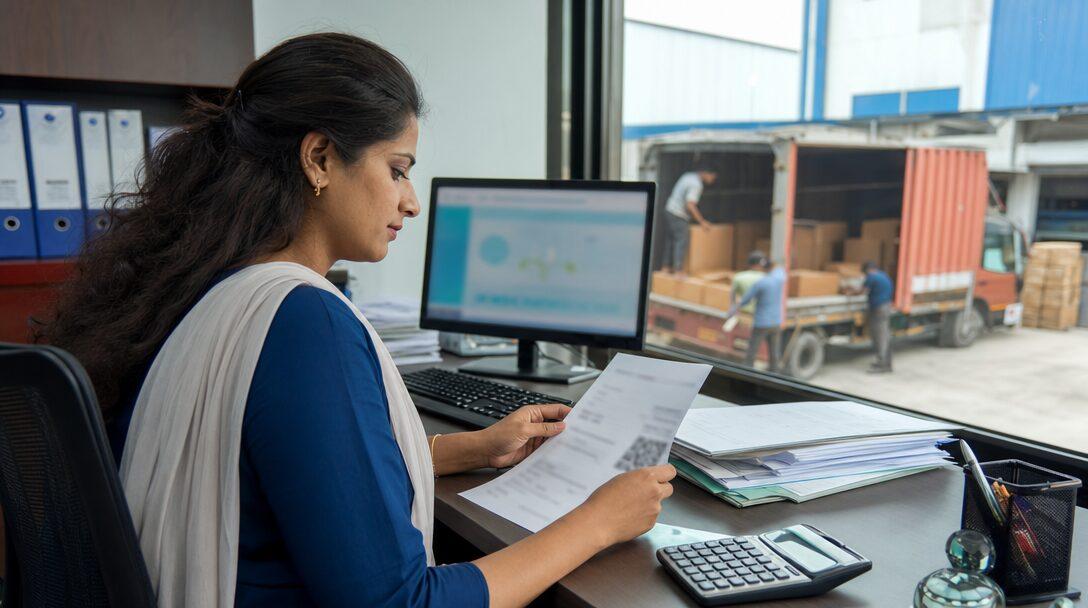
GST compliance software earns its keep in a plant on one desk: the accounts team that types each sales invoice into the e-invoice portal, waits for the IRN, then retypes the same lines into the e-way bill portal before the truck can leave. Picture a plant that dispatches 40 invoices a day this way. Every invoice is entered at least twice, and every retyped GSTIN or HSN code is a chance for the portal to reject it, or accept it wrong. This guide covers who must e-invoice, the e-way bill rules at the gate, how ERP integration works and what to automate first. It is general information, not tax advice; check your position with your CA.
TL;DR
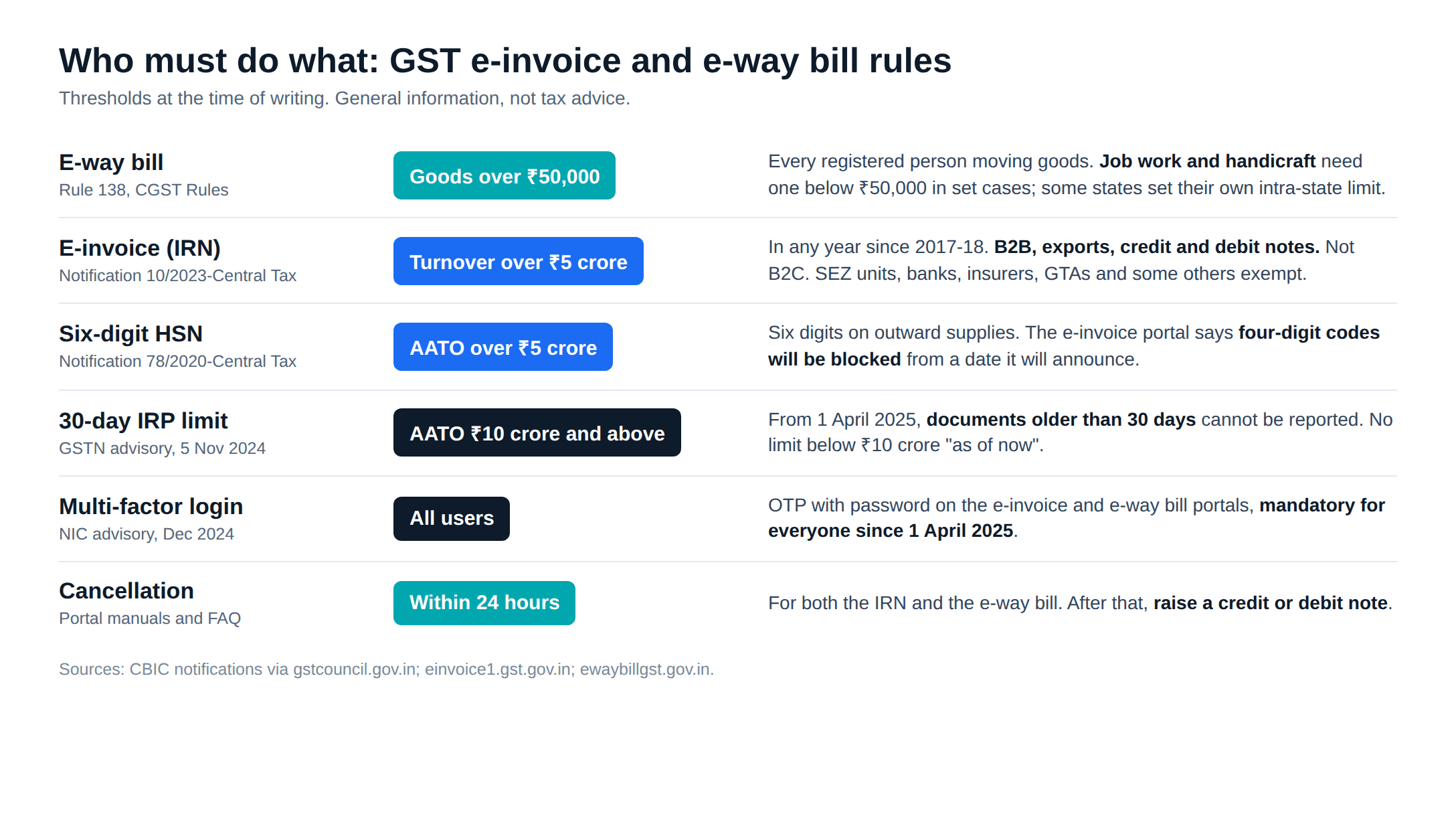
- E-invoicing applies once aggregate turnover has crossed ₹5 crore in any year since 2017-18 (Notification 10/2023-Central Tax). It covers B2B invoices, exports, and credit and debit notes, not B2C sales.
- From 1 April 2025, taxpayers at ₹10 crore and above cannot report a document older than 30 days to the IRP (GSTN advisory).
- An e-way bill is needed to move goods worth more than ₹50,000. An IRN and an e-way bill can each be cancelled only within 24 hours.
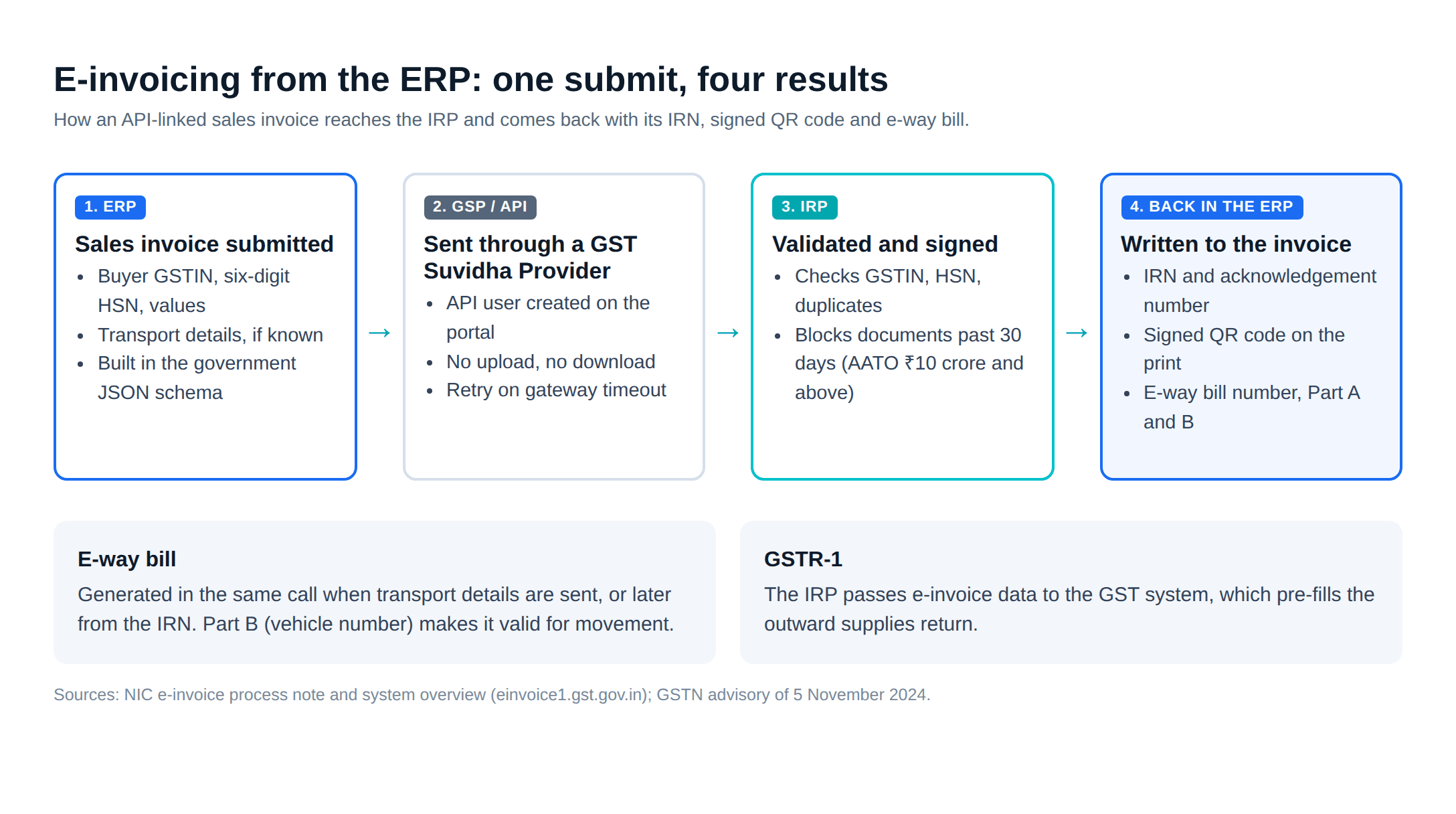
- Integrated through a GST Suvidha Provider (GSP) API, the ERP sends the invoice once and gets back the IRN, the signed QR code and the e-way bill number.
- Automate in this order: IRN on sales invoices, e-way bills with the invoice, cancellations inside 24 hours, then credit notes and job work challans.
Free ERPNext fit check
Will ERPNext fit your factory?
Answer a few quick questions. On a short call we tell you whether ERPNext fits how you make, stock and sell, and what the rollout looks like.
Check my fit →Who must e-invoice, and by when
E-invoicing means reporting each invoice to an Invoice Registration Portal (IRP), which validates it and returns an Invoice Reference Number (IRN) and a digitally signed QR code. NIC runs the e-invoice system at einvoice1.gst.gov.in, and its process note says the IRN must be generated for invoices, debit notes and credit notes for B2B and export transactions.
The ₹5 crore turnover test
Notification 10/2023-Central Tax, dated 10 May 2023, cut the threshold from ₹10 crore to ₹5 crore from 1 August 2023. The test is aggregate turnover across all GSTINs on the same PAN, in any financial year from 2017-18 onwards. A plant that crossed ₹5 crore once stays in, even if turnover later falls.
Exceptions: the e-invoice portal's system overview lists SEZ units, insurers, banking companies and financial institutions including NBFCs, goods transport agencies, passenger transport services, and multiplex cinema admission as exempt. Government departments and local authorities were added by Notification 23/2021-Central Tax. Sales to unregistered buyers need no IRN.
The 30-day reporting window
A GSTN advisory of 5 November 2024 lowered the 30-day limit from taxpayers with annual aggregate turnover (AATO) of ₹100 crore to those at ₹10 crore and above, from 1 April 2025. It applies to invoices, credit notes and debit notes. The advisory's own example: an invoice dated 1 April 2025 cannot be reported after 30 April 2025, because the IRP's validation refuses it. Below ₹10 crore there is no such limit "as of now", in the advisory's words.
Two smaller rules that catch plants
- Six-digit HSN: the e-invoice portal's notice says taxpayers with AATO above ₹5 crore must quote six-digit HSN codes under Notification 78/2020-Central Tax, and that four-digit codes will stop being accepted on a date it will announce.
- Multi-factor login: per the NIC advisory on updates to the e-way bill and e-invoice systems, an OTP on top of the password has been mandatory for every taxpayer and user since 1 April 2025.
E-way bill basics for the dispatch gate
The e-way bill portal describes the e-way bill as the electronic document for moving goods worth more than ₹50,000, for a supply, a non-supply such as a stock transfer, or an inward supply from an unregistered person. Its FAQ says the value includes GST and cess but excludes exempt goods on the same invoice and the freight. Job work and handicraft movements need one even below ₹50,000 in specified cases, and some states set their own intra-state limits.
Part A, Part B and validity
Part A carries the invoice details: GSTINs, HSN, value, the place of delivery. Part B carries the vehicle number or transport document. Per the FAQ, the e-way bill is complete only when Part B is filled, and validity starts at the first Part B entry. Part B is not needed for a movement of up to 50 km within the state from the consignor's premises to the transporter's (or from the transporter to the consignee). No e-way bill is needed for a trip of up to 20 km to a weighbridge and back with a delivery challan.
On validity, Notification 94/2020-Central Tax changed rule 138(10) from 1 January 2021 to one day for every 200 km, or part of it. Over-dimensional cargo gets one day per 20 km. Sources conflict here: the portal FAQ still says 100 km, but the notification text is the law. A day ends at midnight.
Changes since 2025
The same NIC advisory set two limits from 1 January 2025: an e-way bill can only be generated against a document dated within the last 180 days, and extensions stop 360 days after the original generation date. An extension can be requested from 8 hours before to 8 hours after expiry. NIC also runs a second portal, E-Way Bill 2, and its August 2025 note says Part B updates, extensions and transporter changes now work across both.
Cancelling has its own clock. Per the FAQ, the person who generated an e-way bill can cancel it within 24 hours, but not once an officer has verified it in transit.
How e-invoicing from an ERP works
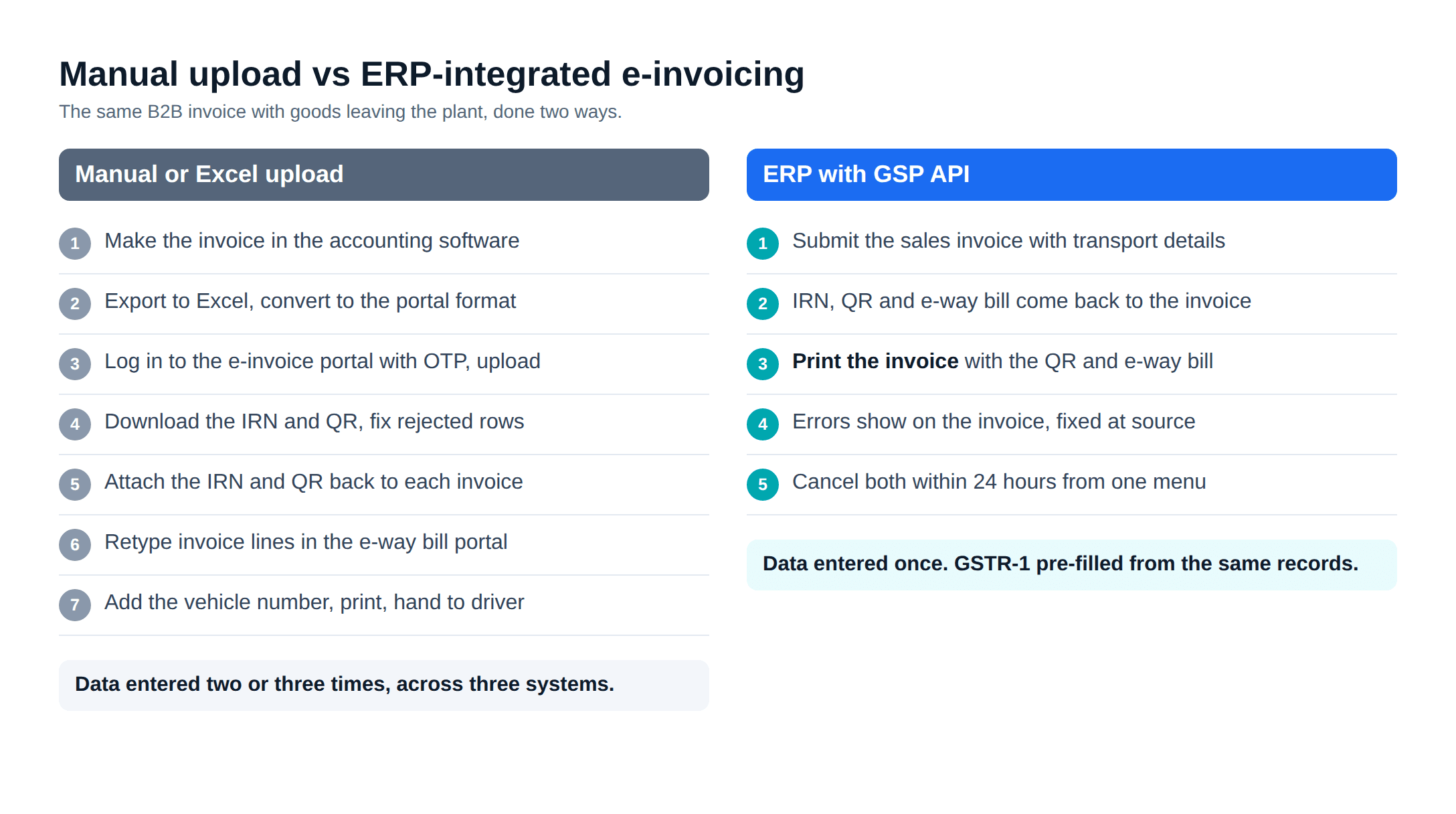
NIC's process note lists the ways to get an IRN: an offline bulk upload tool, or APIs through a GSP, through an ERP, directly from your own system, or through a sister GSTIN on the same PAN. The Excel route is the offline tool: export, convert, upload, download, then attach each IRN back to its invoice by hand.
With an API link, the ERP sends the invoice in the government's JSON schema on submit. The IRP checks it and returns the IRN, an acknowledgement number and the signed QR code, which must be printed on the buyer's copy. The system overview adds that the IRP passes the data on to pre-fill GSTR-1 and to the e-way bill system. The e-way bill can come back in the same call if transport details are sent, or later from the IRN.
What GST compliance software should automate first
Order the work by how often a task happens and what a slip costs. If you automate only one thing, make it the IRN on submit.
IRN on every sales invoice
E-way bill with the invoice
Cancellations inside 24 hours
Credit notes and returns
Where e-invoicing breaks
These are the checks the portals apply, and the places a manual process trips over them:
Failure points to plan for
- A buyer GSTIN that is wrong or cancelled: the IRP rejects the invoice.
- Four-digit HSN codes in the item master, once six digits are enforced.
- An invoice left in draft for weeks, then reported after the 30-day window.
- A cancelled invoice number reused: the portal will not take it again, so the numbering series must skip it.
- Cancellation attempted after 24 hours, or while an e-way bill is active. After the window, the fix is a credit note.
- Missing vehicle details, which leaves only a Part A slip that is not valid for movement.
- A wrong PIN code, so the portal's suggested distance, and the validity, are off.
- The registered mobile number for the OTP belongs to one person, who is on leave or has left.
How ERPNext handles e-invoices and e-way bills
ERPNext does this through the free, open-source India Compliance app. Its e-invoice guide says the e-invoice is generated automatically when a sales invoice is submitted, with the IRN and QR code written back to the invoice. You can also trigger it by hand.
The GST settings page covers what a plant needs:
- Credentials: you create an API user for the GSP on the e-way bill portal and enter it in GST Settings. The e-way bill and e-invoice portals share credentials.
- E-way bill with e-invoice: generated in the same call when the value crosses the threshold you set (₹50,000 by default) and transport details are present.
- Other documents: e-way bills from delivery notes, purchase invoices and subcontracting (job work) transactions. The e-way bill guide adds stock entries, purchase receipts and asset movements, plus updating the vehicle or transporter, extending validity and bulk JSON for the portal.
- Distance: leave it at zero and the portal suggests the distance between PIN codes.
- Applicable from, per company: useful when one company in a group crosses ₹5 crore before the others.
- Retry on timeout: a setting to retry e-invoice generation when the gateway times out.
Per the India Compliance FAQ, cancelling an e-invoice cancels a valid e-way bill with it, and once the window has passed you raise a credit or debit note instead.
The API calls cost money on self-hosted sites. The India Compliance account page says one credit equals one API request, the minimum purchase is 1,000 requests a year with more in multiples of 1,000, purchases are valid for a year, and new users get free trial credits for three months. The same page says Frappe Cloud sites come with the API features bundled, which Frappe announced in 2023; check the current terms for your plan. Our ERPNext pricing guide puts these credits next to hosting and support in the yearly bill.
Tally also generates e-invoices and e-way bills, so compliance alone is not a reason to move (ERPNext vs Tally has the detail). The gain comes when the invoice, delivery note and job work challan sit in the same system as production, as our guide to ERP for manufacturing in India explains.
Before you switch on automation
- Confirm your AATO and whether the 30-day limit applies to you.
- Clean the item master: six-digit HSN on every item you sell.
- Clean the customer master: verify GSTINs and PIN codes.
- Create the GSP API user and register the OTP number to a role, not a person.
- Test on a trial site against the e-invoice sandbox before the first live invoice.
- Decide who cancels within 24 hours, and who raises the credit note after it.
If you want help setting this up end to end, see how we approach ERPNext implementation for manufacturers, including GST setup and testing before go-live.
Frequently asked questions
Who has to generate e-invoices under GST?+
A registered business whose aggregate turnover crossed 5 crore rupees in any financial year from 2017-18 onwards must generate an e-invoice (an IRN) for B2B supplies, exports, and the credit and debit notes against them. The limit has been 5 crore rupees since 1 August 2023, under Notification 10/2023-Central Tax. Some classes are exempt, including SEZ units, insurers, banks and NBFCs, goods transport agencies, passenger transport services, multiplex cinemas, and government departments and local authorities. Sales to unregistered buyers (B2C) do not need an IRN.
What is the time limit for reporting an e-invoice to the IRP?+
From 1 April 2025, a taxpayer with an annual aggregate turnover of 10 crore rupees or more cannot report an invoice, credit note or debit note to the IRP once it is more than 30 days old, according to a GSTN advisory of 5 November 2024. The portal blocks the upload. The same advisory says there is no such limit, as of now, for taxpayers below 10 crore rupees.
Can an e-invoice be cancelled after 24 hours?+
No. The e-invoice portal's user manual allows an IRN to be cancelled only within 24 hours of generation, and not while an active e-way bill exists for it. A cancelled invoice number cannot be used again. After 24 hours the correction is a credit note or debit note, which needs its own IRN, or an amendment through GSTR-1 on the GST portal.
Can the e-way bill be generated together with the e-invoice?+
Yes. The e-invoice system lets a supplier generate the e-way bill in the same request as the IRN, or later from the IRN. Part A comes from the invoice; Part B needs the vehicle or transport document number. In ERPNext, the India Compliance app can create both on submitting the sales invoice when transport details are present, and it cancels both together if the e-invoice is cancelled within the window.
Does ERPNext charge for e-invoicing?+
The India Compliance app is free and open source, but the government API calls it makes use credits on self-hosted sites. Its documentation says one credit equals one API request, the minimum purchase is 1,000 requests a year, and new accounts get trial credits for three months. The same documentation says Frappe Cloud sites get the API features bundled; check the current terms for your plan.
Related reading
- ERPNext pricing in India: hosting, support and API credits in the yearly bill.
- ERPNext vs Tally for manufacturers: where Tally stops being enough.
- ERP for manufacturing in India: what a plant should look for in an ERP.
- ERPNext integrations in India: Tally, GST, WhatsApp, payments and the shop floor.
- ITC-04 and job work under GST: challans, return limits and who files ITC-04.
Free ERPNext fit check
Will ERPNext fit your factory?
Answer a few quick questions. On a short call we tell you whether ERPNext fits how you make, stock and sell, and what the rollout looks like.
Check my fit →About the author

- Tags
- erpnext
- erp
- manufacturing
- india
- gst
Subscribe to Our Newsletter
The AI Build Brief: practical playbooks on how to build, price and ship AI features, in one short email every other week.