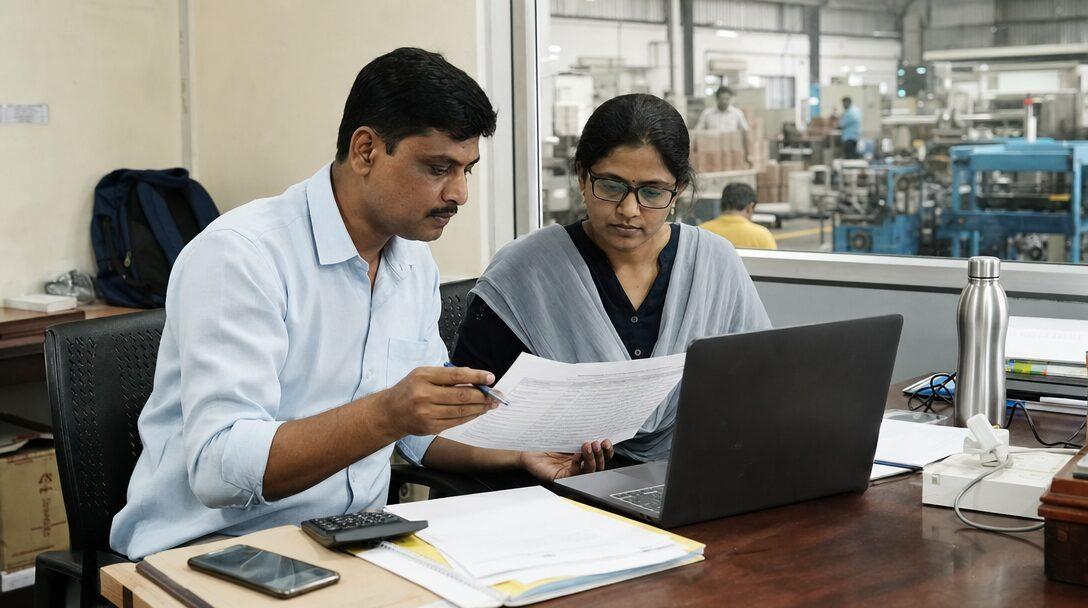
Many small plants in North India run on Tally, and it is easy to see why. It is fast, your accountant knows it, and it has kept the books for years. Tally is good at its job. The open question in ERPNext vs Tally is whether your plant has outgrown that job.
TL;DR
- Tally is an accounting product with a useful stock and manufacturing layer. ERPNext is an ERP that puts accounting, stock, production and quality in one database.
- Tally's own help pages describe BOMs, manufacturing journals, job work, godowns and batch tracking. They do not describe work orders, routings, capacity planning or quality inspection.
- ERPNext has no per-user licence fee. Tally is licensed per site, and its licensing page says online e-invoice and e-way bill generation needs a valid annual TSS subscription.
- A good test for moving: ask "where is this order?" If the answer takes three phone calls, the plant has outgrown its books.
What Tally is built for
TallyPrime is an accounting product, and a very good one. Everything below comes from Tally's own help pages unless stated.
- Books and GST: vouchers, ledgers, GST returns, and e-invoicing and e-way bills generated from inside the invoice.
- Bill of materials: you define a BOM for a stock item, then record a Manufacturing Journal that consumes the raw materials and books the finished good. Tally's manufacturing page mentions by-products, co-products and scrap.
- Stock: multiple godowns, stock journals for transfers between them, and batch and expiry tracking.
- Job work: job work out and job work in orders, and material out and material in vouchers, for plants that send material to a job worker or process material for someone else.
- Cost estimation: a report that rolls up BOM cost.
- Users: two default security levels, owner and data entry operator, and an administrator can control which voucher types and reports each user sees.
A plant with one godown, a simple recipe and an accountant who also keeps the stock is well served by this.
Where a growing plant outgrows it
The gaps show up in operations, not in the ledger. Tally's help pages do not describe work orders, routings, capacity planning or quality inspection, so assume you would need workarounds for these.
A BOM is a recipe, not an instruction. In Tally the Manufacturing Journal records that production happened. It is not a work order released to the floor with a due date, a quantity to make and a status, so nobody can open Tally and see which orders are in progress, which are late and which are waiting for material.
Routing and job cards are missing too. If a part goes through cutting, moulding and packing, you cannot plan each operation on its own machine and record the time. In ERPNext the BOM can carry a routing of operations and workstations, and submitting a Work Order creates a Job Card for each one.
Quality checks usually live in a register. A first-piece or in-process check is a paper form. In ERPNext a quality inspection template can be selected for an operation and is fetched into that operation's job card, so the check is part of the job.
Permissions are coarse. Owner and data entry operator is a thin model when stores, production, purchase and accounts each need different access and a manager has to approve certain documents. ERPNext permissions are by role and document type, with approval workflows.
Finally, the data lives in the accounting tool, so the accountant becomes the stock desk, the production report and the answer to every question. That cost never appears on a quote.
Side by side
This is a fair reading of the product documentation for both, not a benchmark. "Not described" means Tally's help pages do not cover it; a TallyPrime add-on or a customisation may.
| Capability | TallyPrime | ERPNext |
|---|---|---|
| Bill of materials | Yes, with by-products, co-products and scrap | Yes, multi-level, with operations and routing |
| Work orders | Not described | Yes, with status and due dates |
| Routings | Not described | Yes, operations and workstations on the BOM |
| Job cards | Not described | Yes, one per operation from the work order |
| Batch and expiry | Yes | Yes |
| Quality inspection | Not described | Yes, templates and in-process checks |
| Multi-warehouse | Yes, godowns and stock journals | Yes, warehouses with stock entries |
| GST, e-invoice, e-way bill | Yes, built in; online generation needs a valid TSS subscription (Tally licensing) | Yes, through the open-source India Compliance app; some automation needs GST API access, which has a cost via an India Compliance account |
| User roles | Owner and data entry operator, with per-user controls | Role and document permissions, with approval workflows |
| Licence model | Per site (single or multi-user) plus annual subscription, or rental | No licence fee; you pay for hosting and support |
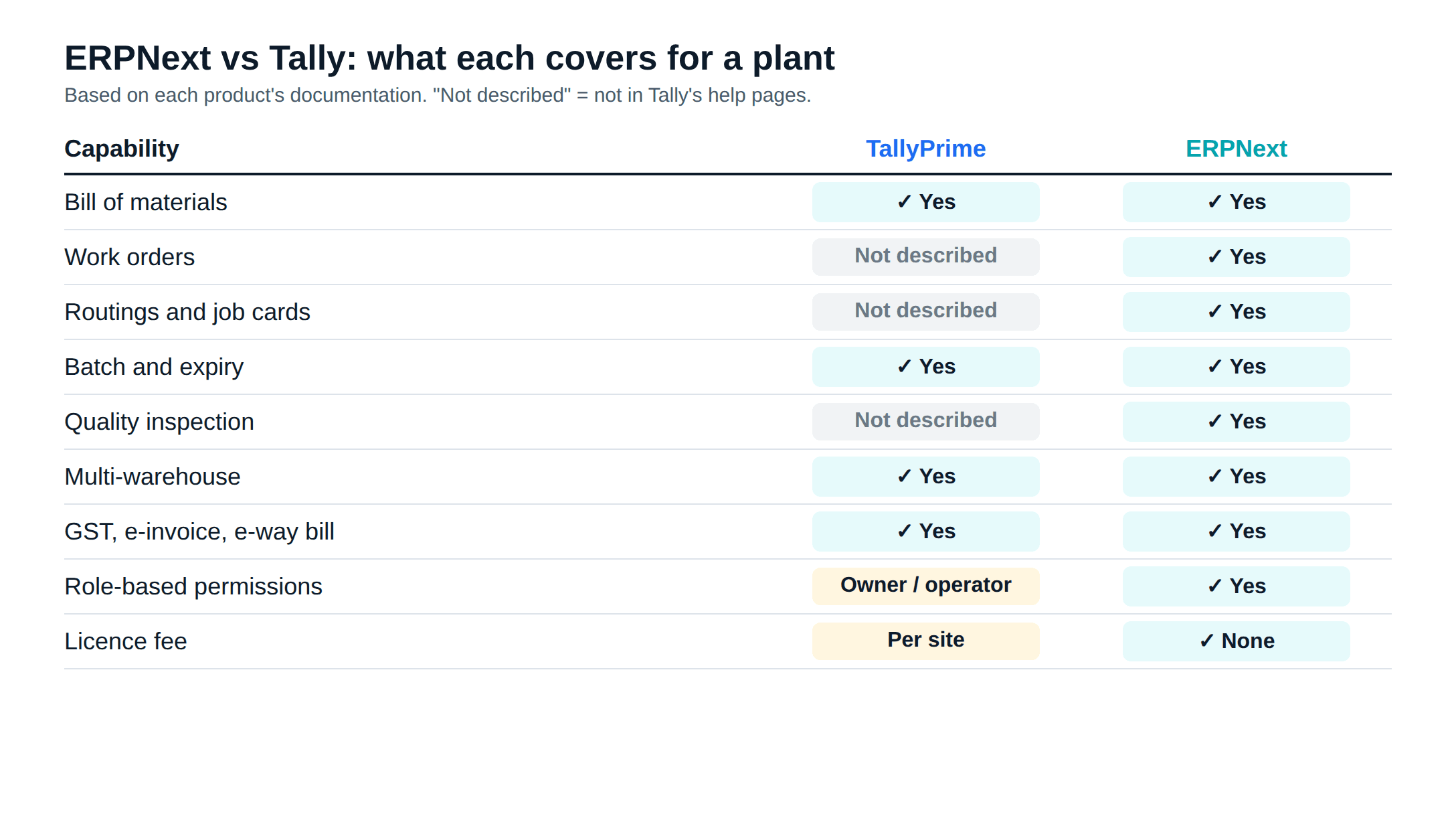
On compliance the two are close: both handle GST, e-invoices and e-way bills, so compliance is not a reason to move. The gap is also not the BOM. It is everything after the BOM: releasing it as an order, running it through machines, checking it and seeing where it stands.
Running both during the switch
You do not have to turn Tally off on day one. A workable pattern for a small plant:
- Set up ERPNext with the opening balances and opening stock as of the first day of a month.
- Run both for one full closing cycle. Stores, production, buying and selling go into ERPNext first; accounts keeps Tally as the check.
- Compare trial balance, stock value and party balances at month end. Fix differences in ERPNext.
- Stop entering in Tally. Keep the old company file as a read-only archive for past years and audits.
Set the end date at the start. Double entry that drags past two months wears the accounts team down, and that is how switches stall. If you want the cost of the whole exercise, the implementation cost guide breaks it down.
Signs it is time to move
Watch for these:
- You keep a spreadsheet beside Tally for production orders, and it is the one people trust.
- The owner cannot see what is in progress without calling the floor.
- You have more than one godown or plant and stock does not tie.
- A customer or auditor has asked for batch traceability that takes a day to produce.
- Different people need different access and you cannot give it.
- The accountant is the bottleneck for every operational question.
If none of these is true, stay on Tally. A migration costs real money and a month of disruption, and it should buy you something you feel.
How to switch
- Write the scope: plants, warehouses, modules, roles, what moves from Tally, integrations and training. This is what makes a quote comparable.
- Clean the masters first. Duplicate items, three spellings of one customer and opening stock that does not match the books are the usual time sinks.
- Configure and test on your own data, with your own BOMs, GST setup and print formats.
- Train by role. Stores, production, purchase, sales and accounts use different screens.
- Run in parallel, then cut over at the start of a month or a financial period.
The data side has its own sequence. Our guide to moving from Tally to ERPNext covers what moves, what stays in Tally and the cut-over weekend.
Metageeks is an independent ERPNext implementer. Our ERPNext implementation starts with discovery and a written scope, and everything we build sits in an account you own. Tell us what the plant runs on today and we will tell you whether ERPNext is worth it or Tally is still enough.
Frequently asked questions
Can ERPNext replace Tally?+
Yes, for a manufacturer it can. ERPNext has a full accounting module with GST, and e-invoicing and e-way bills are covered by the open-source India Compliance app. It also adds work orders, routings, job cards, quality inspection and role-based permissions that Tally's help pages do not describe. Whether it should depends on the plant. If your problems are in the books, Tally is fine. If they are on the shop floor, ERPNext is the better fit.
Can Tally and ERPNext run side by side?+
Yes, for a short period. A common pattern is to move stock, production, buying and selling to ERPNext and keep Tally as a read-only record of past years, or run both for one closing cycle and compare the trial balances. Entering every voucher twice for longer than that burns out the accounts team, so set an end date before you start.
What does switching from Tally to ERPNext cost?+
ERPNext has no licence fee, so the cost is implementation, data migration, training, and hosting and support. Published Indian guides put a manufacturing implementation at roughly 1 to 3 lakh rupees. Our post on what an ERPNext implementation costs in India sets out the ranges, the sources and the six things that move a quote.
Free PDF
The 2026 AI Development Rate Sheet
Build, agent, RAG and consulting rates by tier, in one PDF, so you can check a quote before you sign it.

Written by
Pankaj Kumar
Founder · Metageeks Technologies
Metageeks builds software and AI products for growing businesses. Every build is scoped in writing before it starts, and you see progress every week. We write about what holds up once it reaches production.
Connect on LinkedInThe AI Build Brief
Ship AI that holds up in production.
Practical playbooks on how to build, price and ship AI features, in one short email every other week.