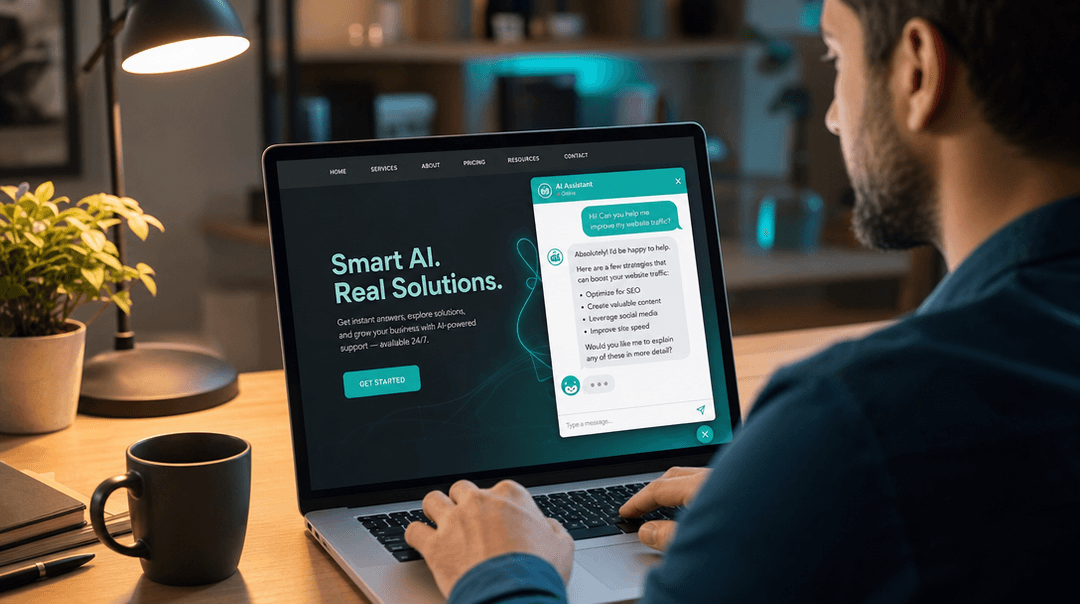
Why most chatbots fail
Works great in the demo. Then a real user asks something unexpected.
Most chatbot projects fail for the same three reasons: the bot was trained on general knowledge instead of your company data, there's no guardrail when it doesn't know the answer, and nobody tested it against real inputs before launch.
We fix all three: the bot answers from your data, we test before shipping, and you get monitoring so problems surface before your customers find them.
Use cases
What businesses actually use AI chatbots for
We scope every chatbot to a specific use case. Broad-purpose bots drift. Focused bots ship and hold up under real traffic.
Customer support bot
Handles tier-1 questions, routes complex cases to a human, and keeps your queue from becoming a headcount problem. Trained on your docs, policies, and past tickets.
Cuts support volume by 40–60% on common queries. Escalates with full context — no repeat questions for the customer.
Internal knowledge assistant
Answers employee questions about policies, processes, and procedures without waiting for the one person who knows. Built on your actual documentation.
Works across Slack, Notion, or your intranet. Updates as your docs change — no manual retraining.
Lead qualification bot
Qualifies inbound leads on your site 24/7 — asks the right questions, scores against your ICP, and hands off to sales with full context.
Integrates with your CRM. Captures leads you'd lose outside business hours. No cold handoffs.
Product onboarding assistant
Guides new users through setup, answers feature questions, and reduces time-to-value without adding to your support load.
Embedded in your product. Answers contextually based on where the user is in the flow. Tracks drop-off.
What's inside every build
Not a wrapper. An engineered system.
Every chatbot we ship includes these components — not as add-ons, but as defaults.
Knowledge base connection
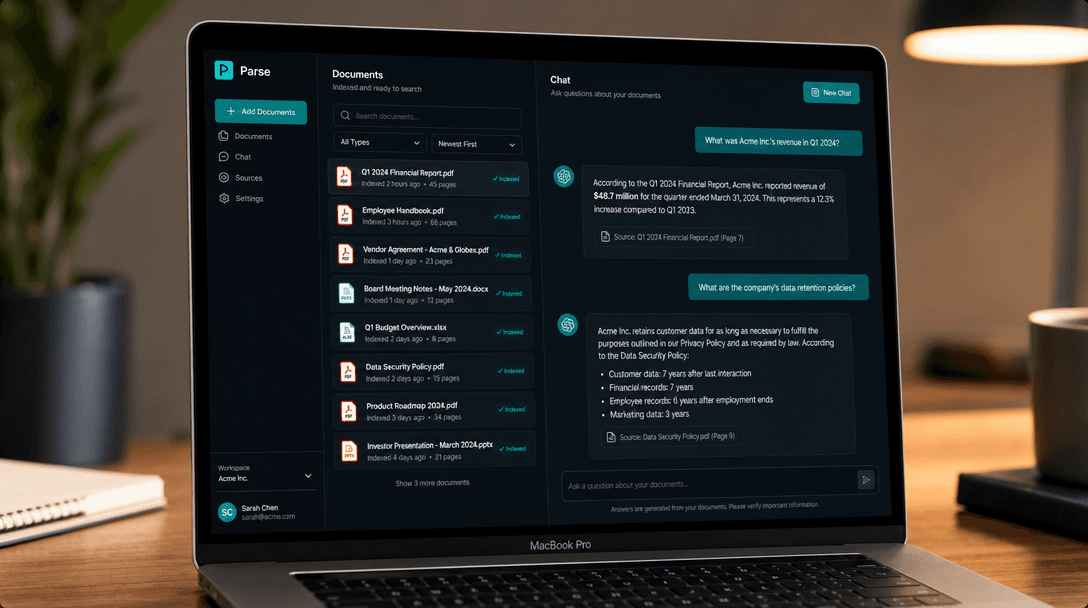
Your chatbot answers from your actual data — docs, CRM records, product catalog — not general AI knowledge. No wrong answers about your own product.
Guardrails & escalation
Confidence thresholds, topic boundaries, and human handoff paths built in by default. The bot knows what it doesn't know and routes accordingly.
Test suite
Before anything reaches a user, we run the bot against hundreds of real-world inputs and measure accuracy, refusal rate, and response time. You see the pass rate before we ship.
Monitoring & logs
Every conversation is logged. Cost per session, response time, escalation rate, and user satisfaction tracked from day one.
Deployment & integration
Deployed to your stack — web widget, Slack, Intercom, Zendesk, or a custom interface. Auth, rate limiting, and PII handling included.
Every chatbot connects to your indexed documents — so answers come from your data, not AI guesswork.
How it works
From first call to production in 4–8 weeks
01
Discovery
We map your use case, data sources, existing stack, and success criteria. By the end of this call, you know what we're building and what it will cost.
02
Data & architecture
We audit your data sources, connect them to the chatbot's knowledge base, and define what a good answer looks like — before we write a line of code.
03
Build & test
Build the chatbot, run it against your test suite, tune until pass rates hit threshold. You review every iteration before it advances.
04
Deploy & hand off
Production deployment to your stack. Monitoring dashboards live from day one. You get a runbook so your team can manage it without us.
Built for
- $1M–$15M businesses with a real support, ops, or sales problem
- Teams spending >10 hrs/week answering the same questions
- Products with high onboarding drop-off or low feature adoption
- Companies with existing documentation they want to put to work
- Founders who need AI that holds up past the demo
Not the right fit if
- You want a prototype to show investors (we build for production)
- Your data doesn't exist yet or lives only in people's heads
- You need a rule-based decision tree, not a language model
- You're pre-revenue without a clear use case defined
Get a quote
Fixed scope. Known cost before we start.
Every project is scoped to a fixed deliverable — use cases, data sources, integrations, and acceptance criteria defined upfront. You know exactly what you're getting before we write a line of code.
Book a 30-minute discovery call and we'll scope your build and send a fixed quote within 48 hours. No commitment required. Or start with the $497 AI Auditif you're still figuring out the right approach.
Common questions
What is AI chatbot development?+
AI chatbot development is building conversational software powered by AI models like GPT-4o or Claude. Unlike rule-based bots that follow rigid scripts, AI chatbots understand natural language, handle unexpected phrasing, and generate context-aware answers. Development covers the conversation flow, connecting the bot to your data, adding guardrails, and deploying it into your product or support stack.
How much does a custom AI chatbot cost?+
Cost depends on the number of data sources, integrations, and deployment target. We give you a fixed-scope quote after a 30-minute discovery call, so you know the full number before any commitment.
How long does it take to build an AI chatbot?+
A focused chatbot (single domain, one integration) takes 3–4 weeks. More complex systems with multiple data sources and custom UI take 6–8 weeks. The timeline includes scoping, build, testing against real inputs, and production deployment — not just a prototype.
What's the difference between a rule-based chatbot and an AI chatbot?+
Rule-based bots follow fixed scripts — if the user says X, the bot says Y. They break the moment someone phrases something unexpectedly. AI chatbots understand intent, handle variation, and reason across context. The trade-off is cost per conversation and the need to test for accuracy. For high-volume simple queries, rule-based bots are sometimes still the right call — we'll tell you if that's the case.
Can the chatbot connect to my existing data?+
Yes. We connect the chatbot to your documentation, CRM records, product catalog, or support history so it answers from your actual data instead of general knowledge. We also support tool-calling for bots that need to take actions — create tickets, look up orders, update records.
How do you prevent the chatbot from making things up?+
We combine three layers: the bot can only answer from your verified sources, confidence thresholds send unclear queries to a human instead of guessing, and we run the bot against hundreds of sample inputs before launch. You get logs of every conversation so problems surface early.
What platforms can you deploy a chatbot to?+
We deploy to web apps (chat widget), internal tools (Slack, Notion, Linear), customer-facing products (embedded in your SaaS), and support platforms (Intercom, Zendesk, Freshdesk via API). Custom interfaces built to spec too.
Ready to ship a chatbot that actually works?
Book a 30-minute discovery call. We'll map your use case, confirm the right approach, and give you a fixed-scope quote before any commitment.