The honest range is $3,000 to $80,000. That spread is real, not a cop-out: it reflects the fact that "AI chatbot" means three different things depending on what you're building.
TL;DR
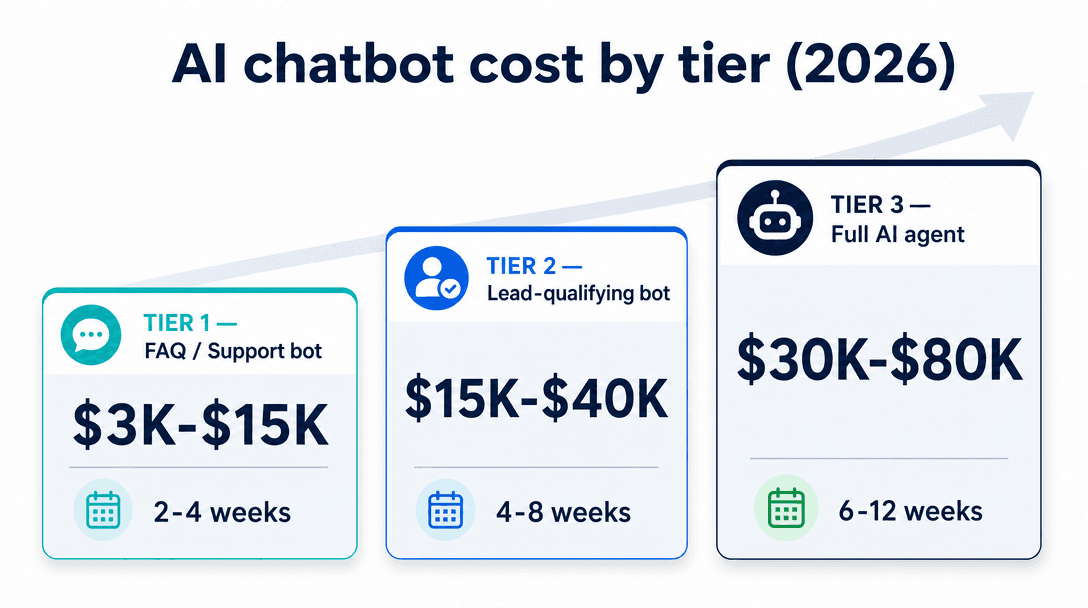
- A basic FAQ chatbot (answers questions from your docs): $3K-$15K. A lead-qualifying chatbot (asks questions, scores intent, hands off to your CRM): $15K-$40K. A full agent (qualifies, routes, books meetings, no human in the loop): $30K-$80K.
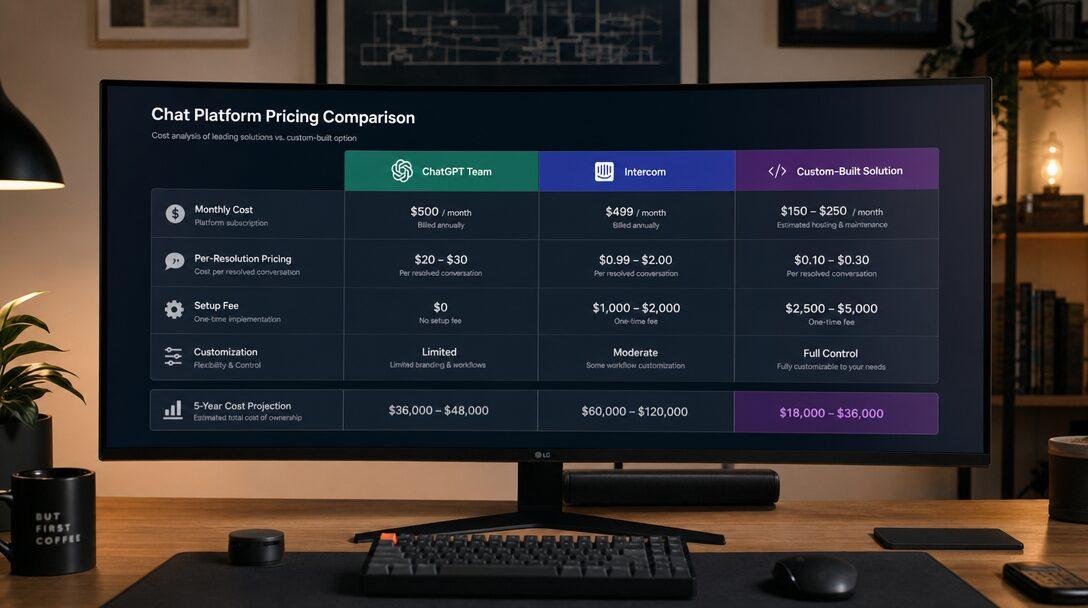
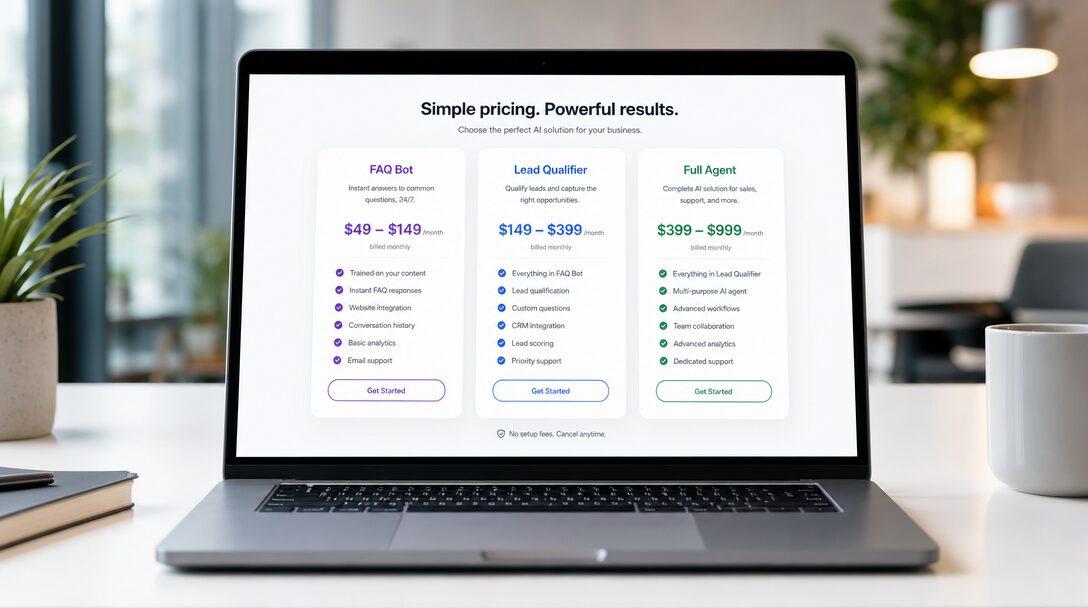
- Off-the-shelf tools like Intercom or HubSpot Chat run $500-$2,000/month in SaaS fees, but they use generic qualification logic. You'll hit their limits within 6 months if your ICP is specific.
- The real cost drivers: CRM integration complexity, RAG pipeline depth, model API costs at scale.
- Don't start with the build. A 20-minute scoping call maps your exact use case before you spend $20K on the wrong chatbot.
The short answer
AI chatbot development costs $3,000-$80,000 in 2026, set by type: a FAQ bot is $3K-$15K, a lead-qualifying chatbot $15K-$40K, and a full AI agent $30K-$80K. Off-the-shelf platforms like Intercom or HubSpot Chat run $500-$2,000/month instead. Pin down which of the three you're building before comparing any quote.
Tell us what your chatbot needs to do and which systems it has to touch, and we'll come back with a written scope and estimate for that build instead of a tier range.
Free scoping call
Turn your AI idea into a written plan
Tell us what you want AI to do. In 30 minutes we tell you plainly whether it will pay for itself, and what it would take to build.
Book a scoping call →Why the range is so wide
"AI chatbot" covers a lot of ground. The cost difference between the three main types is roughly 10x, so it matters which one you're asking about.
A FAQ bot answers questions from a fixed knowledge base: your documentation, product pages, support articles. It uses RAG to search your content and return accurate answers. It can't take actions, it has no memory of the user across sessions, and it doesn't touch your CRM.
A lead-qualifying chatbot runs a conversation with a website visitor, asks qualification questions (budget, company size, urgency, use case), and routes qualified leads to your CRM or calendar. This needs more than a RAG setup: a conversation state machine, your qualification logic baked in, and usually a CRM integration to push qualified leads somewhere useful.
An AI agent does the full thing autonomously: qualify, route, book, confirm. It can look up information, update records, send emails, check calendar availability, and loop back on its own reasoning until the task is done.
The price you get from a vendor tells you which of those three they're building. If someone quotes under $5K for "a lead-qualifying chatbot with CRM integration," they're building option one and calling it option two.
Cost breakdown by tier
Tier 1: FAQ / support chatbot
$3,000-$15,000 · 2-4 weeks
You get RAG set up over your existing content, a conversational interface (embedded widget or standalone), basic conversation logging, and a way to update the knowledge base without a rebuild.
What's not in this tier: CRM integration, lead scoring, memory across sessions, human handoff routing. If you need any of those, you're already in tier 2.
This works well when your support team handles the same 50 questions every week and you want to deflect volume. Or when you want to give website visitors 24/7 answers without hiring another rep. It breaks as soon as you want the chatbot to qualify who it's talking to and respond differently based on the answer.
Tier 2: Lead-qualifying chatbot
$15,000-$40,000 · 4-8 weeks
The chatbot asks structured qualifying questions, scores responses against your ICP criteria, and routes qualified leads to your CRM, booking link, or rep queue. Unqualified visitors get a different response: a resource, a lower-tier offer, or an honest "not a fit."
This tier includes: qualification logic built to your criteria, CRM integration (Salesforce, HubSpot, or your stack), basic conversation memory, handoff logic, and reporting. Autonomous calendar booking isn't in scope. That's what pushes you into tier 3.
Good for when inbound volume is high enough that manual qualification is eating rep time. The math is simple: stop reps spending an hour on a $500 deal when there's a $50K one in the queue.
Tier 3: Full AI agent (qualify → route → book)
$30,000-$80,000 · 6-12 weeks
No human in the loop. The agent qualifies the lead, pulls their company data from your CRM or enriches it from a third-party source, picks the right rep or meeting type, checks calendar availability, books the slot, and sends the confirmation, inside one conversation.
This is agent architecture, not chatbot architecture. Multiple tools the model can call, logic for edge cases, error recovery when an API call fails, observability so you know when something breaks. The $80K end includes multi-tenant deployment, an eval pipeline, and ongoing monitoring.
Free scoping call
Turn your AI idea into a written plan
Tell us what you want AI to do. In 30 minutes we tell you plainly whether it will pay for itself, and what it would take to build.
Book a scoping call →Custom build vs. off-the-shelf tools
| Off-the-shelf (Intercom, HubSpot, Tidio) | Custom-built chatbot | |
|---|---|---|
| Upfront cost | $0-$1,500 | $15K-$80K |
| Monthly cost | $500-$2,000+ | $200-$800 (API + hosting) |
| Qualification logic | Generic: their rules engine | Your ICP criteria, built in |
| CRM integration | Native for major CRMs | Depends on your stack |
| Customization ceiling | Low: capped by their features | None: you own the code |
| Year-1 total cost | $6K-$24K in SaaS fees | $15K-$80K build + $2-10K running |
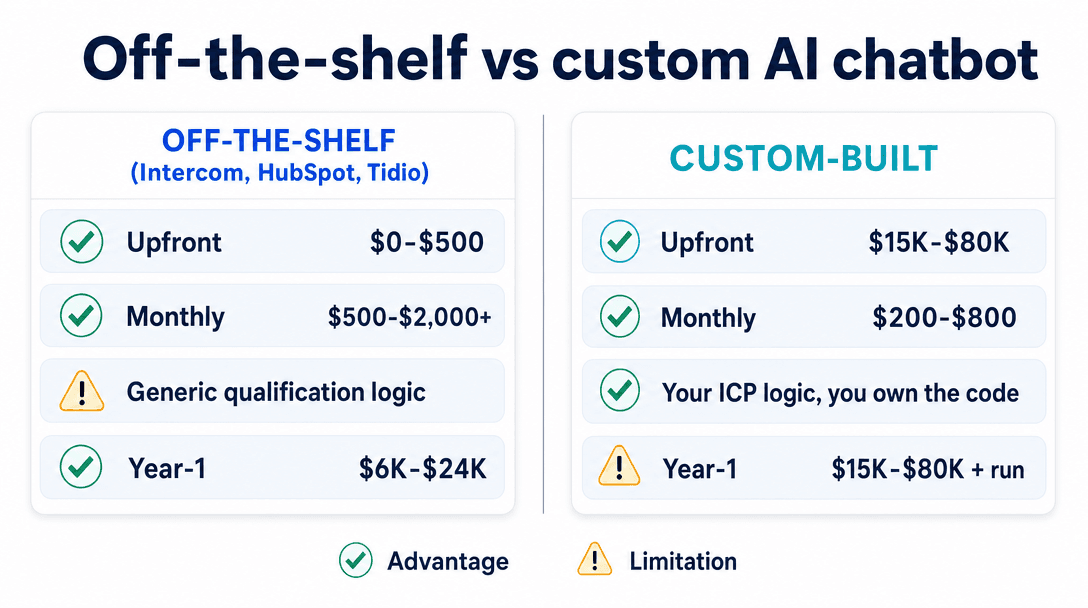
The 3-year math usually flips in favor of a custom build at real volume. But the more important question is fit. Off-the-shelf tools use qualification logic designed for the median SaaS company. If your criteria are specific, and they almost always are, you'll be hacking around platform limitations within 6 months.
If your criteria fit neatly into a standard lead form, start with off-the-shelf. If you're qualifying on company size, specific tool stack, or workflow complexity, you need something built to your criteria.
The cost drivers vendors don't always mention
CRM integration complexity. A native HubSpot integration is a weekend project. A custom CRM with a non-standard API, or one requiring field mapping across 40 custom properties, can add 2-4 weeks. Get clarity on this before you sign.
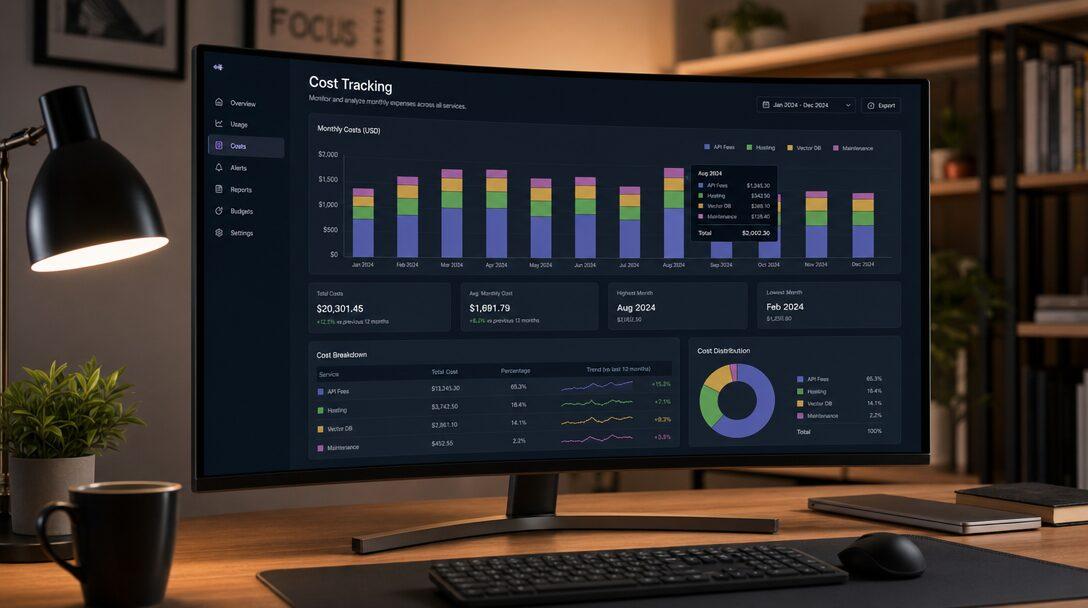
Model API costs at scale. 1,000 conversations/month at GPT-4o pricing runs roughly $200-800/month in API fees. At 10,000 conversations/month, that's $2,000-8,000. Architecture choices (caching common responses, routing early-stage questions to a cheaper model) can cut this by 60-70%. Ask your vendor specifically how they plan to handle it.
Conversation memory. A stateless chatbot treats every message as a fresh conversation. A stateful one remembers context across sessions, which matters for lead qualification when you don't want to ask the same questions twice. Memory adds engineering complexity and cost, but it also improves conversion for anything beyond a basic FAQ bot.
Human handoff logic. When to route to a human, how to transfer conversation context, what to do when the handoff fails: this is more work than it sounds. If your use case needs reliable handoff, scope it explicitly before anything gets built.
Eval infrastructure. A chatbot that works in testing and breaks in production is a real failure mode, and it's more common than people expect. Any vendor skipping an eval pipeline is cutting a corner you'll pay for later. Proper eval adds 1-2 weeks and $3-8K to a build. It's not optional if you care about production reliability.
What US small businesses pay
A US small business has two realistic paths, and the right one depends on how specific your qualification logic is.
The off-the-shelf path uses US SaaS vendors with public pricing: Intercom's Fin (billed at $0.99 per resolution on top of seat plans), HubSpot's Service Hub (seat plans plus AI credits, with a one-time $1,500 onboarding fee on Professional), and Drift all land in the $500-$2,000/month range once you're past their entry tiers. That's $6K-$24K in year-one fees for qualification logic built for the median company, not yours.
The custom path is where most US SMBs end up when their ICP is specific: $3K-$15K for a FAQ bot, or $15K-$40K for a lead-qualifying chatbot built to your criteria by a specialist agency that owns the outcome. It costs more upfront, but per-conversation cost drops sharply at volume and you're not renting someone else's qualification rules. For a US business with real inbound volume, the custom number usually wins inside two years.
How much does AI chatbot development cost in India?
An India-based team lowers the hourly rate, not the amount of work. Clutch's AI development pricing guide, updated September 2026, lists India-based firms at $25-$49/hr against $50-$99/hr for US firms. In Clutch's directory of chatbot companies in India, the top-listed firms charge under $25/hr or $25-$49/hr and set minimum projects of $10,000 or $25,000.
At ₹95.74 to the US dollar (the Wise mid-market rate on 14 September 2026), that's up to about ₹4,700 an hour, with minimum engagements of roughly ₹9.6 lakh or ₹24 lakh.
Two things follow. A $3K-$15K FAQ bot can fall below those minimums, so the savings from an Indian agency show up mostly on tier-2 and tier-3 builds, where the hours are larger. And the tiers don't change with geography. A lead-qualifying chatbot still needs qualification logic, a CRM integration and handoff rules, and a full agent still needs error recovery and evals. What changes is the rate on those hours and how much of the scoping and review lands on your side, so ask for the same written scope you'd ask of any vendor.
Our chatbot engagements
Nothing starts on an open meter. Every engagement begins with a written scope: deliverables, milestones and an estimate of the effort. Billing follows the work, as time-and-materials against that scope, with progress you can see every week and a written change order before anything new gets added, so there are no surprise invoices. (If you're weighing how to staff the build first, here's what it costs to hire a chatbot developer: freelance vs. agency vs. in-house, and where to hire the developer once you've picked a model.)
For AI chatbot development, our engagements work like this:
- Scoping sprint: 1 week. We define your qualification criteria, map conversation flows, spec the integrations, and tell you exactly what tier you need before any build starts.
- Chatbot build: 4-6 weeks, against the written scope. Lead-qualifying chatbot with CRM integration and qualification logic built to your criteria.
- Agent build: 6-10 weeks, against the written scope. Full qualify → route → book automation, with observability and a 90-day support window.
What a build costs comes from that written scope and estimate, not from the tier ranges earlier in this guide. If you'd rather have a fixed scope and a fixed price, with written acceptance criteria and a full refund if we miss them, that's ClearShip.
Scope it before you spend
Three questions that determine most of what your chatbot will cost:
What does "qualified" mean at your company? Write it in plain English: company size, role, industry, urgency signal, budget range. The more specific this is, the faster and cheaper the build. Vague criteria are where scope creep starts.
What happens after a lead is qualified? Does it book a meeting directly? Flag a rep in Slack? Push to a CRM pipeline? The answer changes the integration requirements significantly.
What's the failure mode? What should the chatbot do with someone it can't qualify? The unqualified flow matters as much as the qualified one, and it's where most off-the-shelf tools completely fall apart.
If you can answer all three, you're ready for a real quote. If you can't, any quote you get will be wrong and you'll find out about it 6 weeks into the build.
If you're not sure what you need
The most expensive chatbot project is the one that gets scoped wrong and rebuilt. It happens when "we should have a chatbot" goes straight to "sign the contract" without anyone defining what qualification means, what the integration looks like, or what success is.
A 20-minute scoping call maps your operations, identifies where a chatbot or agent generates the most ROI, and tells you what tier you need before you spend $20K figuring it out yourself.
Most clients come in thinking they need a full agent. About half find a well-built tier-2 chatbot does the job. About a quarter find their highest-ROI AI play is somewhere else entirely. Better to know that before the build starts, not six weeks in.
How much does it cost to develop a chatbot?+
Developing a chatbot costs $3,000-$80,000 in 2026, and which end you land on depends on the type you build. A basic FAQ bot that answers from your documentation is $3K-$15K and takes 2-4 weeks. A lead-qualifying chatbot that asks questions, scores intent and pushes leads to your CRM is $15K-$40K over 4-8 weeks. A full AI agent that qualifies, routes and books meetings with no human in the loop is $30K-$80K over 6-12 weeks. The gap between those three is roughly 10x, so pin down which one you need before comparing quotes or anyone's hourly rate. If a vendor quotes under $5K for a lead-qualifying bot with CRM integration, they're scoping a FAQ bot. After launch, budget for running costs too: $200-$800/month at low volume for model API and hosting.
How much does it cost to implement a chatbot?+
Implementing a chatbot costs $15K-$40K upfront for a custom lead-qualifying build, or $0-$1,500 upfront plus $500-$2,000/month for an off-the-shelf platform. Those are the two cost layers: a one-time build or setup, and an ongoing run cost. On the platform side, Intercom bills its Fin AI agent at $0.99 per resolution on top of annual seat plans from $29 to $132 per seat a month, and HubSpot's Service Hub Professional carries a one-time $1,500 onboarding fee. For a small team, a handful of seats plus a few hundred resolutions a month is how a platform bill reaches that $500-$2,000 range. On the custom side, a lead-qualifying bot takes 4-8 weeks to build, then runs $200-$800/month at low volume for model API and hosting. Over any real time horizon the recurring number matters more than the setup fee, so compare three-year totals rather than year-one sticker prices before you choose.
How much does a basic AI chatbot cost to build?+
A basic AI chatbot costs $3,000-$15,000 to build and takes 2-4 weeks. At that price you get RAG set up over your existing content (documentation, product pages, support articles), an embedded widget or standalone chat interface, basic conversation logging, and a way to update the knowledge base without a rebuild. What you don't get: CRM integration, lead scoring, human handoff routing, or memory of a visitor across sessions. If you need any of those, you're in tier-2 pricing at $15K-$40K. Where you land inside the $3K-$15K band depends mostly on how much content the bot has to search and how messy that content is. A basic bot works well when your support team answers the same 50 questions every week and you want to deflect that volume. It stops being basic once it has to treat visitors differently based on their answers.
What's the difference in cost between a chatbot and an AI agent?+
A chatbot generates responses. An agent takes actions: booking meetings, updating CRM records, routing tickets. The architectural difference is real and so is the cost: a production chatbot runs $10K-$40K, a production agent runs $30K-$80K. Most businesses should start with a chatbot unless they have a specific multi-step workflow to automate end to end.
Is off-the-shelf cheaper than a custom AI chatbot?+
In year one, yes: off-the-shelf tools like Intercom or HubSpot cost $0-$1,500 upfront and $500-$2,000/month, while a custom build costs $15K-$40K upfront and $200-$800/month to run. That puts year-one platform fees at $6K-$24K, against $15K-$40K plus running costs for a custom build. The economics usually flip around year two, because the platform fee keeps growing with seats and resolutions (Intercom bills Fin at $0.99 per resolution) while custom running cost rises more slowly with usage. The bigger question is fit. Off-the-shelf tools use qualification logic designed for the median company. If you qualify on company size, tool stack or workflow complexity, you'll be working around their limits within about six months. If your criteria fit a standard lead form, start with a platform and revisit the decision when inbound volume grows or the qualification rules stop fitting.
What makes AI chatbot development more expensive?+
CRM integration complexity is the biggest one: each external system adds 1-3 weeks. Model API costs at scale come second (GPT-4o isn't cheap at 10K conversations/month). Conversation memory, human handoff logic, and eval infrastructure all add scope. Vendors who skip eval to hit a lower price point are passing the cost to you in production failures.
How long does it take to build an AI chatbot?+
A tier-1 FAQ bot is 2-4 weeks. A tier-2 lead-qualifying chatbot is 4-8 weeks. A full AI agent that qualifies, routes, and books is 6-12 weeks. These assume scope is defined before build starts. Vague requirements add weeks, which is exactly why the scoping sprint exists.
Free scoping call
Turn your AI idea into a written plan
Tell us what you want AI to do. In 30 minutes we tell you plainly whether it will pay for itself, and what it would take to build.
Book a scoping call →About the author

- Tags
- ai chatbot
- pricing
- ai development
Subscribe to Our Newsletter
The AI Build Brief: practical playbooks on how to build, price and ship AI features, in one short email every other week.