Every chatbot platform prices differently on purpose. Per outcome, per resolution, per conversation, per credit, plus seats on top: the model is built so the headline number undersells your real bill. A custom build has no per-conversation fee at all, but it charges a five-figure entry fee instead. Which one wins comes down to your volume and how specific your logic is.
This post is about renting a platform: what Intercom, HubSpot, Zendesk and the smaller tools charge, checked against their pricing pages on September 15, 2026, and where each pricing model breaks. If you're weighing the other route, see what it costs to hire a developer or agency to build a chatbot.
TL;DR
- As of September 2026: Intercom Fin charges $0.99 per outcome (handoffs count), HubSpot's Customer Agent $0.50 per resolution on Service Hub Professional seats, Zendesk $1.50-$2.00 per automated resolution after a small allowance.
- Intercom now bills a qualified sales lead at $9.99, and a Procedure handoff to a human at the same $0.99 as a resolution.
- HubSpot has the cheapest resolution and the steepest entry: $90-$100 per seat plus a $1,500 onboarding fee.
- At 10,000 conversations a month, AI charges alone run about $2,970 (HubSpot) to $8,925 (Zendesk). A custom build runs $400-$1,500 a month after $15K-$40K upfront.
- Drift is closed to new customers after the March 6, 2026 sunset announcement.
- Volume isn't the only axis. If your qualification logic is specific, platforms cap you on capability long before they cap you on cost.
Free scoping call
Turn your AI idea into a written plan
Tell us what you want AI to do. In 30 minutes we tell you plainly whether it will pay for itself, and what it would take to build.
Book a scoping call →What the platforms charge (September 2026)
Every price below was checked on the vendor's own pricing page on September 15, 2026. Seat prices are billed annually unless noted.
| Platform | AI pricing | Seats or plan needed | Included | Source |
|---|---|---|---|---|
| Intercom Fin | $0.99 per outcome; $9.99 per qualified lead | Essential $29, Advanced $85, Expert $132 per seat/mo ($39 / $99 / $139 monthly) | Fin on other helpdesks: no seats, 50-outcome monthly minimum | intercom.com/pricing, fin.ai/pricing |
| HubSpot Customer Agent | 50 credits per resolution ($0.50) | Service Hub Professional $90/seat/mo annual ($100 monthly), Enterprise $150 | 3,000 credits/mo on Professional, 5,000 on Enterprise | HubSpot Service Hub pricing, HubSpot Credits |
| Zendesk AI agents | $1.50 per extra automated resolution committed, $2.00 pay as you go | Suite Team $55, Suite Professional $115 per agent/mo ($69 / $149 monthly) | 5 resolutions per agent/mo on Suite Team, 10 on Suite Professional | zendesk.com/pricing |
| Tidio (Lyro) | Lyro from $39/mo for 50 AI conversations ($32.50 annual) | Starter $29/mo ($24.17 annual), Growth from $59, Plus from $300 + usage | 100 human-handled conversations on Starter | tidio.com/pricing |
| Botpress | Conversation packs: $65 per 100 on Plus, $50 per 100 on Team | Plus $189/mo ($150 annual), Team $939/mo ($750 annual) | 250 conversations and $25 AI usage on Plus; 1,500 and $150 on Team | botpress.com/pricing |
| Chatbase | $40 per extra 1,000 message credits | Hobby $40, Standard $150, Pro $500 per month (20% off yearly) | 700, 4,000 and 15,000 message credits a month | chatbase.co/pricing |
Two things jump out. First, no two rows bill the same unit: outcomes, resolutions, credits, conversations, message credits. Second, the AI charge and the seat charge are separate lines on almost every invoice. For how each billing model behaves in general, the five chatbot pricing models lays them out side by side. The rest of this post is about the specific platforms.
Where each platform's pricing breaks
Intercom Fin: per outcome, and handoffs count
Intercom used to be described as "per resolution." Its pricing now bills per outcome: a resolution, a handoff completed through a Procedure you set up, or a prospect Fin disqualifies, all at $0.99. A prospect Fin qualifies and routes costs $9.99. Intercom charges one outcome per conversation, not one per action.
The break point is the incentive. The better Fin gets, and the more of your flows end in a designed handoff, the more outcomes you pay for. At 6,000 outcomes a month that's $5,940 before a single seat. If you use Fin for sales qualification, a busy month of qualified leads at $9.99 each adds up faster than support resolutions do. If you came here for Intercom chatbot pricing on its own rather than the comparison, that post has the seat tiers, the outcome types and the volume curve in full.
HubSpot Customer Agent: cheapest resolution, steepest entry
On April 14, 2026, HubSpot moved the Customer Agent from $1.00 per conversation to 50 credits ($0.50) per resolved conversation. Conversations that escalate to a human aren't billed. Per resolution, that's the cheapest of the big three.
The catch is getting in. The agent needs Service Hub Professional ($90 a seat a month on an annual commitment, $100 paid monthly) or Enterprise ($150), and Professional carries a one-time $1,500 onboarding fee. The 3,000 included credits (about 60 resolutions) refresh monthly, expire if unused, and are shared with HubSpot's other AI features. If you already live in HubSpot, it's a strong deal. If you'd be buying Service Hub just for the agent, the seats are the real price.
Zendesk AI agents: a small allowance, then $1.50-$2.00 each
Zendesk includes AI agents on every Suite and Support plan and bills by automated resolution. The allowance is small: 5 per agent per month on Suite Team, 10 on Suite Professional. A five-agent team on Suite Professional gets 50 a month. After that, each resolution costs $1.50 on a commitment or $2.00 pay as you go.
That makes Zendesk the most expensive per resolution at volume. It works for a support team already running Zendesk with modest bot volume. It breaks when the bot becomes the main front door.
Tidio and other capped tiers: the ceiling
Tidio is the classic flat-tier model. Starter is $29 a month ($24.17 billed annually) for 100 billable conversations handled by humans, and the Lyro AI agent is priced separately, from $39 a month for 50 AI conversations. Plus starts at $300 a month plus usage. Predictable at low volume, but each ceiling pushes you into the next tier or a usage bill right as the bot starts earning its keep.
Botpress and Chatbase: usage you have to forecast
Botpress sells conversations in packs on top of a plan: Plus includes 250 conversations a month and charges $65 per extra 100, Team includes 1,500 and charges $50 per 100, and model usage beyond the included AI allowance is billed at cost. Chatbase meters message credits: 700 a month on Hobby, 4,000 on Standard, and $40 per extra 1,000. Both are cheap to start and flexible, and both need a volume forecast. You also do more of the building yourself, especially on Botpress.
A note on Drift: on March 6, 2026, Clari + Salesloft announced the gradual sunset of Drift and named 1mind as the successor for its customers. There's no single shutdown date for every account, but Drift is closed as a new option. If a comparison or quote still lists it, plan around its replacements. The Drift migration guide covers the options.
Worked example: 1,000 vs 10,000 conversations a month
Same assumptions for every platform: 60% of conversations resolved by AI, 5 human seats, annual billing, and the plan tier each vendor requires for its AI agent (Intercom Advanced, HubSpot Service Hub Professional, Zendesk Suite Professional).
| Monthly cost | Intercom Fin | HubSpot Customer Agent | Zendesk AI agents | Custom build |
|---|---|---|---|---|
| AI charge at 1,000 conversations | $594 | $270 | $825 | $200-$800 run cost |
| Plus 5 seats | $1,019 | $720 | $1,400 | Your existing inbox |
| AI charge at 10,000 conversations | $5,940 | $2,970 | $8,925 | $400-$1,500 run cost |
| Plus 5 seats | $6,365 | $3,420 | $9,500 | Your existing inbox |
How the AI charges were worked out: Intercom bills 600 or 6,000 outcomes at $0.99. HubSpot bills 50 credits per resolution, minus 3,000 included credits, at $0.01 a credit. Zendesk bills everything past 50 included resolutions at the $1.50 committed rate. HubSpot's $1,500 onboarding fee isn't in the monthly figures.
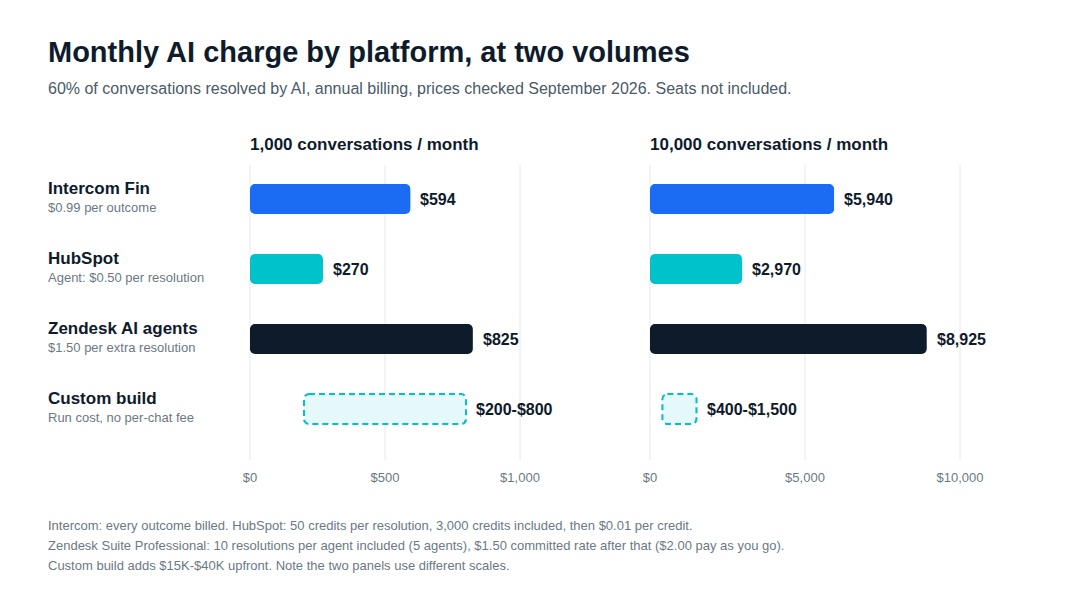
One honest caveat on the custom column: a custom bot doesn't remove your human seats. People still need an inbox to take handoffs, whether that's a helpdesk you already pay for or one the bot writes into. What a custom build removes is the per-conversation AI fee.
The custom build column
A custom chatbot typically costs $15K-$40K up front for a lead-qualifying bot with CRM integration, then roughly $200-$800 a month to run at moderate volume and $400-$1,500 at high volume. There's no per-outcome or per-credit fee. Ten thousand conversations cost the same to price as one thousand; only the underlying model and hosting cost moves, and that's yours to optimize.
The trade is the upfront cost and the fact that you own the maintenance. Who builds it, and what they charge, is a separate decision covered in what it costs to hire a chatbot developer. What it costs to keep running is in chatbot maintenance cost. If you want it built for you, that's AI chatbot development.
The three-year view
Seats are left out here because you pay for a human inbox either way. This compares the AI charge on each platform with a custom build's full cost.
| Three-year cost | Intercom Fin | HubSpot Customer Agent | Zendesk AI agents | Custom build |
|---|---|---|---|---|
| At 1,000 conversations/mo | $21,384 | $9,720 | $29,700 | $22,200-$68,800 |
| At 10,000 conversations/mo | $213,840 | $106,920 | $321,300 | $29,400-$94,000 |
| You own the code | No | No | No | Yes |
Custom totals are $15K-$40K upfront plus 36 months of run cost ($200-$800 at the lower volume, $400-$1,500 at the higher one).
At 1,000 conversations a month the platforms win or tie, especially HubSpot if you're already paying for Service Hub. At 10,000 the custom build is cheaper than every platform over three years. Using the $400-$1,500 run cost, the crossover lands at roughly 1,000-3,000 conversations a month against Zendesk, 1,400-4,400 against Intercom, and 2,800-8,800 against HubSpot. Your resolution rate moves every one of those numbers, so rerun it with your own.
But cost isn't the only crossover, and it's usually not the first one you'll hit.
What most people get wrong about the comparison
They treat it as purely a cost question. It's at least as much a fit question, and fit usually breaks before cost does.
Off-the-shelf platforms ship with qualification logic designed for the median company. If your definition of "qualified" is specific (a particular company size, a specific tool in their stack, a signal that actually predicts a good customer), you'll spend month one bending the platform's rules engine to approximate your logic, and month six discovering it can't quite get there. Most teams that move to a custom build don't do it because the platform got expensive. They do it because the platform couldn't express what they needed.
So run the decision in two passes. First: can a platform model your qualification and routing logic? If your criteria fit a standard lead form, the answer is yes, and a platform is the right call until volume makes it expensive. If they don't, a platform will cap you on capability no matter what you pay, and the cost comparison is moot.
How to actually choose
- Already on HubSpot, Intercom or Zendesk, modest volume → use that platform's agent. Its data and routing are already there.
- High volume, standard logic → run the three-year math above with your resolution rate; a custom build likely wins on cost alone.
- Specific qualification logic, any volume → custom, because platforms cap you on capability. Cost just decides how soon.
- Not sure which bucket you're in → scope it before you commit to either. A wrong platform choice is a migration; a wrong build is a rewrite.
If you're unsure, a 20-minute scoping call tells you whether your highest-ROI move is a platform, a custom build, or something else entirely, before you've spent on either.
The bottom line
As of September 2026, the big platforms bill for AI separately from seats: $0.99 per outcome on Intercom, $0.50 per resolution on HubSpot, $1.50-$2.00 per resolution past a small allowance on Zendesk. At low volume that's cheap and a platform is the right call. At several thousand conversations a month those fees compound past what a custom build costs to run, and the build's code is yours. Volume decides the cost crossover, but fit usually decides first.
Next step: Size a custom build with the full AI chatbot cost guide, or book a 20-minute call and we'll tell you whether to rent or build before you commit to either.
Is a custom AI chatbot cheaper than Intercom or HubSpot?+
Not at low volume. As of September 2026, Intercom Fin charges $0.99 per outcome and HubSpot's Customer Agent $0.50 per resolution, so at 1,000 conversations a month with 60% resolved by AI the AI charge is about $594 on Intercom and $270 on HubSpot, against a custom build's $15K-$40K upfront plus $200-$800 a month. At 10,000 conversations the same charges reach about $5,940 and $2,970 a month, while a custom build runs $400-$1,500, so over three years custom usually wins at that volume.
How does Intercom Fin pricing work?+
As of September 2026, Fin costs $0.99 per outcome. An outcome is a resolution, a handoff through a Procedure you configured, or a disqualified prospect; a qualified prospect costs $9.99. Intercom seats run $29, $85 and $132 per seat per month billed annually ($39, $99 and $139 billed monthly). Using Fin on another helpdesk needs no seats but has a 50-outcome monthly minimum. Because handoffs count, model outcomes, not just resolutions.
How much does HubSpot's Customer Agent cost?+
HubSpot's Customer Agent uses 50 HubSpot Credits per resolved conversation, which is $0.50 at $0.01 per credit, and escalated conversations are not billed. It needs Service Hub Professional ($90 per seat per month with an annual commitment, $100 paid monthly) or Enterprise ($150 per seat). Professional includes 3,000 credits a month, which expire if unused, and carries a one-time $1,500 onboarding fee.
Is Drift still a good chatbot option in 2026?+
No. On March 6, 2026, Clari + Salesloft announced the gradual sunset of Drift and named 1mind as the exclusive successor for its customers. No single shutdown date applies to everyone, but Drift is not a product to start on. Existing users should confirm their renewal and access dates and plan a migration.
At what point does a custom chatbot become cheaper than a platform?+
At a 60% AI resolution rate, and assuming a $15K-$40K build that costs $400-$1,500 a month to run, a custom build beats Zendesk's AI charges over three years somewhere between about 1,000 and 3,000 conversations a month, Intercom Fin between about 1,400 and 4,400, and HubSpot's Customer Agent between about 2,800 and 8,800. Your own crossover moves with your resolution rate and build cost, so run it with your numbers.
When should I choose a platform over a custom chatbot?+
Choose a platform when your qualification and routing logic fits a standard lead form and your conversation volume is modest, and you get a working bot for a few hundred dollars a month with nothing to maintain. Choose custom when your logic is specific enough that the platform's rules engine can't express it, or when your volume is high enough that per-conversation pricing exceeds the cost of building and running your own.
Free scoping call
Turn your AI idea into a written plan
Tell us what you want AI to do. In 30 minutes we tell you plainly whether it will pay for itself, and what it would take to build.
Book a scoping call →About the author

- Tags
- ai chatbot
- pricing
- ai development
Subscribe to Our Newsletter
The AI Build Brief: practical playbooks on how to build, price and ship AI features, in one short email every other week.