

Ask five chatbot vendors what they charge and you'll get five numbers that can't be compared. One quotes per resolution, one quotes per seat, one quotes per message, one quotes a flat monthly fee. The sticker price tells you almost nothing. The pricing model is what decides what you pay, and most buyers never look past the number on the homepage to check which model it's attached to.
TL;DR
- Five pricing models cover the 2026 chatbot market: per-resolution, per-seat, usage-based, flat/tiered subscription, and custom/owned build.
- Per-resolution pricing (Intercom Fin, ~$0.99/resolution) scales against you: the better the bot performs, the more you pay.
- Per-seat pricing is predictable but doesn't shrink as automation increases; you pay for agents whether the bot does their job or not.
- Usage-based and flat subscriptions sit at opposite ends of the predictability spectrum: usage flexes with volume but bills unevenly, flat is steady but you over- or under-pay against real usage.
- At high volume, a custom build's fixed fee plus near-zero marginal cost usually beats every rented model. Below a few thousand conversations a month, renting almost always wins.
Free scoping call
Turn your AI idea into a written plan
Tell us what you want AI to do. In 30 minutes we tell you plainly whether it will pay for itself, and what it would take to build.
Book a scoping call →The short answer
Five pricing models exist in 2026: per-resolution (Intercom Fin, ~$0.99/resolution), per-seat (pay per human agent, ~$29-$149/seat/month), usage-based (pay per message, token, or active user), flat/tiered subscription (a fixed monthly fee with a cap), and custom/owned build (a $15K-$40K fixed fee, then a few cents per conversation). Each one favors a different volume and ownership profile. The model decides your bill far more than the headline rate does.
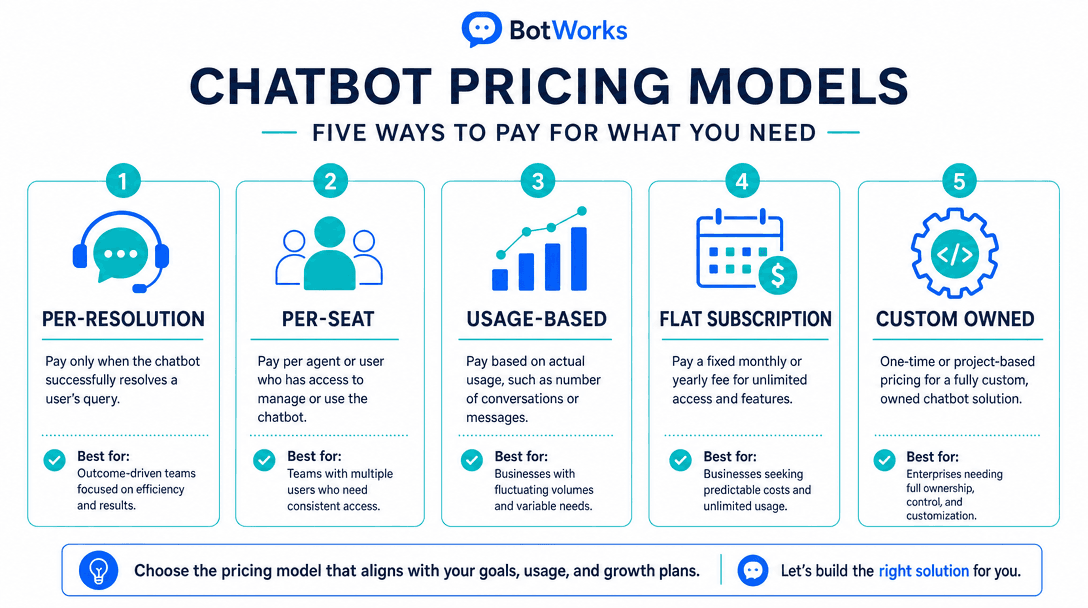
Per-resolution pricing: you pay when the bot closes the conversation
Per-resolution pricing charges a fee only when the bot handles a conversation start to finish without a human stepping in. Intercom Fin is the reference example, priced at roughly $0.99 per resolution on top of its seat-based plans.
It favors the vendor more than it looks. The pitch is "you only pay for outcomes," which sounds fair right up until the bot starts succeeding. Every resolution is a win for the customer and a line item for the vendor, so your bill grows in direct proportion to the thing you wanted the bot to do more of. At 500 resolutions a month, that's about $495. At 5,000, it's roughly $4,950, and that's before seat fees.
It gets expensive fast at scale, because there's no ceiling built into the rate itself. The more your team leans on the bot to deflect tickets, the more the per-resolution fee compounds. For a full breakdown of how this model behaves at different volumes, see the Intercom Fin pricing deep-dive.
Per-seat pricing: you pay for humans, not for resolutions
Per-seat pricing is the older model, inherited from human-agent helpdesk software: you pay a fixed fee per license, usually somewhere between $29 and $149 a month depending on the tier, and that's your bill regardless of how the bot performs.
It favors the buyer on predictability and the vendor on volume. You know exactly what next month costs before it starts, which is useful for budgeting. But the fee is tied to headcount, not automation. If your bot resolves 70% of incoming conversations and you still employ eight agents for the remainder, you're paying for eight seats even though most of the work is happening in the 30% the bot can't handle alone.
It gets expensive when your team doesn't shrink even as your bot improves. Eight seats at $115 a month is $920 a month whether the bot handles 10% of volume or 80%. Per-seat pricing simply doesn't reward automation the way the other models do, for better or worse.
Usage-based pricing: pay for what you consume
Usage-based (or consumption) pricing bills per message, per conversation, per API token, or per monthly active user. It's the model most native to how large language models themselves are billed, so a lot of newer chatbot tooling defaults to it.
It favors whoever can forecast their own usage accurately, which in practice tilts toward the vendor, since your usage pattern is rarely as predictable as you think. A conversation that runs long, a support spike after a product outage, or a shift to more context-heavy prompts can all quietly inflate the bill without any change in conversation count.
It gets expensive when conversations get longer or volume spikes unpredictably. At 2,000 conversations a month averaging eight messages each, $0.02 per message works out to roughly $320. Double the average conversation length during a rough month, and that number doubles with it, even though you didn't add a single new customer.
Flat or tiered subscription: pay the same no matter what
Flat pricing charges a fixed monthly fee, usually bundled into tiers with a volume cap: $299 a month for up to 1,000 conversations, say, with a jump to $599 once you cross it.
It favors whichever side of the cap you land on. If your actual usage sits comfortably inside the tier, you get the most predictable bill of any model on this list. If you're running 300 conversations against a 1,000-conversation tier, you're subsidizing capacity you don't use. Cross the line to 1,200 conversations and you're often bumped to the next full tier rather than billed for the marginal 200.
It gets expensive the moment your usage drifts away from the tier you picked, in either direction. Flat pricing rewards businesses whose volume is steady month to month and punishes anyone whose demand is seasonal or growing.
Custom build: pay once, own the marginal cost
A custom build flips the entire structure. Instead of a per-conversation or per-seat fee, you pay a fixed cost to build the bot, then only your own infrastructure and model costs to run it, typically a few cents per conversation rather than a dollar.
It favors the buyer at volume and the vendor's incentive disappears once the contract closes, because there's no recurring per-conversation margin to protect. A build runs $15K-$40K upfront (see the full chatbot developer cost breakdown for what drives that range), plus roughly $200-$800 a month to operate at moderate volume.
It gets expensive only at the front end. Ten thousand conversations cost the same to price as one thousand; only the raw token and hosting cost moves, and that's a number you can optimize directly instead of a rate someone else sets. For a look at how this compares to renting a specific platform, see custom AI chatbot vs platform pricing or the three-way breakdown in Drift vs Intercom vs a custom AI agent.
The master comparison: five models side by side
| Model | How it's billed | Predictable? | Best for | Gets expensive when |
|---|---|---|---|---|
| Per-resolution | $ per conversation the bot closes | No | Low-to-mid volume, fast start | The bot succeeds and resolution volume climbs |
| Per-seat | $ per human agent license | Yes | Small teams, low automation | The bot does the work but headcount stays flat |
| Usage-based | $ per message, token, or active user | No | Spiky or variable workloads | Conversations run long or traffic spikes |
| Flat/tiered subscription | Fixed $ per month, capped tier | Mostly | Steady, predictable volume | Usage drifts away from the tier, either direction |
| Custom/owned build | Fixed build fee + infra cost | Yes, after launch | High volume, specific logic | Never on marginal cost; only the entry fee is high |
Free scoping call
Turn your AI idea into a written plan
Tell us what you want AI to do. In 30 minutes we tell you plainly whether it will pay for itself, and what it would take to build.
Book a scoping call →How to forecast your real chatbot bill
Most teams budget off the rate card and get surprised by the invoice. Forecasting takes four steps.
First, estimate your monthly conversation or resolution volume, not your total ticket volume. If you run 3,000 support conversations a month and expect the bot to resolve 60% of them without escalation, that's 1,800 resolutions, not 3,000.
Second, multiply by the model's rate. At $0.99 per resolution, 1,800 resolutions costs $1,782 a month. Add seat fees on top if the platform charges both; five seats at $85 adds $425, bringing the total to $2,207 a month.
Third, project that forward 12 months, and account for growth. If resolution volume grows 20% over the year, a per-resolution or usage-based bill grows with it. A flat subscription doesn't move until you cross a tier; a custom build's marginal cost barely moves at all.
Fourth, run the same 12-month number against a fixed build. At $2,207 a month, the per-resolution scenario above totals roughly $26,484 over a year. A custom build at $25K upfront plus $500 a month in infrastructure runs about $31K in year one, but drops to $6,000 in year two with no growth-driven fee increase. The crossover point depends on your exact volume and growth rate, but it's a real number you can calculate before you sign anything, not a guess.
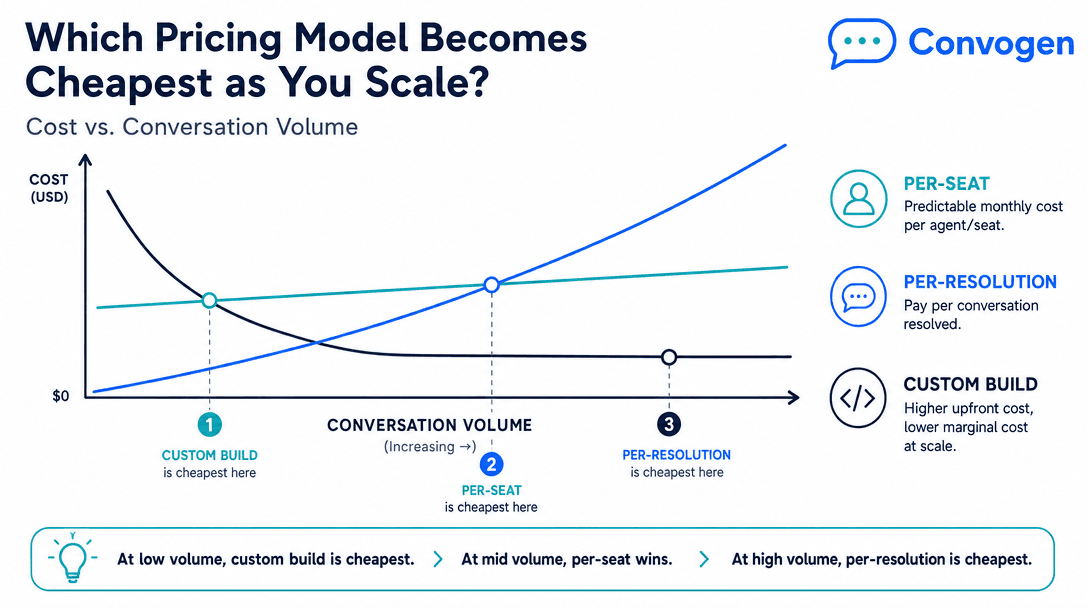
If you're trying to figure out where your own crossover sits before committing budget, that's exactly the kind of question an 20-minute scoping call is built to answer.
What most people get wrong about chatbot pricing
The first mistake is comparing sticker prices across different models. Lining up "$0.99 per resolution" against "$90 per seat" tells you nothing, because they're not measuring the same unit. You have to run both through your actual volume before either number means anything.
The second is assuming per-resolution pricing stays cheap because it started cheap. It's designed to scale with success, which means the month your bot gets good at its job is the month your bill jumps. A pricing model that looks affordable in a demo can look very different a year into real usage.
The third is ignoring that ownership wins at scale. Buyers fixate on the upfront cost of a custom build and skip past the fact that, at high volume, a fixed build fee plus a few cents a conversation almost always beats a per-resolution or usage fee that never stops compounding. The entry cost is real. So is the fact that it's the only cost that doesn't keep climbing.
If you want a fully owned system built around your specific logic rather than a platform's rate card, that's what AI agent development covers.
The bottom line
Five models, five different bets on who carries the risk. Per-resolution and usage-based pricing flex with volume but can spike without warning. Per-seat and flat subscriptions are predictable but don't reward automation. A custom build costs more upfront and less at every volume above a few thousand conversations a month. None of them is universally cheapest. The one that's cheapest for you is the one that matches your actual conversation volume, not the one with the lowest number on the pricing page.
Next step: Run your own numbers against the Intercom Fin pricing deep-dive, or book a 20-minute call and we'll tell you which pricing model fits your volume before you sign a contract.
What are the main chatbot pricing models?+
Five models cover most of the market in 2026: per-resolution (you pay when the bot closes a conversation, like Intercom Fin's ~$0.99/resolution), per-seat (you pay per human agent license, like classic Zendesk or Intercom plans), usage-based (you pay per message, token, or active user), flat or tiered subscription (a fixed monthly fee with a volume cap), and a custom build (a fixed build fee, then near-zero marginal cost per conversation). Each favors a different volume and ownership profile, so the cheapest one depends on how many conversations you run.
What is per-resolution chatbot pricing?+
Per-resolution pricing charges you only when the bot fully closes a conversation without a human stepping in. Intercom Fin is the reference example at roughly $0.99 per resolution, on top of seat fees. It sounds fair because you only pay for success, but that's the catch: the better the bot performs, the more conversations it resolves, and the higher your bill climbs. At 2,000 resolutions a month that's about $1,980 in fees alone, before seats.
Which chatbot pricing model is cheapest?+
It depends entirely on volume. Under a few hundred conversations a month, a flat subscription or a low-volume per-resolution plan is usually cheapest because there's no upfront cost. Once you're running several thousand conversations a month, per-resolution and usage-based pricing both compound past what a custom build's fixed fee plus near-zero marginal cost would run. There's no single cheapest model; there's a cheapest model for your volume.
Is per-seat or usage-based chatbot pricing better?+
Per-seat pricing is more predictable: you know your bill before the month starts. But you pay for every agent license regardless of how much the bot automates, so it doesn't get cheaper as your bot improves. Usage-based pricing scales down when volume is low, but a jump in conversation length or an unexpected traffic spike can double your bill with no warning. Teams with a stable headcount and modest automation tend to prefer per-seat; teams with spiky, unpredictable volume tend to prefer usage-based, as long as they're willing to accept a lumpier bill.
When does building a custom chatbot cost less than a subscription?+
Once your volume is high enough that per-resolution or usage fees compound past the cost of amortizing a fixed build fee, usually in the low thousands of conversations per month and up. A custom build runs $15K-$40K upfront (see the full chatbot developer cost breakdown) plus a few cents per conversation in infrastructure, with no per-conversation vendor markup. Below that volume, a subscription or per-resolution plan is usually cheaper because there's nothing to amortize.
Free scoping call
Turn your AI idea into a written plan
Tell us what you want AI to do. In 30 minutes we tell you plainly whether it will pay for itself, and what it would take to build.
Book a scoping call →About the author

- Tags
- pricing
- chatbots
Subscribe to Our Newsletter
The AI Build Brief: practical playbooks on how to build, price and ship AI features, in one short email every other week.