
What is mobile app development?
Mobile app development is the building of software that installs on a phone and runs there — with access to the camera, location, notifications and offline storage that a browser cannot reliably reach. It splits into native, where Android and iOS are written separately, and cross-platform, where one codebase serves both.
For most businesses, cross-platform is the correct default. React Native gives you both stores from a single codebase, roughly halving the build and the ongoing maintenance, with performance indistinguishable from native for the kinds of apps most companies need. Native earns its extra cost when the app is genuinely hardware-heavy — heavy graphics, continuous background location, intensive camera processing.
The decision that matters more than either is which devices you test on. An app that feels instant on the newest phone and sluggish on a mid-range Android will be judged by the second experience, because that is where most of your users are.
— What we build —
Three kinds of mobile app.
We will tell you on the call which one your idea actually is, and when you do not need an app at all.



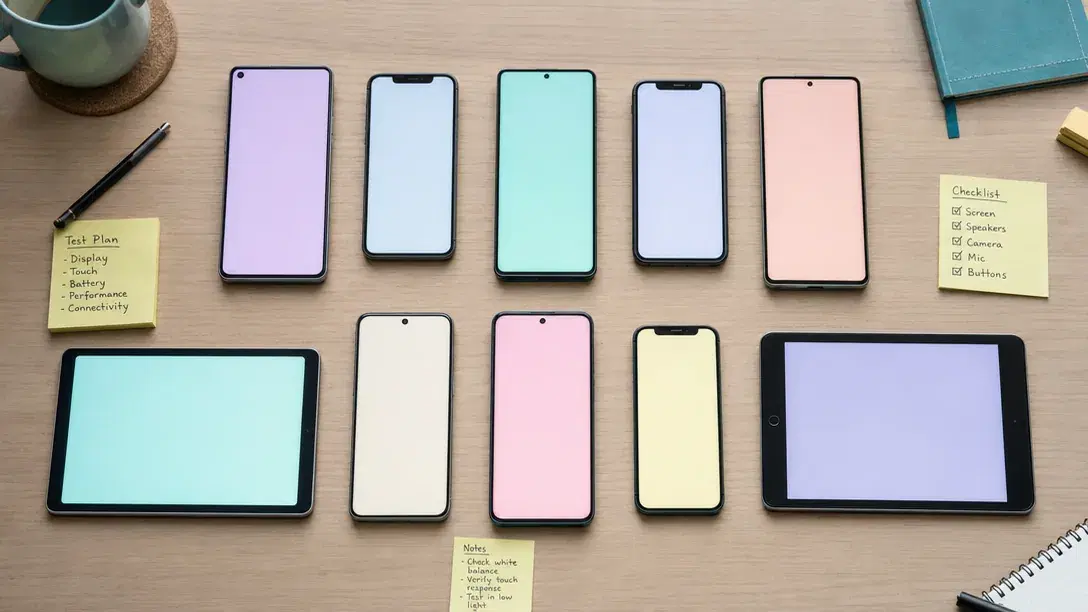
Builds are checked across a spread of real handsets and OS versions, not one flagship simulator.
— What you get —
The parts nobody quotes for.
Store submission, device testing, crash reporting and update paths are in the scope, not discovered afterwards as extras.
01
Store submission, both platforms
Listing assets, privacy declarations, data-safety forms and the review process, handled by us. First-time rejections are common and usually avoidable; we deal with them.
02
Real-device testing
A spread of handsets and OS versions, weighted to what your users actually carry rather than what sits on our desks. Simulators hide the problems that matter.
03
Crash reporting and analytics
Wired in before launch, so you can see which screen a crash came from and on which device, instead of reading a one-star review that just says it broke.
04
An update path
Over-the-air updates for anything that does not need a store review, and a documented release process for what does. Shipping a fix should take days, not a fortnight.
— How we work —
Eight to sixteen weeks, to both stores.
Store review adds unpredictable days at the end, so we start the submission paperwork early rather than at launch.
01 · Discover
Platforms and device mix
1 week
Who your users are, what they carry, and whether this genuinely needs to be an app rather than a mobile web experience.
02 · Design
Screens and navigation
1–2 weeks
Key screens designed to each platform’s conventions, so the app feels native on both rather than like a website in a wrapper.
03 · Build
Two-week sprints
5–10 weeks
Installable test builds at the end of every sprint, delivered to your phone through TestFlight and an internal Android track.
04 · Test
Devices and edge cases
1–2 weeks
Real handsets, poor connections, interrupted payments, permission denials — the states that only appear outside the office.
05 · Submit
Store release
1–2 weeks
Submission to both stores, responses to reviewer queries, and handover of the developer accounts, source and documentation.
— Honest qualification —
Who this is for.
A large share of app enquiries are better served by a mobile web app. We say so, because a store listing nobody installs helps neither of us.
A good fit
- You need the camera, GPS, push notifications or genuine offline use
- Your users will open it often enough to justify installing it
- You want both Android and iOS without paying for two separate builds
- The app extends something real — an existing business, platform or customer base
Not a fit
- A mobile-friendly web app would do the same job without an install
- The plan depends on downloads arriving on their own after launch
- You need it in the stores within a fortnight, review time included
- There is no budget beyond launch — apps need maintenance as the OS versions move
Do you actually need an app?
Tell us what your users need to do on their phones. If a mobile web app does it for a fraction of the cost, that is the answer you will get — and it is the answer we give often.
Real questions
Common Questions
The questions we get asked most, answered directly.
How much does mobile app development cost in India?+
We price per project with the figure fixed in writing before work begins. Scope drives it: how many screens, whether it needs offline sync, whether payments are involved, and whether it integrates with systems you already run. A focused single-purpose app is the smallest engagement we take; a customer app with accounts, payments and push notifications sits several times higher. Both stores are included in one price, because one codebase produces both.
Should we build native or cross-platform?+
Cross-platform, for most businesses. React Native serves both stores from one codebase, which roughly halves the build cost and the ongoing maintenance, and for the apps most companies need the performance difference is not perceptible to users. Go native when the app is genuinely hardware-heavy: continuous background location, heavy real-time graphics, or intensive camera and video processing. We will tell you which category yours falls into during scoping rather than defaulting to whichever is more profitable.
How long does it take to build a mobile app?+
Eight to sixteen weeks from signed scope to a live store listing. The build itself is usually ten of those weeks; the remainder is discovery, design, device testing and store review. App Store review is the genuinely unpredictable part — typically a few days, occasionally longer if a reviewer queries a permission or a privacy declaration. We prepare the submission paperwork during the build rather than at the end, which removes most of that risk.
Do you handle App Store and Play Store submission?+
Yes, both, including listing copy, screenshots, privacy policy declarations and the data-safety forms each store now requires. First submissions are frequently rejected over a permission that is not justified in the listing or a privacy form that does not match the app’s behaviour. We handle those exchanges. You keep ownership of the developer accounts throughout — they are registered to you, not to us.
What happens when Android or iOS releases a new version?+
Apps need maintenance in a way websites do not. Each major OS release can deprecate an API, change a permission model, or alter how notifications behave, and the stores enforce minimum SDK versions on a schedule. Budget for a maintenance retainer or at least an annual update. An app left untouched for two years will eventually stop being installable, and that is a cost worth knowing about before you start rather than after.
Can you take over an existing mobile app?+
Usually, if it is React Native or Flutter and the codebase is in reasonable shape. We begin with a short paid audit covering the code, the build pipeline, the store accounts and the dependency versions, then report on what it will take to move forward. The most common finding is not bad code but abandoned dependencies — libraries two or three major versions behind, where the upgrade is the real work.
— Ready when you are —
Tell us what it needs to do.
Describe your users and what they need on their phones. You will get a straight answer on platform, scope and timeline — including whether an app is the right call at all.