
Ask five app agencies in India what an app costs and you can get five numbers that differ tenfold. Usually none of them is dishonest. Each vendor has pictured a different app, with a different backend, a different amount of testing and a different idea of what "done" means. The published market data is useful once you know what it measures, and this post goes through it.
TL;DR
- GoodFirms' 2020 survey put a simple app built in India at $7,640-$18,200, against $38,200-$91,000 for the same app built in the US.
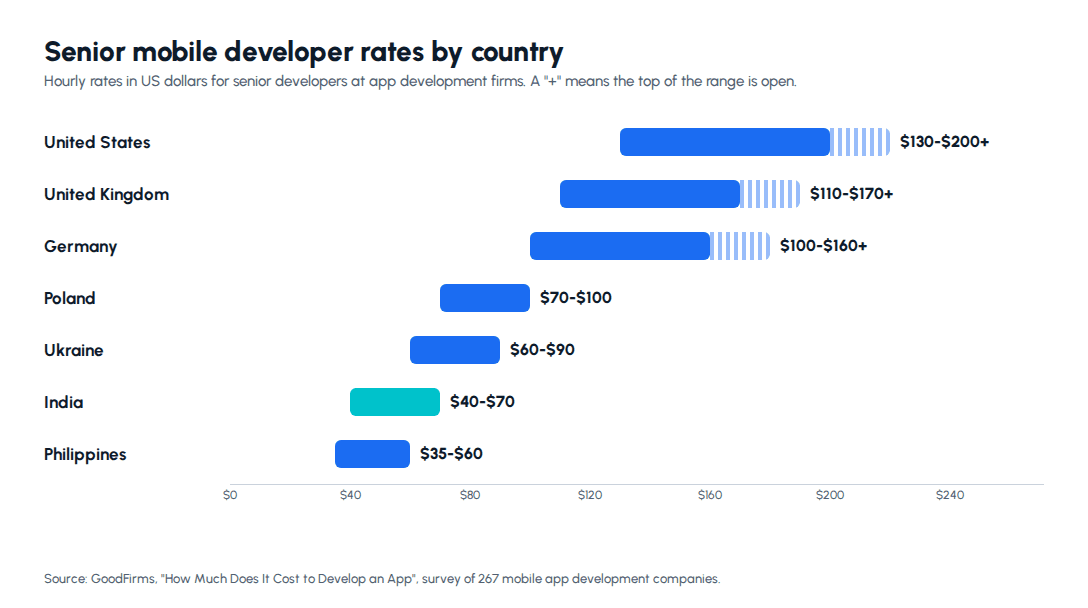
- The gap comes mostly from rates: GoodFirms lists senior mobile developers at $40-$70 an hour in India and $130-$200+ in the US.
- Scope moves cost more than country does. The backend, integrations, user roles, offline sync and payments decide the number.
- Store fees are small: Apple $99 a year, Google Play $25 once. Commission applies only to digital goods sold in the app.
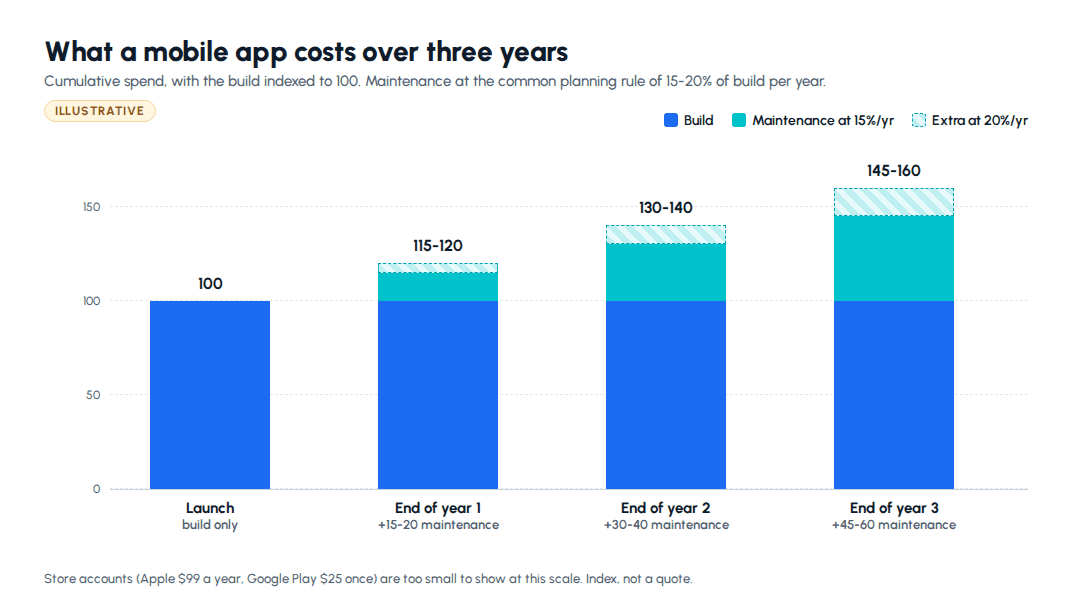
- Plan on 15-20% of the build cost every year to keep the app alive. Apple and Google enforce new SDK targets annually.
The short answer
A 2020 GoodFirms survey put a simple app built in India at $7,640-$18,200, and the same app built in the US at about five times that, mostly because of hourly rates. A mid-level app with accounts, payments and an admin panel costs several times more than a simple one. Store fees barely register. What catches buyers out is scope that was never written down, and maintenance that was never budgeted: plan on 15-20% of the build cost every year.
What does a mobile app cost in India in 2026?
There is no official price list, so the useful figures come from surveys of development firms and buyers. Here is what the named sources say, with the date and sample behind each.
| Source | What it measured | Figure |
|---|---|---|
| GoodFirms regional research (Feb 2020, 150+ firms) | Simple app, India | $7,640-$18,200 |
| Same survey | Simple app, United States | $38,200-$91,000 |
| GoodFirms app cost guide (267 firms, global) | Basic app, 3-6 months | $15,000-$40,000 |
| Same guide | Mid-level app, 6-9 months | $40,000-$120,000 |
| Same guide | Advanced app, 9-12 months | $100,000-$250,000+ |
| Clutch small business survey (158 US small businesses) | Actual spend on their app | 33% spent under $10,000; 32% over $50,000 |
Two cautions before you use any of these. The GoodFirms regional figures are from 2020, and developer salaries in India have risen since. And the global bands in the current GoodFirms guide are not India prices. They describe what firms worldwide charge, so an Indian firm will often quote below them for the same scope.
Why do quotes for the same app differ so much?
A quote is an hourly rate multiplied by hours, and both numbers vary.
The rate. GoodFirms lists senior mobile developer rates by country, and India sits near the bottom of the range.
Salary data explains where agency rates come from. AmbitionBox reports a typical range of ₹6.9-7.7 lakh a year for a React Native developer with one to six years of experience, and ₹7.7-8.5 lakh for an iOS developer. A firm's hourly rate adds designers, testers, project management, devices, tools and the time people spend between projects. A freelancer skips most of that overhead, and most of the safety net with it.
The hours. This is where quotes really diverge. One vendor prices the screens and assumes your backend exists. Another includes an API, an admin panel, testing on a spread of real phones, store submission and a warranty period. Both call the result "the app".
What actually drives the cost of an app?
In rough order of impact:
- The backend and integrations. The app on the phone is often the smaller half. Accounts, business logic, an admin panel for your staff, and connections to CRMs, ERPs or payment gateways live on the server.
- Number of user types. A customer app is one product. A marketplace with customers, providers and administrators is three sets of screens and permissions sharing one database.
- Offline sync. An app that must work without signal and reconcile changes later costs far more than one that simply shows an error.
- Payments and identity checks. Checkout, refunds, invoices and KYC flows carry edge cases and regulatory rules.
- Real-time features. Chat, live tracking and video calls add infrastructure and testing on poor connections.
- Platform approach. Two native apps cost more to build and far more to maintain than one cross-platform codebase. Cross-platform vs native app development covers when the extra cost is justified.
- Design. A custom visual language costs more than a clean interface built on each platform's conventions.
A real example shows how the list stacks up. For a healthcare marketplace in India, Metageeks built a Next.js web app, a NestJS API and a Flutter Android app between May and September 2026. The platform serves four user types, verifies patients through DigiLocker, takes payment through Razorpay and runs video consultations, with more than 1,100 automated tests across web, API and mobile. The Android app itself is a small share of that work. Most of the effort went into identity, payments, tenant isolation and the API both apps call.
What do the App Store and Google Play charge?
Less than most buyers expect, unless you sell digital goods inside the app.
Accounts. The Apple Developer Program costs $99 a year, charged in local currency where available. Google Play Console charges a one-time $25 registration fee. Register both in your company's name, not your vendor's.
Commission. Store commission applies to digital goods and subscriptions sold in the app. Apple's Small Business Program charges 15% if your proceeds stay under $1 million a year, and 30% above that. Google Play's service fee is 15% on the first $1 million of yearly earnings and on auto-renewing subscriptions in most markets, and a revised schedule for users in the US, UK and EEA took effect on June 30, 2026. An app that sells physical goods or real-world services, such as a delivery, a booking or a consultation, normally takes payment through its own gateway, so no commission applies to those sales.
Annual requirements. This is the fee nobody quotes. Since April 28, 2026, Apple has required uploads to be built with Xcode 26 and the iOS 26 SDK. From August 31, 2026, Google Play requires new apps and updates to target Android 16 (API level 36). Both stores move these targets every year, which is why maintenance is not optional.
How much should you budget after launch?
The planning rule most agencies use is 15-20% of the original build cost per year. It is an industry rule of thumb rather than a measured survey figure, but it holds up as a starting point.
That budget covers:
- SDK and OS updates. Each year's Apple and Google requirements, plus behaviour changes in permissions and notifications.
- Dependency upgrades. Libraries two or three major versions behind are the most common source of expensive rescue work.
- Crash and bug fixes. Driven by crash reporting you set up before launch, not by one-star reviews.
- Backend running costs. Hosting, database, monitoring, SMS, maps and email services.
- Small improvements. The changes users ask for once real people start using the app.
An app nobody maintains does not stay frozen. Within a year or two it stops meeting store requirements, and the eventual catch-up is more expensive than the steady upkeep would have been.
Should a US company build its app in India?
The rate difference is real, and India's hiring pools for Android, iOS, Flutter and React Native are deep. Whether the savings survive depends on how the engagement is run.
Plan for the time zone. India Standard Time is nine and a half hours ahead of US Eastern in summer and ten and a half in winter. That works well if two or three overlap hours are agreed at the start, and badly if every question waits a day.
Own the accounts and the code. The Apple and Google developer accounts should be registered to your company, and the source code should live in your repository from the first commit.
Test on your users' devices. A US audience carries a different mix of phones than an Indian one. Agree on the device list in the scope.
Get the scope in writing, then bill against it. A written scope with time-and-materials or retainer billing makes every change visible. A lump-sum quote on a vague brief tends to become a dispute about what was included.
How do you get quotes you can actually compare?
Send every vendor the same brief and ask for the same breakdown:
- A written feature list, with user types and the systems the app must connect to.
- Hours and cost split into design, backend, app, testing and store submission.
- The devices and OS versions they will test on.
- Whether cross-platform or native, and why.
- Who owns the code, the store accounts and the cloud accounts at the end.
- What maintenance costs per month or per year after launch.
A vendor who cannot break the number down has not scoped the app yet.
The bottom line
India offers mobile development at a fraction of US rates, and the published surveys bear that out. The number that matters, though, is set by scope: the backend, integrations, user roles and payments, not the country. Store fees are small, but annual SDK requirements make maintenance a fixed cost. Plan on 15-20% of the build every year from the start.
Next step: To turn your idea into a written scope with a realistic timeline, see how we handle mobile app development for Android and iOS and send us what your users need the app to do.
Frequently asked questions
How much does it cost to develop a mobile app in India?+
Market surveys give wide ranges because apps vary so much. A 2020 GoodFirms survey of more than 150 app companies put a simple app built in India at $7,640 to $18,200, against $38,200 to $91,000 for the same app built in the United States. GoodFirms' current cost guide, based on 267 companies and priced globally, puts basic apps at $15,000 to $40,000 and mid-level apps at $40,000 to $120,000. The gap between India and the US comes mostly from hourly rates, which GoodFirms lists at $40 to $70 for senior developers in India and $130 to $200 or more in the US. Your own number depends less on the country than on scope: the backend, integrations, user roles, offline sync and payments. Get a written scope before you compare any quotes.
Why do app development quotes from India vary so much?+
Because vendors quote different things under the same name. One quote covers screens only, assumes your backend already exists, and skips device testing. Another includes design, an API, an admin panel, testing on real handsets, store submission and a warranty period. Hourly rates differ too. A freelancer with low overheads bills far less than a firm that pays for designers, testers, project managers and people between projects. To compare quotes fairly, give every vendor the same written feature list and ask each one to break out design, backend, app, testing and store work separately, with hours against each. Ask who owns the source code and the store accounts. A quote that cannot be broken down is a guess, and it will grow once the real scope appears during the build.
What are the App Store and Google Play fees for a new app?+
Apple charges $99 a year for its Developer Program, in local currency where available, and Google charges a one-time $25 registration fee for a Play Console account. Commission applies only when you sell digital goods or subscriptions inside the app. Apple takes 15 percent under its Small Business Program if your proceeds stay under $1 million a year, and 30 percent otherwise. Google Play charges 15 percent on the first $1 million of yearly earnings and on auto-renewing subscriptions in most markets, with a revised schedule for users in the US, UK and EEA that took effect on June 30, 2026. Apps that sell physical goods or real-world services, such as deliveries or consultations, normally take payment through their own gateway and pay no store commission on those sales, only their payment gateway's fees.
How much does it cost to maintain a mobile app each year?+
A common planning rule is 15 to 20 percent of the original build cost every year. Treat that as an industry rule of thumb rather than survey data, and adjust it to your app. The money pays for work that is not optional. Apple and Google raise their SDK and target version requirements every year, so an app nobody updates eventually cannot ship updates at all. Libraries go out of date, OS releases change permissions and notification behaviour, and crash reports need fixing. On top of engineering time, budget for backend hosting, monitoring, third-party services such as SMS or maps, and the Apple developer renewal. Apps with payments, health data or many integrations sit at the top of the range, while simple content apps with a stable backend can sit below it.
Is it worth outsourcing app development from the US to India?+
It can be, if you buy the process rather than just the rate. Senior mobile developers in India bill roughly a third of what US developers bill according to GoodFirms, and India has deep pools of Android, iOS, Flutter and React Native developers. The savings disappear when scope is vague, feedback waits a day because nobody planned overlap hours, or the vendor holds the code and store accounts. Protect yourself with a written scope before work starts, builds you can install every sprint, developer accounts registered to your company, source code in your repository, and a few hours of daily overlap despite the nine-and-a-half to ten-and-a-half hour gap between India and US Eastern time. Time-and-materials or retainer billing against that written scope keeps changes visible instead of buried in a fixed quote.
Free PDF
The 2026 AI Development Rate Sheet
Build, agent, RAG and consulting rates by tier, in one PDF, so you can check a quote before you sign it.

Written by
Pankaj Kumar
Founder · Metageeks Technologies
Metageeks builds software and AI products for growing businesses. Every build is scoped in writing before it starts, and you see progress every week. We write about what holds up once it reaches production.
Connect on LinkedInThe AI Build Brief
Ship AI that holds up in production.
Practical playbooks on how to build, price and ship AI features, in one short email every other week.