

Ask several Indian software firms to quote the same internal tool and the numbers can differ several times over. Some of that gap is the hourly rate. Most of it is scope: one vendor priced three user roles and a payment gateway, another priced a login screen and a table. This post gives you the published market rates, the things that actually move effort, and the billing models, so you can tell which kind of quote you are holding.
TL;DR
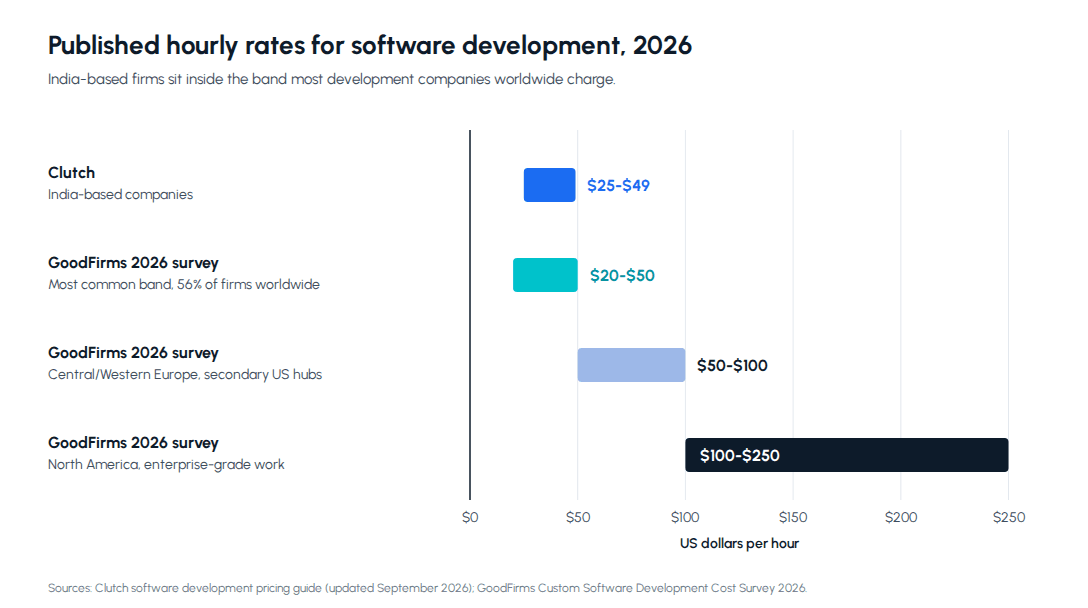
- India-based software companies on Clutch charge $25-$49 an hour. GoodFirms' 2026 survey puts 56 percent of firms worldwide in the $20-$50 band, against $100-$250 for enterprise-grade work in North America.
- Effort, not rate, is what separates quotes. User roles, integrations, payments, regulated data and data migration move the hours most.
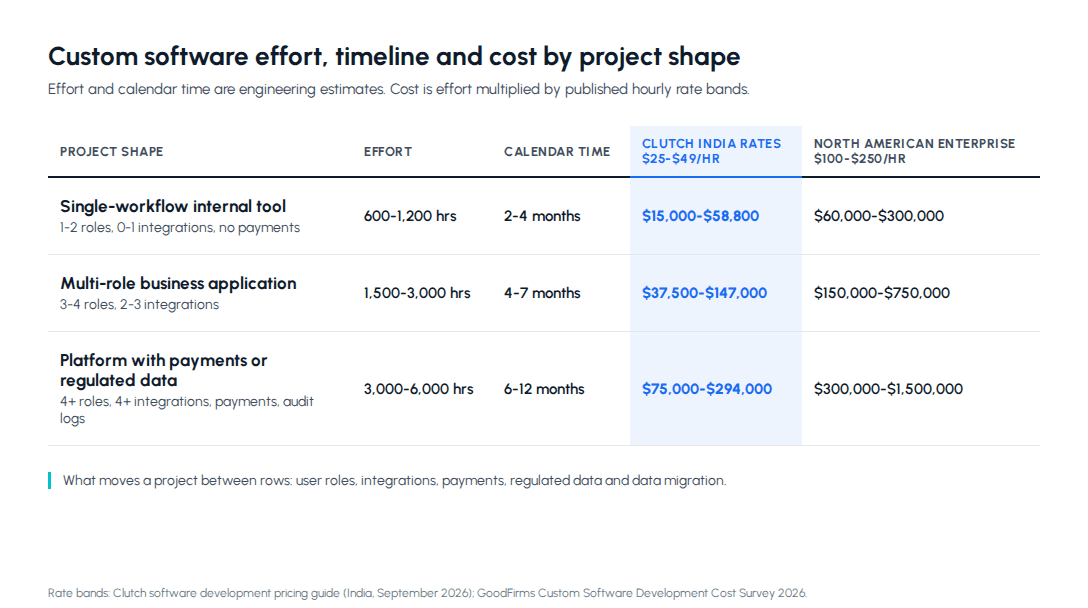
- Rough effort shapes: a single-workflow internal tool runs 600-1,200 hours over 2-4 months, a multi-role business app 1,500-3,000 hours over 4-7 months, and a platform with payments or regulated data 3,000-6,000 hours over 6-12 months.
- At Clutch's India band, those shapes work out to $15,000-$58,800, $37,500-$147,000 and $75,000-$294,000.
- Fixed-price suits small, settled scopes. Time-and-materials against a written scope suits most custom builds. Retainers suit ongoing work after launch.
The short answer
Most custom business software built by an Indian team lands between $15,000 and about $150,000 and takes 2-7 months, based on Clutch's published India rate of $25-$49 an hour applied to typical effort. Platforms that handle payments or regulated data run higher and longer. The rate you negotiate matters less than the scope you agree: two quotes at the same hourly rate can differ several times over because they priced different software.
What do Indian software development teams charge per hour?
Four kinds of published source are worth reading, and each measures something different.
- Agency rates from client reviews. Clutch's software development pricing guide, updated September 2026 from verified reviews, lists India-based companies at $25-$49 an hour. Across all regions, most companies on Clutch sit between $24 and $49, and reviewed projects most often cost $10,000-$49,000.
- Agency rates from a vendor survey. In the GoodFirms Custom Software Development Cost Survey 2026, 56 percent of development companies worldwide charge $20-$50 an hour, a band GoodFirms associates with Eastern Europe, Latin America and Asia. The $50-$100 band covers Central and Western Europe and secondary US tech hubs, and $100-$250 is standard for enterprise-grade work in North America.
- Freelance rates. Upwork's software developer cost guide reports a median of $20 an hour for software developers on the platform, with most between $10 and $100. That is useful context, but a freelancer's rate does not include project management, testing or cover when someone leaves.
- Salaries. Indeed India puts the average base salary of a software engineer at ₹8,90,512 a year, with a typical range of ₹4,45,484 to ₹17,80,114. Levels.fyi, which skews toward product companies and counts stock and bonus, reports a median total compensation of ₹29,93,746.
One caution on the rupee side. None of these sources publishes a reliable rate card for domestic Indian projects quoted in rupees, and quality varies most at the low end of the market. Treat any rupee figure with no named source the way you would treat any unsourced number. The effort model below works in either currency: estimate the hours, then multiply by the rate you are quoted.
Why is a vendor's rate so much higher than a developer's salary?
A developer on ₹8.9 lakh a year costs an employer roughly ₹445 an hour in base salary, spread across 2,000 working hours. The rate you pay a firm covers far more than that seat.
It pays for time that is never billed: hiring, training, the gap between projects, and the hours senior engineers spend reviewing other people's code. It pays for the roles around the developer, such as a project manager, QA, a designer and whoever handles deployment. And it pays for employer costs, tools, office space and margin.
That is why the cheapest quote is often one developer's time with nothing around it. Ask who reviews the code, who tests it and who answers when the original developer leaves. If the answer to all of those is the same person, the rate is low because the project is thin.
What drives the effort on a custom software build?
The hourly rate sets the price of an hour. Scope sets how many hours you buy. These are the drivers that move hours most, roughly in order.
User roles. Every distinct role needs its own screens, permissions and tests, and the interactions between roles are where most of the logic lives. The Dalmia Resorts member records system we built is a modest internal tool with three roles: executives search records and propose corrections, verifiers approve or reject them, and admins upload data and manage accounts. The API checks the role on every request. A single-role version would have been a search screen. The three-role version needed corrections stored as pending requests, a review queue that shows old and new values side by side, and status tracking for every request.
Integrations. Each external system brings authentication, error handling, rate limits and a data model that does not match yours. For Indian businesses the common ones are Tally or Zoho Books for accounting, GST e-invoicing, WhatsApp Business messaging and payment gateways. Writing into a system costs more than reading from it, and a poorly documented system costs more than either.
Payments. Taking money means handling failed payments, refunds, partial captures, reconciliation against bank settlements and webhooks that arrive twice or not at all. A gateway's hosted checkout keeps card data off your servers and cuts the compliance work, but the reconciliation logic is still yours to build.
Regulated data. Health records, financial data and personal data covered by India's Digital Personal Data Protection Act, 2023 need access controls, audit logs, consent handling, encryption and retention rules. For US buyers, HIPAA brings its own requirements. This work is invisible in a demo and substantial in a timeline.
Data migration. Moving records out of spreadsheets or an old system means mapping columns, cleaning duplicates and deciding what happens to rows that do not fit. On the Dalmia Resorts project, each spreadsheet column is mapped to a field before a first import, because sheets typed up over many years rarely use the same column names. Migration is routinely missing from first quotes.
Design, QA and deployment. These are less drivers than fixed shares of every build. A quote with no line for testing has not removed the testing. It has moved it to your users.
How long does custom software take to build, and what does it cost?
The effort and calendar figures below are our engineering estimates for typical builds, not survey data. The cost columns are simple arithmetic: effort multiplied by the published rate bands above.
| Project shape | Typical scope | Effort | Calendar time | At Clutch India rates ($25-$49/hr) | At North American enterprise rates ($100-$250/hr) |
|---|---|---|---|---|---|
| Single-workflow internal tool | 1-2 roles, 0-1 integrations, no payments | 600-1,200 hours | 2-4 months | $15,000-$58,800 | $60,000-$300,000 |
| Multi-role business application | 3-4 roles, 2-3 integrations | 1,500-3,000 hours | 4-7 months | $37,500-$147,000 | $150,000-$750,000 |
| Platform with payments or regulated data | 4+ roles, 4+ integrations, payments, audit logging | 3,000-6,000 hours | 6-12 months | $75,000-$294,000 | $300,000-$1,500,000 |
The survey data lines up with these shapes. GoodFirms' 2026 survey found about two-thirds of companies price medium projects at $30,000-$100,000 with a 3-6 month delivery timeline. Small projects and MVPs come in under $30,000 over 1-3 months, and large projects at $100,000-$200,000 over 6-12 months. Those are global figures rather than India-specific ones, but India's rates sit inside the band most of those firms charge.
Calendar time depends on team size as much as on hours. Adding developers shortens a project up to a point, then adds coordination cost. It also depends on you. Slow feedback on designs, waiting for API credentials from a third party and data that arrives late for migration each add time that no amount of development effort recovers.
What should a US buyer expect when hiring an Indian development team?
The rate gap is real. Clutch's India band of $25-$49 an hour sits well below the $100-$250 GoodFirms reports for North American enterprise-grade work, which is why the same 1,500-hour application can cost a fraction as much. The savings shrink when the engagement is set up badly, so plan for these:
- Working-hour overlap. New Delhi is 9.5 hours ahead of New York during US daylight saving time and 10.5 hours ahead the rest of the year. Agree a fixed daily overlap window for calls and decisions. Teams that rely on written updates and async review lose less time to the gap than teams that need a meeting for every question. How distributed teams deliver for US clients covers the working rhythm in more detail.
- Written scope and acceptance criteria. Distance makes vague requirements expensive. Every feature needs a written description of what done means before work starts.
- Code and IP ownership. The contract should assign code and IP to you and name a repository you control. Check this before signing, not at handover.
- Data handling. If the system handles US health or financial data, confirm the team has worked under HIPAA or similar rules before, and agree who gets access to production.
Free PDF
The 2026 AI Development Rate Sheet
Build, agent, RAG and consulting rates by tier, in one PDF, so you can check a quote before you sign it.
Fixed-price, time-and-materials or retainer: which billing model fits?
| Model | How it works | Suits | Watch for |
|---|---|---|---|
| Fixed-price | One price for a defined scope | Small builds with requirements that will not change | Risk padding in the price, expensive change requests, pressure to cut testing |
| Time-and-materials | You pay for hours worked against a written scope and estimate | Most custom builds, where details emerge once users see working software | Needs weekly reporting of hours against the estimate |
| Retainer | A fixed monthly amount for agreed capacity | Changes, maintenance and support after launch | Unused hours and unclear priorities |
Fixed-price looks safer because it moves the risk to the vendor, who prices that risk in. It works when the scope is small and settled. With most internal software, users only discover what they need once they see the first working screens, and under a fixed-price contract each discovery becomes a change request to negotiate.
Time-and-materials puts the budget risk on the buyer, which is why the written scope matters so much. A well-run engagement has an estimate broken into milestones, weekly reporting of hours against it, and an early warning when a milestone is trending over. You keep the right to reorder or cut scope when the budget tightens.
Retainers make sense after launch. Business software needs small changes, dependency updates and someone who knows the code when something breaks.
Metageeks scopes custom software builds in writing before work starts, then bills time-and-materials against that scope, or a monthly retainer for ongoing work. Our custom software development services page explains how an engagement runs from the first call to handover.
How do you get a quote you can actually budget against?
Send every vendor the same brief, and make it specific:
- List the user roles and what each one can see and change.
- List every system it connects to, and whether it reads, writes or both.
- Say whether it handles payments or regulated data.
- Describe the data you have today, where it lives and roughly how many records there are.
- Name the one workflow that must work at launch, and what can wait.
Then ask each vendor for effort in hours by milestone rather than a single figure, plus who is on the team, how testing is done, what support looks like after launch and who owns the code. A quote you can compare is one where you can see the hours.
If you are still deciding whether to build at all, when custom internal software beats SaaS works through a break-even model with seat costs and workaround hours, and build vs buy AI covers the AI version of the same decision.
Frequently asked questions
How much does custom software development cost in India?+
Based on published rates, most custom business software built by an Indian team costs between $15,000 and $150,000. Clutch lists India-based software companies at $25 to $49 an hour. Applied to typical effort, a single-workflow internal tool of 600 to 1,200 hours comes to $15,000 to $58,800, and a multi-role business application of 1,500 to 3,000 hours comes to $37,500 to $147,000. Platforms that take payments or handle regulated data can need 3,000 to 6,000 hours, or $75,000 to $294,000 at the same rates. The effort figures are estimates, so treat these as planning ranges rather than quotes. User roles, integrations, payments, regulated data and data migration move the number far more than the hourly rate does, which is why a written scope matters more than negotiating the rate down. Add hosting and support after launch to the budget.
What is the hourly rate for software developers in India?+
Clutch's software development pricing guide, updated in September 2026, lists India-based companies at $25 to $49 an hour. GoodFirms' 2026 survey of development companies worldwide found 56 percent charge between $20 and $50 an hour, while enterprise-grade work in North America typically runs $100 to $250. Freelancers cost less: Upwork reports a median of $20 an hour for software developers on its platform. On the salary side, Indeed India puts the average base salary of a software engineer at about 8.9 lakh rupees a year. A company rate sits well above that salary because it covers project management, testing, design, unbilled time between projects, employer costs and margin. Compare vendors on what the rate includes, not the number alone, since a low rate often means nobody reviews or tests the work. Ask for the blended rate across the whole team.
How long does it take to build custom software?+
A single-workflow internal tool with one or two user roles usually takes two to four months. A business application with three or four roles and a few integrations takes four to seven months, and a platform with payments or regulated data takes six to twelve. GoodFirms' 2026 survey reports similar global timelines: one to three months for small projects and MVPs, three to six months for medium projects and six to twelve months for large ones. Calendar time depends on team size and on the buyer as much as on hours. Slow feedback on designs, late access to third-party systems and data that arrives late for migration add weeks that extra development effort cannot recover. Agree who on your side answers questions, and how quickly, before the build starts. Weekly demos of working software keep those delays visible.
Is fixed-price or time-and-materials better for custom software?+
For most custom software, time-and-materials against a written scope works better. Fixed-price moves the risk to the vendor, who prices it in, and turns every requirement users discover after seeing working screens into a change request. It suits small builds with settled requirements. Time-and-materials puts the budget risk on the buyer, so it needs discipline: an estimate broken into milestones, weekly reporting of hours against it and early warning when a milestone runs over. In return you can reorder or cut scope as you learn, and you do not pay a risk premium. A retainer is a third option for ongoing changes, maintenance and support once the software is live. Whichever you choose, get the scope and acceptance criteria in writing before work starts, and confirm who owns the code. Ask for sample weekly reports before signing.
Why do quotes for the same software project vary so much?+
Because vendors are usually pricing different software. One quote may include three user roles, a payment gateway, data migration and automated tests, while another covers a login screen, a few forms and no testing. Rates vary too, from freelancers near Upwork's $20 median to firms charging $25 to $49 an hour on Clutch, but scope differences are usually larger. The fix is to send every vendor the same written brief listing user roles, the systems it must connect to, whether it handles payments or regulated data, and the data you have today. Then ask for effort in hours by milestone rather than a single figure, and ask who tests the work and what happens after launch. Quotes built on the same brief and shown in hours can be compared. Single-number quotes cannot. Give every vendor the same deadline and the same format to reply in.
Free PDF
The 2026 AI Development Rate Sheet
Build, agent, RAG and consulting rates by tier, in one PDF, so you can check a quote before you sign it.

Written by
Pankaj Kumar
Founder · Metageeks Technologies
Metageeks builds software and AI products for growing businesses. Every build is scoped in writing before it starts, and you see progress every week. We write about what holds up once it reaches production.
Connect on LinkedInThe AI Build Brief
Ship AI that holds up in production.
Practical playbooks on how to build, price and ship AI features, in one short email every other week.