

Ask five development firms to price the same web application and the quotes can differ by a factor of six, with every one made in good faith. Two things explain most of the spread. One is where the team works, which you can read off a rate card. The other is what the app has to do once someone logs in, and that is where budgets go wrong, because it is the part most quotes leave vague.
TL;DR
- Clutch's September 2026 pricing data puts most web development agencies at $25-$49 an hour, India-based agencies under $25 and US agencies at $100-$149.
- The same 1,200-hour build costs under $30,000 at India-based rates and $120,000-$178,800 at US agency rates.
- Six things move cost and weeks more than screen count: user roles, payments, multi-tenancy, integrations, real-time features, and performance and accessibility budgets.
- From signed scope, an internal dashboard typically takes 6-8 weeks, a customer portal 8-11, a marketplace 10-14 and a SaaS product 11-14 or more, after 1-3 weeks of discovery and design.
- Ask for a written scope billed on time-and-materials. One fixed number before the requirements exist is a guess with a signature on it.
The short answer
For small to mid-sized custom software projects, 66% of firms in GoodFirms' 2026 cost survey charge $30,000 to $100,000. India-based teams price toward the bottom of that band or below it, and US agencies toward the top or above it. Most web applications take 6-14 weeks from signed scope to production. The rate matters less than the scope behind it: user roles, payments, multi-tenancy, integrations and real-time features decide where in the range you land.
What does a web application cost in 2026?
Published pricing data is messy because "web development" covers everything from a brochure site to a SaaS product, so read each source for what it measures.
Clutch's web development pricing guide, built from verified client reviews and updated in September 2026, puts the average project at $66,499 over a typical nine months, while most projects on the platform cost under $10,000. Both numbers hold. The typical project is a website, and long application engagements pull the average up.
The GoodFirms Custom Software Development Cost Survey 2026 is closer to what a web application is. It found 66% of companies charge $30,000 to $100,000 for small to mid-sized projects, with large systems starting around $100,000 and enterprise platforms often above $200,000.
Hourly rates show where the spread comes from:
| Source | Rate | What it measures |
|---|---|---|
| Clutch, September 2026 | $25-$49/hour | Most common rate for web development agencies |
| Clutch, September 2026 | Under $25/hour | India-based web development agencies |
| Clutch, September 2026 | $100-$149/hour | US-based web development agencies |
| GoodFirms, 2026 | $20-$50/hour | Rate charged by 56% of surveyed software companies |
| Upwork | $30/hour median, $15-$50 typical | Freelance web developers on the platform |
Salaries sit underneath those rates. The US Bureau of Labor Statistics puts the median annual wage for web developers at $92,650 as of May 2025. Payscale's India salary data, updated July 2026, gives full stack developers an average base salary of ₹691,543. Agency rates track those costs plus overhead, which is most of the reason a New Delhi team and a New York team quote such different numbers for similar work.
How do India-based and US teams compare on the same build?
Take a modest web application: three people working full time for ten weeks, or about 1,200 hours of labour.
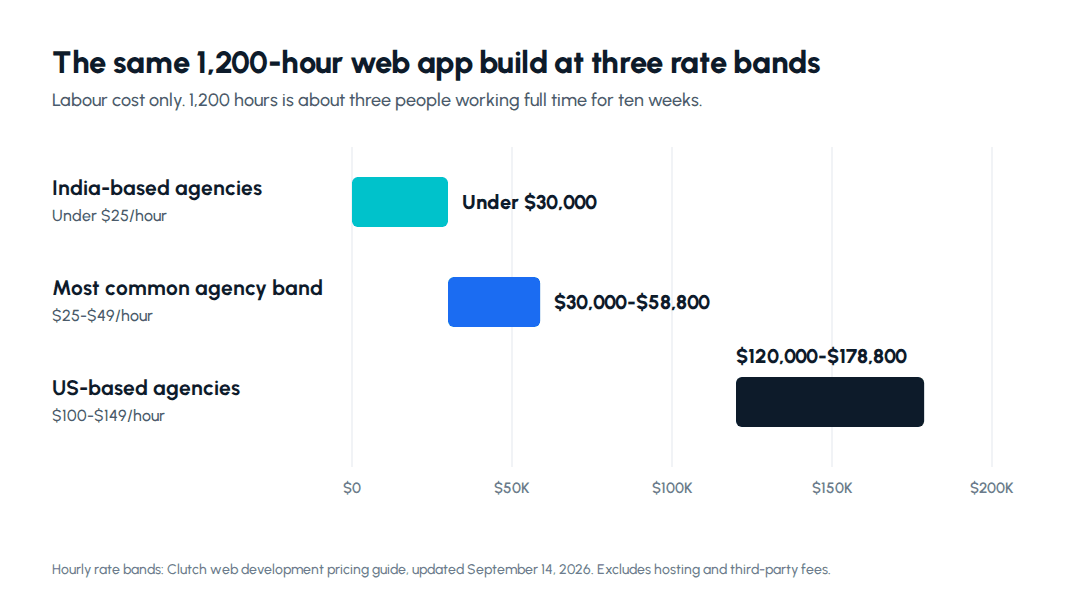
- At the under-$25 rate Clutch lists for India-based agencies, labour comes to under $30,000.
- At the most common agency band of $25-$49, it is $30,000 to $58,800.
- At the $100-$149 band for US agencies, it is $120,000 to $178,800.
The saving is real, with conditions. From the US or Europe, you get fewer overlapping hours, more dependence on written specifications and wider variation in quality between firms. GoodFirms also found that scope creep adds 10-25% to development costs, and that risk grows when the two sides talk less. Buyers who have hired offshore before tend to ask less about the rate and more about overlap hours, written specs and who actually writes the code.
The fair comparison is to give every firm the same written scope, then compare how each one handles change as well as the total.
What makes one web app cost more than another?
Screen count is a weak predictor. An app with one kind of user and no money moving through it can stay small with forty screens, and a marketplace with payouts is a large build with twelve. These six features move cost and weeks the most.
User roles. Every role needs its own screens, its own permission rules, and tests proving one role cannot reach another's data. The internal records application we built for Dalmia Resorts has three roles: support executives propose corrections, verifiers approve or reject them, and admins load data and manage accounts. The API checks the role on every request, and only office networks can reach the app. None of that shows in a demo, and all of it takes build and test time.
Payments. Taking a card payment is quick. Handling refunds, failed charges, invoices and webhooks that arrive twice takes much longer. On Montage India's stock media marketplace, checkout runs through Razorpay and issues GST invoices, money is stored as whole paise, and each webhook event is recorded once so a retry cannot apply it twice.
Multi-tenancy. When several customer organisations share one app, every query has to stay inside one tenant's data. On the healthcare marketplace we built, every domain table carries a tenant ID and PostgreSQL row-level security enforces the boundary. Designing that in from the first week costs far less than adding it after launch.
Integrations. Each outside system brings authentication, rate limits, its own error behaviour and outages you do not control. Price them one by one, and ask whether each integration only reads data or also writes it, because writing is the expensive kind.
Real-time features. Chat, live notifications, shared dashboards and video calls need persistent connections that reconnect cleanly on a patchy mobile network, plus extra infrastructure to test and run.
Performance and accessibility budgets. A load-time target on a mid-range Android phone, keyboard navigation, colour contrast and proper form labels. In India, where StatCounter measured 64.45% of web traffic on mobile in August 2026, an app tuned only on a developer's laptop feels slow to most of its users. Both budgets are cheap to set at the start and expensive to retrofit.
These are the standards we hold every build to in web application development for portals, dashboards, marketplaces and SaaS products, because each one costs less to plan than to bolt on later.
How long does it take to build each type of web app?
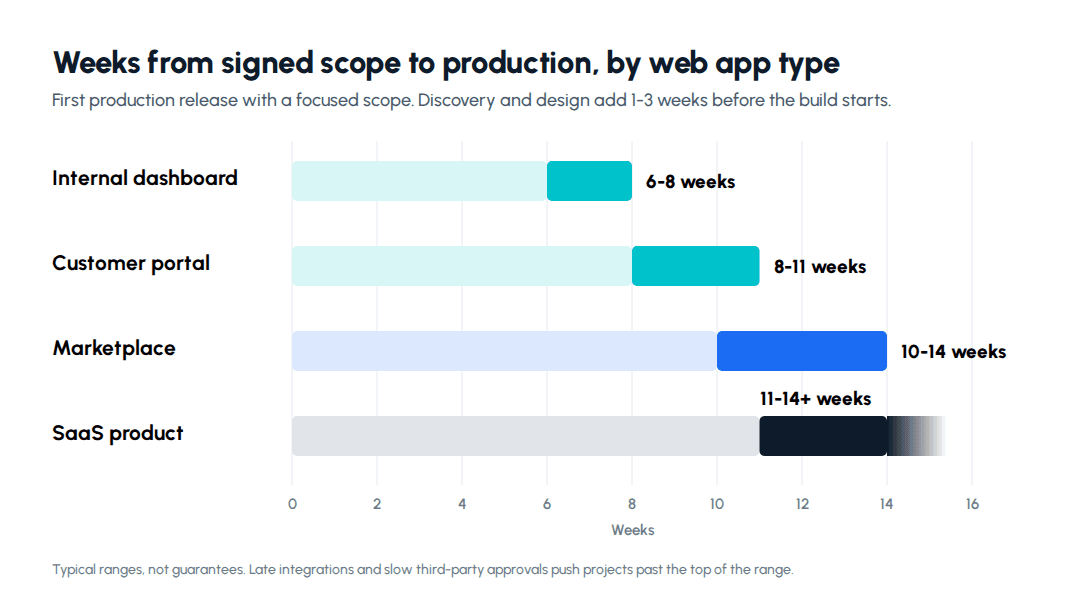
Most web applications take six to fourteen weeks from signed scope to production, with one to three weeks of discovery and design before the build clock starts. The type of app decides where in that range a project lands.
| App type | Typical first release | Weeks from signed scope |
|---|---|---|
| Internal dashboard | One team, a few roles, live data, filters and exports | 6-8 |
| Customer portal | Accounts, document upload, payment status, requests | 8-11 |
| Marketplace | Two sides, listings, search, checkout, payouts | 10-14 |
| SaaS product | Multi-tenant, subscription billing, onboarding, usage limits | 11-14+ |
Those weeks cover a first production release with a focused scope: design, two-week build sprints, a hardening week for device testing, accessibility and security review, and launch. Clutch's nine-month typical project looks very different because it measures whole engagements, including work that continues after launch.
Calendar time also stretches for reasons unrelated to coding: a partner slow to issue API keys, or a product question that waits a week for an answer.
Why do web app budgets run over?
GoodFirms puts the cost of scope creep at 10-25%, and it rarely arrives as one big change. It shows up as a user role nobody mentioned, a report finance needs, or an integration discovered in week six. A few habits before the build keep it in check:
- Map every role and what each one does before anyone designs a screen.
- List integrations by system, marked read or write.
- Agree the performance target and the test devices in writing.
- Name one person on your side who can answer product questions within a day.
How should you structure the contract?
For most web apps, a written scope billed on time-and-materials works better than one fixed number. Requirements move once real users see the first build, and a fixed price only hides that: the vendor either pads the quote or pushes back on every change. With a written scope, each change comes with a short note on its effect on weeks and cost, and you decide. Once the first version is live and the work becomes a steady roadmap, a monthly retainer is usually simpler.
A quote worth trusting breaks out:
- User roles and what each can do
- Payment flows, including refunds and invoices
- Whether the app is multi-tenant
- Each integration, read or write
- The performance target and the devices it is tested on
- Automated tests on sign-up, checkout and permissions
- Monthly hosting and third-party service costs after launch
- Who owns the code, the cloud accounts and the domain
Should the web app come before a mobile app?
For most products, yes. A web app reaches every device through a link, and a fix goes live the same day without store review. The exceptions, and what progressive web apps can and cannot do on an iPhone, are covered in whether to build a web app or a mobile app first.
Next step: See how we scope, build and hand over custom web applications that stay fast on ordinary phones, or describe what your users need to do and get a written scope back.
Frequently asked questions
How much does web application development cost?+
Published data gives a wide band because web development covers everything from a brochure site to a SaaS product. Clutch's September 2026 pricing guide puts the average web development project at $66,499, while most projects listed there cost under $10,000, which reflects how many of them are simple websites. For applications people log in to, GoodFirms' 2026 survey is a closer guide: 66% of firms charge $30,000 to $100,000 for small to mid-sized custom software projects, and large systems start around $100,000. Where the team works moves the number a lot. Clutch lists India-based agencies under $25 an hour and US agencies at $100 to $149, so the same 1,200-hour build costs under $30,000 in one case and more than $120,000 in the other. Scope then moves it further, through user roles, payments, multi-tenancy, integrations and real-time features.
Why are India-based web development rates lower than US rates?+
Mostly because salaries and overheads are lower, not because the work is simpler. The US Bureau of Labor Statistics puts the median annual wage for web developers at $92,650 as of May 2025, while Payscale's July 2026 data gives full stack developers in India an average base salary of about 6.9 lakh rupees. Agency rates follow those costs, which is why Clutch shows India-based agencies under $25 an hour and US agencies at $100 to $149. A lower rate brings costs of its own that a buyer should price in: fewer overlapping working hours with US or European teams, a heavier reliance on written specifications, and wider variation in quality between firms. A team that works from a written scope, shows a deployed build every two weeks and hands over the source code removes most of that risk. Judge the firm on shipped work you can open, not on the rate alone.
How long does it take to build a web application?+
Most web applications take six to fourteen weeks from signed scope to production, with one to three weeks of discovery and design before that. A focused internal dashboard for one team usually takes six to eight weeks. A customer portal with accounts, document uploads and payment status takes eight to eleven. A marketplace, with two sides, search, checkout and payouts, takes ten to fourteen, and a multi-tenant SaaS product with subscription billing takes eleven to fourteen or longer. These are first production releases with a focused scope, not finished products. Clutch reports a typical web development project of nine months in its client reviews, a figure that counts the work continuing after launch. If a quote promises a marketplace with payments in four weeks, ask which hardening steps it leaves out: device testing, accessibility, security review or automated tests on checkout.
What drives the cost of a web app the most?+
Six things, and the number of screens is not one of them. User roles, because every role needs its own screens, permissions and tests proving one role cannot see another's data. Payments, because refunds, failed charges, invoices and webhooks that arrive twice all need handling. Multi-tenancy, where several customer organisations share one app and their data must stay apart. Integrations, since each outside system brings authentication, rate limits and outages you do not control. Real-time features such as chat, live notifications or video calls, which need connections that survive a patchy mobile network. And a performance and accessibility budget, which is cheap to set at the start and expensive to retrofit. An app with one kind of user and no payments can stay small with forty screens, while a marketplace with payouts is a large build with twelve.
Is a fixed price or time-and-materials better for a web app?+
For most web apps, a written scope billed on time-and-materials works better than a single fixed price. Requirements change once real users see the first build, and GoodFirms' 2026 survey found scope creep adds 10 to 25 percent to development costs. Under a fixed price the vendor protects itself by padding the quote or resisting changes, so you pay for the uncertainty either way. A written scope billed on time-and-materials makes the trade visible, because each change comes with a short note on its effect on weeks and cost, and you decide whether to make it. Once the first version is live and the work turns into a steady roadmap of improvements, a monthly retainer is usually simpler to run. Whichever model you choose, ask for a deployed build you can open every two weeks, so progress shows up in the product itself.
Free PDF
The 2026 AI Development Rate Sheet
Build, agent, RAG and consulting rates by tier, in one PDF, so you can check a quote before you sign it.

Written by
Pankaj Kumar
Founder · Metageeks Technologies
Metageeks builds software and AI products for growing businesses. Every build is scoped in writing before it starts, and you see progress every week. We write about what holds up once it reaches production.
Connect on LinkedInThe AI Build Brief
Ship AI that holds up in production.
Practical playbooks on how to build, price and ship AI features, in one short email every other week.