

Someone in your organisation is going to ask about time zones. It is a fair question and it usually gets a bad answer, because vendors treat it as an objection to deflect rather than a real operational fact to plan around. The honest version is more useful: some things do break, they are fewer and more specific than people expect, and the thing that predicts whether a project succeeds is not where the team sits.
TL;DR
- One thing breaks with distance: the speed of resolving ambiguity. Everything else is a planning problem.
- Guaranteed, predictable overlap hours matter more than how many. Two dependable hours beat six unreliable ones.
- Code quality, seniority, and review depth do not vary with geography. They vary with who employs the engineers.
- The question that predicts outcomes is in-house versus brokered, not onshore versus offshore.
- Four questions will tell you which one you are buying, and they cost you nothing to ask.
Free scoping call
Turn your AI idea into a written plan
Tell us what you want AI to do. In 30 minutes we tell you plainly whether it will pay for itself, and what it would take to build.
Book a scoping call →The short answer
The real cost of a distributed team is decision latency, not quality. A question needing your input costs minutes in an office and can cost most of a day across a closed overlap window. Fix it with guaranteed daily overlap hours, decisions front-loaded into a written specification, and no single person as a bottleneck. Then spend your remaining scepticism on the question that matters more: does the vendor employ the engineers, or are they reselling someone else's?
What genuinely breaks
Ambiguity resolution. This is the whole cost, and it is real. An engineer hits a question the specification did not anticipate. In a shared office they walk over and get an answer in ninety seconds. Across a closed window, they either guess or park it, and a parked question can cost the better part of a day. Over a ten-week build that adds up.
The fix is not working longer hours. It is reducing the number of questions that need you at all, by writing specifications that decide the ambiguous cases in advance, and by making sure the engineer always has something else to move to when they are blocked. Both are good practice regardless of geography. Distance just makes skipping them expensive.
Review latency on tight loops. When two people are iterating rapidly on something subtle, distance is friction. This matters during discovery and during the final tuning pass, and much less during the build itself. Schedule those phases into the overlap window deliberately rather than hoping.
Informal context. The hallway conversation where someone mentions that the finance team is about to change the approval flow. That signal does not travel by default. It has to be replaced by a structured weekly conversation that explicitly asks what changed on your side.
What does not break
Code quality. It varies with who wrote it, not where they were sitting. Ask for a code sample, ask how they test, and judge the answer on its merits. This is checkable, so check it rather than using location as a proxy.
Seniority. The distribution of skill is not geographic. What is geographic is the market rate, which is why the arrangement exists at all, and pretending otherwise is silly.
Written communication. In fact it usually improves, because a distributed team has to write things down. Specifications get more precise, decisions get recorded, and six months later you can find out why something works the way it does. Co-located teams frequently cannot answer that question at all.
Accountability. This is contract design, not geography. Weekly commits to your repository, a deployment in your cloud account from week one, and a delivered evaluation set make progress visible from any distance. Those terms are covered in what an AI agent engagement includes, and they do more for accountability than sharing a postcode.
The question that actually predicts outcomes
Location is the wrong axis. The one that matters is whether the company you sign with employs the people who write your code.
A brokered vendor sells you a project and subcontracts the build, sometimes through more than one layer. The result is a team with no direct relationship to the firm you contracted, no continuity between projects, and nobody who carries the context when someone rotates off. This happens at every price point and in every country, including expensive onshore ones, and it is a much better predictor of a bad outcome than a time zone.
An in-house team employs its engineers. The people on your kickoff call are the people committing code, and they are still there in month six. When something goes wrong, one company owns it.
| In-house team | Brokered vendor | |
|---|---|---|
| Who writes the code | Employees you can meet | Subcontractors, sometimes layered |
| Continuity | Same people throughout | Rotates without notice |
| Accountability | One company | Diffuse by design |
| Context retention | Accumulates | Leaves with each rotation |
| Your visibility | Named individuals | A project manager |
Ask four questions and you will know which you are dealing with. Who employs the engineers who will do this work? Can I meet them by name before I sign? Is any part of this subcontracted, and will you put that in writing? Will the commits in my repository come from those same people?
A vendor with an in-house team answers all four in a sentence each. Anyone else will reframe the question, which is itself the answer. Questions to ask an AI consultant covers the rest of the selection conversation, and hiring chatbot developers offshore looks at the same trade from the hiring side.
How we work, specifically
We are a distributed team. Our engineers are in India, and a meaningful share of our clients are in the US and UK. That is the arrangement, and we would rather describe it plainly than let a vague phrase on a website do the work.
The engineers are ours. We do not subcontract client work, you meet the specific people who will build your system before anything is signed, and those are the names on the commits. If someone has to rotate off, you hear it from us with a transition plan attached rather than noticing a different writing style in the status update.
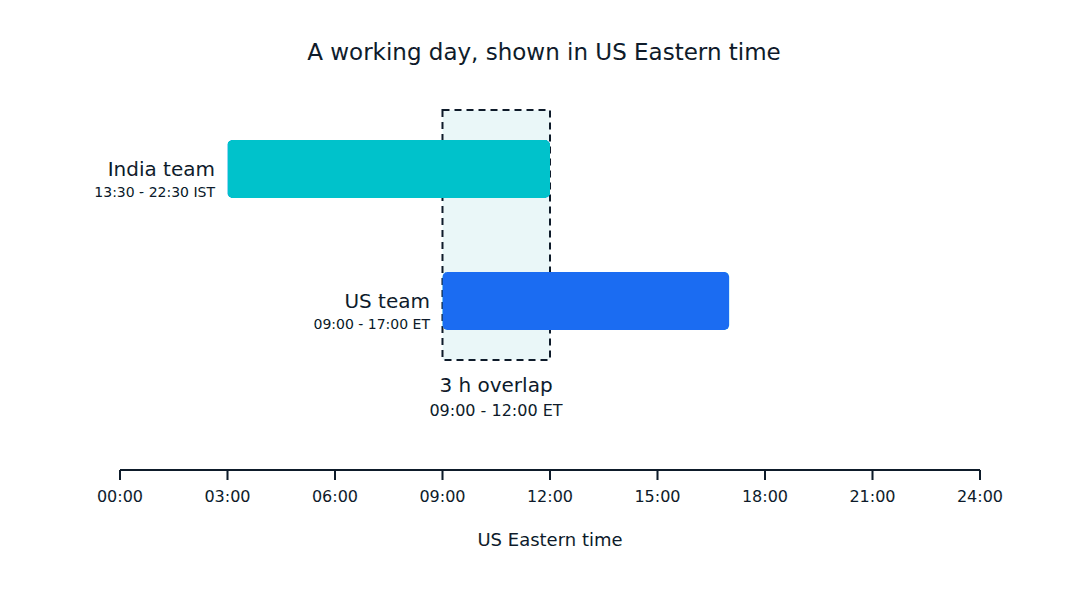
We hold guaranteed overlap into the US morning every working day, treated as protected time rather than best effort. Discovery, demos, and the final tuning pass get scheduled inside it deliberately, because those are the phases where latency costs something. That is the schedule behind our AI development for US small businesses.
Everything runs in your cloud accounts, your repository, from week one. You do not wait for a demo to find out where the project stands, and you can hand the whole thing to another team at any point without asking us for anything.
That is the working model. If your organisation needs something different, such as personnel in a specific jurisdiction for regulatory reasons, we will tell you we are the wrong fit rather than working around it.
Free scoping call
Turn your AI idea into a written plan
Tell us what you want AI to do. In 30 minutes we tell you plainly whether it will pay for itself, and what it would take to build.
Book a scoping call →When distributed genuinely does not work
Physical presence is required. On-site hardware, shop-floor observation, or anything where somebody has to be in the building. No amount of coordination substitutes.
Your organisation cannot decide asynchronously. If every question needs a meeting, and meetings take a week to schedule, distance multiplies an existing problem rather than creating one. Worth being honest with yourself about, because the same trait makes co-located projects late too.
Regulation requires a jurisdiction. Some contracts require personnel or data handling in a specific country. That is a legal constraint and there is no clever answer to it. The related data-residency questions are covered in the security review checklist.
Outside those three, distribution is a coordination problem with well-understood solutions, and the teams that struggle with it are usually the ones that never set up the solutions.
The bottom line
The time-zone question deserves a straight answer rather than a reassurance. What breaks is decision latency, and it is fixed with guaranteed overlap and specifications that decide the ambiguous cases in advance. What does not break is quality, seniority, or accountability, all of which depend on who employs the engineers and what your contract requires them to show you.
If you are evaluating vendors, spend less scrutiny on where they sit and more on whether they will name the people writing your code. That question separates good outcomes from bad ones far more reliably, and unlike a time zone, the answer is not visible on a website.
Next step: If you want to meet the engineers before deciding anything, ask for a technical call and we will put the people who would do the work on it. No account manager, no pitch deck. The company page covers who we are.
Does working with a distributed AI development team actually slow projects down?+
It slows down one specific thing: resolving ambiguity. A question that needs a decision from you costs minutes when you share an office and can cost most of a day when the overlap window has closed. Everything else, including code quality, review depth, and delivery speed, is unaffected by geography. The fix is structural rather than heroic: guarantee overlap hours, front-load decisions into written specifications, and make sure nobody is ever blocked on a single person's reply.
What's the difference between an in-house team and a brokered AI vendor?+
An in-house team employs the engineers who write your code. A brokered vendor sells you a project and subcontracts the work, sometimes more than once, which means the people building your system have no direct relationship with the company you signed with. This matters more than location. Ask who employs the engineers, whether you can meet them, and whether anyone outside the company will touch the repository.
How many overlap hours do you need with a distributed development team?+
Three to four guaranteed hours a day is enough for a project of this size, provided they are the same hours every day and everyone treats them as protected. What matters more than the count is predictability: knowing that a question asked at a certain time gets an answer that day is worth more than a larger but unreliable window. Two hours of dependable overlap beats six hours of maybe.
How can I verify a vendor's engineers are actually in-house?+
Ask to meet the specific people who would work on your project, by name, on a call, before you sign. Ask whether any part of the work is subcontracted and get the answer in writing. Then check that the repository commits come from those same people once the project starts. A vendor who resists the first request or cannot answer the second is telling you something useful at no cost to you.
When does a distributed team genuinely not work?+
Three cases. When the work requires being physically present, such as on-site hardware or shop-floor observation. When your organisation cannot make decisions asynchronously and every question needs a meeting. And when regulatory constraints require personnel in a specific jurisdiction, which is a legal requirement rather than a preference. Outside those, distribution is a coordination problem with known solutions, not a quality problem.
Free scoping call
Turn your AI idea into a written plan
Tell us what you want AI to do. In 30 minutes we tell you plainly whether it will pay for itself, and what it would take to build.
Book a scoping call →About the author

- Tags
- ai consulting
- hiring
- ai development
Subscribe to Our Newsletter
The AI Build Brief: practical playbooks on how to build, price and ship AI features, in one short email every other week.