
Most AI proposals answer the wrong question. They quote a number and describe an outcome, and somewhere between those two things sits everything that determines whether the project succeeds: what gets built, what gets tested, what you receive at the end, and what happens when it is wrong. This post is our answer to "what do I actually get," written the way we would want to read it as a buyer.
TL;DR
- Five phases, nine deliverables. If a proposal does not name them individually, it has not been scoped.
- Discovery should be short, paid, and able to end in "do not build this."
- The evaluation set matters more than the code, because it is what lets anyone change the system later.
- Data cleanup, process change, and post-handover content maintenance are usually excluded. Ask early.
- Integration depth is the single biggest cost driver. Volume and model choice barely affect the build.
Free scoping call
Turn your AI idea into a written plan
Tell us what you want AI to do. In 30 minutes we tell you plainly whether it will pay for itself, and what it would take to build.
Book a scoping call →The short answer
A properly scoped AI agent engagement runs eight to ten weeks across five phases and produces nine named deliverables, including a working deployment in your cloud account from week one, the evaluation set as files, and a documented fallback path for when the agent is unsure. Anything less than that list is a demo with an invoice attached.
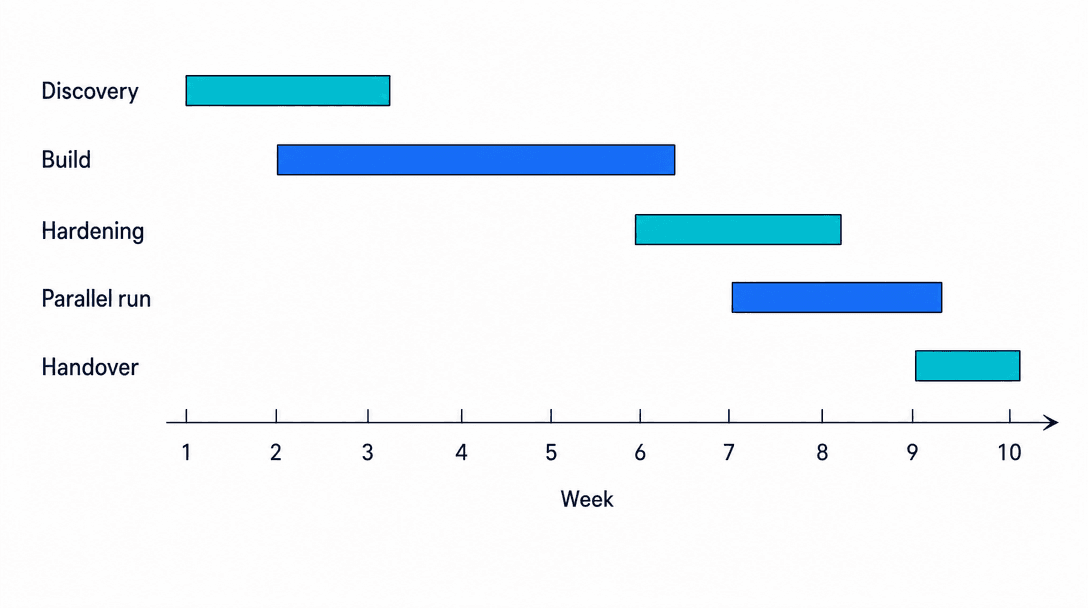
The five phases and what each one produces
Discovery and specification, weeks one to two. We map the workflow as it actually runs, not as the process document describes it, identify which data sources exist and what condition they are in, and write a specification with a numeric accuracy target. This phase ends in a go or no-go, and the no-go is real. If the process is unstable or the data is not there, we say so and you stop, which is the outcome an AI readiness assessment is designed to reach cheaply.
Build, weeks two to six. The agent, its retrieval layer, and its integrations, deployed to your cloud account from the first week even when it does very little. Weekly commits to your repository. You watch it get built rather than seeing it at the end.
Evaluation and hardening, weeks five to eight, overlapping the build. The evaluation set gets constructed from real cases, accuracy is measured against the target rather than described, monitoring and alerting go in, tool permissions get scoped down from whatever was convenient during development, and the fallback path is defined and approved. The security review checklist covers what this phase has to satisfy.
Parallel run, weeks seven to nine. The agent handles real traffic without acting on it, and its answers get compared against what humans actually did. This is where the last gaps surface, and finding them here costs nothing.
Handover, weeks nine to ten. Documentation, a walkthrough with whoever will own it, and the full package transferred. Then a defined support window while your team settles in.
The nine deliverables
| Deliverable | Why it matters to you |
|---|---|
| Written specification with accuracy target | Defines done, so nobody argues about it later |
| Deployment in your cloud account | You can see progress and you keep it |
| Source code in your repository | Ownership, and a second opinion is possible |
| Prompt and system instruction files | Where the business logic actually lives |
| Evaluation set: cases and expected outputs | Lets anyone change the system safely |
| Monitoring and alerting | Quality degradation is invisible without it |
| Documented fallback path | What happens when it is unsure, decided in advance |
| Architecture and operations document | So the next person does not start from zero |
| Handover session | Ninety minutes that saves weeks |
The one people underrate is the evaluation set. Code can be rewritten. The set of real cases with known-correct answers is what makes the system maintainable by anyone, including a team that replaces us. Handing that over is the difference between a client who owns a system and a client who owns a dependency, which is the same argument we make in who owns the AI system you paid for.
What is not included
Naming exclusions in a proposal is more useful than another paragraph of capability, so here are ours.
Source data cleanup beyond a defined scope. If your product catalogue has conflicting entries across three systems, resolving that is its own project. We will find it in discovery and quote it separately rather than absorbing it quietly and running late.
Changing the business process. If the workflow needs redesigning before automation makes sense, we will say so. Automating a broken process produces a faster broken process.
Ongoing content maintenance after handover. Keeping the knowledge base current is an operational job. We can do it under a separate arrangement, and it should not be assumed inside a build.
Unlimited scope changes after the specification is signed. Changes are fine and get quoted. The specification exists so both sides can tell the difference between a change and a misunderstanding.
Who this is wrong for
Three cases where we would tell you not to buy this.
Your volume is small and your queue is simple. If an agent would handle a few hundred straightforward conversations a month, a subscription platform is cheaper and better and you should go buy one. The three-year cost comparison shows exactly where that line sits, and it does not flatter us.
You have not tested demand. If nobody has confirmed that people want this, spend two weeks on a rough pilot first. Taking a pilot to production is a much better sequence than committing to a full build on an untested assumption.
Nobody internal will own it. A system with no owner degrades within months regardless of how well it is built. If you cannot name the person and their hours, the build is premature.
Saying this out loud costs us some work and saves both sides a bad engagement, which is the trade we prefer.
Free scoping call
Turn your AI idea into a written plan
Tell us what you want AI to do. In 30 minutes we tell you plainly whether it will pay for itself, and what it would take to build.
Book a scoping call →What moves the price
Four things, in order of impact.
Integration depth. Reading from a system is straightforward. Writing to it with authentication, error handling, and rollback is several times the work. Two agents described identically in a meeting can differ threefold on this alone.
Data condition. Clean, structured, single-source data is fast. Data spread across systems that disagree adds weeks before any AI work starts.
The accuracy bar. Getting from 80% to 90% costs meaningfully more than reaching 80%. Getting to 98% is a different project, and for many workflows it is not worth buying. Set the bar against what the failure actually costs.
Compliance scope. A formal security review, data residency requirements, or an audit trail for a regulated process are real engineering rather than paperwork.
Two things that barely move it: conversation volume, which affects running cost rather than build cost, and model choice, which is a configuration decision you can revisit later. Custom AI agent cost breaks the numbers down. For your own build, tell us what you're building and we'll send a written scope.
The bottom line
Ask any vendor for the deliverable list before the price. A team that has built these before can produce it in one email, because the list does not change much between projects. A team that answers with adjectives has not thought about your project specifically, and you will discover the gaps in week six.
The list we work from is above. Compare it against whatever proposal is on your desk, and pay particular attention to three items: a deployment in your own cloud account from week one, the evaluation set delivered as files, and a written fallback path. Those three are the ones most often missing and most expensive to add later.
Next step: If you want a scoped proposal against this structure rather than a generic quote, describe the workflow you want handled and we will come back with phases, deliverables, and exclusions in writing. The AI agent development page covers the kinds of builds we take on.
What deliverables should a custom AI agent project produce?+
Nine, and you should see them listed in the proposal rather than described in a conversation: a written specification with a numeric accuracy target, a working deployment in your own cloud account, the source code in a repository you own, the prompt and system instruction files, an evaluation set with cases and expected outputs, monitoring and alerting, a documented fallback path, an architecture and operations document, and a handover session. A proposal that lists only "a working AI agent" has not been scoped.
How long does a custom AI agent build take?+
Eight to ten weeks is typical for a first agent with two or three integrations. Discovery takes one to two weeks, the build four to six, hardening and evaluation overlap the back half, and the parallel run adds two. Deep integration work, compliance review, or data that needs cleaning before it is usable are the three things that extend it. Anyone quoting four weeks for a system that touches your production data is quoting the build and omitting everything around it.
What is not included in an AI agent development project?+
Usually: cleaning up source data that is too inconsistent to use, changing the business process the agent sits inside, ongoing content maintenance after handover, and unlimited scope changes once the specification is signed. Good vendors name these exclusions in the proposal. The one that causes the most friction is data cleanup, because it is invisible until week two and it can be larger than the build itself.
Should discovery be a separate paid phase?+
Yes, and be wary when it is free. Free discovery is a sales activity with a predetermined conclusion, because nobody spends two unpaid weeks to recommend that you not proceed. A short paid discovery that can end in a documented "do not build this" is the cheapest risk reduction available on an AI project, and the report is useful to you even if you take it to a different vendor.
What drives the price of an AI agent build up or down?+
Four things, in order of impact: how many systems it has to write to rather than read from, how clean the source data is, how high the accuracy bar has to be, and whether a compliance or security review is in scope. Model choice and conversation volume barely move the build cost, though they matter for running cost. Two agents with identical descriptions can differ by a factor of three on integration depth alone.
Free scoping call
Turn your AI idea into a written plan
Tell us what you want AI to do. In 30 minutes we tell you plainly whether it will pay for itself, and what it would take to build.
Book a scoping call →About the author

- Tags
- ai agents
- ai development
- ai consulting
Subscribe to Our Newsletter
The AI Build Brief: practical playbooks on how to build, price and ship AI features, in one short email every other week.