

Every AI support pricing page quotes a per-unit number, and per-unit numbers are designed to feel small. Ninety-nine cents a resolution sounds like nothing. The only way to find out what it costs you is to fix a scenario, hold it constant across every option, and run it out three years. So that is what this post does. One desk, one volume, one growth rate, every assumption written down where you can argue with it.
TL;DR
- Modelled scenario: 15 support agents, 4,000 tickets a month, 60% AI-resolvable, 25% annual volume growth.
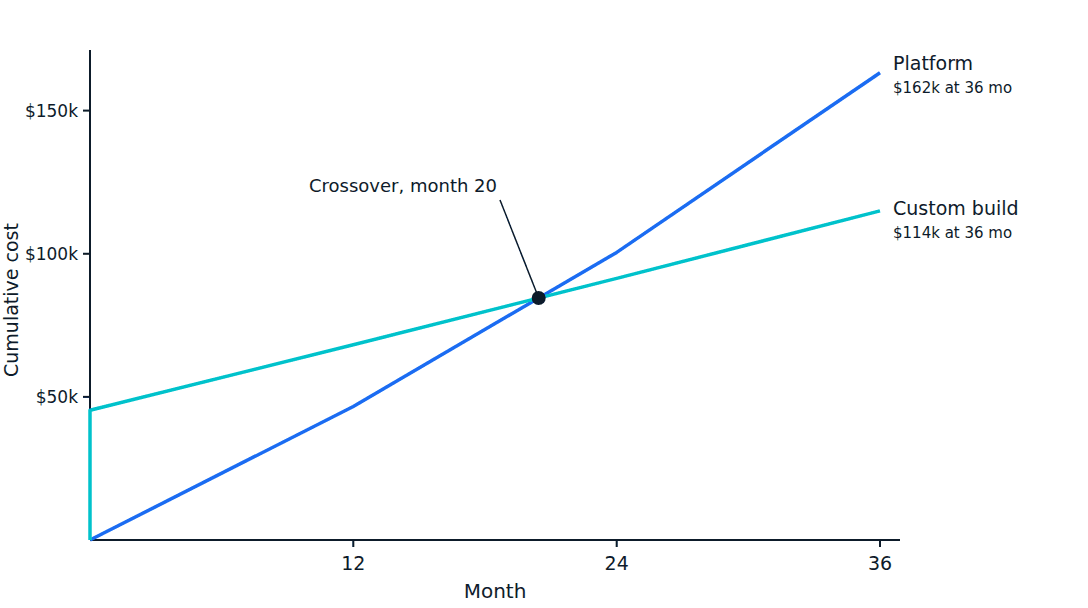
- Over 36 months the per-resolution platforms land near $162K. The custom build lands near $114K. Cumulative cost crosses around month 20.
- Below roughly 1,300 resolutions a month the lines never cross, and buying is the correct answer. We show that case too.
- The variable that decides this is resolution volume and its growth rate. Headcount barely matters.
- Every number below is an assumption you should replace with your own quote. The model is the deliverable, not our arithmetic.
Free scoping call
Turn your AI idea into a written plan
Tell us what you want AI to do. In 30 minutes we tell you plainly whether it will pay for itself, and what it would take to build.
Book a scoping call →The short answer
At 2,400 AI resolutions a month growing 25% a year, a per-resolution platform costs roughly $162,000 over three years and a custom agent roughly $114,000, with cumulative cost crossing in month 21. Below about 1,300 resolutions a month, the platform wins and never gives the lead back. Your crossover is set by two numbers: monthly resolution volume and growth rate. Substitute yours into the tables below.
The scenario, fixed for every option
A comparison is only useful if nothing moves between the columns. Here is what we held constant.
| Input | Value |
|---|---|
| Support agents (seats) | 15 |
| Inbound tickets per month | 4,000 |
| Share resolvable by AI | 60% |
| AI resolutions per month, year 1 | 2,400 |
| Annual volume growth | 25% |
| Modelled seat price | $99 per seat per month |
| Modelled per-resolution price | $0.99 |
| Time horizon | 36 months |
Two of these deserve a flag. The seat price and the per-resolution price are list-adjacent assumptions, not quotes. Both Intercom and Zendesk discount at volume and on annual commitments, sometimes heavily, and neither publishes what you will pay at 2,400 resolutions a month. If you have a real quote, put it in. The shape of the answer will not change; the crossover month will.
The 60% resolvable share is deliberately optimistic and matches what a well-tuned agent achieves on a mostly transactional queue. If your queue is more complex, that number falls, which pushes the crossover later and favours buying.
Option one: a per-resolution platform
The bill has two parts, and only one of them is predictable.
Year 1: 15 seats at $99 is $1,485 a month. 2,400 resolutions at $0.99 is $2,376 a month. Combined, $3,861 a month, or $46,332 for the year.
Year 2 at 25% growth: 3,000 resolutions a month. Seats stay at $1,485, resolutions rise to $2,970. That is $4,455 a month, or $53,460.
Year 3: 3,750 resolutions a month. $1,485 plus $3,712 is $5,197 a month, or $62,367.
Three-year total: $162,159.
Look at what happened between year one and year three. Seat cost never moved. Resolution cost grew 56%. You did not add a single feature or a single person, and your annual bill went up by $16,000, because the agent got busier. That is the model working exactly as designed.
Zendesk AI is structured the same way: a per-seat suite fee plus a per-automated-resolution charge. Swap the two rates and the arithmetic is identical. Which of the two is cheaper for you is a question about your negotiated rate, not about the products, which is why we are not going to pretend a list-price winner exists. Zendesk AI versus Intercom Fin versus a custom agent covers where they differ on capability, which is the more useful axis.
Option two: a custom agent
Four cost lines, and the one people forget is the biggest.
| Line | Year 1 | Year 2 | Year 3 |
|---|---|---|---|
| Build (one-time) | $45,000 | 0 | 0 |
| Model inference | $1,152 | $1,440 | $1,800 |
| Hosting and vector storage | $7,200 | $7,200 | $7,200 |
| Maintenance and tuning | $14,400 | $14,400 | $14,400 |
| Total | $67,752 | $23,040 | $23,400 |
Three-year total: $114,192.
Inference is the line everyone quotes and it is almost irrelevant: at roughly four cents a conversation, 2,400 resolutions a month costs about $96. Maintenance is twelve times larger. Someone has to keep the knowledge base current, review the escalations the agent got wrong, tune retrieval when answers drift, and ship the fix. Budget that as a real line or you will discover it in month four as an unplanned one. Custom AI agent cost breaks the build number down further.
Year one is where the build loses badly: $67,752 against $46,332. You are $21,000 behind after twelve months, and that is the number a CFO will point at. Year two is where it turns. The platform costs $4,455 a month and climbing; the build costs $1,920 a month and flat. The gap closes at $2,535 a month, which clears a $21,420 deficit in about eight and a half months. Crossover lands in month 20 or 21.
Where buying wins, and it is not close
Run the same model at a smaller desk: 5 agents, 800 tickets a month, 480 AI resolutions.
| Platform | Custom build | |
|---|---|---|
| Year 1 | $11,640 | $63,300 |
| Year 2 | $13,065 | $18,400 |
| Year 3 | $14,845 | $18,500 |
| 3-year total | $39,550 | $100,200 |
The build costs two and a half times more and never catches up, because the fixed cost alone is larger than the entire three-year subscription. There is no growth rate inside three years that rescues it.
This is the honest answer for most small teams, and it is why we tell a meaningful share of the people who ask us for a build to go buy a platform instead. If your resolution count is in the hundreds, a subscription is not a compromise. It is the correct answer, and the argument for a custom build at that scale is about control rather than cost. Say so out loud rather than dressing it up as savings.
Free scoping call
Turn your AI idea into a written plan
Tell us what you want AI to do. In 30 minutes we tell you plainly whether it will pay for itself, and what it would take to build.
Book a scoping call →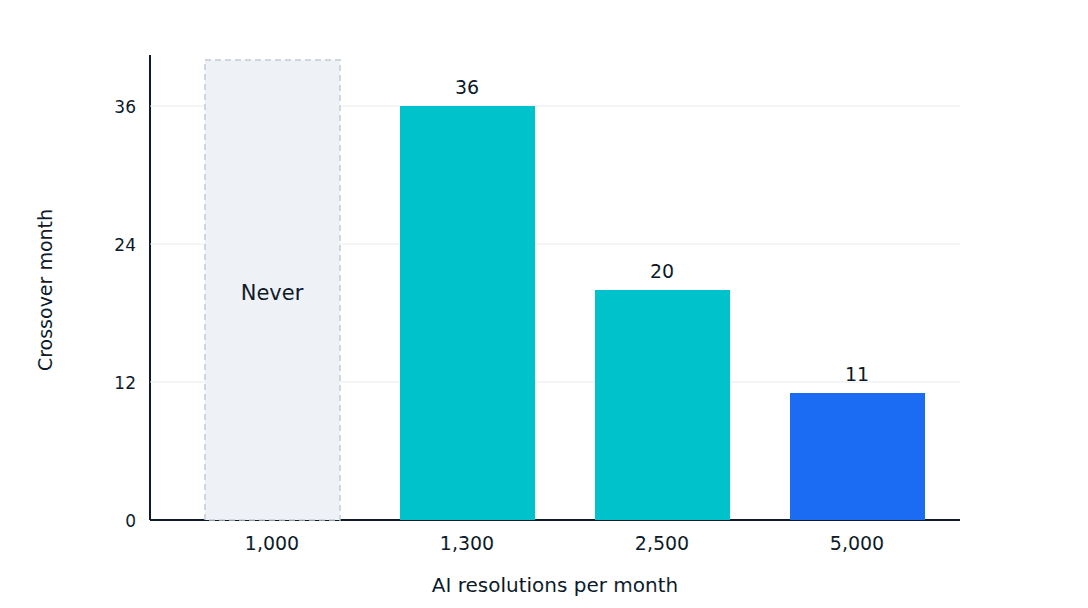
The four numbers that actually decide it
Everything above collapses to four inputs. If you change nothing else, get these right.
Monthly AI resolutions: not tickets. Resolutions the AI closes without a human. Pull the real figure from your current tool rather than estimating from deflection ambition.
Growth rate: a 10% grower and a 40% grower reach opposite conclusions from identical starting volume. Use the rate your business actually ran last year, not the one in the board deck.
Your negotiated per-resolution rate: get it in writing from both vendors with your projected volume attached. List price at scale is fiction.
Maintenance capacity: whether you will staff the ongoing tuning a custom system needs. If the answer is no, the build's cost advantage evaporates, because an unmaintained agent degrades and you end up paying for a rebuild.
Two things people put in the model that do not belong: seat count, which barely moves the answer in either direction, and headcount savings, which almost never materialise. Teams redeploy support staff onto retention and onboarding rather than removing them. That is usually the right operational call, and it means the AI line is additive rather than substitutive. Model it that way and you will not have to walk a number back later.
What we would actually recommend
Under 1,300 resolutions a month, buy. The math is not ambiguous and the flexibility is worth something on its own.
Between 1,300 and 2,500, it depends on your logic. If your queue is answerable from a knowledge base, keep buying. If a real slice of it needs the agent to read several systems and apply rules specific to your business, the platform ceiling will cost you more in unresolved tickets than the subscription saves. That is where building your own support agent earns its cost.
Above 2,500 and growing, the per-resolution model is working against you and the crossover arrives inside a normal budget cycle. That is the point where building becomes a finance decision rather than an engineering preference. If you are already on Fin, what actually breaks when you migrate off covers the exit sequence.
The bottom line
Per-resolution pricing is not a rip-off. It is a model that correctly matches cost to usage, which is exactly why it becomes expensive when usage is your growth story. A fixed build is not automatically cheaper either. It is a large payment up front in exchange for a flat line afterwards, and it only pays off if you stay long enough to reach the crossover and staff the maintenance that keeps it working.
The model in this post takes about twenty minutes to rebuild in a spreadsheet with your own numbers. That is a better use of an afternoon than reading another comparison table.
Next step: If you would rather not build the spreadsheet, a 20-minute scoping call is a good place to talk this model through against your actual resolution volume, growth rate, and vendor quotes. Or talk it through with us first.
At what ticket volume does a custom AI support agent beat Intercom Fin?+
In our modelled 15-agent scenario at 2,400 AI resolutions a month with 25% annual growth, cumulative cost crosses in month 20 or 21. Below roughly 1,300 resolutions a month, a per-resolution platform usually wins outright and never crosses, because the fixed build cost is larger than three years of subscription. The crossover is driven by resolution volume and growth rate, not by headcount, so run it with your own two numbers rather than borrowing ours.
Why does per-resolution pricing get more expensive as the agent improves?+
Because you are billed for success. Every ticket the agent resolves without a human is a billable event, so a deflection rate improvement from 50% to 70% raises your invoice rather than lowering it. Seat savings can offset this, but only if you reduce headcount, which most teams do not do. They redeploy the same people onto higher-value work, which is the right call operationally and means the AI line item is purely additive.
What ongoing costs does a custom AI agent actually have?+
Four lines: model inference, which usually runs in cents per conversation; hosting and vector storage; monitoring and evaluation tooling; and human maintenance to update the knowledge base, tune prompts, and fix regressions. In our model those totalled about $1,900 a month at 2,400 resolutions. Teams that budget only for inference are the ones who are surprised in month four, because maintenance is the largest of the four and the easiest to forget.
Is Zendesk AI cheaper than Intercom Fin?+
The structures are similar enough that the answer comes down to your negotiated rate rather than list price. Both bill a per-seat suite fee plus a per-automated-resolution charge, and both discount meaningfully at volume and on annual commitments. Get a written quote from each with your own projected resolution count, then substitute those numbers into the model in this post. Comparing published list prices is close to meaningless at any real scale.
Should I include the cost of my own team's time in the comparison?+
Yes, and most comparisons skip it. A custom build needs someone internally to own the knowledge base, review escalations, and sign off on releases. Budget a few hours a week. A platform needs that too, just less of it. Leaving internal time out of the model is the single most common way a build-versus-buy comparison ends up flattering the build.
Free scoping call
Turn your AI idea into a written plan
Tell us what you want AI to do. In 30 minutes we tell you plainly whether it will pay for itself, and what it would take to build.
Book a scoping call →About the author

- Tags
- ai agents
- customer support
- pricing
Subscribe to Our Newsletter
The AI Build Brief: practical playbooks on how to build, price and ship AI features, in one short email every other week.