

Support leaders get asked for a deflection number before they get asked anything else. It is the metric on every vendor slide, and it is the one metric you can improve by making your product worse. An agent that refuses to escalate deflects beautifully. Customers just leave and open a second ticket somewhere you are not counting.
TL;DR
- Deflection is a diagnostic, not a target. Track it against re-contact rate and CSAT or it will lie to you.
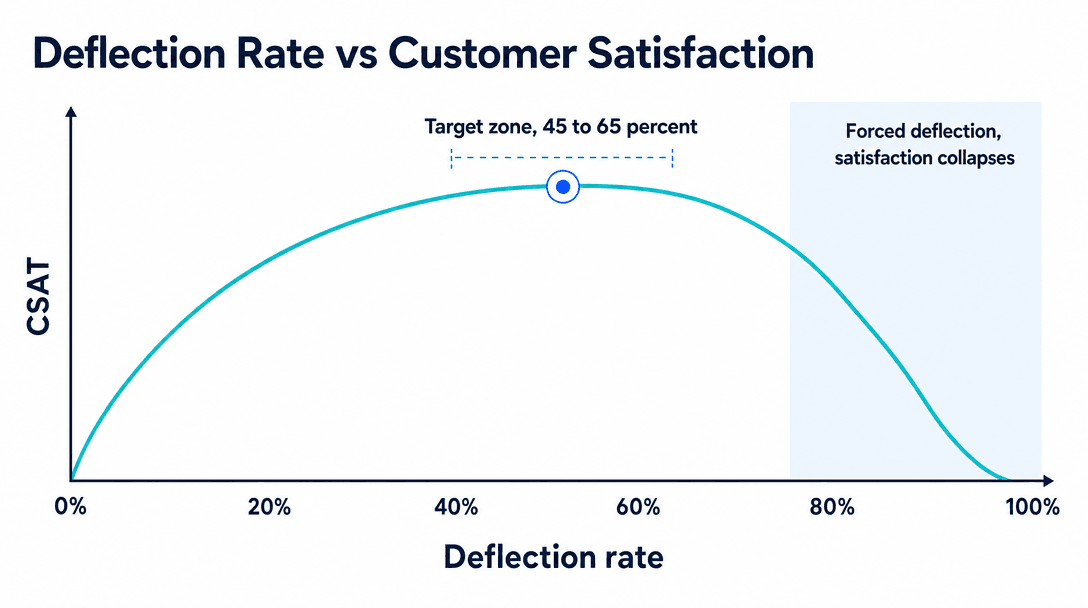
- 45-65% deflection is healthy for most SMB queues. Past ~70% you are usually suppressing escalation, not resolving more.
- Route by confidence into three lanes: resolve, draft for review, hand off. Not by topic.
- Put a hard escalation timer inside your SLA clock. A stuck agent looks active while it burns your first-response window.
- The handoff quality decides everything. Cheap escalation is what lets you tune the agent for honesty.
Free scoping call
Turn your AI idea into a written plan
Tell us what you want AI to do. In 30 minutes we tell you plainly whether it will pay for itself, and what it would take to build.
Book a scoping call →The short answer
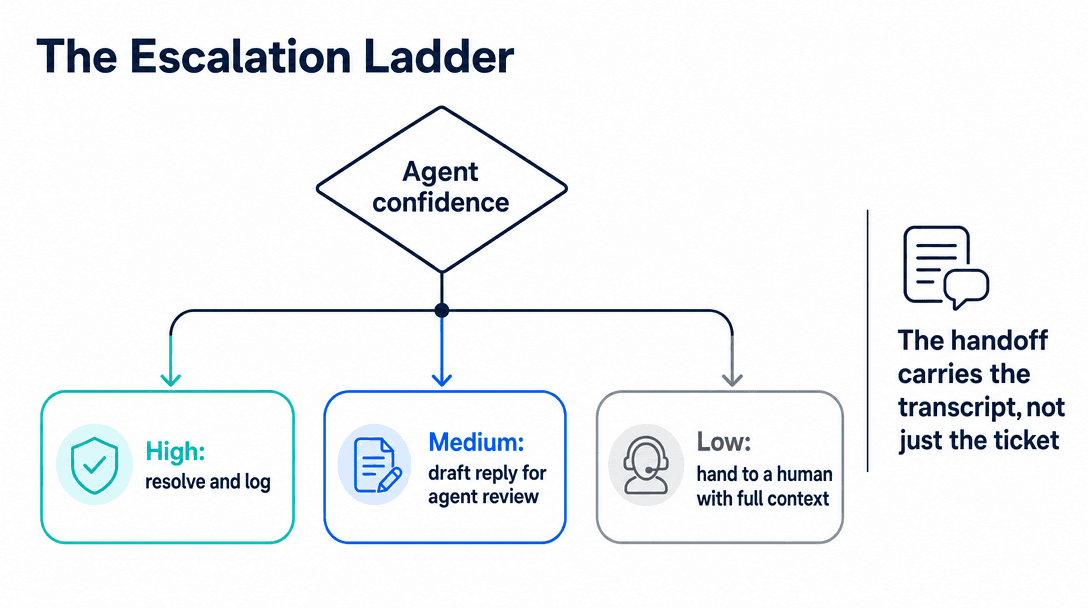
Design the agent around a confidence ladder, not a topic list. High confidence: resolve and log. Medium: draft a reply a human approves. Low: hand off immediately with the transcript, the agent's reading of the issue, and what it already tried. Add a hard escalation timer inside your existing SLA clock so a stuck conversation hands off automatically regardless of confidence. Target 45-65% deflection and watch it alongside re-contact rate and CSAT, because deflection can always be raised by making escalation harder. Budget $18K-$35K for a documentation-and-lookup agent, $35K-$70K once it takes actions.
Why deflection is the wrong thing to optimize
Deflection rate measures conversations that ended without a human. It says nothing about whether the customer's problem ended.
Three things raise deflection without helping anyone. The agent answers a question it should have escalated, and the customer accepts a wrong answer. The agent makes escalation slow or hidden, so people give up. Or the agent resolves the easy half of a two-part question and closes the conversation.
All three produce a better dashboard and a worse support operation, and you will not see it in the deflection number. You see it in re-contact rate, in CSAT on agent-handled conversations, and in the channel your customers switch to when chat stops helping.
The number worth optimizing is resolved-without-recontact within your SLA. That is harder to instrument and it is the only version that maps to what a support team is for.
The confidence ladder
Most support agents are designed around topics: this agent handles billing, escalate anything about refunds. Topic routing breaks because the customer does not know which topic they are in, and a single message often spans two.
Confidence routing works better. The agent scores how well the retrieved context supports an answer, and that score picks the lane.
High confidence. The answer is well supported by a current, authoritative document, and the question is inside scope. Resolve, log it, move on.
Medium confidence. The agent has an answer but the support is partial or the sources disagree. Draft the reply and put it in front of a human, who edits and sends. This lane is underused and it is where a lot of the value sits, because a good draft turns a five-minute reply into a thirty-second one without risking a wrong answer.
Low confidence. Hand off. No apology loop, no third attempt at rephrasing the question.
The medium lane is what makes the whole design work economically. Pure resolve-or-escalate systems force every borderline case into one of two expensive outcomes. A draft lane converts them into human speed-ups.
The SLA problem nobody plans for
The failure that catches teams out looks like this. Your first-response SLA is fifteen minutes. The agent picks up a conversation, tries four times, asks two clarifying questions, and escalates at minute eleven. The human queue now has four minutes to make a first response that customers will perceive as having taken eleven.
From the customer's side, the clock started when they wrote in. From your dashboard's side, the human's clock started at minute eleven. Those are different numbers, and only one of them is the one you will be judged on.
Two fixes. Measure the agent's time inside the same clock as the human queue, so your SLA reporting reflects the customer's experience. And set a hard escalation timer: if the agent has not resolved within a defined number of turns or seconds, it hands off automatically whatever its confidence says.
Set the timer below your SLA, not at it
If your first-response SLA is fifteen minutes, the agent's hard timer should sit around five. That leaves a real window for the human handoff. A timer set at the SLA boundary guarantees that every escalated conversation is already late.
The handoff is the whole design
An escalation that makes the customer start over is a punishment, and everyone involved learns from it. Customers learn to bypass the agent. Support staff learn to distrust it. And whoever tunes the thresholds learns to push them higher so escalations happen less often, which quietly reintroduces every wrong answer the confidence ladder was there to prevent.
A clean handoff carries four things: the full transcript, the agent's summary of what it understands the issue to be, what it already tried and ruled out, and any records it looked up. The human opens the ticket already oriented.
Done properly, a handoff makes the human faster than they would have been starting cold, because the diagnostic work is already visible. That is the point at which escalation stops being a failure and starts being a routing decision, and it is what lets you tune the agent toward saying "I don't know" instead of guessing.
For the guardrails that keep the agent honest inside the high-confidence lane, see how to prevent AI chatbot hallucinations.
Actions, and where to put the brakes
An agent that can only answer has capped value. Most support volume is not questions, it is requests: check my order, change my address, resend the invoice, cancel this. Those requests are where support agents that take actions earn their place.
Actions split into three risk tiers, and each needs a different rule.
Read-only lookups (order status, account details, shipment tracking) can run automatically at high confidence. The worst case is a wrong lookup, which the customer will correct.
Reversible writes (updating an address, resending a document, creating a ticket) should run automatically but log the prior value and post what changed into the conversation, so both the customer and any reviewing human can see it.
Irreversible or financial actions (refunds, cancellations, credits) belong behind a human approval or a hard cap. A refund under a threshold with a clear policy match is a reasonable candidate for automation; anything above it is not, and the cost of getting that wrong is not symmetric with the time saved.
What most people get wrong
Launching on the whole queue. A support agent should start on one channel or one slice of traffic, because real customers ask things no test set anticipated, and you want to meet those at a volume your team can still absorb manually.
Treating content as done. The agent is exactly as accurate as the documentation it reads. Support content drifts constantly, and a bot that was right in March is quietly wrong by September unless someone owns the index. This is the most common reason agents that launched well stop working, and it is a content ownership problem rather than a technical one.
Measuring only the agent. Compare against your human baseline on the same queries: what was your resolution time and CSAT before? Without that, a 4.1 CSAT on agent conversations means nothing, because your humans might have been at 4.6 or at 3.8.
Skipping the draft lane. Teams build resolve-or-escalate and lose the cheapest win in the whole system.
Cost and timeline
A support agent answering from documentation with one system lookup runs $18K to $35K and takes six to ten weeks. Running cost sits around $300 to $900 a month at moderate volume.
Adding actions, approval steps and multi-system access pushes it to $35K to $70K over ten to sixteen weeks.
Budget the ongoing work too. Content maintenance and evaluation runs a few hours a month, and it is not optional. The chatbot maintenance cost breakdown covers what that looks like as a line item, and custom AI agent cost covers how build ranges move with scope.
Free scoping call
Turn your AI idea into a written plan
Tell us what you want AI to do. In 30 minutes we tell you plainly whether it will pay for itself, and what it would take to build.
Book a scoping call →The bottom line
Build the confidence ladder before you build anything else, and put the draft lane in it. Set a hard escalation timer inside your existing SLA clock so a stuck agent cannot eat your first-response window while looking busy. Make the handoff carry the transcript and the agent's reasoning, because cheap escalation is the thing that lets you tune for honesty instead of for a deflection target. Then watch deflection next to re-contact rate and CSAT, and treat any deflection number above roughly 70 percent as a question rather than an achievement.
Next step: For the reliability layer underneath all of this, read preventing AI chatbot hallucinations. If you want deflection and SLA risk modelled against your own ticket data before committing to a build, that is what a 20-minute scoping call produces.
What is an AI agent for customer support?+
A support agent is an AI system that handles incoming customer conversations end to end where it can, and hands the rest to a human with full context. Unlike a scripted chatbot, it decides what to do at each turn: look something up, ask a clarifying question, resolve the issue, or escalate. The difference that matters operationally is that it can take actions, such as checking an order or creating a ticket, rather than only describing how the customer could do it themselves.
What deflection rate should an AI support agent achieve?+
For most SMB support queues, 45 to 65 percent is a healthy target, and pushing much past that usually costs you customer satisfaction. Deflection above roughly 70 percent generally means the agent is answering questions it should have escalated, which produces resolved-looking tickets and unhappy customers who re-contact through another channel. Track deflection alongside re-contact rate and CSAT, because deflection on its own can be raised by making escalation harder, which is not an improvement.
How do you stop an AI support agent from breaking your SLA?+
Measure the agent's time inside the same clock as your human queue and set a hard escalation timer. If the agent has not resolved a conversation within a defined number of turns or seconds, it hands off automatically regardless of its confidence. Without that timer, a stuck agent silently consumes your entire first-response window while looking active, which is how SLAs get missed by systems that appear to be working.
What should an AI agent do when it cannot resolve a ticket?+
Escalate with the full context attached: the conversation transcript, its own reading of the issue, what it already tried, and any records it looked up. The failure to avoid is a handoff where the customer starts over with an agent who cannot see the conversation. A clean handoff is what makes escalation cheap, and cheap escalation is what lets you tune the agent for honesty rather than for a deflection number.
How much does an AI customer support agent cost to build?+
A support agent answering from documentation with one system integration typically runs $18K to $35K to build and $300 to $900 a month to run at moderate volume. Adding actions such as order lookups, refunds or ticket creation with approval steps pushes the build to $35K to $70K. Ongoing evaluation and content maintenance is a real line item, usually a few hours a month, and skipping it is why agents that launched well degrade within two quarters.
Free scoping call
Turn your AI idea into a written plan
Tell us what you want AI to do. In 30 minutes we tell you plainly whether it will pay for itself, and what it would take to build.
Book a scoping call →About the author

- Tags
- ai agents
- customer support
Subscribe to Our Newsletter
The AI Build Brief: practical playbooks on how to build, price and ship AI features, in one short email every other week.