

A support bot that is wrong 2% of the time sounds acceptable until you look at which 2%. It is almost never the easy questions. It is the refund policy, the contract term, the compatibility question. Those are the answers customers act on. A hallucination is not a quality problem in the abstract; it is a wrong commitment made in your company's voice, in writing, to a customer who will hold you to it.
TL;DR
- Most production hallucinations are content and retrieval failures, not model failures. Swapping models rarely fixes them.
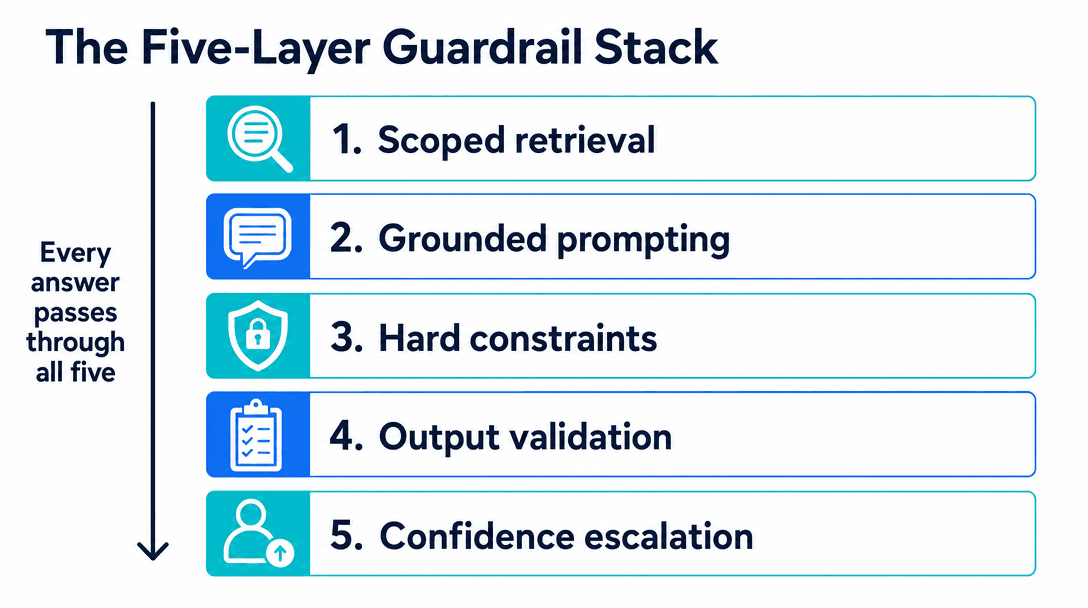
- Five guardrails do the real work: scoped retrieval, grounded prompting, hard constraints, output validation, and confidence-based escalation.
- The strongest single predictor of a reliable bot is whether it will say "I don't know," so test that explicitly.
- You cannot eliminate hallucinations. You can make them rare, harmless, and visible, which is the actual engineering goal.
- Budget for evaluation. A fixed test set of 100-300 real questions, run on every change, is what separates a bot that stays reliable from one that quietly degrades.
Free scoping call
Turn your AI idea into a written plan
Tell us what you want AI to do. In 30 minutes we tell you plainly whether it will pay for itself, and what it would take to build.
Book a scoping call →The short answer
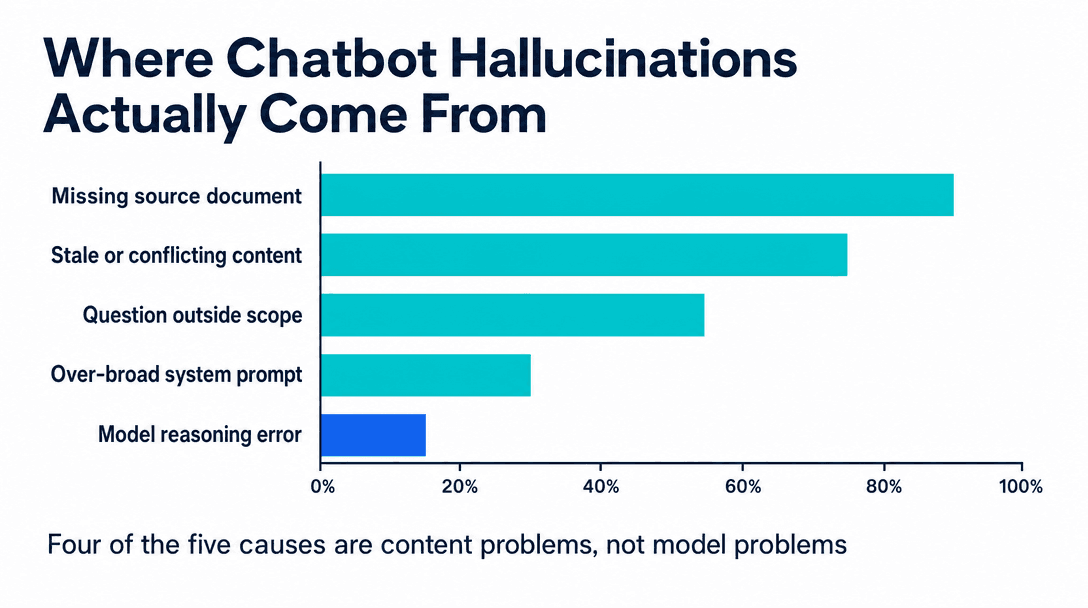
Chatbot hallucinations are prevented with a five-layer stack, not a better model. Scoped retrieval limits what the bot can read. Grounded prompting forces answers to cite retrieved content. Hard constraints block whole categories of response: prices, legal terms, medical guidance. Output validation checks the answer against the source before it ships. Confidence escalation routes anything uncertain to a human with the full transcript. Four of the five most common causes are content problems: a missing document, two contradicting documents, a question outside scope, or an over-broad system prompt. Fix the content layer first. It is cheaper, and it removes more failures than any model change.
Where hallucinations come from
The word "hallucination" makes this sound like a mysterious property of language models. In production, the causes are mundane and mostly traceable.
The answer does not exist anywhere the bot can reach. A customer asks about a policy that lives in a Slack thread from eighteen months ago. Nothing in the indexed content covers it. The model, asked a direct question with no grounding, produces the most plausible-sounding answer, which is a guess wearing a confident tone.
Two documents disagree. The help center says 30-day returns. The terms page says 14 days. Nobody noticed, because no human ever read both in the same minute. The bot retrieves one, answers from it, and is now wrong half the time depending on which chunk ranked higher.
The question is outside scope and nothing stops it. A support bot gets asked for tax advice, or whether a product is safe for a medical condition. Without an explicit refusal path, it will try, because trying is what it was built to do.
The system prompt is too permissive. "You are a helpful assistant for Acme Corp" is an instruction to be helpful, and a model interpreting that instruction will read "I don't know" as failure. Helpfulness and accuracy are in tension, and the prompt decides which one wins.
Model reasoning errors, where the bot has the right document and still gets it wrong, exist. They are the smallest slice. Which matters commercially, because content problems are far cheaper to fix than model problems.
Layer 1: Scope what the bot can read
The first and cheapest guardrail is subtraction. Most teams index everything they have: the help center, the blog, old PDFs, the marketing site. The theory is that more context means better answers. It usually means the opposite.
A marketing page written in 2024 promising "unlimited storage on every plan" is not context. It is a landmine. When retrieval pulls it into an answer about current plan limits, the bot is not hallucinating in any interesting sense; it is faithfully reporting a document you told it to trust.
Index deliberately. Every source gets an owner, a last-reviewed date, and a decision about whether it is authoritative for customer-facing answers. Anything that fails those three tests comes out of the index. This one pass typically removes more failure modes than any prompt tuning that follows it, and it costs a person a day.
The RAG vs fine-tuning breakdown covers why retrieval, rather than training, is the right place to solve this for almost every business.
Layer 2: Ground the prompt so answers must trace to a source
Grounding means the bot answers from retrieved content rather than about a topic. The difference shows up in the instruction.
A weak instruction tells the model what it is. A strong instruction tells the model what it may use, and what to do when that runs out: answer only from the provided documents, quote or reference the source, and if the documents do not contain the answer, say so and escalate rather than infer.
That last clause is the one that does the work. It converts "I don't know" from a failure into the correct output for a specific, named condition. Without it, the model is optimizing for a helpful-sounding reply, and a helpful-sounding reply to a question it cannot answer is exactly a hallucination.
Two details matter in practice. Ask for the source alongside the answer, even if you never show it to the customer. It makes wrong answers auditable after the fact. And keep the retrieved context tight; stuffing twenty marginally relevant chunks into the window gives the model more raw material to blend into something that was in none of them.
Layer 3: Hard constraints on categories that must never be guessed
Some answers should not be generated at all, however good the retrieval is. These are the answers where being wrong is expensive in a way no apology fixes.
For most businesses the list is short and obvious once you write it down: specific prices and discounts, contract and liability terms, refund eligibility for an individual account, anything with a regulatory dimension, and any commitment about a delivery date. For these, the bot should retrieve a canonical fixed response or escalate. It should never compose.
This is deliberately blunt. A constraint layer is not clever, and it will occasionally refuse something the bot could have answered correctly. That is the trade: you accept a slightly higher escalation rate in exchange for removing the categories where a hallucination becomes a legal or financial problem rather than an annoyance.
The pattern to watch for
The most damaging hallucinations in production are rarely factual errors on their own. They are fabricated commitments: a discount the bot invented, a return window it rounded up, a compatibility guarantee it inferred. If a category of answer could be quoted back to you in a dispute, it belongs behind a hard constraint.
Layer 4: Validate the output before the customer sees it
Layers 1 to 3 shape the answer. Layer 4 checks it.
Simple validation catches a lot. Does the answer contain a number, date, or price that does not appear in any retrieved chunk? Flag it. Does it reference a product or feature name not in your catalog? Flag it. Does it exceed a length that suggests the model started elaborating past its source? Flag it.
More thorough setups run a second model pass whose only job is to check the answer against the retrieved context and return a supported/unsupported verdict. That adds latency and cost per conversation, so it is usually reserved for high-stakes categories rather than applied to every "what are your hours" exchange.
The point of this layer is not to catch everything. It is to catch the class of failure where the bot produced a specific, checkable claim that its own sources do not support. That is both the most common damaging hallucination and the easiest one to detect mechanically.
Layer 5: Escalate on low confidence, and make escalation good
The final layer accepts that the first four will not be perfect and decides what happens when they are not.
Route by confidence into three lanes. High confidence: answer and log. Medium: draft the answer but put it in front of a human before it sends. Low: hand to a person immediately.
The part teams get wrong is the quality of the handoff. If escalation means the customer starts over with an agent who cannot see the conversation, escalation is a punishment, and the bot will be tuned to avoid it, quietly reintroducing every failure the other four layers removed. A good handoff carries the transcript, the bot's read of the question, and what it already tried. Done properly, escalation becomes cheap enough that the bot can afford to be honest.
Ongoing tuning of these thresholds is real work, and it is a line item people forget when budgeting. The chatbot maintenance cost breakdown covers what that costs monthly.
What most people get wrong
The default reaction to a hallucination is to change the model. A bigger model, a newer version, a different vendor. It feels like the direct fix, and it is nearly always the wrong first move.
If the answer was not in your index, no model finds it. If two documents contradict, a better model picks one more eloquently. If the system prompt rewards helpfulness over accuracy, a more capable model follows that instruction more effectively. Model upgrades fix reasoning errors, which are the smallest category, and they cost more per conversation while doing it.
The second mistake is treating reliability as a launch milestone rather than a running property. A bot that was accurate in March is not automatically accurate in September, because your content changed, your products changed, and nobody re-ran the tests. Reliability decays silently, and the first signal is usually a customer complaint rather than a dashboard.
How to test for this before it reaches a customer
Build a fixed evaluation set. One hundred to three hundred real questions, pulled from actual support tickets rather than invented in a planning meeting, each with a known correct answer.
Deliberately include a slice of twenty or thirty questions the bot should not be able to answer. Out of scope, not in the documentation, or requiring information no one has written down. This slice is the most informative part of the whole set, because a bot's willingness to decline is the strongest single predictor of how it will behave on the day it meets a question nobody anticipated.
Score every answer as correct, incomplete, or fabricated. Incomplete is acceptable and often fine. Fabricated on the unanswerable slice is a release blocker, not a backlog item.
Then run the whole set on every content change, prompt change, and model change, not just at launch. This is the piece that keeps the bot honest six months later, and it takes minutes once it exists.
The bottom line
Hallucinations are an engineering problem with mostly unglamorous solutions. Scope what the bot reads, force it to answer from what it read, block the categories where guessing is expensive, check the output against the source, and make escalation good enough that the bot can afford to admit uncertainty. Do not start with the model. Start with the index, because that is where most of your failures live. And build the evaluation set before launch, because it is the only thing that will tell you when a bot that used to be reliable stopped being reliable.
Next step: If you're running a bot now and don't know its real hallucination rate, that's the first number worth having, and a 20-minute scoping call measures it against your own transcripts. For what a reliability-first build involves, see AI chatbot development.
What causes AI chatbot hallucinations?+
Most production hallucinations are content problems rather than model problems. The four most common causes are: the answer does not exist in any document the bot can reach, so it fills the gap; two documents contradict each other and the bot picks one; the question falls outside the bot's intended scope and nothing stops it from trying; or the system prompt is written so broadly that the bot believes answering is always better than declining. Pure model reasoning errors happen, but they are a smaller share than most teams assume.
Can you eliminate AI hallucinations completely?+
No, and any vendor who promises zero hallucinations is describing a system that has not been tested at volume. What you can do is make hallucinations rare, cheap, and visible: rare through scoped retrieval and grounded prompting, cheap by making sure the bot cannot take a damaging action on a wrong answer, and visible through logging and confidence scoring so you find failures before customers do. Reliability engineering, not elimination, is the realistic goal.
Does RAG stop hallucinations?+
Retrieval-augmented generation reduces hallucinations substantially but does not stop them. RAG grounds the answer in your documents, which fixes the largest category of failure: the model inventing facts it never had. It does not help when the retrieved document is wrong, outdated, or contradicts another document, and it does not stop the model from adding unsupported detail around a correct retrieved fact. RAG is the foundation, not the whole answer.
How do you test an AI chatbot for hallucinations before launch?+
Build a fixed evaluation set of 100 to 300 real questions with known correct answers, drawn from actual support tickets rather than imagined ones. Include a deliberate slice of unanswerable and out-of-scope questions, because the bot's willingness to say 'I don't know' is the single most predictive reliability signal. Run the full set on every change, score answers as correct, incomplete, or fabricated, and treat any fabricated answer on the out-of-scope slice as a release blocker.
What should an AI chatbot do when it doesn't know the answer?+
It should say so plainly and hand off with context. A good escalation passes the full conversation transcript and the bot's best understanding of the question to a human, so the customer does not have to repeat themselves. The failure mode to design against is a bot that treats declining as a loss and produces a confident guess instead. Make the escalation path cheap and fast enough that saying 'I don't know' is never the worse option for the customer.
Free scoping call
Turn your AI idea into a written plan
Tell us what you want AI to do. In 30 minutes we tell you plainly whether it will pay for itself, and what it would take to build.
Book a scoping call →About the author

- Tags
- chatbots
- reliability
Subscribe to Our Newsletter
The AI Build Brief: practical playbooks on how to build, price and ship AI features, in one short email every other week.