

You built it in a weekend and it worked. That is the whole appeal of a no-code builder, and it is a real one. Then the bot became something the business depends on, and the same quality that made it fast to build made it hard to fix. Somebody changed a flow last month and nobody knows which one. A customer got an answer nobody can explain. The one integration you actually need does not exist, so there are now three services glued around the outside holding it together.
TL;DR
- The ceiling is not about features. It is about version control, evaluation, retrieval visibility, and integration depth, none of which no-code builders were designed to provide.
- The clearest signal is time spent working around the tool exceeding time spent building in it.
- Your flow exports are documentation, not something you import elsewhere. Plan to rebuild logic, not migrate it.
- Rebuilding is usually cheaper than the original build, because you already know your intents and edge cases.
- If your bot answers FAQs at modest volume and takes no actions, stay. The ceiling only exists if you are pushing against it.
Free scoping call
Turn your AI idea into a written plan
Tell us what you want AI to do. In 30 minutes we tell you plainly whether it will pay for itself, and what it would take to build.
Book a scoping call →The short answer
You have outgrown a no-code builder when the tool becomes the constraint rather than the accelerator. Watch for four specific failures: no rollback when a change goes wrong, no evidence that a change helped, no visibility into why the bot answered as it did, and no clean path to take authenticated actions in your own systems. One of those is survivable. Three together mean the workarounds now cost more than a rebuild would.
The six signs you have hit the ceiling
Nobody can roll back. Someone edited a flow, quality dropped, and there is no diff to read and no previous version to restore. You are reconstructing last week's configuration from memory. Software solved this problem decades ago, and most builders still do not offer it in any form you would recognise.
You cannot prove a change helped. You adjusted a prompt and the answers feel better. Feel is the only instrument you have. Without a fixed set of test conversations you re-run after every change, every edit is a gamble you find out about from customers.
A fix in one place breaks another. Classic regression, and it goes undetected because there is no test suite. Support tells you in week three.
You cannot see why it answered. The bot gave a wrong answer confidently. Which document did it retrieve? What was in the context window? Most builders show you the conversation and not the reasoning path, which turns debugging into guesswork. This is the same failure mode we cover in preventing AI hallucinations, and it is much harder to fix from inside a closed tool.
The integration you need does not exist. Reading data is usually fine. Writing is where it falls apart: creating a ticket with the right ownership, updating a record behind an authenticated API, or applying a rule that depends on two systems agreeing. The workaround is a webhook into an automation service into a second automation service, and now you have a distributed system nobody designed.
Cost stopped tracking value. Per-message or per-contact pricing is cheap at pilot volume. At real volume, teams often find they are paying platform rates for what is mostly model inference they could buy directly for a fraction.
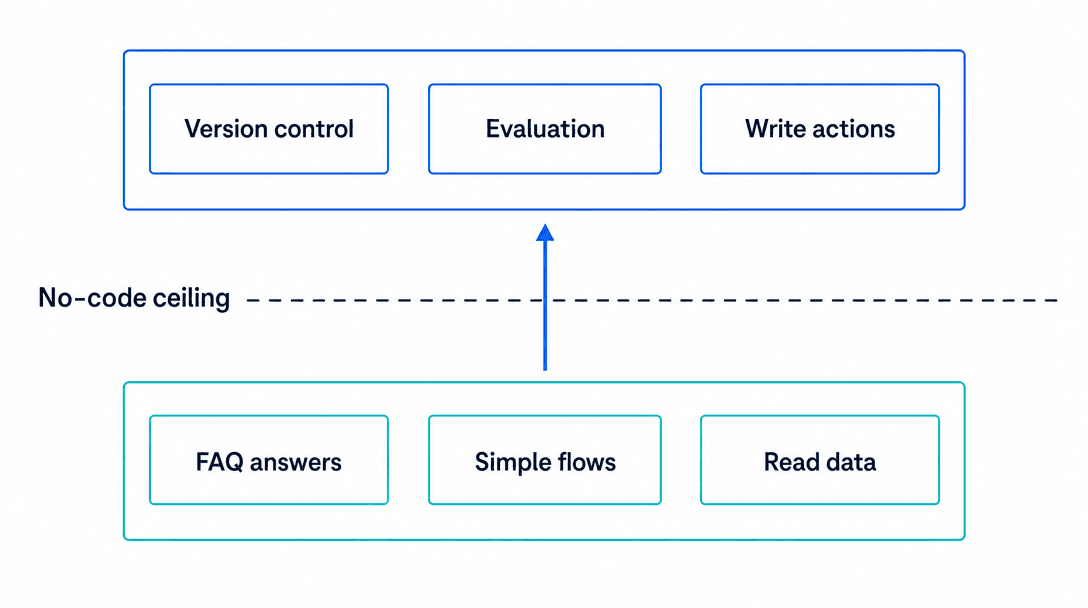
What is actually missing under the hood
Four things, and they are all infrastructure rather than features. This is why "wait for the roadmap" rarely resolves it: these are architectural choices, not gaps.
| Capability | No-code builder | What you need at scale |
|---|---|---|
| Version control | Manual duplicates, if any | Git history, diffs, rollback |
| Evaluation | Manual spot checks | Fixed test set re-run on every change |
| Retrieval visibility | Answer only | Which chunks, what scores, what context |
| Writes into your systems | Webhook plus glue | Authenticated calls with error handling |
| Conversation data | Vendor account | Your database, your retention rules |
| Model choice | Whatever is offered | Whatever fits the task and budget |
The last row matters more than it looks. Routing simple classification to a cheap fast model and hard reasoning to a stronger one is where much of the cost advantage of owning your stack comes from, and it is exactly the control a closed builder cannot hand you.
Your three options
Stay and add guardrails. Put the knowledge base under version control even if the flows cannot be. Write a fixed list of thirty test questions and run them manually before every release. This is unglamorous and it buys you real months. Do this first regardless of what you decide next, because it also produces the evaluation set you will need if you do rebuild.
Move to a support platform. If your bot is essentially customer support, a platform like Intercom or Zendesk gives you a more mature version of the same trade. You will still be renting, and you will still hit a ceiling, but it will be a higher one with better tooling. Chatbot versus conversational AI platform covers the distinction, and the three-year cost comparison covers what that costs at volume.
Rebuild as a custom agent. The right call when your bot takes actions, when the logic is specific to how your business works, or when the workaround stack has become its own maintenance burden. Build versus buy is the general framing. Custom AI agent cost and how long it takes to build cover the two questions people ask next.
What migrating actually involves
Start with an honest inventory. Every intent the bot handles, every integration it touches, every flow that exists. Most teams find at least one flow nobody remembers building and one that has been broken for months without anyone noticing.
Export your conversation logs, and do it early. Those logs are the most valuable asset in the whole migration, because they are your evaluation set. A few hundred real conversations, labelled for whether the bot got it right, tells you exactly what the replacement has to beat. Building that set from scratch afterwards takes weeks.
Then accept that you are rebuilding rather than porting. Flow exports describe structure, not behaviour. The tuning that made the thing work lives in prompt wording, retrieval settings, and a dozen small decisions that do not survive a file format. Document the logic in plain language, one rule per line, and rebuild from the document.
Reconnect integrations one at a time and test each with a real record. This is where the workaround stack pays you back, because dismantling it is how you discover what it was actually doing.
Free scoping call
Turn your AI idea into a written plan
Tell us what you want AI to do. In 30 minutes we tell you plainly whether it will pay for itself, and what it would take to build.
Book a scoping call →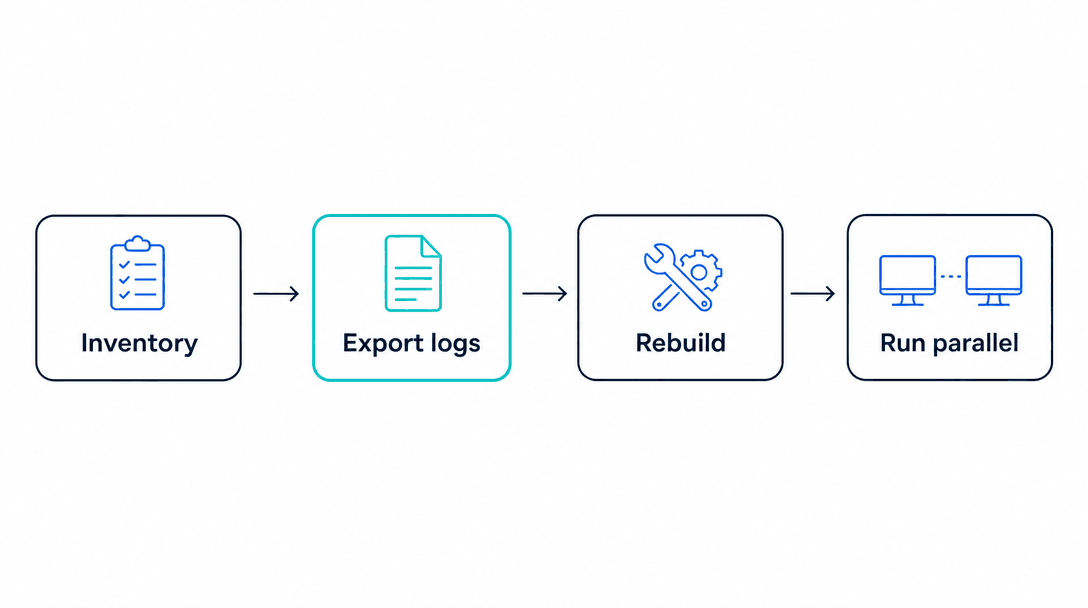
When staying put is the right answer
A no-code builder is a good tool for a large category of problem, and this post should not be read as a case against them.
If your bot answers questions that have answers in a document, handles a few hundred conversations a month, and never needs to change anything in another system, you have not outgrown anything. Rebuilding would cost more and give you a bot that does the same job with more moving parts. That is a downgrade wearing an engineering budget.
The same applies if the bot is a pilot. The point of a pilot is to find out whether the problem is worth solving, and a no-code builder answers that faster and cheaper than anything else available. Reach for a custom build after the pilot proves the case, which is the sequence we walk through in taking an AI pilot to production.
The ceiling only exists if you are pushing against it. Most teams who move are moving because their bot started doing real operational work, and the tool that was perfect for a weekend project turned out to be the wrong shape for infrastructure.
The bottom line
The question is not whether your builder is good. It is whether the bot has become something your business depends on. Dependence changes the requirements: you need to roll back a bad change, prove a good one worked, explain a wrong answer, and take actions inside your own systems without three intermediaries.
If you are there, do the guardrail work first. Version the knowledge base, build the test set from your real logs, and see how much of the pain that removes. It sometimes removes enough. When it does not, you will have already produced the two artifacts a rebuild needs most, and the migration will be shorter for it.
Next step: If you want an outside read on whether your bot has actually hit a ceiling or just needs better guardrails, tell us what it does today and we will tell you which one it is. If you already know it is a rebuild, the AI agent development page covers how we scope them.
What are the main limitations of no-code chatbot builders?+
Five come up repeatedly: no version control, so you cannot see who changed what or roll back a bad edit; no evaluation harness, so you cannot prove a change improved anything; opaque retrieval, so when the bot answers wrong you cannot see which document it pulled; shallow integrations, which handle reads well but struggle with authenticated writes into your systems; and conversation data that lives in the vendor's account rather than yours. None of these matter for an FAQ bot. All of them matter once the bot takes actions.
When should I move off a no-code chatbot platform?+
When you are spending more time working around the tool than building with it. Concretely: when a needed change is impossible rather than fiddly, when nobody can explain why the bot answered something, when a fix for one flow breaks another and you find out from a customer, or when the workaround stack has grown to several external services glued around the builder. One of these is a bad week. Three at once is a ceiling.
Can I export my flows from Voiceflow or Botpress?+
You can usually export flow definitions and conversation logs in some machine-readable form, and both have APIs. What does not export is the behaviour, because the flow file describes structure rather than the tuning that made it work. Plan to export the logs for evaluation data, document the flow logic in plain language, and treat the export as reference material rather than something you can import elsewhere and run.
Is moving from a no-code builder to a custom agent expensive?+
The rebuild is usually cheaper than the first build was, because the hard thinking is already done. You know your intents, your edge cases, and where the bot fails, and that knowledge is most of the work. What you are paying for is engineering time to rebuild retrieval, reconnect integrations properly, and add the version control and evaluation layer the builder never had. Four to twelve weeks is the normal range depending on integration depth.
Should everyone eventually move off no-code chatbot tools?+
No. If your bot answers questions from a knowledge base, handles modest volume, and rarely needs to take an action inside another system, a no-code builder is the right tool and will stay the right tool. The ceiling only exists if you are trying to reach past it. Most teams that move are moving because the bot started doing real operational work, not because the platform got worse.
Free scoping call
Turn your AI idea into a written plan
Tell us what you want AI to do. In 30 minutes we tell you plainly whether it will pay for itself, and what it would take to build.
Book a scoping call →About the author

- Tags
- chatbots
- ai agents
- migration
Subscribe to Our Newsletter
The AI Build Brief: practical playbooks on how to build, price and ship AI features, in one short email every other week.