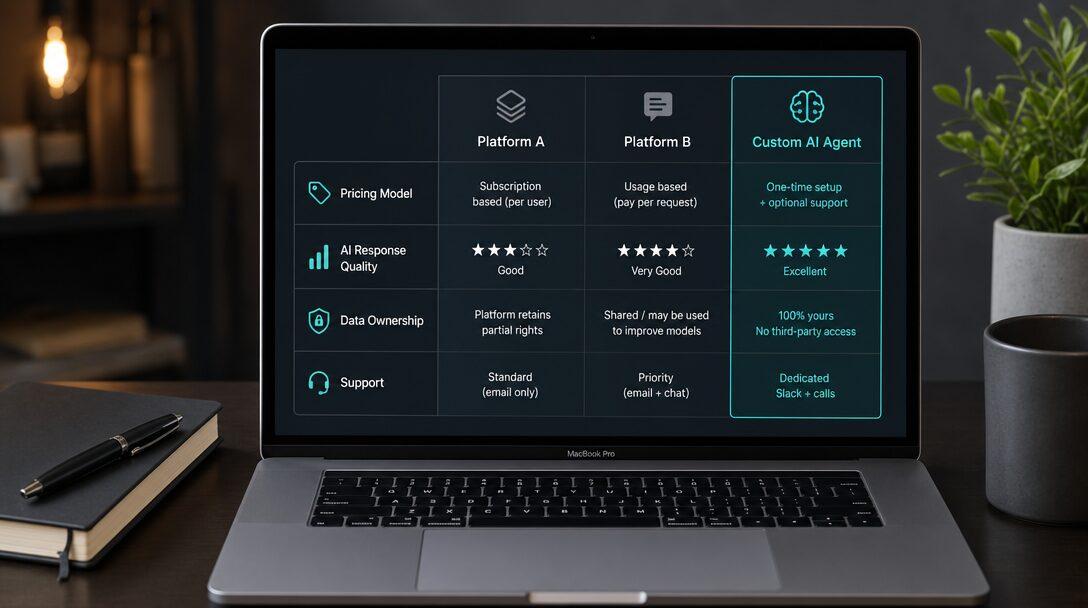

Both Zendesk and Intercom now sell competent AI support agents, and the comparison people actually run is the wrong one. The question is rarely which AI answers better, because both are good. It is which pricing model survives your growth, and whether your support is mostly answering questions or mostly doing things.
TL;DR
- Zendesk AI is ticket-native and makes agents faster. Intercom Fin is conversation-native and removes conversations entirely. Different business cases.
- The AI quality gap between them is small. The pricing-model gap is large and compounds over years.
- Fin's per-resolution pricing is cheap at low volume and scales forever. Zendesk's seat-plus-AI blend is predictable but you pay regardless of performance.
- A custom agent wins on two or more of: sustained high volume, action-heavy tickets, unusual logic. On none of them, buy.
- Switching later costs more than either vendor implies, because automation logic and tuning do not migrate.
- Neither reliably cuts headcount in year one. Both let you absorb growth without adding it.
The short answer
Pick the AI that matches your system of record, not the one that demos best. If your support runs on structured tickets with SLAs, Zendesk. If it runs on live chat and you want conversations gone rather than faster, Intercom Fin. Build custom only when volume, actions, or logic force it. This post compares two live suites; if you are migrating off a sunsetting vendor, the Drift comparison is the closer fit.
The real axis: ticket-native vs conversation-native
Zendesk and Intercom did not converge on AI from the same place, and their architecture still shows.
Zendesk grew up around the ticket. A structured object with a status, an assignee, an SLA, a priority, and a queue. Its AI is strongest at things that operate on that structure: classifying intent on arrival, routing to the right team, summarising a long thread for the agent picking it up, suggesting a reply, detecting sentiment for escalation. The centre of gravity is making a human agent faster and better informed.
Intercom grew up around the conversation. A live messenger where a customer expects an answer now. Fin is strongest at resolving a question end to end without a human ever entering the thread. The centre of gravity is removing the conversation from the queue entirely.
This distinction predicts most of what follows. If your support model is a structured queue with SLAs, tiering, and specialist teams, Zendesk's shape fits and Fin will feel like it is fighting your process. If your support model is chat-first and volume-heavy with a long tail of repeat questions, Fin's shape fits and Zendesk's AI will feel like an assistant when you wanted a replacement.
Neither is better. They are answers to different questions.
Head to head
| Zendesk AI | Intercom Fin | Custom AI agent | |
|---|---|---|---|
| Best at | Triage, routing, agent assist, summarisation | End-to-end resolution in chat | Whatever you scope it to |
| Pricing shape | Per seat + AI add-ons and resolution components | ~$0.99 per resolution + seat plans | Fixed build + your own running cost |
| Cost at low volume | Moderate, seat-driven | Low | Poor - build cost dominates |
| Cost at high volume | Predictable but seat-heavy | Scales linearly, no ceiling | Best - fixed cost amortises |
| Taking actions in your systems | Good within Zendesk, custom work beyond | Limited without engineering | Strongest - it is the point |
| Time to value | Days to weeks | Under a day to start | 4-10 weeks |
| Ownership | Vendor | Vendor | Yours |
| Lock-in risk | High - suite is system of record | High - inbox is system of record | Low |
Where the pricing models diverge
This is the part worth modelling before you sign anything, because it is the difference that grows.
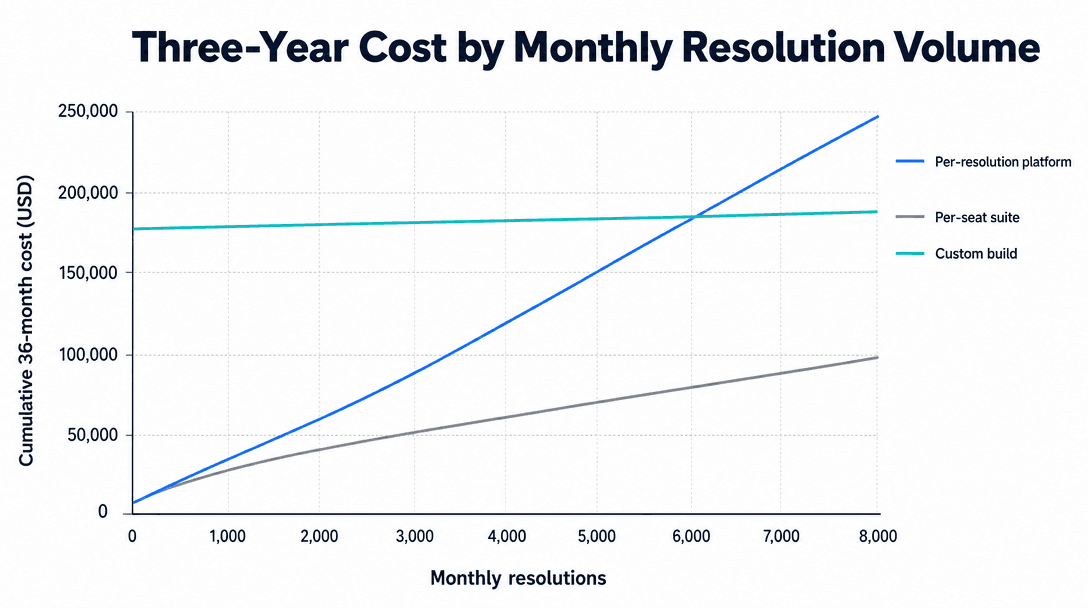
Intercom Fin charges roughly $0.99 per resolution on top of seat plans. The appeal is obvious: no build cost, and you only pay when it works. The problem appears at scale. Every improvement in performance raises your bill, and the line never bends. A team at 800 resolutions a month pays around $790. The same team at 6,000 pays around $5,940, or roughly $71,000 a year, and there is no volume ceiling that changes the shape. We modelled that in detail in what $0.99 per resolution actually costs.
Zendesk blends per-seat licensing with AI capabilities sold as add-ons and, increasingly, resolution-based components of its own. This is more predictable and easier to budget, but you pay for seats whether the AI deflects anything or not. The failure mode is inverted: instead of a bill that punishes success, you get a bill that ignores performance entirely.
A custom agent is a fixed build cost, typically $15,000 to $40,000 for a support agent with real integrations, plus a running cost that is usually a few hundred dollars a month at meaningful volume. It is the worst option at low volume by a wide margin and the best at sustained high volume. The general shape of that decision is in chatbot pricing models.
The practical exercise: take your current monthly resolution volume, double it, and price all three at that number over 36 months. The ranking often reverses versus the ranking at today's volume, and 36 months is a realistic horizon given how expensive switching is.
The question that actually decides it
Forget vendor comparison for a moment and audit your own tickets. Take 200 recent ones and sort each into:
- Answerable - the resolution is an explanation, and the information exists in your documentation
- Actionable - the resolution requires changing something in a system: an order, a subscription, a booking, an account
- Judgment - the resolution requires a human decision, negotiation, or empathy
That split tells you more than any feature matrix.
Mostly answerable? Both suites will do well, and Fin will likely deflect more. Buy, do not build.
Mostly actionable? This is where off-the-shelf agents underperform their demos. Both Zendesk and Intercom can trigger actions, but non-trivial writes into your own systems mean custom engineering either way, and at that point you are partially building anyway with a vendor's constraints on top. This is the strongest single argument for a custom agent.
Mostly judgment? Neither AI is your answer and you should be buying agent-assist tooling rather than resolution automation. Zendesk's shape fits this better.
The lock-in question people ask too late
Both suites become your system of record, which is the real switching cost. Ticket history migrates. Your macros, routing rules, SLA configuration, reporting history, and months of AI tuning do not. Assume several weeks of rebuild plus a period of degraded service if you move. This is why the pricing model at signing matters more than the first invoice does.
When a custom agent is actually the right call
Three conditions. Two or more should be true, and if only one is true you are probably rationalising a build you already wanted.
- Sustained high volume. Per-resolution pricing has compounded past what a build plus running costs would total over 12 to 24 months, and volume is going up not down.
- Action-heavy support. Most resolutions require writing into your own systems, so you are facing custom integration work regardless of which vendor you choose.
- Logic a suite cannot express. Your qualification, routing, or resolution rules require workarounds that are fragile and hard to maintain inside someone else's product model.
If you hit these, the case is strong and it is mostly an arithmetic one. Full cost breakdown in what a custom AI agent costs.
If you hit none of them, building is a costly way to end up with something worse. Buy the suite that matches your system of record, invest the saved budget in the documentation that determines your resolution rate, and revisit the question in a year when your volume tells you something new.
The bottom line
The AI quality difference between Zendesk and Intercom is smaller than either would like you to believe, and it is not what you should be choosing on. Choose on shape: ticket-native versus conversation-native, and which one matches how your team already works.
Then choose on pricing model, at twice your current volume, over three years. That is the number that determines whether you are still happy with this decision in 2028, and it is the one nobody models before signing.
Next step: For capability depth on one side of this, read the Intercom Fin review. To price the third option properly, see what a custom AI agent costs.
Frequently asked questions
What is the main difference between Zendesk AI and Intercom Fin?+
They are built around different centres of gravity. Zendesk AI is ticket-native, designed around a structured queue, routing, SLAs, and agent workflows, so it excels at triage, classification, and assisting human agents. Intercom Fin is conversation-native, designed around a live messenger, so it excels at resolving a customer question end to end in chat. The practical consequence is that Zendesk tends to make your agents faster while Fin tends to remove conversations from them entirely, which are different business cases.
Which is cheaper, Zendesk AI or Intercom Fin?+
It depends on your volume shape rather than on a headline rate. Fin's per-resolution model, around $0.99 per resolution, is cheap at low volume and scales linearly forever, so it gets expensive at high volume. Zendesk blends per-seat pricing with AI add-ons and resolution-based components, which is more predictable but means you pay for seats whether or not the AI performs. Low volume usually favours Fin. Sustained high volume usually favours a fixed-cost arrangement, whether that is a negotiated Zendesk contract or a custom build.
When does a custom AI agent beat Zendesk or Intercom?+
Three conditions, and you generally want at least two of them. High sustained volume, where per-resolution pricing compounds into more than a build would cost over a year. Action-heavy support, where resolving a ticket means writing into your own systems rather than explaining something. And unusual logic that a suite cannot express without heavy workarounds. If none of those apply, buying is almost always the right call and a custom build is an expensive way to get a worse product.
Can I use Intercom Fin with Zendesk?+
Technically there are integration paths, but it is rarely a good idea. Both products derive most of their value from being native to their own inbox, including context passing, agent handoff, and reporting. Running Fin on top of Zendesk usually gives you a degraded version of both and two vendors to manage. If you are committed to Zendesk as the system of record, evaluate Zendesk's own AI agents or a custom agent that integrates with Zendesk rather than bolting on a competitor's front end.
How hard is it to switch between Zendesk and Intercom later?+
Harder than either vendor implies. Ticket history and contacts migrate reasonably well. What does not migrate is your automation logic, macros, routing rules, SLA configuration, reporting history, and any AI tuning work you have done, all of which get rebuilt from scratch. Budget several weeks of configuration work plus a period of degraded performance. This switching cost is exactly why the pricing model matters more at signing than the current monthly bill does.
Do these AI agents actually reduce support headcount?+
Usually they change what headcount does rather than reducing it, at least in the first year. Repetitive question volume falls, so agents spend proportionally more time on complex and emotionally loaded conversations, which is harder work and often requires more skill rather than less. Teams that plan for headcount reduction on day one tend to be disappointed. Teams that plan for handling growth without adding headcount tend to get what they wanted.
Free PDF
The 2026 AI Development Rate Sheet
Build, agent, RAG and consulting rates by tier, in one PDF, so you can check a quote before you sign it.

Written by
Pankaj Kumar
Founder · Metageeks Technologies
Metageeks builds software and AI products for growing businesses. Every build is scoped in writing before it starts, and you see progress every week. We write about what holds up once it reaches production.
Connect on LinkedInThe AI Build Brief
Ship AI that holds up in production.
Practical playbooks on how to build, price and ship AI features, in one short email every other week.