

Intercom Fin is the most widely deployed AI support agent on the market, and most reviews of it are either vendor case studies or complaints about the bill. Neither tells you the thing you actually need to know before buying: what resolution rate you will realistically hit, and what has to be true about your business for that number to be good.
TL;DR
- Fin is genuinely strong at answering documented questions, and genuinely weak at taking actions in other systems.
- Your help centre quality, not the model, is the main variable in your resolution rate. Good docs land 40-60%. Thin docs sit under 25%.
- Setup takes a day. Getting to a defensible resolution rate takes four to eight weeks of content work you own.
- Per-resolution pricing means the better it works, the more you pay. That inverts normal automation economics at scale.
- Best fit: existing Intercom teams, question-heavy support, under a couple thousand resolutions a month.
- Worst fit: action-heavy support, non-Intercom stacks, or high volume where a fixed-cost build wins over a year.
The short answer
Fin is a very good answering machine and a mediocre doing machine. If your support inbox is mostly "how does X work" and you already live in Intercom, it will resolve a meaningful share of it within weeks. If your inbox is mostly "please change my order," you are buying the wrong shape of tool. This review covers capability and fit. For the cost model, see Intercom Fin pricing.
What Fin actually does well
Fin reads your help centre, past conversations, and any content sources you connect, then answers customer questions conversationally inside the Intercom inbox. When it cannot answer, it hands off to a human with the conversation intact.
The things it does genuinely well:
Retrieval quality is strong. Fin is good at finding the relevant passage across a large content library and answering from it rather than from general knowledge. It is noticeably more conservative than a general-purpose chatbot about answering things it has no source for, which is the correct behaviour for support and the reason its answers are more trustworthy than a raw model wired to your docs.
Handoff is well designed. The escalation path preserves context, so the human agent picks up mid-conversation rather than asking the customer to repeat themselves. This sounds minor. It is the single most common failure point in home-built support bots and Intercom got it right.
Time to first value is very short. You can have Fin answering real customer questions within a day of deciding to try it. Compared to any build project, that is a real advantage and it is why Fin is usually the correct first move even for teams who will eventually build something custom.
Multilingual works. Answering in the customer's language from English source content works well enough to rely on, which removes a whole category of staffing problem for stores selling internationally.
The resolution rate question, answered honestly
This is where most reviews mislead by omission.
Intercom cites resolution rates around 50 percent and above for well-configured accounts. That is achievable and not a marketing fiction. What the number hides is that the dominant variable is your documentation, not Intercom's model.
Fin can only resolve a question if the answer exists somewhere it can read. It will not invent your refund window. It will not guess your shipping cutoff. If your help centre has 40 thin articles written three years ago, Fin's ceiling is low and no amount of tuning raises it, because the information is not there.
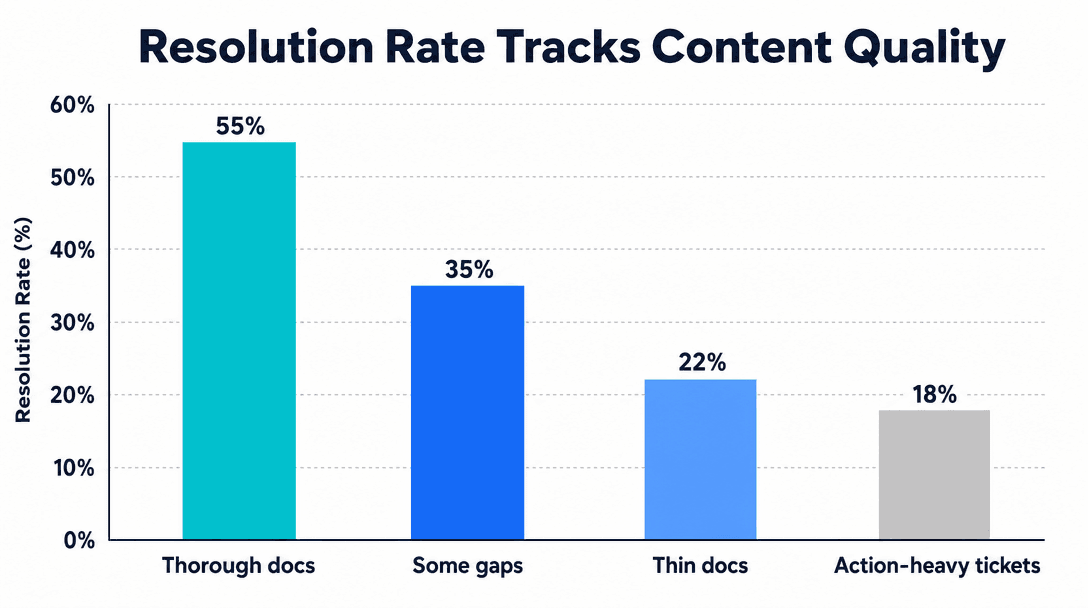
Realistic bands, based on what teams report and what the mechanism implies:
| Your content situation | Realistic resolution rate |
|---|---|
| Thorough, current, well-structured help centre | 45-60% |
| Decent docs with gaps and some stale articles | 25-40% |
| Thin docs, tribal knowledge, mostly in agents' heads | Under 25% |
| Support is mostly account actions, not questions | Under 20% regardless of docs |
The practical consequence: your Fin evaluation should start with a help centre audit, not a demo. Pull your last 200 tickets, tag each one as "answer exists in our docs" or "does not," and the resulting percentage is roughly your realistic ceiling. That exercise takes an afternoon and it predicts your outcome better than any trial.
Where Fin breaks
Answering versus acting. This is the fundamental limit. Fin explains your returns policy beautifully. It struggles to actually process the return. Anything requiring a write into your order system, billing platform, or CRM either needs custom engineering through Intercom's action framework or falls back to a human. If you audit your tickets and most of them end in a system change rather than an explanation, Fin's ceiling is structurally low. That is a mismatch, not a flaw in Fin, and it is the most common reason for disappointed deployments.
The economics invert at scale. Per-resolution pricing means every improvement in performance increases your bill. A team that doubles its deflection rate doubles its Fin cost, which is the opposite of how automation is supposed to work. At a few hundred resolutions a month this is irrelevant. At several thousand it is the dominant cost consideration, and it is why high-volume teams keep re-running the build-versus-buy math. The full breakdown is in Intercom Fin pricing.
It is weakest standalone. Fin can run outside a full Intercom setup, but most of its advantages come from being native to the Intercom inbox: the handoff, the context, the agent workflow. Teams on Zendesk, HubSpot, or a homegrown helpdesk get a worse version of the product and should compare against alternatives built for their stack rather than defaulting to the best-known name.
Content maintenance never ends. Fin's performance decays as your product changes and your docs do not. Somebody has to own the help centre permanently. Teams that treat setup as a project rather than a standing responsibility watch their resolution rate slide over two quarters and conclude the AI got worse.
Who should buy it, and who should not
Buy Fin if: you are already on Intercom, your support is question-heavy rather than action-heavy, your documentation is decent or you are willing to invest in it, and your volume is under roughly 2,000 resolutions a month. In that profile it is close to unbeatable on time-to-value and you would be creating work for yourself by building anything.
Think hard if: you are on another helpdesk, your volume is several thousand resolutions a month, or a large share of tickets require actions in your own systems. Any of those three means the default answer stops being obvious.
Skip it if: your support volume is genuinely low. Under a few hundred conversations a month, the honest answer is that neither Fin nor a custom build clears its cost, and a better help centre plus canned responses solves most of it for free.
The audit that predicts your outcome
Take 200 recent tickets. Tag each as answerable from existing docs, answerable if we wrote one article, or requires an action in another system. The first bucket is what Fin resolves today. The first plus second is your ceiling after content work. The third bucket is the share Fin will not touch without engineering, and if it is over 40 percent you are looking at the wrong category of tool.
How it compares, briefly
Fin's real competition is the shape of the decision, not other chatbots. Against Zendesk's AI agents, the choice usually follows your helpdesk rather than the AI capability, and we compare both against a custom build in Zendesk AI vs Intercom Fin vs a custom agent. Against Drift, the question is largely settled by Drift's sunset, covered in the migration guide. Against a custom AI agent, it is a volume and action-complexity calculation rather than a quality one, laid out in Drift vs Intercom vs a custom AI agent.
The bottom line
Intercom Fin is a well-built product that is frequently bought for the wrong reason. It is not a way to avoid writing documentation, it is a way to get far more leverage out of documentation you have already written. Teams who understand that get a strong result in six weeks. Teams who expect the model to compensate for a thin help centre get a 20 percent resolution rate and a vendor to blame.
Audit your tickets first. If most of them are questions with documented answers and you are already on Intercom, buy it. If most of them are actions, or if you are resolving thousands a month, price a fixed-cost alternative before you sign an annual contract.
Next step: Model the cost at your actual volume in Intercom Fin pricing, or see where a custom agent starts winning in what a custom AI agent costs.
Frequently asked questions
Is Intercom Fin any good?+
For its intended job, yes. Fin is one of the strongest out-of-the-box support agents available, and it is genuinely good at resolving repetitive, documented questions without a build project. It is weak wherever the answer is not already written down somewhere it can read, and wherever resolving the question requires taking an action in another system rather than explaining something. Judge it on those two axes rather than on its demo, which is always run against clean, complete documentation.
What resolution rate does Intercom Fin actually achieve?+
Intercom publicly references resolution rates in the 50 percent range and higher for well-configured accounts, and that is achievable, but it is heavily dependent on your help centre quality rather than on Fin. Teams with thorough, current, well-structured documentation land in the 40 to 60 percent range. Teams with thin or stale docs frequently sit under 25 percent and blame the AI. Your content is the variable, which is why the honest pre-purchase question is how good your help centre is, not how good the model is.
What are Intercom Fin's biggest limitations?+
Three stand out. It answers well but acts poorly, so anything requiring a write into another system usually still needs a human or extra engineering. It is only as good as your documented content, and it will not invent policy you never wrote down. And its per-resolution pricing means the better it performs, the more you pay, which inverts the usual economics of automation and punishes exactly the high-volume teams that benefit most.
Who should not use Intercom Fin?+
Teams already off Intercom should think hard, because Fin's value is highest when it sits inside the Intercom inbox and weakest as a standalone product. Teams whose support volume is mostly account-specific actions rather than questions will be disappointed. And teams resolving several thousand conversations a month should model the annual per-resolution cost against a fixed-cost build before committing, because that is where the pricing model stops working in your favour.
How long does Intercom Fin take to set up?+
Basic setup is genuinely fast, often under a day, because Fin ingests your existing help centre and starts answering. Getting it to a resolution rate you would defend takes considerably longer, usually four to eight weeks of reviewing conversations, rewriting weak articles, adding missing ones, and tuning handoff rules. The setup is quick. The content work behind a good resolution rate is the real project, and it is work you own, not work Intercom does for you.
Is Intercom Fin better than building a custom AI agent?+
Better for most teams under a couple of thousand resolutions a month, because you get a working system in days with no build risk. Worse once volume is high, once the work requires taking actions across your own systems, or once per-resolution costs exceed what a fixed-price build plus running costs would total over a year. It is a genuine buy-versus-build question decided by volume and by how much of your support is answering versus doing.
Free PDF
The 2026 AI Development Rate Sheet
Build, agent, RAG and consulting rates by tier, in one PDF, so you can check a quote before you sign it.

Written by
Pankaj Kumar
Founder · Metageeks Technologies
Metageeks builds software and AI products for growing businesses. Every build is scoped in writing before it starts, and you see progress every week. We write about what holds up once it reaches production.
Connect on LinkedInThe AI Build Brief
Ship AI that holds up in production.
Practical playbooks on how to build, price and ship AI features, in one short email every other week.