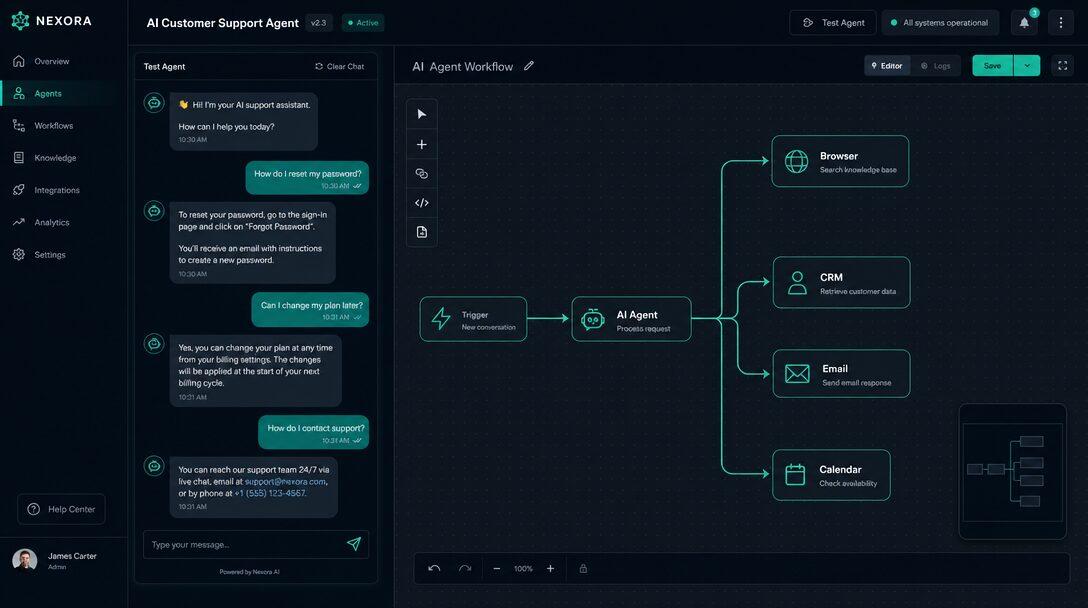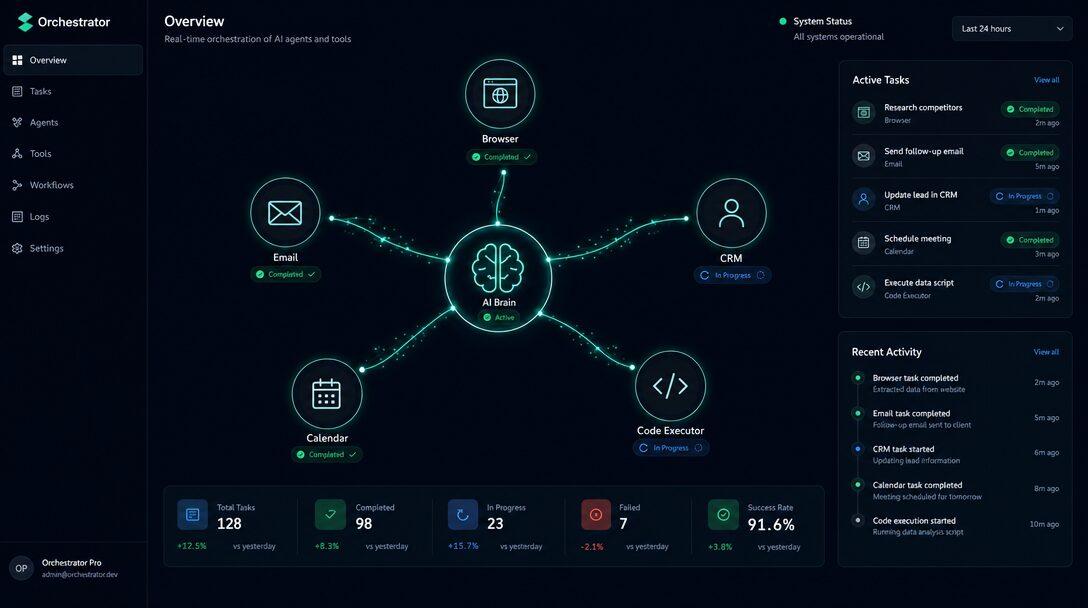

An AI chatbot that gets an answer wrong sends an embarrassing message. An AI agent that gets an action wrong issues a refund, overwrites a customer record, or emails the wrong client. That difference, not model quality, is what you are paying for when you build an agent, and it is why the price is not a bigger version of a chatbot quote.
TL;DR
- Narrow agent, 1-2 integrations: $15K-$30K. Production agent, 3-5 integrations plus approvals: $30K-$60K. Orchestrated multi-step: $60K-$150K+.
- Running costs are $200-$2,000/month, higher than a chatbot because one task burns many model calls.
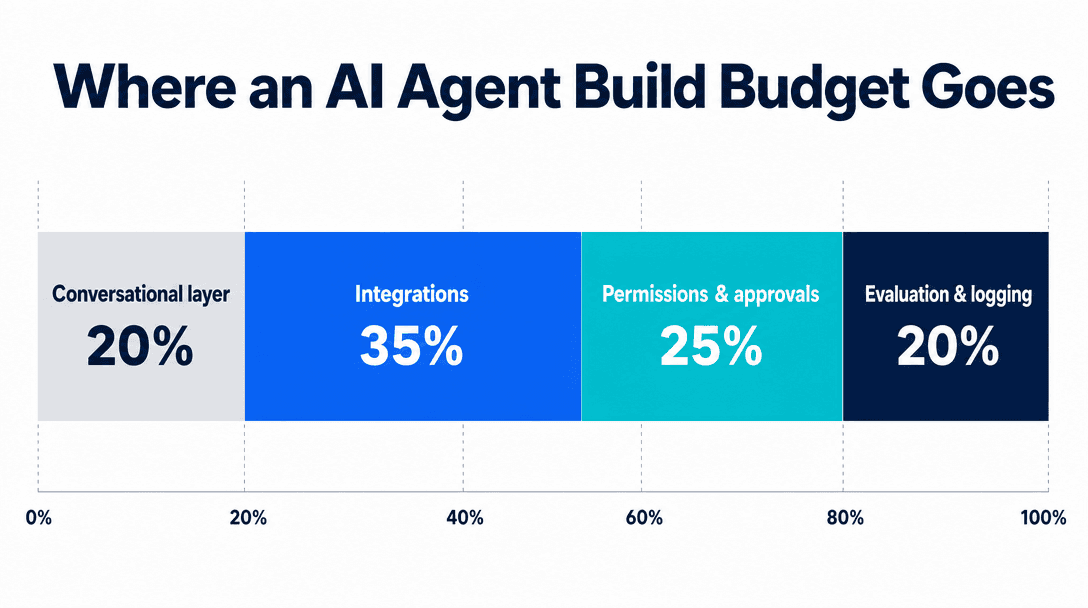
- 60-70% of an agent build is containment work: permissions, approvals, rollback, evaluation, logging. Not conversation.
- Cost drivers ranked: integration count, cost of a wrong action, step count, evaluation requirements. Model choice barely matters.
- If your use case is mostly answering questions, you want a chatbot and the chatbot cost breakdown is the right page.
- Timelines run 4-10 weeks. Anyone promising a production agent on your live systems in under two weeks is skipping the safety work.
Make sure you want an agent
Most businesses asking for an "AI agent" describe a chatbot: answer customer questions from our documentation. That is a different and cheaper build, covered in AI chatbot development cost. An agent is worth its premium only when the system needs to do things across your tools, not explain things. If you are not sure which you need, AI agent vs chatbot sorts it in a few minutes and can save you a five-figure mistake.
What actually makes an agent expensive
The conversational layer of an agent is the cheap part. It is the same technology as a chatbot and it is largely a solved problem. The cost sits in everything that stops a capable system from doing damage at speed.
Permission scoping. An agent that can update records can, without constraints, update the wrong ones. Every tool the agent can call needs explicit boundaries: which records, which fields, which conditions, what it may never touch. This is design work before it is engineering work, and it is where a good build spends its first week.
Approval steps. For anything consequential, a human confirms before the action commits. Building that well means holding state, presenting the proposed action clearly, handling timeouts, and dealing with the human who approves 40 pending actions at once without reading them.
Retry and rollback. Agents fail mid-chain. Step three succeeded, step four timed out, and now your system is in a state nobody designed for. Handling partial failure is ordinary distributed-systems engineering and it is a large share of the budget.
Evaluation harness. You cannot ship an agent that touches money or customer data without a test suite that runs realistic tasks and scores the outcomes. Unlike normal software tests, these are probabilistic, so the harness needs enough cases to detect a regression that only appears one time in fifty.
Action logging. Every decision, every tool call, every input and output, retained. You need this to debug, and you need it the first time a customer asks why the system did something.
None of that is AI work. All of it is why an agent costs two to four times a comparable chatbot.
The cost bands
| Agent type | Typical build | Monthly run | What you get |
|---|---|---|---|
| Narrow, single-purpose | $15,000-$30,000 | $200-$500 | One or two integrations, one task type, human approval on everything consequential |
| Production, multi-tool | $30,000-$60,000 | $400-$1,200 | Three to five integrations, conditional approval, evaluation harness, full logging |
| Orchestrated / multi-step | $60,000-$150,000+ | $800-$2,000+ | Long task chains, multiple specialised agents, rollback handling, monitoring dashboards |
If you have a task in mind, send us the systems it would touch and we will come back with a written scope and estimate for that agent, rather than a band.
Narrow, single-purpose is where most businesses should start. One job: qualify an inbound lead and write it to the CRM, or read an invoice and file it into accounting. One or two systems. A human confirms anything that matters. This is the agent equivalent of a first automation, and it is the version most likely to survive contact with reality.
Production, multi-tool is the common serious build. The agent reads from several systems, decides, and writes to a couple of them, escalating what it is unsure about. The jump in price over the narrow band is almost entirely integration count and the conditional approval logic that comes with it.
Orchestrated is expensive and rarer than the market implies. Multiple agents, long chains, agents checking other agents' work. Most businesses quoted at this level do not need it, and should ask hard whether the requirement is real or architectural enthusiasm.
The four cost drivers, ranked
1. Integration count. This is the dominant variable. Each system the agent writes into brings authentication, rate limits, error semantics, data model mismatches, and a set of edge cases that only appear in production. Rough rule: each additional write integration adds $5,000 to $12,000 depending on how well documented the target system is. Read-only integrations are much cheaper than write integrations, often by half.
2. Cost of a wrong action. An agent that drafts internal summaries needs light guardrails. One that issues refunds, changes bookings, or sends client-facing email needs approval workflows, rollback, and audit trails. This single question can double a quote, and it should. Ask yourself what the worst plausible wrong action costs you, and price accordingly.
3. Step count. A two-step task has few failure modes. A seven-step task has many, and they interact. Each step added to a chain increases testing surface more than linearly, which is why keeping agents narrow is a cost strategy and not just an engineering preference.
4. Evaluation requirements. Anything touching money, health, legal, or customer records needs a real evaluation suite, typically $5,000 to $15,000 of the build. Internal-only tools with a human reviewing every output can get away with much less.
Notably absent: model choice. Whether you use one frontier model or another moves running cost somewhat and build cost almost not at all. Vendors who lead with model selection as a cost lever are talking about the least important variable.
Running costs, and why they surprise people
Agents cost more to run than chatbots, and the reason is structural. A chatbot answering a question makes roughly one model call. An agent completing a task plans, calls a tool, reads the result, decides what to do next, possibly calls another tool, and checks its own work. That single task might consume five to fifteen model calls.
So running cost scales with tasks x steps per task, not just with volume. A modest-volume agent doing complex tasks can cost more monthly than a high-volume chatbot.
Budget components:
- Model usage - the largest and most variable piece, $100 to $1,500/month at typical volumes
- Hosting and infrastructure - $50 to $300/month
- Monitoring and logging - $50 to $200/month, and worth every dollar the first time something goes wrong
- Maintenance - integrations break when vendors change APIs; budget a few hours a month or a small retainer
Ask any vendor for a monthly figure at twice your expected volume. If they cannot produce one, they have not run an agent in production.
Where buying beats building
Buy when your use case is mostly answering. Platforms like Intercom Fin resolve documented questions well, immediately, with no build risk, and you should not pay to rebuild that. The Zendesk, Fin, and custom agent comparison covers where that line sits.
Build when your use case is mostly doing, when the logic is specific to your business, or when per-unit platform pricing has compounded past a fixed build cost over a 12 to 24 month horizon.
The trap in the middle: buying a platform for an action-heavy use case. You pay the platform fee and then pay for custom integration work anyway, because the platform was never designed to write into your systems. That combination is the most expensive outcome available and it is disappointingly common.
What a fair quote looks like
A quote you can trust breaks out:
- Integration count, listed by system, and read versus write for each
- Which actions require human approval and which commit automatically
- Whether an evaluation harness is included, and how many test cases
- Monthly running cost at your expected volume and at twice that
- Who owns the code, the prompts, and the evaluation suite
- What happens when an integration breaks after launch
A quote that is one number with a timeline is not a quote, it is a hope. And a six-figure quote for a first agent is almost always the wrong shape of project. Start narrow, prove the task, then expand volume before scope. The 30-day first automation plan applies to agents as much as to simpler automations.
How much does it cost to build a custom AI agent in India?
An India-based team charges roughly half the US hourly rate, but it does not halve the list of work. Clutch's AI development pricing guide, updated September 2026, lists India-based firms at $25-$49 an hour against $50-$99 for US firms, and Clutch's directory of AI developers in India shows established firms at under $25 or $25-$49 an hour, with minimum projects of $10,000 or $25,000.
At ₹95.74 to the US dollar (the Wise mid-market rate on 14 September 2026), that is about ₹2,400-₹4,700 an hour, and a minimum engagement of roughly ₹9.6 lakh or ₹24 lakh.
The containment work described above is the same in any country: permission scoping, approval steps, rollback, an evaluation harness and action logging. The saving comes from the rate on those hours, so it shows up most on production and orchestrated builds, where the hours are large. For a narrow agent, a $10,000 or $25,000 minimum sits inside the $15,000-$30,000 band anyway, so compare total quotes rather than rates. Whoever builds it, ask for the fair-quote breakdown listed above.
The bottom line
A custom AI agent costs $15,000 to $60,000 for most real business use cases, plus a few hundred to a couple of thousand dollars a month to run. The number is set by how many systems it writes into and how expensive it is when it gets one wrong, not by which model sits underneath.
Before you price anything, confirm you need an agent rather than a chatbot. The most expensive AI mistake available in 2026 is not choosing the wrong vendor, it is buying an agent-shaped budget for a chatbot-shaped problem.
Next step: If your use case is answering rather than acting, the chatbot cost breakdown is the accurate page. To scope an agent properly, see AI agent development.
Frequently asked questions
How much does a custom AI agent cost in 2026?+
A custom AI agent costs $15,000 to $30,000 for a narrow build with one or two integrations, $30,000 to $60,000 for a production agent with three to five integrations and a human approval step, and $60,000 to $150,000 or more for orchestrated multi-step agents with evaluation harnesses and rollback handling. Running costs add $200 to $2,000 a month depending on volume and how many model calls each task consumes. Integration count and the cost of being wrong drive the number far more than the AI itself does: each additional write integration adds roughly $5,000 to $12,000, and an agent that issues refunds or sends client-facing email needs approval and rollback machinery that one drafting internal summaries does not. Most businesses should start in the narrow band, prove the task works, and expand volume before scope.
Why does an AI agent cost more than a chatbot?+
An AI agent typically costs two to four times a comparable chatbot, because an agent takes actions and a chatbot produces text. A wrong chatbot answer is an embarrassing message. A wrong agent action is a refund issued, a record overwritten, or an email sent to the wrong client. That difference forces engineering a chatbot never needs: permission scoping so the agent only touches the right records, approval steps for consequential actions, retry and rollback logic for tasks that fail halfway, evaluation harnesses that test realistic tasks, and full action logging. Typically 60 to 70 percent of an agent build is this containment work, not the conversational layer, which is the same technology a chatbot uses. Agents also cost more to run, because one task can consume five to fifteen model calls where a chatbot answer takes roughly one.
What actually drives the cost of an AI agent build?+
Four things, in order. Integration count, because each system it writes into brings authentication, error handling, and edge cases. The cost of a wrong action, which determines how much approval and rollback machinery you need. Step count, since each additional step in a chain multiplies the ways it can fail. And whether an evaluation harness is required, which is essentially non-negotiable for anything touching money or customer records. Model choice barely moves the number.
What does it cost to run an AI agent per month?+
A production AI agent usually costs $200 to $2,000 a month to run at moderate volume. Model usage is the largest and most variable piece, typically $100 to $1,500 a month, followed by hosting and infrastructure at $50 to $300 and monitoring and logging at $50 to $200, plus a few hours a month of maintenance for integrations that break when vendors change their APIs. Agents cost noticeably more to run than chatbots because a single task can consume five to fifteen model calls as the agent plans, calls tools, reads results, and checks its own work. Running cost therefore scales with tasks multiplied by steps per task, not just with volume, so a modest-volume agent doing complex tasks can cost more each month than a high-volume chatbot. Ask any vendor for a monthly figure at twice your expected volume.
Is it cheaper to buy an AI agent platform than build one?+
Almost always at low volume, and often not at high volume or where actions are involved. Platforms are excellent at answering and weak at writing into your specific systems, so action-heavy use cases end up requiring custom engineering anyway, on top of the platform fee. The honest rule is to buy if your use case is mostly answering questions, and to price a build if most tasks end in a system change. Volume and action complexity decide it, not preference.
How long does it take to build a custom AI agent?+
Most production AI agents take four to ten weeks to build. A narrow single-integration agent can ship in three to four weeks. Anything with multiple integrations, an approval workflow, and an evaluation harness realistically takes eight to twelve. The integration and testing work dominates the timeline, not the AI development: each system the agent writes into needs authentication, error handling and edge-case testing, and the evaluation suite needs enough realistic tasks to catch a failure that only appears one time in fifty. Scoping takes time too, since permission boundaries and approval rules are design decisions that come before any code. Any vendor promising a production agent touching your live systems in under two weeks is either scoping something trivial or skipping the containment work, and that work is where most of an agent budget belongs.
Free PDF
The 2026 AI Development Rate Sheet
Build, agent, RAG and consulting rates by tier, in one PDF, so you can check a quote before you sign it.

Written by
Pankaj Kumar
Founder · Metageeks Technologies
Metageeks builds software and AI products for growing businesses. Every build is scoped in writing before it starts, and you see progress every week. We write about what holds up once it reaches production.
Connect on LinkedInThe AI Build Brief
Ship AI that holds up in production.
Practical playbooks on how to build, price and ship AI features, in one short email every other week.