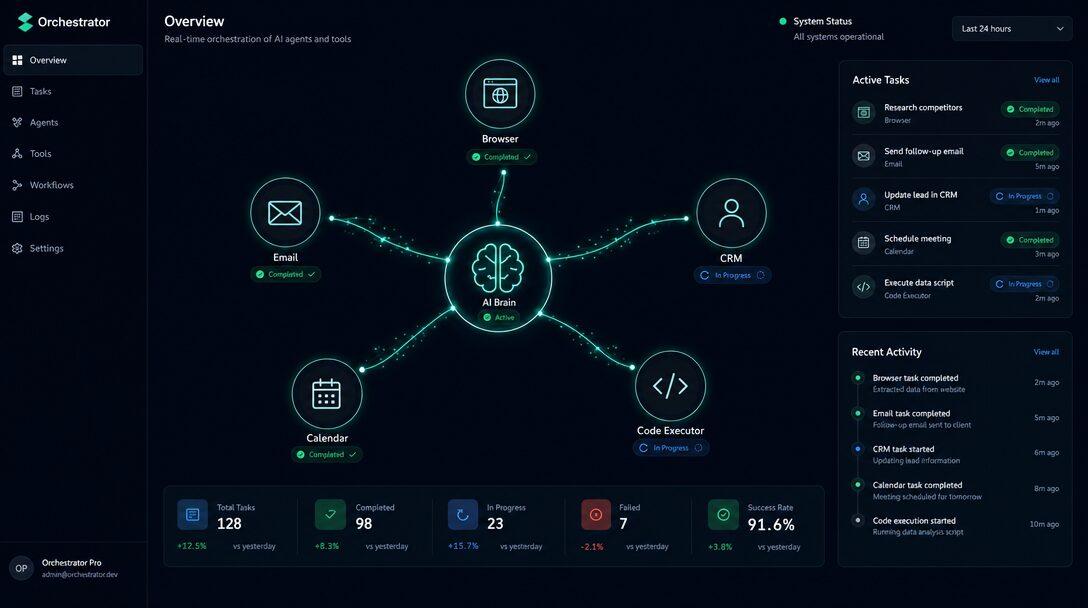
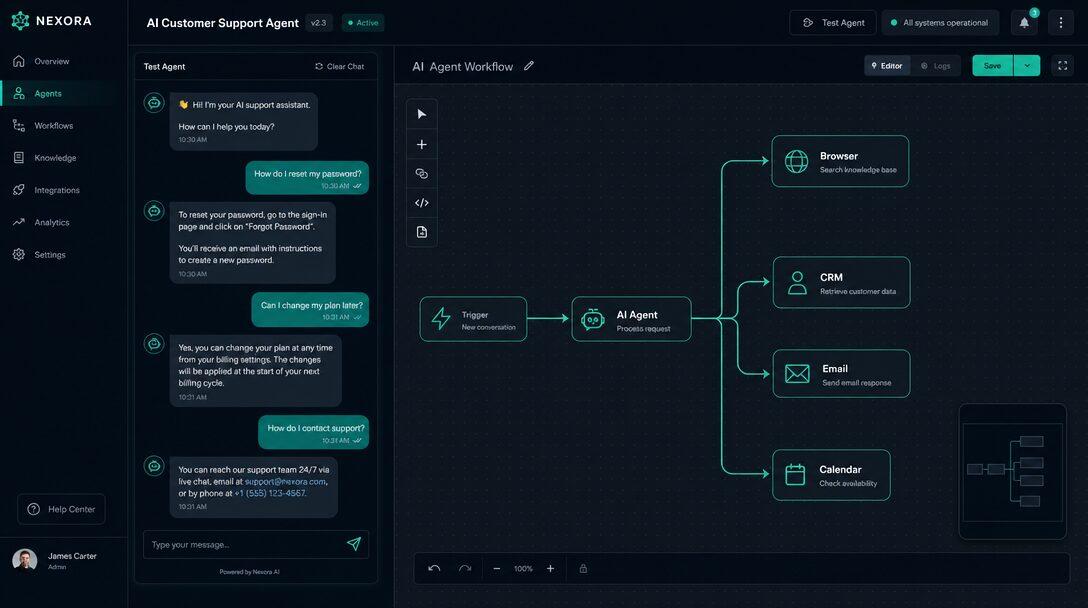
Every vendor selling you "AI" is selling you either a chatbot, an agent, or something in between, and most of them use the words interchangeably. That's a problem, because the two are architecturally different, solve different problems, and cost very different amounts to build and run.
TL;DR
- A chatbot generates a response to a question. An agent takes actions to complete a task.
- Chatbots are better for: answering questions, handling FAQs, first-line support deflection.
- Agents are better for: multi-step processes that require reading systems and doing something with the result.
- Cost gap is real: a production chatbot runs $10K-$40K. A production agent runs $25K-$80K.
- Most businesses should start with a chatbot. Add an agent when you've identified a specific multi-step process costing significant human time every week.
Free scoping call
Turn your AI idea into a written plan
Tell us what you want AI to do. In 30 minutes we tell you plainly whether it will pay for itself, and what it would take to build.
Book a scoping call →What a chatbot actually is
A chatbot is a conversational interface. The user sends a message. The chatbot generates a response. That's the complete loop.
Modern AI chatbots use large language models instead of keyword matching, which makes them dramatically better than the scripted chatbots of 2018. A well-built chatbot with RAG (Retrieval-Augmented Generation) can accurately answer questions from your documentation, policy docs, or product catalog, in natural language, at scale.
What a chatbot cannot do is take action. It can tell a customer their order status (if it can look it up) but it can't change the order, reroute the shipment, or issue the refund. It can answer a support question but can't update the CRM record or escalate the ticket.
The moment you need the AI to do something, not just say something, you've crossed into agent territory.
What an AI agent actually is
An AI agent is software that can perceive input, make decisions, take actions using tools, observe the results, and continue until a goal is accomplished.
The key addition is tools: functions the agent can call to interact with other systems. A tool might be:
- A CRM API call (read a contact record, update a field)
- A database query (look up order history, check inventory)
- An email send (draft and send a message on behalf of the user)
- A web search (find current pricing, check competitor updates)
- A code executor (run a script, process a file)
The agent decides which tools to call and in what order, based on what it's trying to accomplish. It reasons about the task and chooses actions instead of following a fixed script.
The clearest way to see the difference
Same scenario, both approaches.
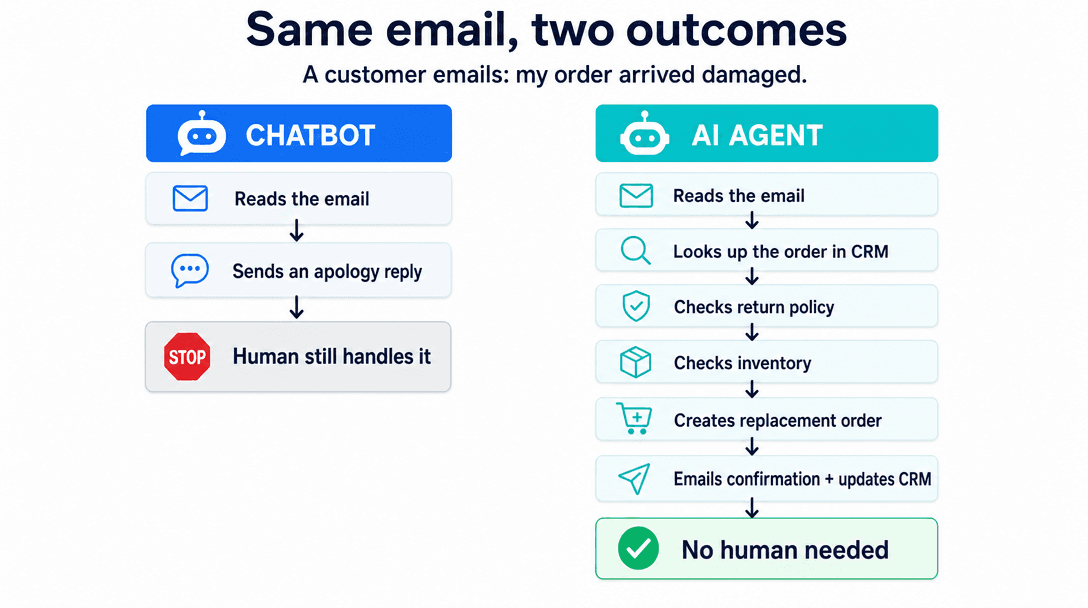
Scenario: A customer emails saying their order arrived damaged.
Chatbot:
- Reads the email
- Generates a reply: "We're sorry about this. Please reply with your order number and photos, and our team will process a replacement within 2 business days."
- Done: a human still has to handle the follow-up
Agent:
- Reads the email
- Searches the CRM for the customer's order using their email address
- Finds the order, checks the item and return policy: damaged items are eligible for immediate replacement
- Checks warehouse inventory: replacement available
- Creates a new replacement order in the fulfillment system
- Sends the customer a confirmation email with the replacement order number and tracking ETA
- Updates the CRM record with a note and flags the original shipment for quality review
- Done: no human involved
The chatbot moves the conversation forward. The agent closes the loop.
When to use a chatbot
Chatbots make sense in a few specific situations.
If your main need is answering questions (product, pricing, policies, anything already in your documentation), a RAG chatbot handles this better and cheaper than an agent.
They're also good for deflecting support volume. 60-80% of support tickets are repeat questions with known answers. A chatbot handles these without touching your team.
If you're starting your AI journey, chatbots are faster to build (1-2 weeks for a production RAG chatbot), cheaper to run, and easier to evaluate. That's a sensible first step before committing to agent infrastructure.
One more case: regulated industries. Chatbots are easier to audit than agents. Every response can be traced back to a source document. Agents make decisions that are harder to explain after the fact.
When to use an AI agent
Here's when an agent is the right call.
The clearest signal is someone on your team spending hours every day reading inputs, making decisions, and taking actions across multiple systems. That process is a candidate.
Agents are especially suited to work that requires accessing and updating multiple systems: CRM, support inbox, accounting software, all in one pass. That's what they're built for.
Some tasks aren't about answering anything; they need to be completed. Lead qualification, invoice processing, customer onboarding, meeting scheduling. A chatbot can't close those loops. An agent can.
Volume matters too. If this process runs 10 times a week, the ROI math may not work. If it runs 200 times a week, it almost certainly does.
Cost and complexity comparison
| Chatbot | AI Agent | |
|---|---|---|
| What it does | Answers questions | Executes tasks |
| Actions | None (or read-only) | Read + write across systems |
| Typical build cost | $10K-$40K | $25K-$80K |
| Time to production | 1-4 weeks | 4-12 weeks |
| Maintenance | Low | Moderate-high |
| Needs evals? | Recommended | Required |
| Failure mode | Wrong answer | Wrong action |
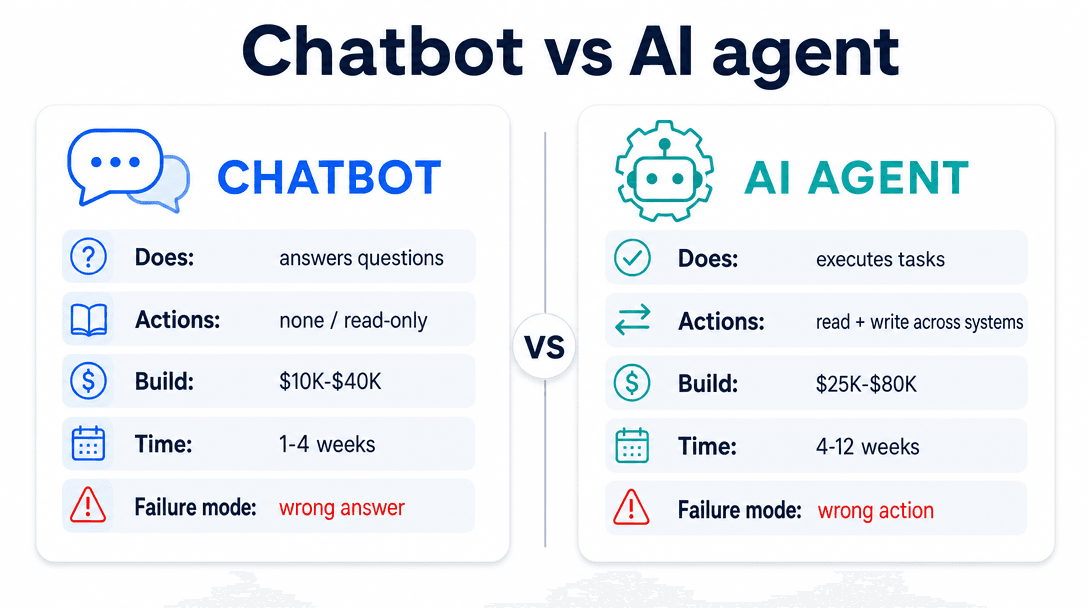
The failure mode difference matters. A chatbot giving a wrong answer is a bad experience. An agent taking a wrong action (sending an unintended email, modifying the wrong record) can be a real business problem. Production agents need guardrails, human-in-the-loop escalation paths, and monitoring.
Free scoping call
Turn your AI idea into a written plan
Tell us what you want AI to do. In 30 minutes we tell you plainly whether it will pay for itself, and what it would take to build.
Book a scoping call →What most vendors are actually selling you
The confusion in the market is partly deliberate. "AI agent" sounds more advanced and justifies a higher price tag, so vendors call things agents that are really sophisticated chatbots.
The test: can it take actions that change the state of your systems? If not (if it can only read and respond), it's a chatbot, regardless of what it's called.
Some vendors build "agentic" chatbots: chatbots with one or two tool calls bolted on, like looking up an order status. This is a reasonable intermediate step. Just be clear about what you're buying and what the system can and can't do.
How to decide what you need
Two questions are enough:
1. What's the end state I want the AI to produce?
- A response to a question → chatbot
- A completed task across one or more systems → agent
2. What's the volume and value of the process?
- Low volume (< 50 instances/week) → consider whether automation pays off at all
- High volume, low decision complexity → traditional automation may be faster and cheaper
- High volume, high decision complexity → agent
If you're still unsure, a Discovery Sprint (one week, fixed scope) maps your processes, identifies the right approach, and produces a working prototype you can evaluate before committing to a full build.
Chatbots respond. Agents act. Both are useful: the question is which problem you're trying to solve.
For most $1M-$15M businesses starting out, the practical path is chatbot first for customer-facing Q&A, then agent for the internal processes eating the most team time. You don't have to choose one forever. You choose one to start.
Explore AI agent development →
A 20-minute scoping call maps your specific processes and identifies which approach fits each one before you commit to a build.
Free scoping call
Turn your AI idea into a written plan
Tell us what you want AI to do. In 30 minutes we tell you plainly whether it will pay for itself, and what it would take to build.
Book a scoping call →About the author

- Tags
- ai agents
- ai chatbot
- ai agent development
Subscribe to Our Newsletter
The AI Build Brief: practical playbooks on how to build, price and ship AI features, in one short email every other week.