"AI agent" has become the phrase every vendor drops in a pitch deck. Which means it now means almost nothing unless you pull it apart carefully.
Here's what it is, what it isn't, and how to tell whether your business needs one.
TL;DR
- An AI agent is software that can perceive input, decide what to do, take actions (API calls, database writes, searches), and loop until the task is done, without a human approving each step.
- Chatbots answer questions. Agents execute tasks. The difference is tool use and autonomy.
- You probably need an agent if: a human is spending 5+ hours a week on a repetitive multi-step process that involves reading data and making decisions.
- You probably don't need one yet if: you haven't mapped the process, don't have clean data, or can solve the problem with a simpler automation.
- A proof-of-concept agent can be built in 2-4 weeks for $8K-$25K. Production-ready is 3-8 weeks more.
Free scoping call
Turn your AI idea into a written plan
Tell us what you want AI to do. In 30 minutes we tell you plainly whether it will pay for itself, and what it would take to build.
Book a scoping call →What an AI agent actually is
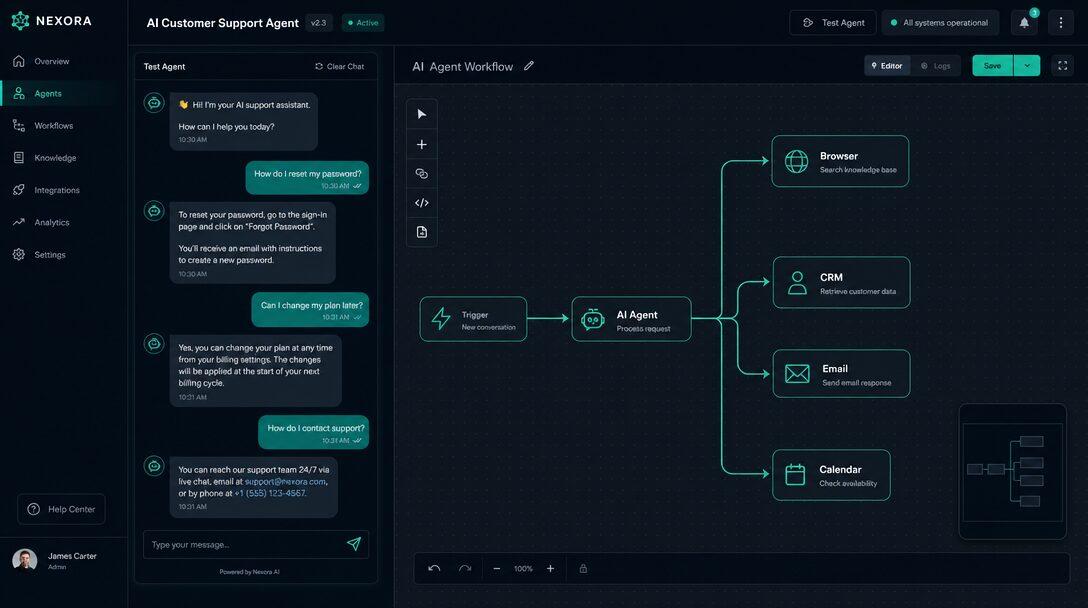
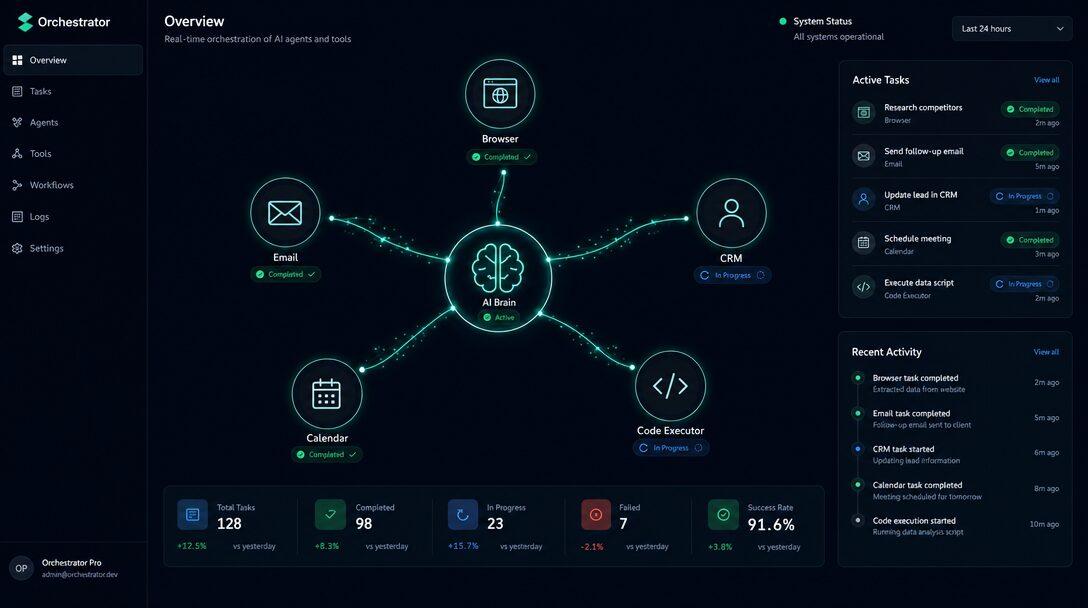
The term gets used to mean everything from a chatbot with a system prompt to a fully autonomous system managing your operations. The precise definition: an AI agent is software that can perceive input, reason about it, take actions using tools, and loop until a goal is accomplished, without requiring human approval at each step.
The critical word is actions. A chatbot generates text. An agent can:
- Search the web or your internal knowledge base
- Read and write files or databases
- Call APIs: your CRM, your support inbox, your calendar
- Execute code
- Trigger workflows in other systems
And it can chain these together. You give it a goal ("process this support ticket and update the customer record"), and it decides which actions to take and in what order, checks the results, and continues until the task is done.
The anatomy of an agent
Most production AI agents have four components.
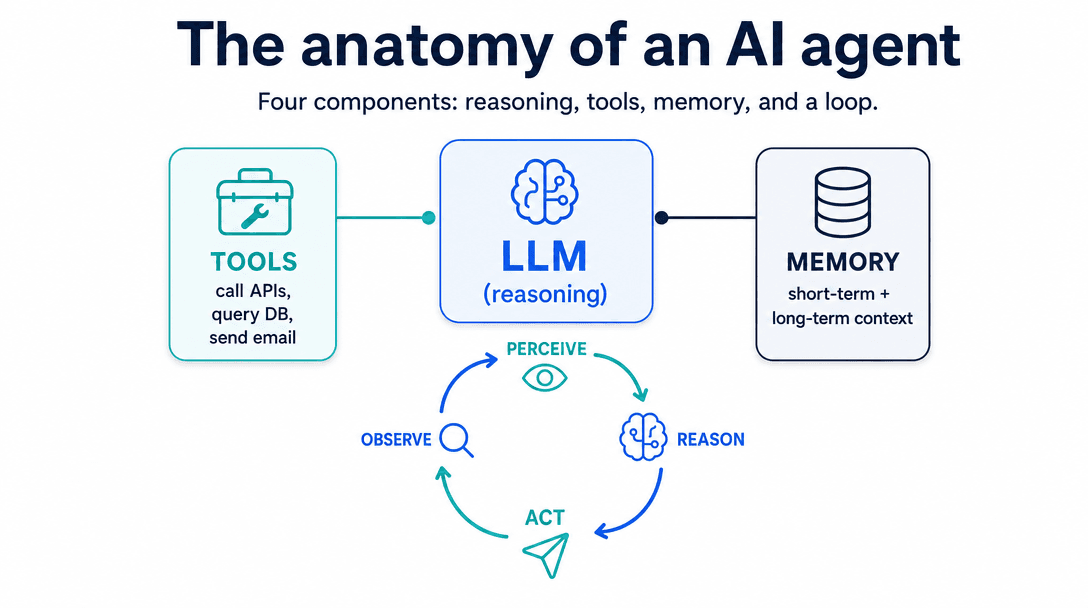
The LLM is the reasoning layer, usually GPT-4o, Claude, or a similar model. It reads the current state, decides what to do next, and generates the action.
Tools are functions the agent can call. These are defined by the developer: a tool is just a function with a description the LLM can understand. Tools can query your database, send an email, or call any external API.
Memory is the context the agent can read and write across steps. Short-term memory is the conversation context; long-term memory is a vector store or database the agent can query across sessions.
The loop ties it together. Agents run in a cycle: perceive → reason → act → observe result → reason again, until the task is complete or a stopping condition is met. That cycle is what makes agents different from one-shot LLM calls. A single LLM call answers a question. An agent runs a process.
How AI agents differ from chatbots
The easiest way to understand the difference is to look at the same problem handled by each.
Scenario: A customer emails saying they haven't received a refund.
Chatbot approach: The chatbot reads the email, generates a reply: "We're sorry to hear this. Please contact our support team at support@company.com." Done. The human support team still has to look up the order, check the refund status, and take action.
Agent approach: The agent reads the email, looks up the customer's order ID in the CRM, checks the refund status in the payment system, finds the refund failed due to an expired card, triggers a retry with the new card on file, updates the ticket status, and sends the customer a personalized email with the resolution. No human touched it.
Same input. Completely different output, because the agent can take actions, not just generate text.
How AI agents differ from traditional automation
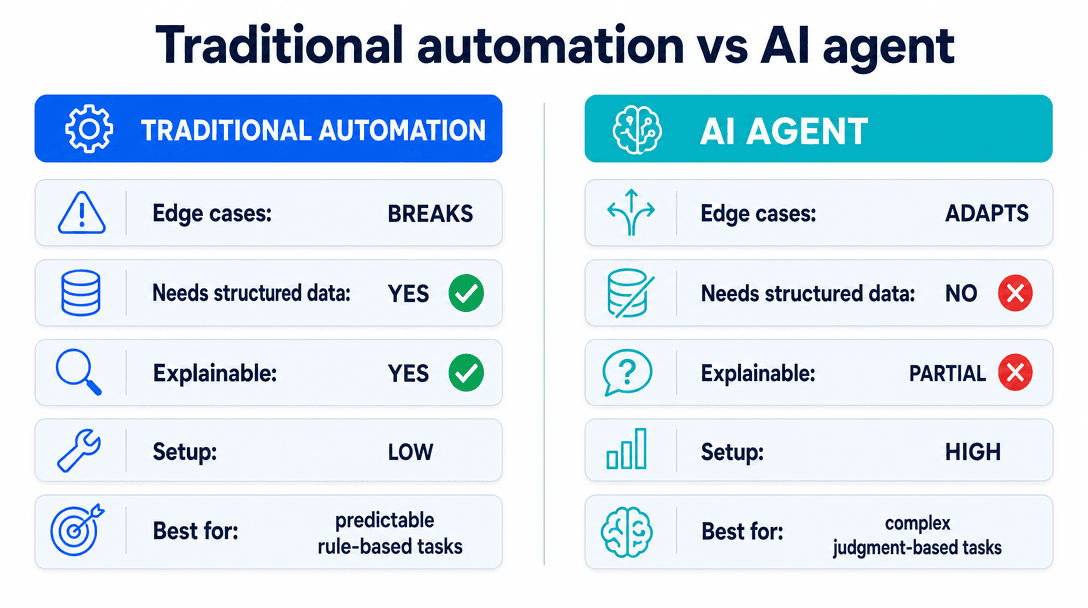
Traditional automation (Zapier, Make, n8n) follows fixed rules. If X happens, do Y. The path is hardcoded.
An agent can decide which path to take based on what it finds. If the refund failed for reason A, do this. If reason B, do that. If something unexpected, escalate to a human. Traditional automation breaks on edge cases. Agents handle them.
The tradeoff: agents are harder to build, test, and trust. You need evaluation pipelines to verify they're making the right decisions. You need escalation paths for cases they can't handle. Traditional automation is deterministic; agents are probabilistic. Both have their place.
| Traditional Automation | AI Agent | |
|---|---|---|
| Handles edge cases | ❌ Breaks | ✅ Adapts |
| Requires structured data | ✅ Yes | ❌ Works with unstructured |
| Explainable decisions | ✅ Yes | Partial |
| Setup complexity | Low | High |
| Best for | Predictable, rule-based tasks | Complex, judgment-based tasks |
When your business actually needs an AI agent
The honest signal: a human is spending 5+ hours per week on a multi-step process that involves reading variable inputs and making decisions at each step.
Good candidates:
- Lead qualification: reading inbound inquiries, researching the company, scoring against your ICP, routing to the right rep. Done manually, that's 2-4 hours a day of sales team time.
- Invoice processing: matching invoices to purchase orders, flagging discrepancies, entering data into accounting.
- Content monitoring: tracking competitor updates, pricing changes, job postings, and summarizing what's relevant.
- Customer onboarding: collecting documents, running checks, triggering downstream systems, sending status updates.
- Scheduling and logistics: coordinating across calendars, booking resources, handling rescheduling requests.
What these have in common: they're multi-step, they involve reading and deciding, and they're currently eating someone's time every single day.
When you don't need an AI agent
Not every problem needs an agent. If your problem is one of these, start somewhere simpler.
"We want to answer customer questions faster": that's a chatbot. A well-built RAG chatbot over your knowledge base handles most support queries for a fraction of what an agent costs.
"We want to automate this three-step workflow": if the workflow is fixed and predictable, traditional automation is faster to build and more reliable to operate.
"We want AI to help our team": a copilot, AI embedded in your existing tools, is often the right answer before full automation.
Agents are powerful and have become much cheaper to build in 2026. But they're still meaningfully more complex than the alternatives. Start with the simplest tool that solves the problem.
What it takes to build a production AI agent
Teams consistently underestimate the gap between a demo and a production-ready agent.
The demo is easy: 200 lines of Python, a few tool definitions, a loop. It works when you're watching it. Production is different.
You need automated tests that check whether the agent is making the right decisions. Without evals, you don't know if it's working until a customer complains. Every step the agent takes needs to be logged: when it does something wrong (and it will), you need to trace exactly what it saw, what it decided, and why.
Agents can also take actions you didn't anticipate. Production agents need constraints: what they can and can't do, escalation paths, hard stops for high-risk actions.
And the first version of your agent won't behave the way you want. The eval-and-iterate loop is where most of the real work happens.
A proof-of-concept that validates your use case takes 2-4 weeks and runs $8,000-$25,000. A production-ready agent with proper evals, observability, and guardrails is typically 3-8 more weeks at $25,000-$80,000. If a vendor quotes you a "production-ready agent" in 1 week for $3,000, they're describing a demo.
An AI agent is software that can act, not just respond. If you have a multi-step process that currently requires human judgment at each step, an agent is worth evaluating. If you have a simpler problem (answering questions, running a fixed workflow), start with a simpler tool.
The AI agent space has matured significantly in 2026. The frameworks are better, the models are cheaper, and the patterns are more established. A well-scoped agent project is now a realistic bet for a $1M-$15M business, if you have a clear use case and a team that can evaluate what "working" looks like.
See what AI agent development actually looks like →
If you're not sure which AI approach is right for your specific operations, a 20-minute scoping call maps your processes and identifies where an agent would pay off, before you commit to a build.
Free scoping call
Turn your AI idea into a written plan
Tell us what you want AI to do. In 30 minutes we tell you plainly whether it will pay for itself, and what it would take to build.
Book a scoping call →About the author

- Tags
- ai agents
- ai agent development
Subscribe to Our Newsletter
The AI Build Brief: practical playbooks on how to build, price and ship AI features, in one short email every other week.