
What do cloud and DevOps services cover?
Cloud and DevOps services cover the layer beneath your application: where it runs, how new versions reach production, how you find out when something breaks, and what the whole thing costs each month. The work is infrastructure as code, deployment pipelines, monitoring, backups and security configuration.
Most growing companies arrive here with the same three symptoms. Infrastructure was set up by hand in a web console, so nobody can reproduce it and one person is the documentation. Deployments are manual and therefore rare and frightening. And the monthly bill has been climbing for a year without anyone able to say which service is responsible.
All three have the same root cause — infrastructure that exists only as clicks someone made once — and the same fix: write it down as code, automate the path to production, and put a number on every resource.
— What we do —
Four kinds of cloud work.
Usually one of these is urgent and the others are quietly overdue. We scope the urgent one first.

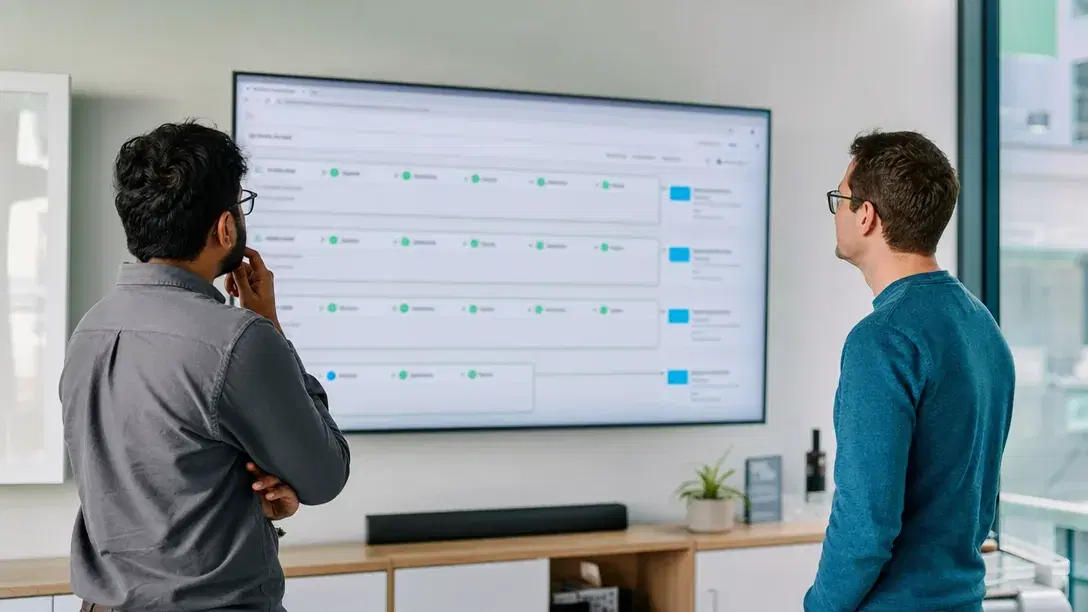



Handover includes a runbook: what to do at 3am, written for whoever is on call rather than for us.
— What you get —
Independence, by design.
The measure of this work is whether your team can operate the result without calling us. That is the deliverable.
01
Everything in your accounts
Your AWS or Google Cloud organisation, your domains, your repositories. We work inside them with scoped access and hand the keys back. Nothing critical sits in an account you do not own.
02
Written infrastructure
Terraform or AWS CDK in your repository, so a new environment is a command rather than a memory. Changes get reviewed before they reach production, like code.
03
A tested recovery path
Backups that have actually been restored at least once, and a documented rollback. An untested backup is a belief, not a safeguard.
04
A runbook your team can use
What each alert means, what to check first, who to call and how to roll back — written for the person on call at 3am, not for the engineer who built it.
— How we work —
Audit first, then change things.
We do not touch production before we understand what depends on it. Most of the risk in this work is in the surprises.
01 · Audit
What you have now
3–5 days
Inventory of infrastructure, spend, access, backups and single points of failure. You get the written findings whether or not you continue with us.
02 · Prioritise
Risk and cost order
2 days
Ranked by what would hurt most if it failed and what is costing most now. You choose what we do; the list is yours either way.
03 · Codify
Infrastructure as code
2–4 weeks
The current environment reproduced as code and verified against what is actually running, before anything is changed.
04 · Automate
Pipelines and monitoring
1–3 weeks
Deployment automated, alerts configured and tuned, backups tested by restoring one for real.
05 · Hand over
Runbook and training
1 week
Walkthrough with your engineers, runbook delivered, access transferred. Ongoing support is optional and separately priced.
— Honest qualification —
Who this is for.
This work pays for itself in avoided outages and reduced spend, or it does not. We will tell you which case you are in.
A good fit
- Infrastructure was set up by hand and only one person understands it
- Deployments are manual, so releases are rare and nerve-wracking
- Cloud spend has grown steadily and nobody can attribute it
- You have had an outage where the first question was what changed
Not a fit
- You want someone to be your permanent on-call rota — hire for that, we will help you scope the role
- A managed platform already handles this and your scale does not need more
- Nobody on your side can be given time to learn the handover
- You need certification-grade compliance evidence rather than engineering work
Start with the audit.
A few days of investigation produces a written inventory of risk and spend. You keep the findings and the priority list regardless of whether we do any of the work.
Real questions
Common Questions
The questions we get asked most, answered directly.
What do cloud and DevOps services actually include?+
Four things in practice: infrastructure as code so your environment is reproducible, CI/CD pipelines so deployments are automatic and reversible, monitoring and alerting so failures are detected by systems rather than customers, and cost work so the monthly bill is attributable. Security configuration and backup testing run through all four. What it does not include is being your permanent operations team — the point of the engagement is that your people can run the result.
How much can we reduce our AWS bill?+
It depends entirely on how the account grew. Environments built by hand over a couple of years typically carry meaningful waste: oversized instances chosen defensively, development environments nobody shut down, storage in the wrong class, and data taking an expensive network path. Accounts that were built deliberately have far less to find. The audit gives you a specific number for your account before you commit to any of the work, which is the only honest way to answer this.
Do we need DevOps if we are only a small team?+
You need the outcomes, not the job title. A five-person team does not need a dedicated DevOps engineer, but it does need deployments that do not depend on one person being free, alerts that fire before customers notice, and a backup someone has actually restored. Those are a few weeks of setup, not a permanent hire. The mistake small teams make is skipping this until an outage forces the conversation.
Which cloud provider should we use?+
Whichever one your team can operate. AWS has the deepest service catalogue and the largest hiring pool in India, which is why most of our work lands there. Google Cloud is competitive and often simpler for data-heavy workloads. The provider matters far less than whether your infrastructure is written down and your deployments are automated — a well-run Google Cloud setup beats a hand-clicked AWS one every time, and moving between them later is rarely the bottleneck people fear.
Will you have access to our production systems?+
Only scoped access, only for the duration, and only in accounts you own. We work inside your cloud organisation and your repositories rather than creating anything under our own name, and access is revoked at handover. You should require this of any vendor: if a supplier holds the only credentials to your infrastructure, you have a business continuity problem regardless of how good their engineering is.
What happens after the handover?+
Your team runs it, using the runbook and the training session. Some clients take a small monthly retainer for changes and to be reachable during incidents; others take the handover and never need us again. Both are normal. What we do not do is engineer a dependency — if you cannot operate the infrastructure without us afterwards, the engagement failed at its main objective.
— Ready when you are —
Find out what is actually running.
Start with the audit. A few days of investigation, a written inventory of risk and spend, and a priority list you keep either way.