You got a quote. It said $45,000. Maybe $60,000. The firm was confident, the deck was polished, and you still can't tell whether that number is fair or whether you're getting priced like a Fortune 500. Honestly, that's the part that nags at you. Not the price, the fact that you have no way to check it.
TL;DR
- AI consulting in 2026 runs $150-$500/hr hourly, $5K-$50K for fixed-scope projects, $3K-$15K/mo on retainer, and $40K-$80K+ for enterprise engagements.
- The price isn't random. Scope, how clean your data is, how many systems need wiring together, and whether you're buying advice or a working build all move it.
- That $40K enterprise quote is usually the wrong shape for a $1M-$15M business: too broad, too slow, and priced for a buyer who isn't you.
- Buy a fixed-scope assessment first. It's the cheapest way to know what you should pay for before you sign anything.
- A 20-minute scoping call turns a vague $40K quote into a number you can defend.
The short answer
AI consulting in 2026 costs $150-$500/hr hourly, $5K-$50K for a fixed-scope project, $3K-$15K/mo on retainer, and $40K-$80K+ for enterprise engagements. The range is set by scope, data readiness, integration count, and whether you're buying advice or a working build, so for a $1M-$15M business, a fixed-scope assessment is usually the right place to start, not an enterprise program.
If you already have a quote, or a workflow in mind, send us the details and we'll come back with a written scope and estimate you can hold other quotes against.
Free scoping call
Turn your AI idea into a written plan
Tell us what you want AI to do. In 30 minutes we tell you plainly whether it will pay for itself, and what it would take to build.
Book a scoping call →How much does AI consulting cost in 2026?
The answer most firms won't print: AI consulting runs from a few hundred dollars an hour to well into six figures for a full engagement. The spread is that wide because "AI consulting" isn't one thing.
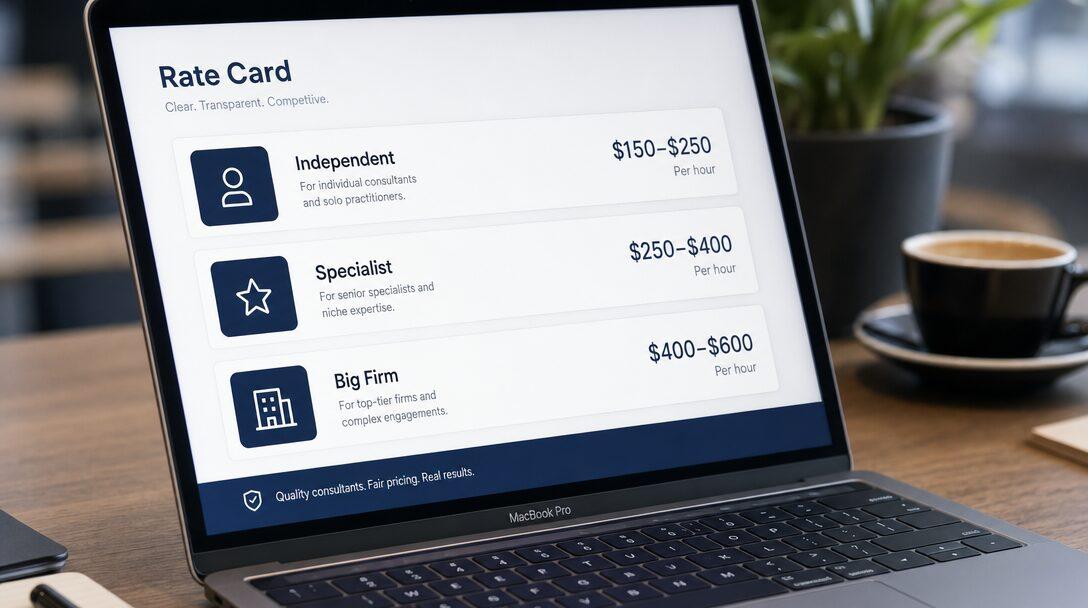
It can mean a two-hour strategy call. It can mean a 12-week custom agent build. It can mean a retained advisor who sits in on your leadership meetings. The price follows the shape of the work. There is no rate card.
Here's roughly what it looks like for a US business in the $1M-$15M range.
| Pricing model | Typical range | What you actually get | Best for |
|---|---|---|---|
| Hourly | $150-$500/hr | Ad-hoc advice, reviews, troubleshooting | A specific question or second opinion |
| Fixed-scope project | $5K-$50K | A defined deliverable (assessment, build, roadmap) | Knowing the cost before you start |
| Monthly retainer | $3K-$15K/mo | Ongoing access + execution capacity | Continuous work over months |
| Enterprise engagement | $40K-$80K+ | Multi-phase transformation programs | Large orgs with internal teams |
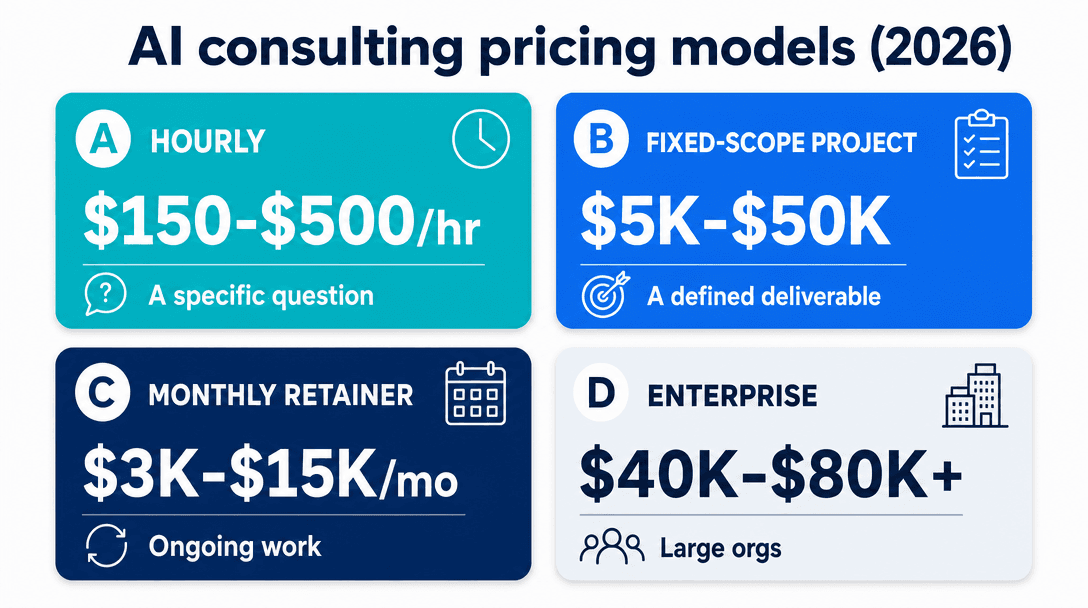
Independent consultants and boutiques cluster at the lower end. For a competent specialist, $200-$300/hr is normal. Big-name firms and "AI transformation" practices live in the enterprise tier, which is where most SMB owners get sticker shock.
Free scoping call
Turn your AI idea into a written plan
Tell us what you want AI to do. In 30 minutes we tell you plainly whether it will pay for itself, and what it would take to build.
Book a scoping call →What actually drives the cost
To judge whether a quote is fair, stop comparing it to other quotes and compare it to the work. Four things move the number more than anything else.
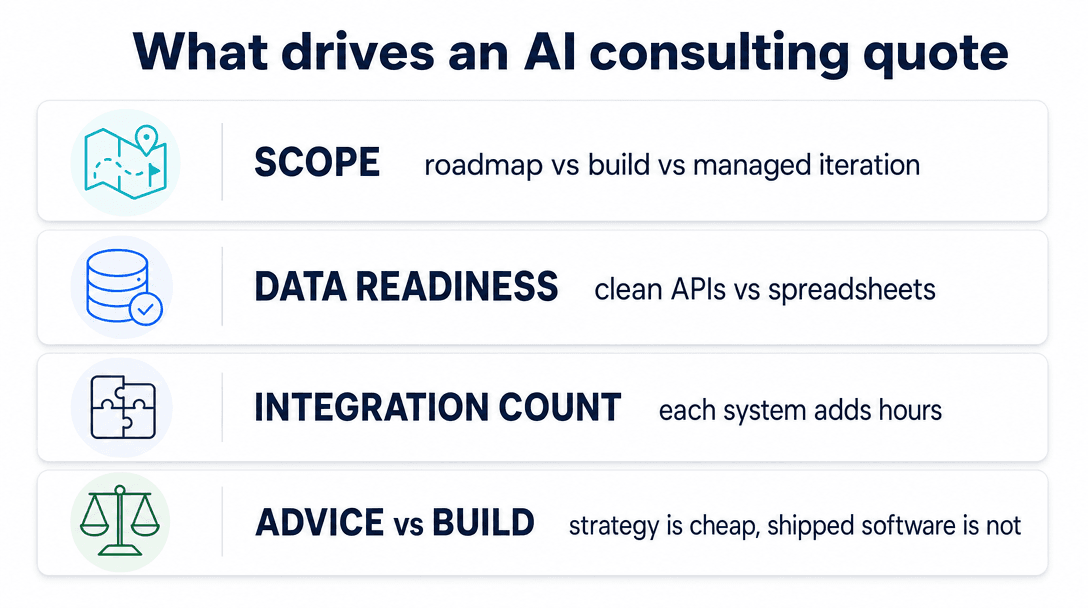
Scope is the first. A roadmap costs less than a build. A build costs less than a build plus six months of managed iteration. The single biggest reason quotes vary 10x is that they aren't quoting the same thing, and most buyers never make them spell it out.
Then there's data readiness. If your data is clean, accessible, and sitting in systems with APIs, the work goes faster and costs less. If it lives in spreadsheets, a legacy ERP, and three people's heads, a chunk of the budget goes to making it usable before any AI touches it. This is the cost people never see coming.
Integration count matters more than most buyers expect. Wiring up one system is cheap. Wiring up your CRM, your ops database, Slack, and a billing platform, each with its own auth, rate limits, and edge cases, is where the hours pile up. Ask any quote how many integrations it assumes.
And then there's the big one: advice versus a build. Pure advice (strategy, vendor selection, roadmaps) is the cheap end. A working custom system you own is the expensive end, because someone has to write, test, and ship software. A $40K quote for "strategy and a roadmap" buys you something very different from a $40K quote that ships a working agent. Same price, nowhere near the same value.
When two quotes are far apart, it's almost always one of these four. It's rarely one firm being greedy.
What most people get wrong
The mistake usually isn't paying too much. It's buying the wrong shape of engagement for the size of the business.
The $40K-$80K enterprise engagement is built for a company that has an internal data team, a change-management function, and the patience for a multi-quarter program. It's priced to cover the consultant's risk of working across a large, slow organization. If you're a 40-person professional-services firm, you're paying for overhead you don't have and slowness you can't afford.
A transformation program is rarely what an SMB owner needs. What you need is usually one well-scoped answer: where is AI worth the money in this specific business, and what should you build first? That's a fixed-scope question, and it should be priced like one.
The enterprise firm won't sell you that, because their model doesn't work at small contract sizes. So they wrap the small question inside a big engagement, and you pay enterprise rates for an SMB problem. Haggling won't fix it. Buying a different product will.
The value is real, but only when the engagement fits the business. A mismatch is how good money gets wasted on good consultants.
How to de-risk it before you commit
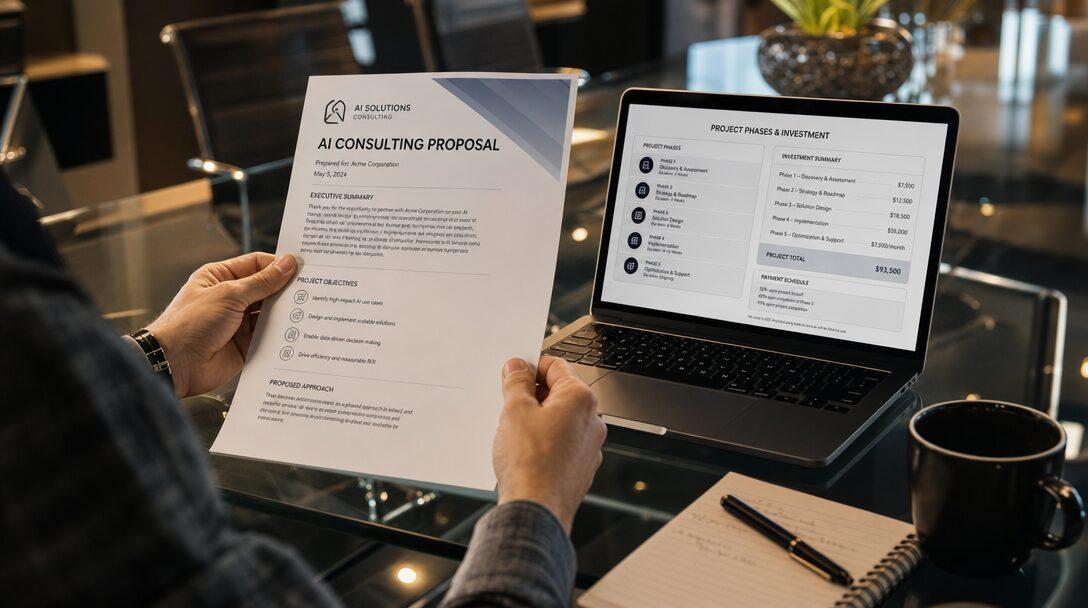
The most expensive AI consulting mistake is signing a large open-scope contract before anyone has defined what you're building. Negotiating the rate won't save you. Buying scope first, cheaply, as its own step, will.
A fixed-scope assessment does three things a $40K open engagement can't. It puts a hard number and a hard deliverable on the table, so you know what you're paying for. It surfaces your data and integration realities before they turn into budget surprises halfway through the project. And it tells you whether the answer is build, buy, or "you don't need a consultant for this yet."
That last one is the one people underrate. Sometimes the honest finding is that an off-the-shelf tool covers your need (this is where build vs buy AI goes deeper), and you've just saved yourself a six-figure build. A good assessment is allowed to talk you out of spending money. An open-scope engagement has no reason to.
A 20-minute scoping call is a sensible first step: we talk through the workflow you have in mind and tell you plainly whether it points to build, buy, or not yet. Then get the scope written down before anyone quotes. If the work is worth $40K, you'll know why, and you can take that scope to any firm and get a quote you can evaluate. If it's worth $8K, you found that out without signing a $40K contract first.
It's the cheapest way to turn a vague enterprise quote into a decision you can stand behind.
Hourly vs. project vs. retainer: which to pick
The pricing model should match how much certainty you have, not which sounds cheapest.
| Situation | Right model | Why |
|---|---|---|
| You have one specific question | Hourly | Pay only for the answer, no commitment |
| You know the outcome, not the path | Fixed-scope project | Caps your downside, forces a clear deliverable |
| You'll have ongoing work for months | Retainer | Cheaper per-hour, keeps context warm |
| You don't yet know what you need | Assessment first | Buy clarity before you buy execution |
Hourly feels safe but punishes you on anything multi-week: costs drift and there's no fixed endpoint. Retainers are efficient once the work is steady, and wasteful if you're not feeding the consultant enough to stay busy. For most first engagements I'd default to fixed-scope, because it forces both sides to agree on what "done" means before any money moves.
If you're not yet sure consulting is the right spend at all, start with whether it is worth it for a business your size. If you're weighing this against just hiring someone, it's worth working out when a salary beats a contract for your stage. And before you sign anything, know the questions that separate a real specialist from a rebranded generalist.
What US small businesses pay
For a US business in the $1M-$15M range, the realistic spend sits far below the enterprise quotes that grab attention. US-based independent AI consultants and boutiques bill $150-$300/hr; the $400-$500/hr tier is mostly large US firms pricing for enterprise buyers. A fixed-scope project for a US SMB (an assessment, a roadmap, or a single workflow build) typically lands at $5K-$50K, with monthly retainers at $3K-$15K.
The mismatch US small businesses keep running into: a national consulting firm quotes $40K-$80K for a transformation program built for companies with internal data teams and a change-management function. For a 40-person US firm, that's overhead you're not using and a timeline you can't afford. The cheaper, faster path is a US-based specialist on a fixed scope, or a scoped assessment first, so you walk into any quote already knowing what the work is worth.
How much does AI consulting cost for a small business in India?
For a small business in India, AI consulting from an established firm costs far less per hour than in the US, but the minimum engagement is still a real budget line. Clutch's directory of AI consultants in India lists most of its top firms at $25-$49/hr, a few specialists at $50-$99/hr or $100-$149/hr, and minimum projects of $10,000 or $25,000. The same directory puts typical engagements at $10,000-$49,000.
At ₹95.74 to the US dollar (the Wise mid-market rate on 14 September 2026), that works out to:
| Item | USD | INR (approx.) |
|---|---|---|
| Common hourly band | $25-$49/hr | ₹2,400-₹4,700/hr |
| Specialist hourly band | $50-$99/hr | ₹4,800-₹9,500/hr |
| Minimum project | $10,000 or $25,000 | ₹9.6 lakh or ₹24 lakh |
| Typical engagement | $10,000-$49,000 | ₹9.6 lakh-₹47 lakh |
For a small Indian company, those minimums matter more than the rate. If what you need is one answer or one workflow, a ₹9.6 lakh floor may be more than the problem is worth, so scope it narrowly first and ask whether the firm takes smaller fixed-scope projects. The four cost drivers above apply the same way in rupees: scope, data readiness, integration count, and advice versus build.
The bottom line
AI consulting in 2026 costs $150-$500/hr, $5K-$50K per project, $3K-$15K/mo on retainer, and $40K-$80K+ for enterprise programs. The right number for you comes down to scope, how clean your data is, how many systems get integrated, and whether you're buying advice or a build. That $40K quote isn't necessarily unfair. It's just often the wrong shape for a $1M-$15M business. Scope the work cheaply first, and every quote after that turns into something you can judge instead of guess at.
Next step: Book a 20-minute call before you commit to any large engagement, or read the full AI consulting overview to see how a fixed-scope approach replaces the open-ended enterprise model.
How much does an AI consultant charge per hour?+
Most competent AI consultants charge $150-$500/hr in 2026, with independent specialists and boutiques usually at $200-$300/hr. The $400-$500/hr end is typical for senior specialists at established firms, for niche work like applied ML or agent architecture, and for large US firms pricing for enterprise buyers. Outside the US the rate drops sharply: established AI consulting firms in India mostly list $25-$49/hr on Clutch, with a few specialists at $50-$149/hr. Hourly billing works well for a specific question, a second opinion on a vendor, or a short review where you want to be able to stop at any point. For anything that runs several weeks, a fixed-scope project at $5K-$50K usually costs less overall, because it caps the hours and forces both sides to define the deliverable. Before comparing rates, check what each consultant would deliver for them.
Is AI consulting worth the cost for a small business?+
AI consulting is usually worth the cost for a small business when it's a $5K-$50K fixed-scope project tied to one workflow, and usually not when it's a $40K-$80K enterprise transformation program. The enterprise program is built for companies with internal data teams and a change-management function, so a small business ends up paying for overhead and slowness it doesn't have. A single targeted build, such as automating one reporting process or qualifying inbound leads, often pays back inside a year. What decides it is whether the consultant can name a specific, measurable workflow they'll improve and how you'll measure it, rather than selling "AI strategy" in the abstract. Ask for the current cost of that workflow in hours or money before you sign. If nobody can put a number on it, the engagement has no way to show it was worth paying for.
Why do AI consulting quotes vary so much?+
AI consulting quotes for similar-sounding work can differ 10x, from $5K to $50K or more, because firms are rarely quoting the same deliverable. One firm prices a strategy roadmap while another prices a working custom build with six integrations, and both call it AI consulting. Four drivers explain most of the gap. Scope comes first: a roadmap costs less than a build, and a build costs less than a build plus months of iteration. Data readiness is next, since clean data in systems with APIs is quick to work with and spreadsheets or a legacy ERP are not. Integration count matters because each connected system brings its own auth, rate limits and edge cases. The last is advice versus build: strategy is the cheap end, shipped software you own is the expensive end. To compare quotes fairly, make each one list what gets delivered and how many integrations it assumes.
What's the cheapest way to start with AI consulting?+
A fixed-scope assessment instead of an open-ended engagement. Rather than signing a $40K contract to figure out what to build, you pay for a clear, defined deliverable that identifies your highest-ROI opportunity and recommends build, buy, or wait. A 20-minute scoping call is a low-commitment way to start. It's the cheapest way to get a scope you can defend before you spend real money on execution.
Do AI consultants charge a retainer or fixed fee?+
AI consultants charge both: fixed project fees usually run $5K-$50K, and monthly retainers $3K-$15K. A fixed fee suits work where you know the outcome you want and need a defined deliverable, because it caps your downside and puts the estimation risk on the consultant. A retainer makes sense once there's ongoing, steady work, such as iterating on a system that's already live, since the effective hourly rate drops and the consultant keeps your context warm. The risk with a retainer is drift: it continues by default, so set a review date, typically 90 days, and define what each month delivers. Hourly billing, at $150-$500/hr, fits one-off questions. For a first engagement, fixed-scope is usually the safer default, because it forces both sides to agree on what "done" means before any money moves.
Free scoping call
Turn your AI idea into a written plan
Tell us what you want AI to do. In 30 minutes we tell you plainly whether it will pay for itself, and what it would take to build.
Book a scoping call →About the author
- Tags
- ai consulting
- pricing
Subscribe to Our Newsletter
The AI Build Brief: practical playbooks on how to build, price and ship AI features, in one short email every other week.