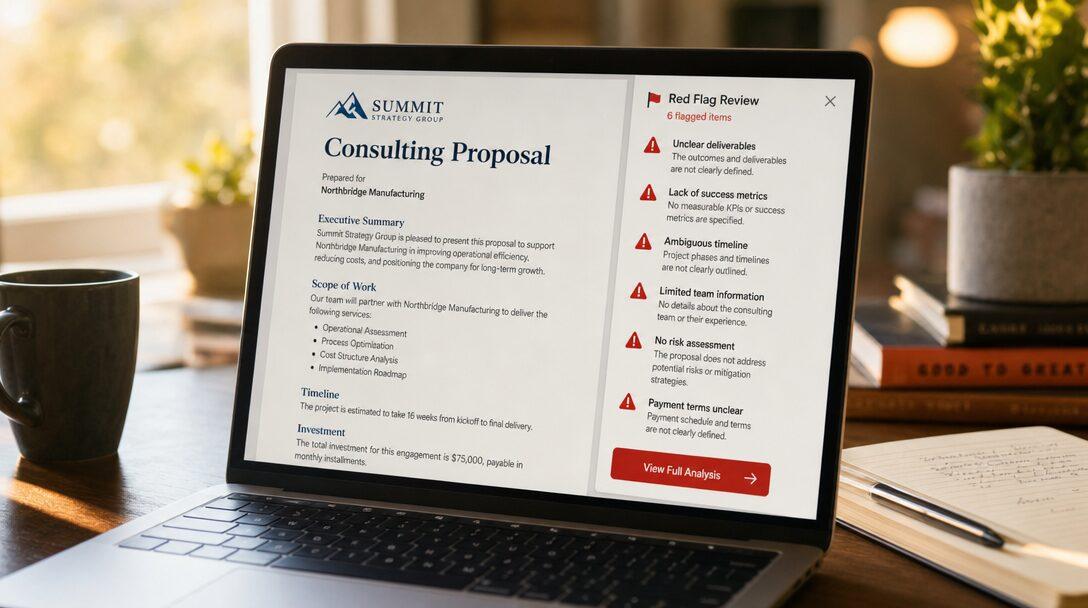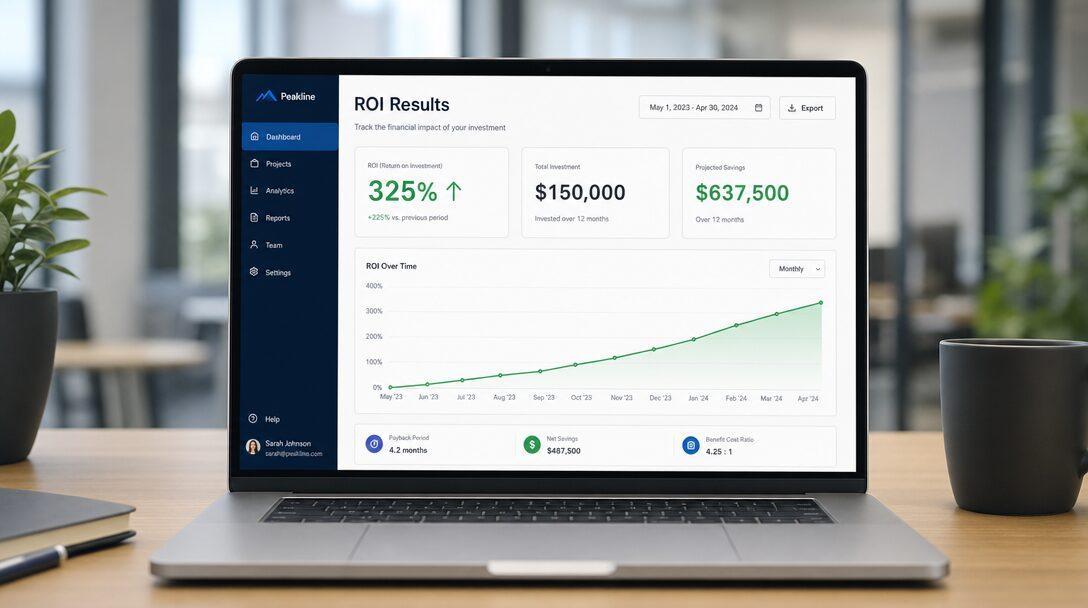
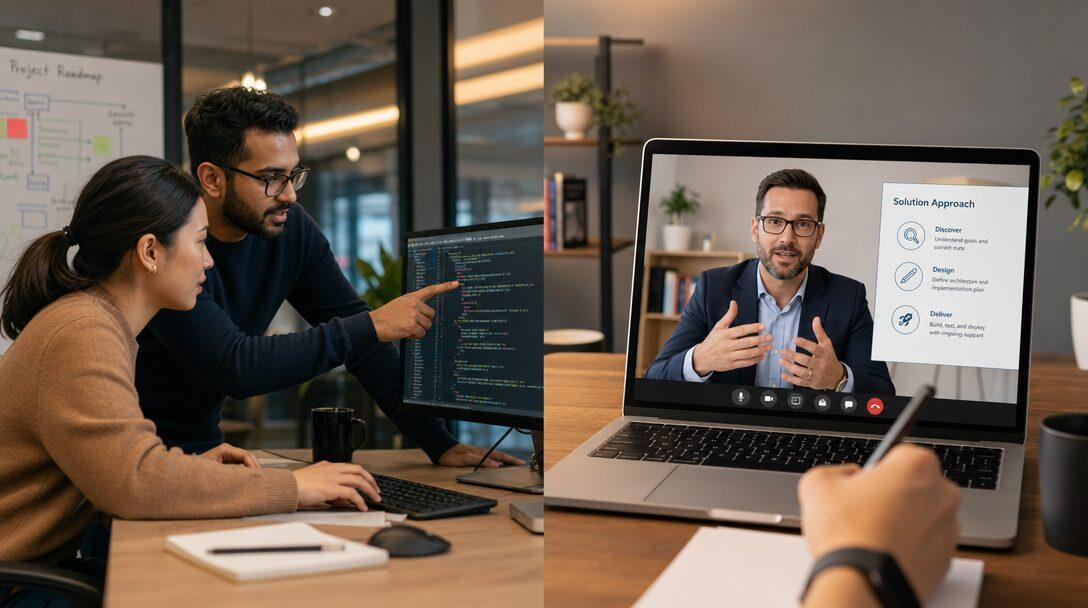
You've decided AI is worth real money to your business. Now you're staring at two job descriptions: post a $120K role and hire an AI engineer, or sign a fixed-scope consulting engagement. They look like the same decision. They're not even close.
TL;DR
- For $1M-$15M businesses, a consultant is faster and cheaper for the first 12-18 months. Hire in-house once you're at $30M+ with enough AI work to keep someone busy for years.
- That $120K base salary is really $160K-$200K once you add benefits, overhead, recruiting, and the 3-6 months of ramp before they ship anything.
- The hidden risk of hiring is single-skill exposure: one person's strengths become your ceiling, and a mis-scoped role means unwinding a full-time employee instead of ending a contract.
- A consultant gets you breadth and no ramp, and the cost stops when the work does. The catch is that the deepest knowledge of your system walks out with them unless you plan the handoff.
- The sequence that works for most SMBs: a consultant builds the roadmap and first system, then you hire in-house once the demand is proven and continuous.
Free scoping call
Turn your AI idea into a written plan
Tell us what you want AI to do. In 30 minutes we tell you plainly whether it will pay for itself, and what it would take to build.
Book a scoping call →The two options are not the same shape
An in-house hire is a bet on continuous demand. You're committing to a salary every month, forever, on the assumption that there will always be enough AI work to justify it. That's a great bet if you have a roadmap of ten projects. It's a terrible bet if you have one project and a vague hope of "more later."
A consultant is a bet on a specific outcome. You scope the work, agree on a price, and the cost ends when the work ends. You're not buying a person's time indefinitely. You're buying a result.
For a $1M-$15M business, the second shape almost always fits better at the start. You usually don't yet know how much AI work you actually have. You've got one or two painful workflows and a hunch that AI helps. That's not a roadmap. It's a starting point, and you don't hire a full-time employee to go explore a starting point. You bring in a consultant to turn the hunch into a plan.
What an in-house AI hire actually costs
The $120K on the job posting is the smallest part of the real cost. Here's what gets added once a person is on your payroll.
Benefits and overhead run roughly 30% on top of base. Payroll taxes, health insurance, the retirement match, software licenses, equipment, the seat itself. A $120K base is about $156K before they've written a line of code.
Recruiting is real money too. A specialist AI engineer is hard to find. A recruiter takes 15-25% of first-year salary, and even doing it yourself burns weeks of leadership time plus a few months of an open, advertised role going unfilled.
Then ramp, the cost nobody budgets for. A new hire needs 3-6 months to learn your business, your data, your systems, and your customers before their output is reliable. You pay full salary that whole time for partial output.
The last one catches everybody: single-skill exposure. You hire one person, you get one person's skill set. Maybe they're brilliant at model fine-tuning but shaky on the data plumbing and integrations that actually make a system production-ready. You don't find the gap until you're six months in.
Add it up and a $120K hire is realistically a $160K-$200K first-year commitment. That's before you account for the role being scoped wrong, at which point unwinding a full-time employee hurts a lot more than ending an engagement.
What a consultant actually gets you
A consultant skips the parts of the in-house cost that hurt most. There's no ramp, because they've shipped this kind of system before and week one is productive. No benefits, no overhead, no equity, no recruiting cycle. The cost is fixed and known up front, and it stops when the project ships.
The breadth matters more than people expect. A good consultant has seen lead qualification, support triage, document pipelines, and internal copilots across dozens of businesses. That pattern library is why they avoid the dead ends a first-time in-house hire walks straight into. (If you're weighing the price specifically, we break it down in how much AI consulting costs.)
One real trade-off: when the engagement ends, the consultant walks out with the deepest knowledge of your system in their head. Speed and breadth now, institutional knowledge later. You close that gap by making the handoff a deliverable: pretending the trade doesn't exist is how teams get stranded.
In-house vs. consultant: the honest comparison
| In-house AI hire | AI consultant | |
|---|---|---|
| First-year cost | $160K-$200K fully loaded | Fixed scope, $15K-$60K typical |
| Time to first output | 3-6 months (ramp) | Weeks |
| Skill coverage | One person's skill set | Breadth across many projects |
| Ongoing commitment | Permanent salary | Ends when the work ends |
| Recruiting/hiring risk | High; months to fill, hard to undo | None |
| Benefits, equity, overhead | ~30%+ on top of base | None |
| Institutional knowledge | Stays in-house | Leaves unless handoff is planned |
| Best fit | Continuous, multi-year roadmap | First 12-18 months, defined scope |
In-house wins on permanence. Once that person is ramped, their context compounds and they're always around for the next thing. A consultant wins on speed and reversibility. You get moving in weeks, and you're not married to a permanent cost before you know how big the opportunity actually is.
What most people get wrong
The common mistake is treating the in-house hire as the "serious" option and the consultant as a cheap shortcut. The instinct says owning the talent means owning the capability.
For a $1M-$15M business that's backwards. Hiring full-time before you have a proven roadmap is the riskier move, not the safer one. You're committing $160K+ a year on a bet that one person's particular skill set matches a body of work you haven't fully defined. Get the volume wrong, or get the skills wrong, and you don't have a project to cancel. You have an employee to manage out.
The second mistake is assuming a consultant means no knowledge stays behind. That's only true if you let it. Write scope documentation, code ownership, and a handoff session into the engagement, and the knowledge transfer becomes part of the deliverable. We cover this in what to know before hiring an AI consultant. The contract terms that protect you are the same ones that prevent the lock-out.
If you're still asking whether outside help is worth it at all, is AI consulting worth it walks through the ROI math directly.
The decision framework
Use a consultant when:
- You're under roughly $30M in revenue and don't yet have a multi-project AI roadmap.
- You have one or two specific, painful workflows and want them solved in weeks, not after a hiring cycle.
- You're not certain how much ongoing AI work you'll actually have.
- You want a fixed, reversible cost while you learn the shape of the opportunity.
Hire in-house when:
- You're at $30M+ revenue with a roadmap that will keep one person genuinely busy for years.
- AI is becoming core to your product or operations, not a set of bolt-on improvements.
- You need someone available daily for maintenance and the next idea, and the volume justifies a full salary.
- You've already validated demand with outside help and know exactly what skill set to hire for.
The line in the middle is continuous, multi-year demand. If you can honestly point to it, hire. If you're squinting to see it, don't bet a salary on it yet.
This is a close cousin of the build vs. buy AI decision. Both come down to scoping the actual work before you commit to a structure.
The hybrid path most SMBs should take
The two options aren't permanent rivals. They're a sequence.
Start with a consultant. They build the roadmap, deliver the first working system, and prove (or disprove) that there's real, recurring AI work in your business. That first engagement is also the cheapest, fastest way to find out whether a full-time role is justified at all.
Once there's a clear, ongoing pipeline of AI work, and I mean a pipeline, not a hope, you hire in-house to maintain and extend what's already running. By then you know exactly what skills to hire for, because you've watched the work get done. You've replaced a guess with evidence.
Take a mid-sized professional services firm. A fixed-scope engagement builds a document-processing pipeline. It runs in production for six months. Only then does a junior in-house engineer get hired to own and extend it. The consultant de-risked the hire, and the hire made the consultant's work permanent. Neither move alone would have been as smart as doing both in that order.
The bottom line
For a $1M-$15M business, the in-house AI expert vs. AI consultant question usually has a clear first answer: start with the consultant. It's faster, the cost is fixed and reversible, and you avoid betting a $160K-$200K salary on a roadmap you haven't proven yet. Hire in-house once continuous, multi-year demand is real, ideally after a consultant has shown you what that demand actually looks like. Speed first. Permanence once it's earned.
Next step: A consultant gets you moving in weeks, not the months an in-house hire needs to find, sign, and ramp. See how AI consulting works, or start with the lower-risk 20-minute scoping call to find your highest-ROI opportunity before you commit to either path.
Should I hire an in-house AI expert or a consultant?+
For most $1M-$15M businesses, start with a consultant. You usually don't have a proven, multi-year AI roadmap yet, and a fixed-scope engagement gets a real system shipped in weeks at a cost that ends when the work ends. Hire in-house once you have continuous demand that genuinely keeps a full-time person busy, which usually shows up around $30M+ in revenue. The decision hinges on whether you can point to ongoing work or just a one-off project.
How much does an in-house AI engineer cost?+
The base salary is usually $120K-$180K, but that's the smallest part. Add roughly 30% for benefits and overhead, another 15-25% of first-year salary in recruiting, and 3-6 months of ramp where you pay full salary for partial output. Fully loaded, a $120K hire realistically costs $160K-$200K in year one. And that's before you factor in the risk that the role was scoped wrong and is now hard to unwind.
When does it make sense to hire AI in-house?+
When you're at roughly $30M+ revenue with an ongoing AI roadmap that keeps one person busy for years, and AI is becoming core to your product or operations rather than a few bolt-on improvements. It also helps to have validated demand first, ideally through a consultant, so you know exactly what skill set to hire for. If you're squinting to find continuous, multi-year work, it's too early to commit to a permanent salary.
Can a consultant transfer knowledge to my team?+
Yes, if you plan for it. The honest downside of a consultant is that the deepest knowledge of your system can leave with them. You prevent that by making the handoff a deliverable: scope documentation, full code ownership, and a knowledge-transfer session written into the engagement. Get those in the contract up front and the institutional knowledge stays with your team even after the consultant is gone.
What's the fastest way to get AI moving without a full-time hire?+
A fixed-scope consulting engagement. No recruiting cycle, no 3-6 month ramp, no permanent salary commitment. A consultant who has shipped similar systems is productive in week one. For an even lower-risk first step, a 20-minute scoping call identifies your highest-ROI opportunity first, so you know what to build before you spend on a build or a hire.
Free scoping call
Turn your AI idea into a written plan
Tell us what you want AI to do. In 30 minutes we tell you plainly whether it will pay for itself, and what it would take to build.
Book a scoping call →About the author

- Tags
- ai consulting
- ai strategy
Subscribe to Our Newsletter
The AI Build Brief: practical playbooks on how to build, price and ship AI features, in one short email every other week.