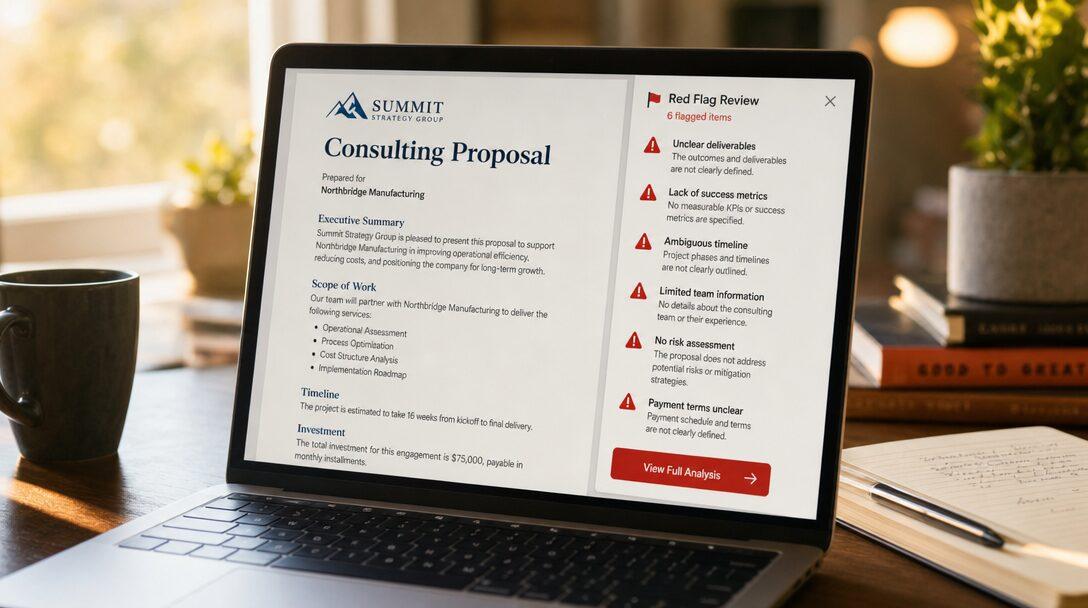
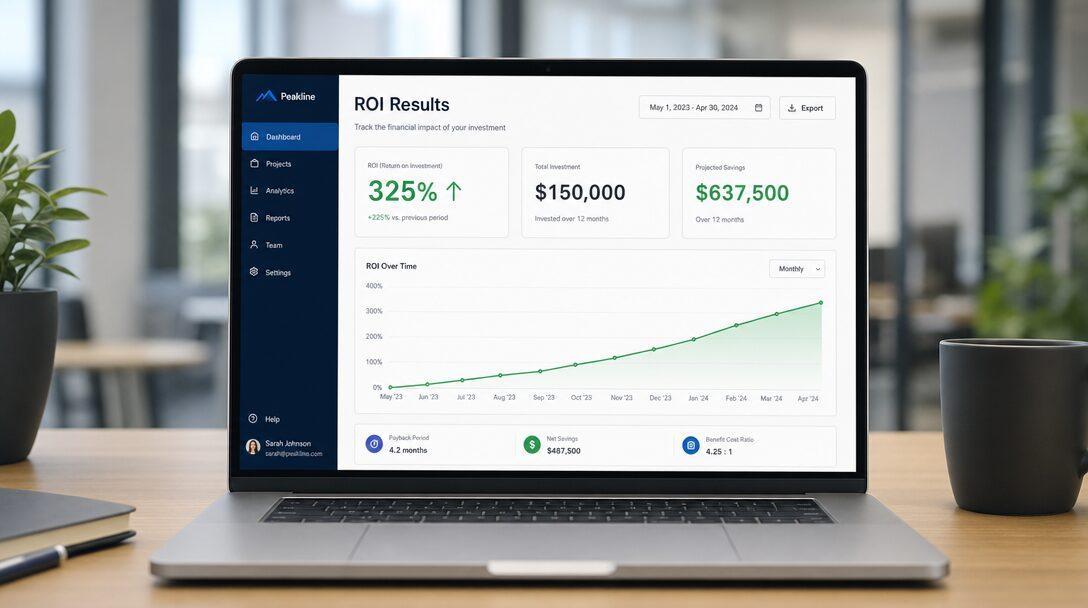
An enterprise firm quoted you $40K, maybe $80K. You walked, and you were right to. But notice why you walked: not because you doubt AI works. You walked because the price made no sense against a problem you couldn't fully describe yet. Good instinct. It answered a different question than the one that actually matters.
TL;DR
- "Is AI consulting worth it" is the wrong question. Ask whether your problem is the right shape for AI: that's what decides the ROI.
- For operations-heavy $1M-$15M businesses, a tightly scoped engagement on one repetitive, high-volume workflow usually pays back 3-10x in year one.
- AI is worth it when your bottleneck is repetitive work like document classification, lead qualification, or report generation. It's not worth it when your bottleneck is sales, pricing, or whether anyone wants what you sell.
- Consulting doesn't have to mean a six-figure retainer and a slide deck. A fixed-scope engagement on one workflow is a completely different product.
- Get the problem scoped before you spend $40K. A 20-minute scoping call tells you whether it's worth solving with AI at all.
Free scoping call
Turn your AI idea into a written plan
Tell us what you want AI to do. In 30 minutes we tell you plainly whether it will pay for itself, and what it would take to build.
Book a scoping call →It's not "is it worth it," it's "is my problem the right shape"
ROI from AI consulting doesn't come from the consultant. It comes from the workflow you point them at. The same engagement can return $200K or nothing, depending on what you ask it to fix.
So "is AI consulting worth it for a small business" has no general answer. Asking it is like asking whether hiring a contractor is worth it without saying if you've got a leaky faucet or a cracked foundation. Depends entirely on the job.
The job has a shape. Some problems fit AI almost perfectly: high-volume, text-heavy, the same task done over and over. Others look like AI problems on the surface, but underneath they're sales problems or pricing problems. Which kind you actually have is what matters: everything else follows from that.
Get it right and the math takes care of itself. Get it wrong and it doesn't matter how good the consultant is.
Which problem shapes are worth it
AI earns its keep when work is repetitive, high-volume, and currently burning hours you can put a number on. The clearest fits tend to cluster around a few categories.
Document processing is where AI consistently outperforms expectations. Invoices, contracts, intake forms, insurance claims: anything where someone reads a document and types values into a system all day. If you can describe the task that way, you're close to a perfect fit. The accuracy rates on structured extraction are high enough that you're genuinely replacing labor, not assisting it.
Lead qualification is another strong case. Inbound inquiries scored and routed, rather than a person manually triaging a queue. Once a system like this is running, the question of who should own it long-term comes up fast, and in-house AI expert vs consultant covers that tradeoff directly.
Report generation (weekly ops summaries, client-facing updates, proposal drafts assembled from your data) works well wherever inputs are structured and outputs follow a predictable pattern. The first build takes time; after that, the marginal cost per report approaches zero.
Support triage rounds out the list: first-pass categorization and response drafting, with your team handling anything the model flags as unclear.
The way to check if you have one of these: can you name the person doing the task, describe it in a single sentence, and count the hours per week without hesitation? If yes, you probably have an AI problem worth scoping. If you need a longer explanation, the task is usually messier than it looks and the build estimate will reflect that.
Which problem shapes aren't worth it
This is where most money gets wasted: pointing AI at a problem that isn't shaped like an AI problem.
Skip the consulting engagement when:
- Your bottleneck is sales. If leads aren't closing, the problem is your offer, your pitch, or your follow-up process. Automating a broken sales process just produces broken outcomes faster.
- Your bottleneck is pricing. Thin margins aren't a unit-economics problem any model can fix. That's a positioning call.
- You don't have product-market fit yet. If customers aren't sure they want what you sell, efficiency is the wrong lever. You need demand before you need throughput.
- The volume isn't there. A task you do five times a month rarely justifies a build, however annoying it is. ROI scales with frequency.
If your real constraint is on that list, the honest advice is to not hire an AI consultant yet. Fix the constraint first. A good consultant will tell you exactly that and walk away from the deal, which is, incidentally, one of the better tests for whether you're talking to the right one. What to know before hiring an AI consultant covers how to read the signals.
What most people get wrong
The biggest mistake isn't picking a bad consultant. It's assuming "AI consulting" means one thing: a big retainer, a discovery phase, a deck, and a roadmap you're then left to implement yourself.
That's the enterprise model. It exists because enterprises can afford to pay for thinking and keep the headcount to do the building. A $1M-$15M business has neither. When one gets quoted $40K to $80K, it's being sold a product built for a different buyer.
There's another model. Fixed-scope engagements that target one workflow, ship working software, and end. You pay for a result, not for a quarter of someone's calendar, and you're not handed a slide deck to act on yourself. That's what AI consulting should look like for an operator your size, which is why the enterprise quote couldn't answer whether consulting is worth it. You were pricing the wrong product.
The second mistake is treating the consulting fee as the input to the ROI math. It isn't. The input is the value of the workflow you're fixing. A $25K engagement that recovers $150K a year in labor is a 6x return whether the fee was $25K or $35K. Fixating on the fee while ignoring the prize is how people talk themselves out of good decisions.
The actual ROI math
You can run these numbers before you talk to anyone.
Pick one workflow. Count the hours your team spends on it per week. Multiply by your loaded hourly cost: salary plus overhead, typically 1.3-1.5x base pay. Annualize it. That's the prize. Then set a realistic fixed-scope engagement cost next to it.
| Workflow | Hours/week | Loaded rate | Annual cost today | AI can recover | Recovered value/yr | Engagement cost | Year-1 ROI |
|---|---|---|---|---|---|---|---|
| Manual lead qualification | 10 | $55 | $28,600 | ~80% | ~$22,900 | $18K | 1.3x |
| Invoice/document data entry | 25 | $45 | $58,500 | ~85% | ~$49,700 | $22K | 2.3x |
| Weekly report generation | 12 | $70 | $43,700 | ~75% | ~$32,800 | $15K | 2.2x |
| Combined ops workflow | 40 | $55 | $114,400 | ~80% | ~$91,500 | $30K | 3.0x |
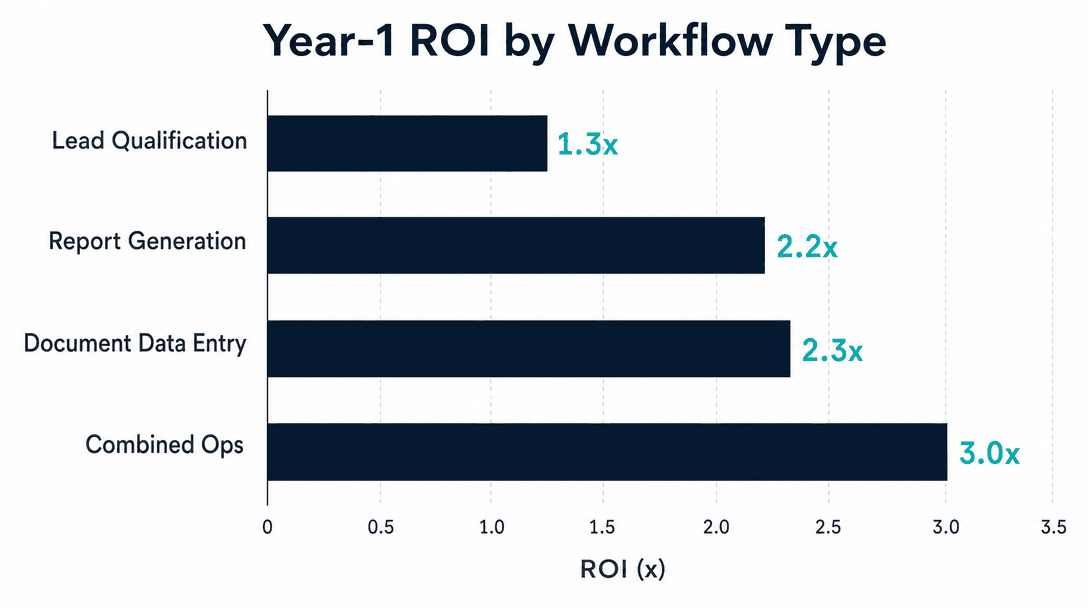
Even the conservative single-workflow cases clear 1.3-2.3x in year one, and the build keeps paying in year two with no new fee. The bigger lever is what happens to the recovered hours. Stack a few workflows, or move those hours into revenue work instead of eliminating them, and returns compound fast. A rep who stops triaging leads and starts closing them is worth considerably more than the triage hours you recovered.
The cases that hit 5-10x are the high-volume ones. A 40-person firm running 25-plus hours a week of document processing can erase a recurring six-figure cost with one build. That's the shape worth looking for. For a fuller breakdown of typical fees, see how much AI consulting costs.
How to find out before you spend on consulting
You don't have to guess at the shape of your problem, and you definitely shouldn't pay $40K to find out.
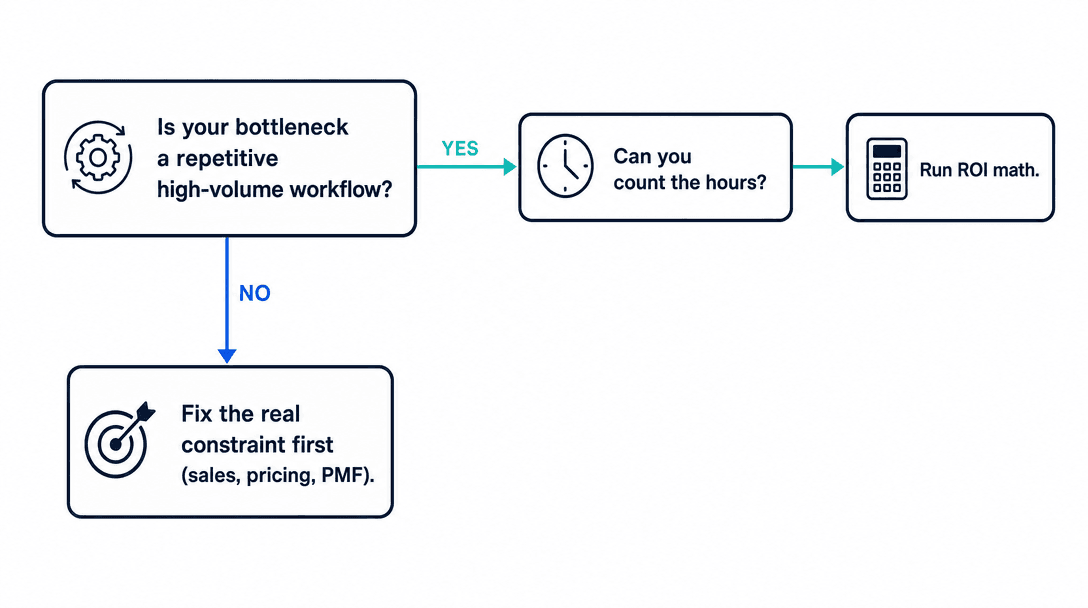
That's what a 20-minute scoping call is for. On the call we go through your operations and give you a recommendation. It names your highest-ROI workflow, runs the recovery math against your real numbers, and tells you straight whether your problem is the right shape for AI, or whether your bottleneck sits somewhere a model can't reach. If the verdict is "this isn't an AI problem," you learned it in 20 minutes instead of on a $40K project.
If it's "yes, and here's the workflow worth $90K a year," you now have something most buyers never walk into a consulting conversation with: a scoped problem and a number on it. After that, the downstream decisions get easier. Build vs. buy, in-house vs. consultant, which firm to approach. (On that first fork, see build vs buy AI.)
Most clients who come to us have already paid for something that didn't fit. That call is what they should have made first.
The bottom line
There's no universal answer to "is AI consulting worth it for a small business," and anyone who gives you one without asking about your specific operations is guessing.
What there is: a concrete test. Does your business have a specific, repetitive, high-volume workflow with a headcount cost you can calculate? If yes, a well-scoped engagement on that one workflow very likely pays back 3-10x in year one. If your real constraint is sales, pricing, or whether anyone wants the product, automation doesn't help.
The fee was never the variable. The shape of your problem was. Find that out first (cheaply, with a real number) and the rest of the decision takes care of itself.
Is AI consulting worth it for a small business?+
It's worth it when you have an operations bottleneck shaped like an AI problem: repetitive, high-volume work that's eating hours you can count, like document processing, lead qualification, or report generation. For $1M-$15M businesses with the right workflow, a fixed-scope engagement usually returns 3-10x in year one. It's not worth it when your real constraint is sales, pricing, or product-market fit, because AI can't fix any of those. The deciding factor isn't the consultant's fee. It's the shape of the problem you point them at.
What ROI can a small business expect from AI?+
Run the math on one workflow. Hours spent per week, times your loaded hourly cost, annualized. That's the prize. A typical single-workflow build recovers 75-85% of those hours and pays back 1.3-2.3x in year one, then keeps returning value in year two with no new fee. High-volume cases (25-plus hours a week of repetitive work) can hit 5-10x. Returns compound further when the recovered hours go to revenue work instead of just disappearing.
When is AI consulting NOT worth it?+
When your bottleneck isn't a workflow problem. If leads aren't closing, that's a sales problem. If margins are thin, that's a pricing problem. If customers aren't sure they want your product, that's a product-market-fit problem. Automating any of these just makes a broken process run faster. AI also isn't worth it when the volume is too low. A task you do a handful of times a month rarely justifies a build. A good consultant will tell you to fix the underlying constraint first and walk away from the deal.
How do I know if my business is ready for AI?+
You're ready when you can name a specific, repetitive workflow, count the hours it eats, and attach a dollar figure to those hours. If you can't describe the workflow precisely ("we want AI for efficiency" doesn't count), you're not ready to scope a build and no quote will be accurate. Readiness is about having a defined, high-volume problem with a measurable cost, not about company size or technical maturity.
Is a scoping call worth it before hiring a consultant?+
Yes. A 20-minute scoping call tells you whether your problem is the right shape for AI and which workflow has the highest ROI, with the recovery math run against your real numbers. If the answer is "this isn't an AI problem," you've avoided a $40K mistake. If it's "yes, here's the workflow worth $90K a year," you walk into any consulting conversation with a scoped problem and a number attached, which is the one thing most buyers don't have.
Free scoping call
Turn your AI idea into a written plan
Tell us what you want AI to do. In 30 minutes we tell you plainly whether it will pay for itself, and what it would take to build.
Book a scoping call →About the author

- Tags
- ai consulting
- ai strategy
Subscribe to Our Newsletter
The AI Build Brief: practical playbooks on how to build, price and ship AI features, in one short email every other week.