There are a lot of people who can talk about AI and not many who can ship something that works. Finding a consultant is easy. The hard part is telling apart the one who'll hand you a working system from the one who'll hand you a slide deck and an invoice.
TL;DR
- The best single filter is one question: "What's the acceptance criteria for this engagement?" A real consultant answers in numbers. A deck-seller changes the subject.
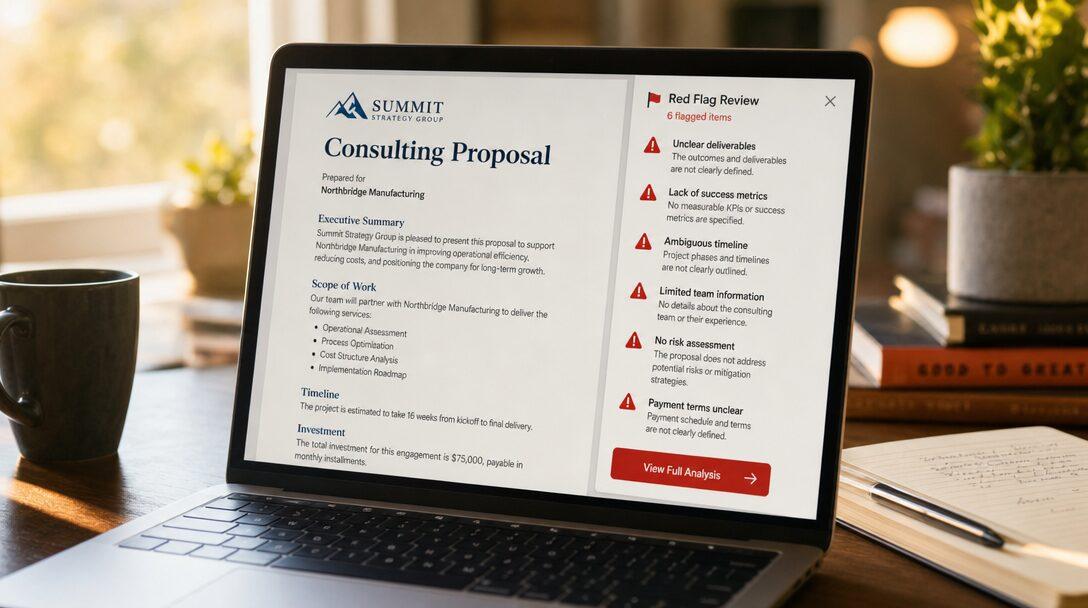
- Red flags: vague deliverables, no fixed scope, no refund policy, jargon with no business number attached, can't show prior work, wants a long retainer before delivering anything.
- Green flags: fixed scope, prior work in your industry, real references, written acceptance criteria, and a recommendation to start with the smallest useful step.
- Don't start with a big open-ended retainer. Start with a small fixed-scope paid assessment and judge the thinking before you commit budget.
- A 20-minute scoping call is a cheap way to see how a consultant actually thinks before any large commitment.
Free scoping call
Turn your AI idea into a written plan
Tell us what you want AI to do. In 30 minutes we tell you plainly whether it will pay for itself, and what it would take to build.
Book a scoping call →Why this is hard to get right
Say you're buying AI for the first time. You've got two or three vendors on a shortlist, and every one of them sounds confident. They all use the same words: agents, RAG, automation, ROI. But the words are free. Anyone can say them. What actually separates a real consultant from a deck-seller is whether they'll commit to a specific outcome in writing, at a fixed price, with a way out if they miss.
Most buyers don't know what to look for, so they default to the cheapest quote or the smoothest pitch. Both are bad proxies. The smoothest pitch usually comes from whoever has sold this deck the most times. The cheapest quote usually means the scope is undefined, and undefined scope balloons later.
You don't need to understand the technology to size up the person. You need to know which questions force a real answer.
Red flags vs. green flags
If a vendor lands mostly in the left column, walk.
| Signal | Red flag (deck-seller) | Green flag (real consultant) |
|---|---|---|
| Deliverables | "Strategy," "roadmap," "transformation," no nouns you can point at | A named system, document, or working feature you can use |
| Scope | Open-ended, "we'll figure it out as we go" | Fixed scope written down before any payment |
| Pricing | Large retainer required up front, no milestones | Fixed price tied to a defined outcome, or staged milestones |
| Refund / exit | None offered, won't discuss it | Clear terms if acceptance criteria aren't met |
| Language | Jargon with no business number attached | Talks in hours saved, errors reduced, revenue moved |
| Prior work | Can't show anything, "it's all confidential" | Anonymized case studies, demos, or references |
| First step | Wants a 6-month commitment before delivering anything | Recommends the smallest useful build first |
| Acceptance criteria | Deflects when asked | Answers in measurable terms, on the spot |
None of these is fatal on its own. Confidentiality is real, and some consultants can't share named clients. But when someone can't show any evidence of prior work, won't fix scope, and won't put acceptance criteria in writing, that's a pattern, not a coincidence.
The one question that separates real consultants from deck-sellers
One question cuts through the rest: "What's the acceptance criteria for this engagement?"
A real consultant answers without flinching, in terms you can measure. Something like: "Lead qualification time drops from 8 hours a week to under 1, the system routes correctly on 95% of test cases, and it's running in your CRM by week six." That's a sentence you can hold them to.
A deck-seller pivots. They'll start talking about alignment, or enablement, or a phased approach to capability building. Notice what's missing: a number, a date, a thing that either exists or doesn't at the end.
A consultant who won't write down acceptance criteria has given the engagement no definition of done. No definition of done means no definition of failure, so you can't actually tell whether you got what you paid for. What you've bought instead is a relationship, which is what people sell when they can't promise a result.
The questions to ask before you sign anything
The answers matter less than whether they answer at all.
- What's the acceptance criteria for this engagement? The one that matters most. It should be measurable, dated, and specific, or it isn't real.
- What exactly will I have at the end? A working system, a document, a trained team. A noun, not "transformation."
- What's the fixed price and what's included? If they can't price a defined scope, the scope isn't defined.
- What's the smallest first step you'd recommend? Real consultants shrink the first commitment. Deck-sellers grow it.
- Can you show me something you've built or shipped? A demo, an anonymized case study, a reference in your industry. Anything real.
- What happens if it doesn't hit the acceptance criteria? You want to hear about a refund, a fix-it clause, or staged payments. A shrug is the wrong answer.
- Who actually does the work? The person pitching, or a subcontractor you'll never meet?
- What do you need from me, and how many hours? Honest consultants name your time cost. Optimists pretend you have none.
- How do you handle scope changes? A written change process means they've done this before and got burned at least once.
You're not testing AI knowledge here. You're testing whether they'll commit to specifics. The questions about how much AI consulting costs and whether AI consulting is worth it get a lot easier once you can tell who's actually going to deliver.
What most people get wrong
The usual advice is to hire the most experienced, most credentialed consultant you can afford and put them on a long retainer so they can "really get to know your business." For AI work in a $1M-$15M company, that's backwards.
A long open-ended retainer is the worst possible first engagement. It pays the consultant for staying rather than for delivering, it loads your risk up front before you've seen anything work, and it makes leaving expensive and awkward once you realize the slides aren't turning into software.
So commit as little as you can at first. A small fixed-scope paid assessment tells you more about a consultant in two weeks than a six-month retainer does in two months, because the assessment forces a deliverable and the retainer doesn't.
And credentials don't predict delivery. Plenty of people with impressive titles have never shipped a production system. What predicts delivery is a track record of shipped work and a willingness to be measured on it. Hire for that, not for the resume.
Why a small paid assessment beats a big retainer
The smartest first engagement is the smallest one that still produces something real. Here's the comparison every first-time buyer should see.
| Criteria | Big open-ended retainer | Small fixed-scope assessment |
|---|---|---|
| Up-front commitment | $5K-$20K/mo, months long | A few hundred to a few thousand, once |
| Your risk before any result | High; you pay before you see | Low; defined deliverable, defined price |
| What you get | Meetings, decks, "alignment" | A specific document or working artifact |
| How you judge the consultant | Slowly, after spending a lot | Fast, on a real output |
| Exit if it's not working | Expensive and awkward | Built in; the engagement just ends |
| Incentive it creates | Reward for staying | Reward for delivering |
A fixed-scope assessment earns its keep two ways. It produces something you can use, like a prioritized opportunity or a scoped build with real numbers attached. And it lets you watch how the consultant thinks and writes before you hand over a budget. If the assessment is sharp and honest about trade-offs, that's your signal to go bigger. If it's a recycled deck with your logo dropped on it, you've lost a small fee instead of a quarter.
This is why a scoped first step matters. Ask for a written assessment before a build: where AI actually moves the needle in your operations, what to build first, and the math behind the recommendation. Fixed scope, fixed deliverable, fixed timeline, which is the standard you should hold any AI consulting engagement to. Use it to read how a consultant thinks before you commit to anything large. If the thinking is good, you'll know. If it isn't, you found out on a small piece of work instead of a retainer.
Once you've picked a direction, in-house AI expert vs. consultant and build vs. buy AI cover the decisions that come next.
The bottom line
It really does come down to one question: will they commit to a measurable outcome in writing, at a fixed price, with a way out if they miss? Ask for the acceptance criteria and watch whether they answer in numbers or in adjectives. Start small with a fixed-scope paid assessment, judge the thinking, then scale the commitment if it earns it. The consultants worth hiring won't mind any of this. Being measured is how they win the work.
Next step: Start with a small, fixed-scope deliverable. A 20-minute scoping call gets the problem defined, and shows you how a consultant should think before you commit to anything bigger. When you're ready to go further, AI consulting starts from the same place: a written scope with defined outcomes and acceptance criteria, an estimate of effort, and weekly visibility once the work begins.
What should I ask before hiring an AI consultant?+
Lead with: "What's the acceptance criteria for this engagement?" A real consultant answers in measurable terms, like hours saved, error rates, or a dated deliverable. After that, ask what you'll actually have at the end, what the fixed price includes, what the smallest sensible first step is, whether they can show prior work, and what happens if they miss the criteria. The answers matter less than whether they'll commit to specifics at all.
What are red flags in an AI consultant?+
The big ones: vague deliverables ("strategy" or "transformation" with no nouns under them), no fixed scope, no refund or exit terms, jargon with no business number attached, an inability to show any prior work, and a push for a long retainer before delivering anything. One of these alone might be explainable. All of them together is a deck-seller, not a builder.
How do I know if an AI consultant is legit?+
Legit consultants commit to measurable outcomes in writing, fix their scope and price, and can point to something they've actually shipped, even if it's anonymized. They recommend starting small, and they're honest about how much of your own time the project will eat. If someone deflects on acceptance criteria, won't fix scope, and can't show evidence of prior delivery, treat that as your answer.
Should an AI consultant offer a fixed scope?+
Yes, at least for the first engagement. A fixed scope means the consultant understands the problem well enough to define "done," and it caps your risk. Open-ended scope almost always balloons in cost and timeline. If a consultant can't fix the scope, it usually means the scope isn't defined yet, in which case you're paying to discover it on the clock. Start fixed, expand later if the work earns it.
What's a safe first engagement with an AI consultant?+
The smallest fixed-scope, fixed-price piece of work that produces something real: a prioritized opportunity assessment, a scoped build plan, or one working feature. It caps your downside at a known number and lets you judge the consultant's thinking on an actual deliverable before committing budget. A 20-minute scoping call is built for exactly this: a fixed scope, a fixed number, and a written deliverable.
Free scoping call
Turn your AI idea into a written plan
Tell us what you want AI to do. In 30 minutes we tell you plainly whether it will pay for itself, and what it would take to build.
Book a scoping call →About the author

- Tags
- ai consulting
- ai strategy
Subscribe to Our Newsletter
The AI Build Brief: practical playbooks on how to build, price and ship AI features, in one short email every other week.