
"Conversational AI platform" is the phrase a vendor uses when "chatbot" sounds too small. It signals something more capable, more enterprise, more permanent. What it describes is a specific commercial arrangement: someone else owns the logic that talks to your customers, and you pay them every month for the privilege of configuring it. That may be exactly the right deal for you. It may also be the reason your bill triples in year two while the one thing you needed it to do stays impossible.
TL;DR
- A conversational AI platform is a hosted product you configure. A custom chatbot is a system you own. Both can run the same models. What differs is who controls them.
- Platforms win on speed and year-one cost: live in days, no build fee, a managed console.
- Custom builds win on ownership and cost at volume: a fixed fee, then cents per conversation instead of a per-resolution markup.
- The deciding question is not "which is better" but "will I hit the platform's ceiling before the contract renews?" Integration depth and volume are what push you into it.
- Under ~500 conversations a month with standard support content, buy the platform. Above a few thousand, or with real system integration, build.
Free scoping call
Turn your AI idea into a written plan
Tell us what you want AI to do. In 30 minutes we tell you plainly whether it will pay for itself, and what it would take to build.
Book a scoping call →The short answer
A conversational AI platform is a hosted product: you upload content, configure rules, and the vendor owns the underlying logic. A custom chatbot is built against your systems, and you own the retrieval logic, escalation rules, data boundaries and model choice. Platforms cost $0 upfront and roughly $300-$2,000+/month depending on volume; custom builds run $15K-$40K once, then a few cents per conversation. Choose the platform when your use case is standard support over help-center content at low volume. Choose the build when the bot must read or write to internal systems, volume runs into the thousands per month, or the conversation has to follow logic only your business has.
What a conversational AI platform gives you
Strip the category name back and a platform is four things bundled together: a chat widget, a hosted language model, an admin console, and a library of connectors.
You upload your help center. You set a tone, a few escalation rules, and maybe some canned flows for things like refunds or password resets. You paste a snippet into your site header. Within a few days, customers are getting answers.
That speed is the main thing you are buying. There is no procurement cycle for infrastructure, no engineer writing retrieval code, no decision about which model to use. The vendor has already made every one of those decisions, and for a standard support use case they have usually made them competently.
What you are also buying, whether or not the sales call mentions it, is a ceiling. The platform will do the things the console exposes. It will not do the things the console does not expose, and no amount of budget changes that in the short term. If your escalation logic needs to check inventory in an ERP the vendor has never heard of, you file a feature request and wait.
What a custom build gives you instead
A custom build inverts every one of those trades. Nothing works on day one. There is no console until someone builds it. The first four to eight weeks produce no customer-facing value at all.
In exchange, every decision the platform made for you becomes yours. Which model answers which type of question. What the bot is allowed to read, and from where. When it escalates, and what context it hands the human. Whether a conversation can trigger a write into your CRM, and under what approval rule. Where the data sits.
The important thing here is not that custom is more powerful in the abstract. On a plain "what are your business hours" question, a platform and a custom build produce an identical answer, and the platform produced it eight weeks earlier for free. Custom only earns its cost where the question is specific to your business and the answer lives somewhere a generic connector cannot reach.
If you want the full breakdown of what drives that build number, the AI chatbot cost guide walks through the ranges line by line.
The five differences that decide it
Most comparison tables in this category compare features. Features converge. Every vendor ships the same capabilities within about two quarters of each other. These five differences do not converge, because they are structural.
| Conversational AI platform | Custom AI chatbot | |
|---|---|---|
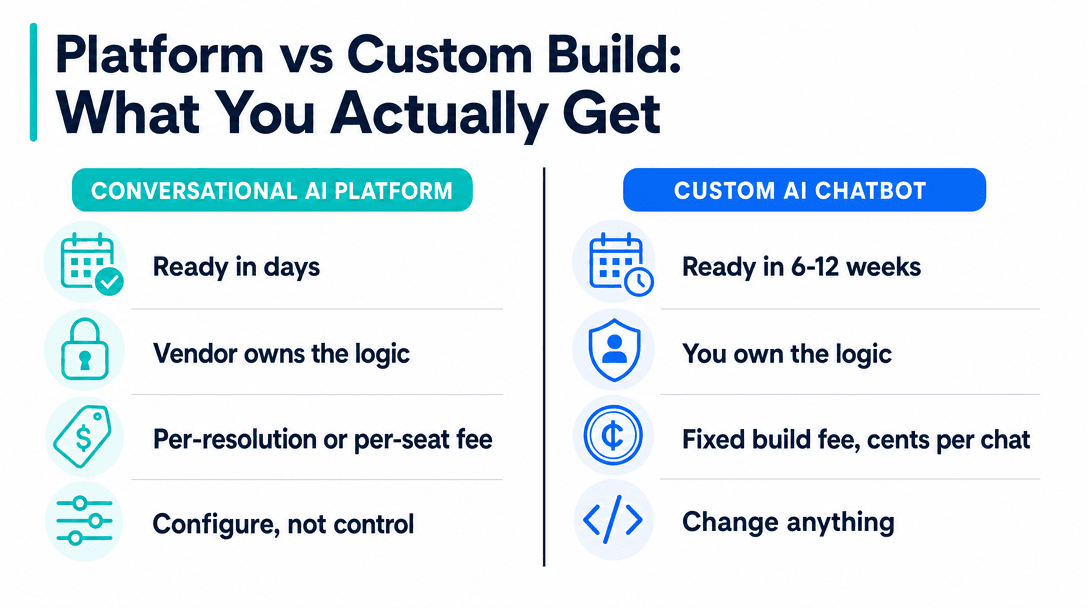
| Time to first answer | Days | 6-12 weeks |
| Who owns the logic | Vendor | You |
| Cost shape | Recurring, scales with usage | Fixed build, then cents per conversation |
| Integration ceiling | The connector library | Anything with an API |
| What happens if you leave | Configuration is lost | The system is yours |
The last row is the one buyers underweight. Configuration is not portable. Two years of tuned intents, escalation rules and content mappings live inside the vendor's product, and none of it comes with you. That is not a criticism of platforms; it is how hosted software works. But it does mean the switching cost you will face in year three is invisible in the year-one quote.
The money, over three years rather than three months
Year-one arithmetic almost always favors the platform, and any honest comparison should say so plainly.
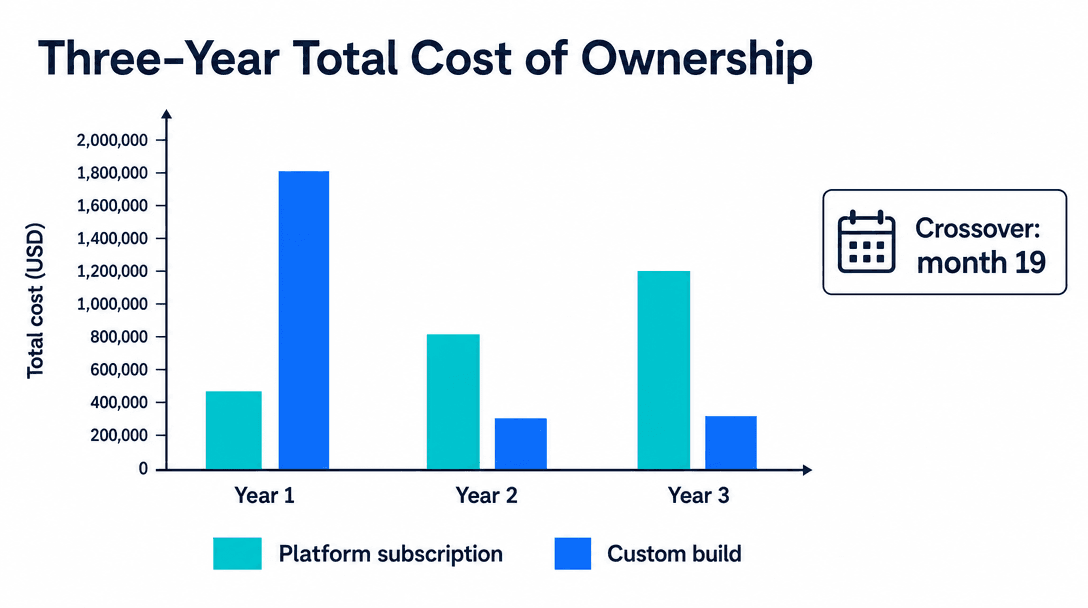
A platform starts at zero upfront. Call it $500 a month for a small deployment: $6,000 in year one. A custom build at $25,000 plus $400 a month in infrastructure is $29,800 in year one. The platform wins by roughly $24,000, and if your business needs a working bot this quarter, that gap decides it on its own.
The shape changes with time and volume, because the two cost curves are not parallel. Platform fees track usage: more conversations, more resolutions, more seats, higher tier. A custom build's fee is spent once, and the marginal cost of the ten-thousandth conversation is essentially the same few cents as the hundredth.
At 500 conversations a month, the platform likely stays cheaper forever, and you should buy it. At 3,000 resolutions a month on a $0.99 per-resolution model, you are looking at roughly $2,970 a month in resolution fees alone, before seats, or about $35,600 a year, every year, rising. Against that, a one-time $25K build with $5K a year to run is cheaper before the end of year two and dramatically cheaper by year three.
The chatbot pricing models breakdown covers how each billing structure behaves as you scale, and the Intercom Fin pricing deep-dive runs the per-resolution math in detail.
Free scoping call
Turn your AI idea into a written plan
Tell us what you want AI to do. In 30 minutes we tell you plainly whether it will pay for itself, and what it would take to build.
Book a scoping call →What most people get wrong
The common mistake is treating this as a question about capability. Buyers sit through two demos, watch both bots answer questions competently, and conclude the products are basically the same, so they pick on price, and price in month one always means the platform.
That is the wrong axis. Both options will answer your easy questions well. The decision is made entirely at the edges: the 10% of conversations that touch a system, break a rule, or need a judgment your business makes differently than everyone else. A platform handles the 90% and hands you the 10% as an escalation. A custom build can be made to handle a chunk of that 10% too, and that chunk is usually where the money is, because those are the conversations attached to a purchase, a renewal, or a churn risk.
The second mistake is the mirror image: assuming custom is automatically the sophisticated choice. It is not. A custom build for a business doing 200 support conversations a month is a $25,000 answer to a $500-a-month question. If a platform's ceiling is above your head, the ceiling does not exist as far as you are concerned. Buy the platform and spend the $25K on something that is constrained.
How to decide, in about twenty minutes
Run these four checks against your own situation. They are ordered so the cheapest disqualifier comes first.
1. Count your monthly conversation volume, not your ticket volume. Only conversations the bot would handle count. If that number is under roughly 500, stop here and buy a platform. Nothing below is likely to change the answer.
2. List the systems the bot must read from or write to. Not "would be nice." Must. If everything on that list has a native connector in the platform you are considering, the integration argument for building disappears. If two or more do not, it strengthens considerably.
3. Write down the three most valuable conversations the bot could handle. Not the most common ones. The most valuable. If those three depend on business logic that lives in someone's head or a spreadsheet rather than in a help article, a platform is going to escalate all three.
4. Check your data constraints. If a contract, a customer, or a regulator requires that conversation data stay inside infrastructure you control, that is usually a decision on its own, and it is worth confirming before you compare anything else.
Two or more of checks 2-4 pointing toward custom is worth acting on. One usually is not.
The honest case for starting on a platform even if you'll build later
There is a sequencing argument that gets lost in build-versus-buy framing, and it is often the right answer for a business that has never run a bot before.
Run a platform for two quarters first. It costs a few thousand dollars and produces something no scoping document can: a transcript log of what your customers ask, how often, and where the bot fails. That log is the single most useful input to a custom build. Teams that build first tend to design for the questions they imagined; teams that ran a platform first design for the questions they measured.
The cost of this approach is a few months of subscription fees and some throwaway configuration. The benefit is a build scoped against evidence. For most businesses that is a good trade, and it is what we would usually recommend before quoting anything.
The bottom line
A conversational AI platform and a custom chatbot are not competing on intelligence. They compete on where the ceiling sits and who pays for the room above it. If your conversations are standard, low-volume, and answerable from content you have already written, the platform is the better business decision and the cheaper one, probably for years. If your bot has to reach into systems, carry your specific logic, or handle thousands of conversations a month, the platform's ceiling becomes your problem and the recurring fee becomes the expensive half of the deal. Count the volume, list the systems, and let those two numbers decide it rather than the demo.
Next step: If you're weighing both and want the numbers run against your own conversation volume and systems rather than a generic table, that's what a 20-minute scoping call produces. Or start with the AI chatbot development pillar for what a build involves.
What is a conversational AI platform?+
A conversational AI platform is a hosted product that gives you a chat interface, a language model, an admin console, and a set of connectors, all managed by a vendor. You configure it rather than build it: you upload your help content, set some rules about tone and escalation, drop a snippet on your site, and it answers customers. Intercom Fin, Zendesk AI, Ada and Sierra all sit in this category. The vendor owns the underlying logic, the model choice, and the release schedule; you own the configuration.
What is the difference between a conversational AI platform and a custom chatbot?+
The difference is ownership, not intelligence. Both can run on the same underlying models. A platform gives you speed and a managed console in exchange for a recurring per-seat or per-resolution fee and a hard ceiling on what you can change. A custom chatbot is built against your systems, so you decide the retrieval logic, the escalation rules, the data boundaries and the model, and you pay a fixed build fee plus your own infrastructure cost instead of a per-conversation markup. Platforms are configured; custom bots are designed.
When should a business choose a conversational AI platform?+
Choose a platform when your use case is standard customer support over content that already lives in a help center, your monthly conversation volume is in the hundreds rather than the thousands, you have no engineering capacity, and you need to be live this month. Under those conditions the platform is the better buy: it is faster, cheaper in year one, and the ceiling on customization will not bind before you outgrow it anyway.
When is a custom chatbot worth building instead?+
A custom build starts to make sense when at least two of these are true: your bot needs to read or write to internal systems a platform does not connect to, your conversation volume is in the low thousands per month or higher so per-resolution fees compound, the conversation has to follow business logic specific to you, or your data cannot leave your own infrastructure for contractual or regulatory reasons. Below that, you are paying build costs for control you will not use.
Is a conversational AI platform cheaper than building a chatbot?+
In year one, almost always yes. A platform has no upfront build cost and starts at a few hundred dollars a month, while a custom build typically runs $15K-$40K before it answers a single question. The comparison flips over a longer horizon, because platform fees scale with usage while a custom build's marginal cost is a few cents per conversation. The crossover point depends on volume: at a few hundred conversations a month it may never arrive, and at several thousand it often lands somewhere inside the second year.
Free scoping call
Turn your AI idea into a written plan
Tell us what you want AI to do. In 30 minutes we tell you plainly whether it will pay for itself, and what it would take to build.
Book a scoping call →About the author

- Tags
- chatbots
- build vs buy
Subscribe to Our Newsletter
The AI Build Brief: practical playbooks on how to build, price and ship AI features, in one short email every other week.