

You are probably here because the resolution bill stopped making sense. Fin worked, deflection looked fine, and then volume grew and the invoice grew with it in a straight line that nobody on the finance side enjoys explaining. Or the agent hit a wall on the one workflow that actually matters to your business, and no amount of help-center tuning got it past. Either way, you have decided to look. What you need now is a sequence, not another feature chart.
TL;DR
- The per-resolution model is the usual reason teams leave. It scales with success, so the better Fin performs, the more you pay.
- What breaks is not the widget. It is your resolution logic, your integrations, your reporting baselines, and your conversation history if you let the account lapse before exporting.
- Export first, decide second. You cannot compare options against a support operation you have not documented.
- Three weeks is enough for a platform switch if you run both systems in parallel before cutting over. A custom build is four to twelve weeks.
- Price your alternative before you call Intercom. A modelled comparison is the only thing that makes a renegotiation credible.
Free scoping call
Turn your AI idea into a written plan
Tell us what you want AI to do. In 30 minutes we tell you plainly whether it will pay for itself, and what it would take to build.
Book a scoping call →The short answer
Export your conversation history and pull twelve months of resolution volume, deflection rate, and CSAT before you do anything else, because that data disappears with the account. Then model your real monthly resolution count against Fin's per-resolution pricing versus a fixed-fee custom build to find your crossover point. If you switch platforms, three weeks is realistic: one week to export and build, one to run parallel, one to cut over and monitor.
Why teams actually leave Fin
Three reasons come up repeatedly, and only one of them is about price.
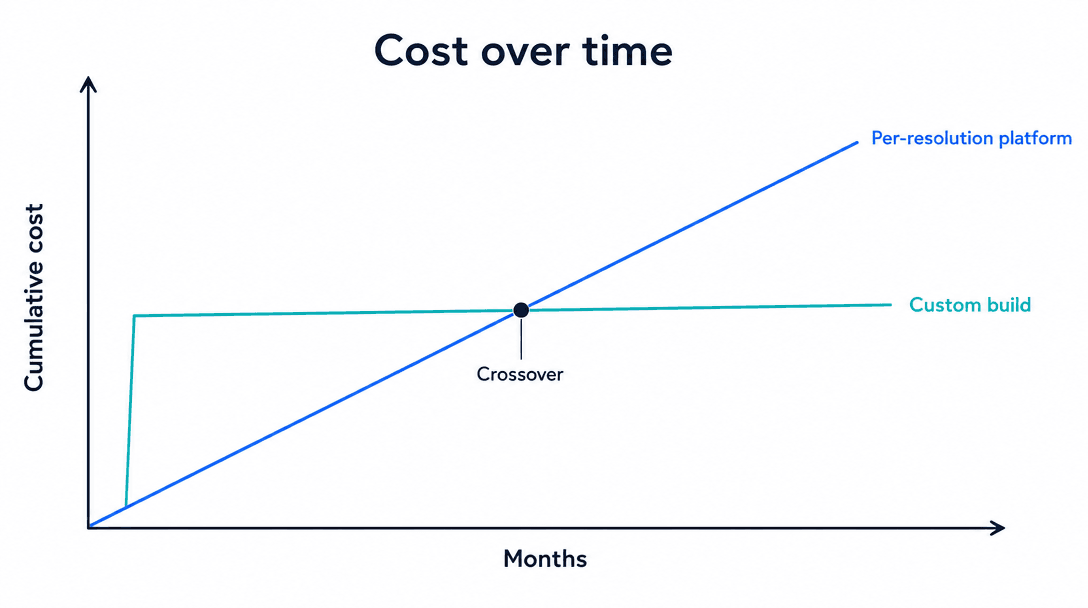
The first is the shape of the bill. Fin charges per resolution, on top of seats. That model is fair at low volume, and it is the reason Fin is easy to say yes to. The problem shows up later: your cost curve is a diagonal line pinned to your success. Deflect more tickets, pay more. Grow the business, pay more. There is no point at which the marginal conversation gets cheaper, which is the opposite of how most infrastructure behaves. Teams do not leave because a resolution is expensive. They leave because the line never flattens.
The second is the logic ceiling. Fin is very good at answering questions that have answers sitting in a knowledge base. It is much weaker when the correct response requires reading three systems, applying a rule specific to your business, and taking an action. If your support volume is mostly "where is my order" and "how do I reset my password," you will never hit this ceiling. If a meaningful slice of your queue needs the agent to check entitlement, look up a contract term, and then decide, you will hit it early and stay stuck against it.
The third is ownership, and it is the one people mention last and regret first. Your qualification rules, your tone, your escalation ladder, and a year of tuning all live inside someone else's product. That is a fine trade when the product does exactly what you need. It stops being fine when pricing changes, your roadmap request goes nowhere, or the vendor gets acquired. We wrote about that pattern in the context of Drift's shutdown, and it applies here too.
If you have not yet read the full pricing breakdown, Intercom Fin pricing covers the tiers and where the costs hide. This post assumes you already know the numbers and want the exit plan.
What actually breaks when you leave
The chat widget is trivial to replace. These are the things that hurt.
Resolution logic: every rule that decides when Fin answers, when it escalates, and who it escalates to. None of this transfers. It has to be documented in plain language and rebuilt, and most teams discover their real logic is more elaborate than anyone remembers.
Conversation history: exportable, but only while you are a customer. Intercom's export runs asynchronously, and a large account can take a long time to process. Teams that start this in the final week of their contract are the ones who lose data.
Reporting baselines: your monthly resolution counts, deflection rate, and CSAT trend live in Intercom's reporting layer. They do not come with you. Without them you have no way to judge whether the replacement is better, worse, or the same, which turns your first quarter on the new system into a guessing exercise.
Integrations: CRM sync, calendar, Slack routing, order lookup. Each has its own auth and field mapping, and at least one of them was fixed by someone who has since left.
Help center coupling: Fin answers from your knowledge base. If you built that knowledge base to feed Fin specifically, structured the way Fin likes to retrieve, that structure may not be what the next system wants.
Your three options, priced honestly
| Stay and renegotiate | Switch platforms | Build a custom agent | |
|---|---|---|---|
| Time to live | Immediate | 2-3 weeks | 4-12 weeks |
| Cost shape | Same diagonal, lower slope | Different diagonal | Fixed build, then cents per conversation |
| Custom logic ceiling | Unchanged | Usually similar | None you did not choose |
| Who owns it | Intercom | New vendor | You |
| Best when | Volume is flat and the logic fits | Fin is the wrong fit, not the wrong model | Volume is real and logic is specific |
Renegotiating is underrated and most teams skip it. Vendors discount hardest for accounts that are visibly ready to leave, and "visibly ready" means a priced alternative and a written migration plan, not a frustrated email. Even if you stay, you stay on better terms. The thing to be honest about: a discount lowers the slope of the line, it does not change the shape. If per-resolution billing is the problem at your growth rate, a discount buys you a year.
Switching platforms makes sense when Fin specifically is the wrong fit but the SaaS model still works for you. Zendesk AI versus Fin versus a custom agent walks the head-to-head in detail.
Building your own is the right call when two things are true at once: your monthly volume is high enough that per-resolution fees are real money, and your resolution logic is specific enough that a generic tool will always sit below your ceiling. One without the other usually does not justify the build. Both together usually do. We scope these on the AI agent development page, and building a support agent without breaking your SLAs covers the design constraints.
The three-week migration sequence
Week zero, before you commit to anything. Start the conversation export. Pull twelve months of resolution volume, deflection rate, CSAT, and escalation rate into a spreadsheet you control. Then write down what Fin actually does today, one rule per line, in language a person could follow. That document is the most valuable artifact in this whole process, and it is the one every team wants to skip.
Week one, build in parallel. Stand up the replacement against your exported knowledge base and rebuild the escalation rules from your week-zero document. Do not point any live traffic at it. Reconnect integrations one at a time and verify each with a real record, not a test payload.
Week two, shadow mode. Feed the new system the same conversations Fin is handling, without letting it respond to customers. Compare its answers to Fin's on the same inputs. This is where you find the gaps, and finding them here costs nothing, because Fin is still your safety net.
Week three, staged cutover. Route a slice of traffic to the new system, starting with the lowest-risk queue. Watch escalation rate and CSAT against the baseline you captured in week zero. Widen the slice daily if the numbers hold. Keep the Intercom account live until you have a full week of clean data on the new system, and treat that overlapping subscription as insurance rather than waste.
Free scoping call
Turn your AI idea into a written plan
Tell us what you want AI to do. In 30 minutes we tell you plainly whether it will pay for itself, and what it would take to build.
Book a scoping call →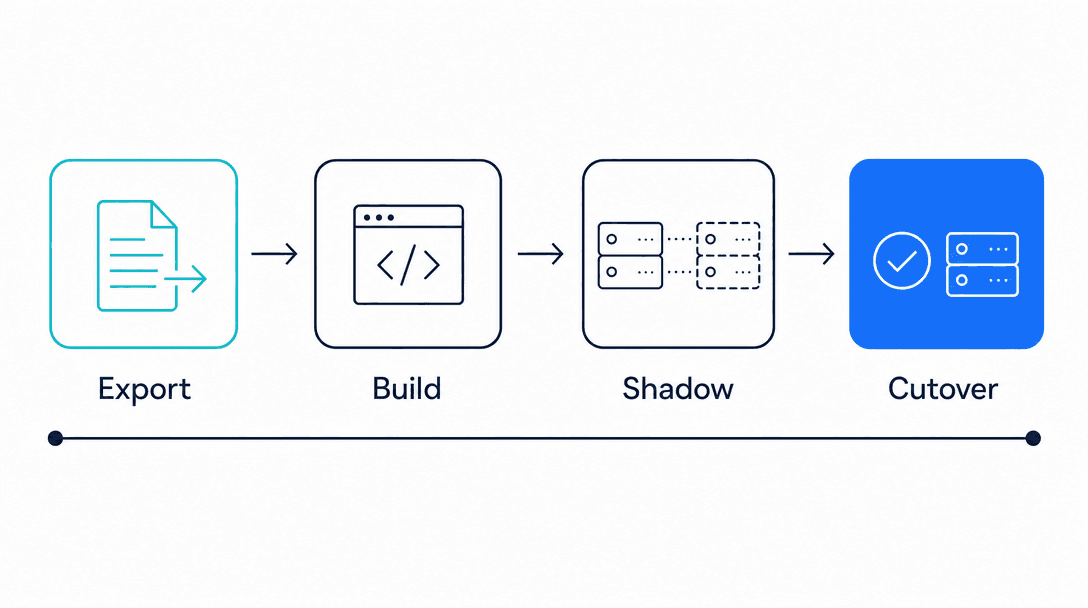
What most teams get wrong
They cancel before they export. The account is the access, and once it lapses you are negotiating with a support queue for your own data. Export in week zero, verify the file opens and contains conversations rather than metadata, and only then start counting down your contract.
They migrate the logic unchanged. A year of accumulated rules includes some rules that were wrong the whole time. Migration is the one moment you are rebuilding everything anyway, which makes it the cheapest possible time to fix the escalation path that has been quietly annoying your team since spring. Rebuilding it identically preserves the bugs along with the behaviour.
They compare on price per resolution instead of total cost at their actual volume. A number quoted per unit is designed to feel small. Multiply it by your real monthly count, project it across eighteen months at your current growth rate, and compare that total to a fixed build plus inference. Sometimes Fin still wins, and if so you have just saved yourself a migration. Run the arithmetic before you form the opinion.
They cut over on a Friday. Do it on a Tuesday morning, when the people who built it are awake and the week has room to absorb a problem.
The bottom line
Leaving Fin is not hard. Leaving Fin badly is, and the difference is almost entirely about sequence. Export and document while you still have full access. Model your real volume against both options rather than arguing about per-unit price. Run the replacement in shadow mode against live traffic before a single customer sees it. Keep the old subscription running one week longer than feels necessary.
If your volume is modest and your queue is mostly FAQ, staying on Fin at a renegotiated rate is a defensible answer, and there is no prize for migrating. If your resolution count runs into the thousands and your logic keeps hitting a ceiling, the per-resolution model will keep getting more expensive precisely as you get better at using it.
Next step: If you want the crossover run against your own numbers rather than a generic chart, a 20-minute scoping call is a good place to weigh Fin against a custom build using your actual resolution volume. Or if you would rather talk through your current Fin setup first, get in touch.
Can I export my conversation history from Intercom?+
Yes. Intercom offers a data export in Settings, and the API gives you programmatic access to conversations, contacts, and articles. The catch is that exports are asynchronous and large accounts can take hours or days to process, so start the export in week one rather than the week you plan to cut over. Verify the file actually contains what you need before you cancel anything, because access to the export tooling goes away with the subscription.
What happens to my Fin resolution history and reporting baselines?+
Your historical resolution counts and CSAT data live in Intercom's reporting layer and do not transfer to another platform. Pull a full year of monthly resolution volume, deflection rate, and CSAT before you leave, and store it as a spreadsheet. You need those numbers as the baseline to judge whether the replacement is performing better or worse, and once the account closes you cannot get them back.
Is a custom AI agent actually cheaper than Intercom Fin?+
It depends entirely on volume. Fin bills per resolution, so the cost line is a straight diagonal that never flattens. A custom build is a fixed cost up front plus per-conversation inference that usually runs in cents rather than near a dollar. At a few hundred resolutions a month, Fin is almost always cheaper. Somewhere in the low thousands per month, the lines cross. Run the crossover with your own numbers before deciding anything.
How long does it take to migrate off Intercom Fin?+
Three weeks is realistic for a lift-and-shift to another platform if you start the data export immediately and run both systems in parallel before cutover. A custom agent build is a different timeline, typically four to twelve weeks depending on how many systems it connects to. In both cases the migration itself is fast. The part that takes time is documenting the resolution logic you built inside Fin over the last year.
Should I renegotiate with Intercom before leaving?+
Yes, and do it with a real alternative already priced. Vendors discount hardest for accounts that are visibly ready to leave, and a modelled cost comparison plus a documented migration plan is what makes that credible. Even if you decide to stay, the exercise gives you a better contract. Just do not treat a discount as a permanent fix if the per-resolution model is the thing that stops working at your growth rate.
Free scoping call
Turn your AI idea into a written plan
Tell us what you want AI to do. In 30 minutes we tell you plainly whether it will pay for itself, and what it would take to build.
Book a scoping call →About the author

- Tags
- ai agents
- customer support
- migration
Subscribe to Our Newsletter
The AI Build Brief: practical playbooks on how to build, price and ship AI features, in one short email every other week.