
The demo went well. Everyone in the room could see it, the numbers from the trial were good, and there is now a slide saying "move to production" with a date on it. That slide is where a large number of AI projects quietly die, because the work between a pilot that impresses a room and a system a business depends on is a second project, and it usually is not on anyone's plan.
TL;DR
- A pilot succeeds by removing what production has to handle: messy data, unattended operation, peak volume, unforgiving users.
- Production adds seven things a pilot has none of, and none of them are model work.
- Budget production hardening at half to twice the pilot cost, over four to ten weeks. Underbudgeting this is the usual cause of a stall.
- The pilot tool is often the wrong production tool, and that is fine. Judge each on its own job.
- Four readiness tests: a measured accuracy number, an approved wrong-answer path, cost modelled at peak, and a named owner.
Free scoping call
Turn your AI idea into a written plan
Tell us what you want AI to do. In 30 minutes we tell you plainly whether it will pay for itself, and what it would take to build.
Book a scoping call →The short answer
Your pilot answered "can this work?" Production answers "does it keep working unattended, at volume, on the worst input of the week, when the person who built it is away?" Those are different questions with different budgets. Plan phase two as a project with its own scope and its own timeline, and expect it to cost between half and twice the pilot over four to ten weeks.
Why the pilot went so well
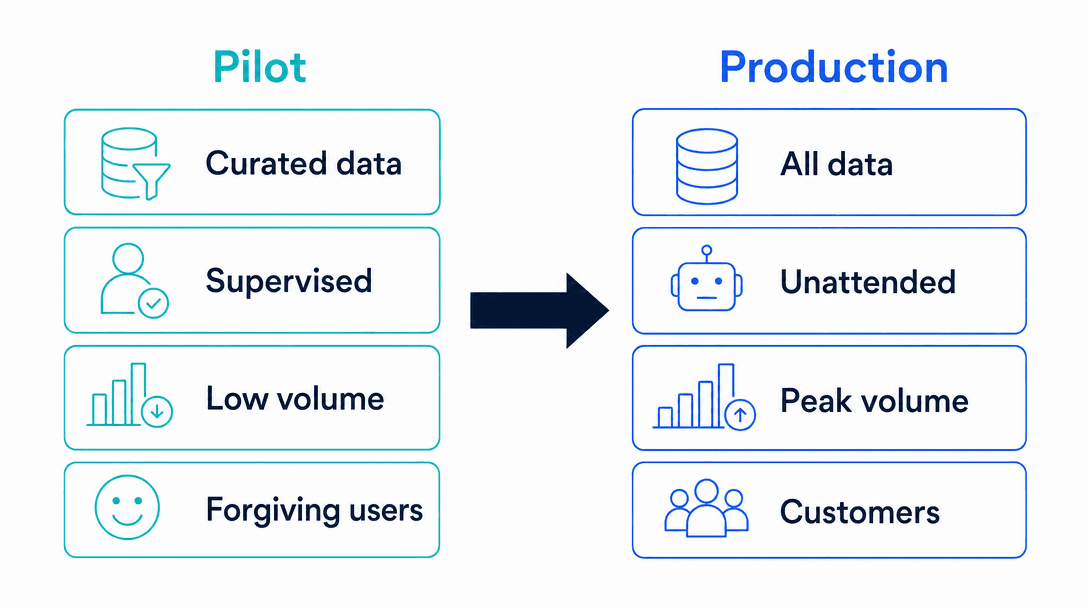
A pilot is a controlled experiment, and a well-run one deliberately removes variables. That is the correct design. It is also why the result does not transfer.
The data was curated. Somebody picked the documents, cleaned the spreadsheet, and quietly excluded the three sources that are a mess. Production gets all of them, including the one where the field names changed in 2023.
Someone was watching. During the trial a human saw every output and corrected the odd one without recording it as a failure. Production runs unattended at 2am.
Volume was low. Fifty conversations, not five thousand. Latency, rate limits, and cost per unit all behave differently a decimal place up.
The audience was forgiving. Colleagues who wanted it to work interpreted a mediocre answer generously. Customers do not, and they will find the input that breaks it inside the first week, because there are more of them and they are not trying to be fair.
None of this means the pilot lied. It means the pilot answered its question honestly and a different question remains open.
The seven things production needs
An evaluation harness. A fixed set of test cases with known-correct answers that runs on every change. Without it you cannot tell whether today's improvement broke last month's fix, and every release becomes a wager. Build this from real pilot conversations while they are still fresh.
Monitoring and alerting. Not uptime. Quality. Escalation rate, refusal rate, latency, cost per conversation, and answer distribution. A degrading AI system does not throw errors. It gets subtly worse, and the only way to notice is to watch a number that moves.
A defined fallback. What happens when the model is down, rate-limited, or unsure? "It fails" is an answer, and it needs to be a chosen one with a person's name against it, not a discovery. Usually the fallback is a graceful handoff to a human with the context attached.
Cost control at real volume. Set a per-conversation budget, route simple tasks to cheaper models, cache what repeats, and alert on spend. A pilot's model bill is a rounding error, and the same architecture at production volume is a line item somebody will question.
Scoped access and audit logging. The pilot ran on a credential that worked. Production needs least privilege per tool and a log that reconstructs any decision. The security review checklist covers what your own procurement team will ask.
A named owner and an on-call path. Who gets contacted when it misbehaves on a Saturday? A system with no owner degrades, and the degradation is invisible until it is a complaint.
A change process. How a prompt change reaches production: who reviews it, what tests run, how it rolls back. Editing a live prompt because someone noticed a bad answer is how a working system becomes an unpredictable one.
What actually changes, side by side
| Pilot | Production | |
|---|---|---|
| Data | Curated subset | Everything, including the broken source |
| Supervision | Human watching | Unattended |
| Volume | Tens | Thousands |
| Failure cost | Mild embarrassment | Customer impact, sometimes liability |
| Quality measure | Impression | Measured against a fixed set |
| Model choice | Best available | Routed by task and cost |
| Access | Whatever worked | Least privilege, logged |
| Owner | The builder | A named person with time allocated |
Read the right column as a scope document. That is the phase two backlog, and almost none of it is prompt work, which is why teams who budget phase two as "polish" run out of money at the halfway mark.
Scoping phase two honestly
Start with the failure catalogue. Go through every pilot conversation and mark the ones that went wrong. Group them by cause. That list, ordered by frequency, is your priority order, and it beats any generic hardening checklist because it is made of your actual problems.
Then decide the accuracy bar and write it down as a number before you start improving anything. "Better" is not a target. "94% on the 200-case evaluation set, with no unhandled escalations" is. Teams that skip this tune indefinitely, because there is no defined point at which they are finished.
Decide the wrong-answer path next, and get it approved by whoever owns the customer relationship. This is a business decision wearing a technical hat, and engineers should not be making it alone.
Model cost at peak rather than average. Your busiest hour is what has to hold, and it is often several times the mean.
Finally, name the owner before you start. Not the sponsor. The person who will read the weekly quality report and has hours in their week to act on it. If that person does not exist, phase two is not ready to start regardless of how good the pilot was, which is the same finding an AI readiness assessment produces at the other end of the lifecycle.
Free scoping call
Turn your AI idea into a written plan
Tell us what you want AI to do. In 30 minutes we tell you plainly whether it will pay for itself, and what it would take to build.
Book a scoping call →When not to go to production
A successful pilot creates momentum, and momentum is a poor reason to spend money. Three cases where stopping is correct.
The value was smaller than expected. The pilot worked and saved four hours a month. Production hardening plus ongoing maintenance costs more than four hours a month is worth. This is a good outcome, cheaply discovered, and the only mistake available now is continuing out of embarrassment.
The process is still moving. If the workflow the system automates changed twice during the pilot, you would be hardening a moving target. Fix the process, then automate it.
Nobody will own it. Covered above and worth repeating, because it is the most common of the three and the easiest to paper over with a name on a slide.
Choosing not to proceed after a successful pilot feels like failure and usually is not. The pilot did its job: it produced a decision. If the decision is no, the money bought you the right answer, which is what you were paying for. Stalled AI project triage covers what to do when that decision was never made and the project simply stopped instead.
The bottom line
Treat the pilot and the production system as two projects with two budgets, because that is what they are. The pilot proves value under favourable conditions. Production keeps value under unfavourable ones, and the gap between them is evaluation, monitoring, fallbacks, cost control, access, ownership, and change management.
Scope phase two off your own failure catalogue rather than a generic checklist, set a numeric accuracy bar before you start tuning, and name the owner on day one. Do that and the second project becomes unremarkable engineering with a predictable end date, which is exactly what you want after the exciting part is over.
Next step: If you want phase two scoped from your pilot's actual failure data rather than a template, send us the pilot results and we will come back with the backlog and a timeline. The AI implementation page covers how we run these.
Why do successful AI pilots fail in production?+
Because a pilot is designed to remove exactly the things production has to handle. Curated data instead of messy data, a supervised operator instead of an unattended system, low volume instead of peak load, and a forgiving internal audience instead of customers. The pilot answered whether the idea works. Production answers whether it works unattended, at volume, on the worst input of the week, when the person who built it is on holiday.
How much does it cost to take an AI pilot to production?+
As a planning figure, expect production hardening to cost somewhere between half and twice what the pilot cost, and to take four to ten weeks. The variance comes from integration depth and compliance requirements rather than from model work. Teams that budget production as a small percentage of the pilot are the ones who stall halfway, because monitoring, evaluation, fallback paths, and access control are real engineering rather than configuration.
What is the difference between an AI pilot and a production AI system?+
A pilot proves the idea can work under favourable conditions. A production system keeps working under unfavourable ones. Concretely, production adds an evaluation harness, monitoring and alerting, a defined fallback when the model is unavailable or unsure, cost controls at real volume, scoped access and audit logging, a named on-call owner, and a change process. None of those are visible in a demo, and all of them are the reason the demo was fast.
Should I use the same tool for production that I used for the pilot?+
Often not, and that is not a failure of the pilot tool. No-code builders and rapid prototyping tools are excellent at answering the question a pilot exists to answer, and they lack version control, evaluation, and integration depth that production needs. Judge the pilot on whether it proved the value, then choose the production stack on separate criteria. Keeping the pilot tool because switching feels like waste is the sunk cost fallacy in a technical costume.
How do I know if my AI pilot is ready for production?+
Four tests. You have a fixed evaluation set with a measured accuracy number, not an impression. You know what happens when the model is wrong, and someone has approved that answer. You have modelled cost at peak volume rather than pilot volume. And a named person has agreed to own it in production with time allocated. If any of the four is missing, that gap is your next two weeks of work.
Free scoping call
Turn your AI idea into a written plan
Tell us what you want AI to do. In 30 minutes we tell you plainly whether it will pay for itself, and what it would take to build.
Book a scoping call →About the author

- Tags
- ai implementation
- ai strategy
- ai agents
Subscribe to Our Newsletter
The AI Build Brief: practical playbooks on how to build, price and ship AI features, in one short email every other week.