

Something is sitting in your organisation right now that was supposed to be live in the spring. There was a demo everyone liked. There was a pilot that mostly worked. Then it stopped, and it has been stopped long enough that nobody brings it up in status meetings anymore. The budget is spent, the vendor has gone quiet or gone entirely, and the honest question on the table is whether to put more money into it.
TL;DR
- Stalled AI projects almost always break at one specific layer. Find that layer before deciding anything.
- Four stall types cover most cases: data, accuracy, adoption, and ownership. Only one of them is a modelling problem.
- Integration work, data plumbing, and any logged examples are usually salvageable, and they are typically half the original spend.
- Prompt logic with no version history and no test set rarely survives, because you cannot safely change what you cannot measure.
- Killing it is the right answer when the process underneath is unstable, the value is smaller than the maintenance, or nobody senior owns it.
Free scoping call
Turn your AI idea into a written plan
Tell us what you want AI to do. In 30 minutes we tell you plainly whether it will pay for itself, and what it would take to build.
Book a scoping call →Before you spend anything more
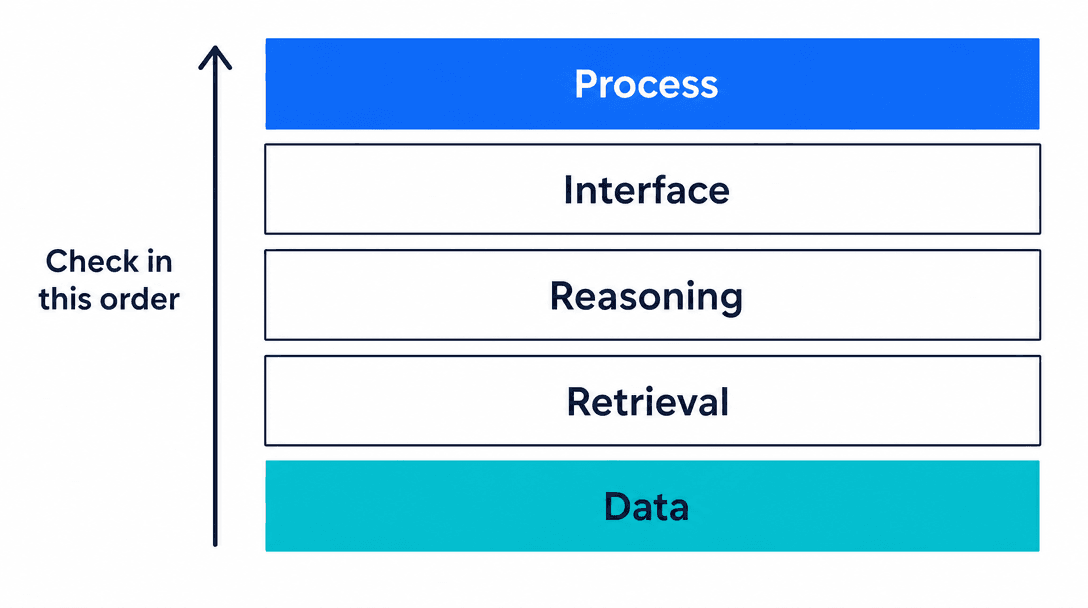
Do not authorise a rebuild until someone has named which layer failed. Data, retrieval, reasoning, interface, or process. Teams that skip this step rebuild the layer that was working, because that is the layer that is interesting to rebuild. Diagnosis takes one to two weeks and it routinely changes the recommendation from "rebuild" to "fix one integration."
The four ways AI projects stall
The data stall. The system needed information that turned out to be missing, scattered across systems that disagree, or too inconsistent to use. This is the most common failure and the least discussed, because it surfaces after the contract is signed and it is nobody's favourite discovery. It looks like a technical problem and it is usually an organisational one.
The accuracy stall. It works, but not well enough. It got to 70% and stayed there through three rounds of prompt changes. Almost every time we see this, there is no fixed evaluation set, which means every change was a guess and the team was optimising against yesterday's impression. You cannot climb a hill you cannot see.
The adoption stall. It works fine and nobody uses it. The output lands in a dashboard people do not open, or it asks someone to change a habit for a benefit they did not ask for. This one stings the most because the engineering succeeded. It is also the cheapest to fix, and the fix is almost never technical. Often it means moving the output into a tool your team already uses.
The ownership stall. The vendor relationship broke, the internal champion left, or the project sat between two departments and belonged to neither. The system may be perfectly fine. Nobody has the authority or the context to finish it. Replacing an AI vendor mid-project covers this case specifically.
Find the broken layer
Work through these in order and stop at the first "no."
| Layer | The question | If broken |
|---|---|---|
| Data | Can the system reliably get the information it needs? | Fix the pipeline first. Nothing above this matters. |
| Retrieval | Does it find the right context for a given question? | Usually chunking, indexing, or source quality |
| Reasoning | Given correct context, does it decide correctly? | The only genuine model problem |
| Interface | Does the output reach someone at the moment they need it? | Move it, do not rebuild it |
| Process | Is there a stable human workflow around it? | Stop. Fix this before touching software. |
Most teams assume they have a reasoning problem, because that is the layer everyone talks about. In our experience it is the rarest of the five. When a system gives a wrong answer, the usual cause is that it retrieved the wrong document, not that it reasoned badly about the right one. That distinction is the difference between a two-week fix and a three-month rebuild, and you can only tell them apart by looking at what the system actually retrieved, which we cover in more depth in preventing AI hallucinations.
What you can usually keep
The sunk cost fallacy says past spend should not influence future decisions, and that is right as far as it goes. It also gets misapplied here, because a stalled AI project does contain reusable assets, and writing them off is its own kind of error.
Almost always reusable: the integration work, including auth, field mappings, and the API quirks somebody already fought through. The data pipeline, if one exists. Credentials and access approvals, which in a mid-sized company took longer to obtain than to build. Domain knowledge captured in discovery documents. Together these are often half the original cost, and none of it is model-dependent.
Usually reusable: logged conversations and any labelled examples. Even a failed system produced data about what people asked and where it went wrong. That becomes your evaluation set, which is the most valuable single artifact for the rebuild.
Rarely reusable: accumulated prompt logic with no version history and no tests. Not because it is bad, but because you cannot verify it, cannot change it safely, and cannot tell which parts were load-bearing. No-code flow configurations tend to land here too, for the reasons covered in outgrowing no-code builders.
The three outcomes
Resume. The build was sound and one thing blocked it: a data source that never arrived, an approval that stalled, a departure. Unblock it and finish. This is more common than people expect and it is worth checking for first, because the answer is sometimes an email rather than a project.
Rebuild the core, keep the edges. The most frequent recommendation. Keep the integrations, the pipeline, the access, and the logged data. Rebuild the reasoning and retrieval layers properly, with version control and an evaluation set from day one. Typically four to eight weeks rather than the twelve a fresh build would take, because the unglamorous half is already done.
Kill it. Sometimes correct, and worth taking seriously rather than treating as failure. Kill it when the process underneath changes shape faster than software can track. Kill it when the annual value at stake is smaller than the annual cost of keeping the system healthy, which is a calculation almost nobody does before starting. Kill it when no senior person owns the outcome, because a system without an owner degrades into a liability regardless of how good it is.
Free scoping call
Turn your AI idea into a written plan
Tell us what you want AI to do. In 30 minutes we tell you plainly whether it will pay for itself, and what it would take to build.
Book a scoping call →The questions that decide it
Ask these in a room with the people who were actually involved, not in a vendor meeting.
What specifically stopped? Not "it did not work." The precise moment, the precise blocker.
If the same thing were built again perfectly, what would it be worth per year? Put a number on it. If the number is small, that is the finding, and it is a cheap one to discover now rather than after a second build.
Has the underlying process changed since the project started? If it has changed twice, you were automating a moving target, and the problem sits upstream of any software. This is the check an AI readiness assessment is designed to catch before you build.
Can anyone explain why the system behaves as it does? If nobody can, the knowledge does not exist and a handover will not create it.
Who will own this in production? Not sponsor it. Own it, with time allocated.
If the honest answers are "we do not know," "not much," and "nobody," you have your decision, and it is the cheapest good news you will get this quarter.
The bottom line
A stalled AI project is not evidence that AI does not work for your business. It is evidence that one specific layer broke, and in most cases that layer can be named inside two weeks of looking.
The expensive mistake is not the original failure. It is authorising a second build without diagnosing the first, which reliably produces a system that fails the same way with a different vendor's name on it. The second most expensive mistake is throwing away integration and access work that took four months to obtain because the visible part disappointed.
Diagnose first. Then resume, rebuild the core, or stop, and be equally willing to reach any of the three.
Next step: A 20-minute scoping call is a good place to talk through which layer failed, what looks salvageable, and whether the project is worth finishing. If it is not, we will say so. Or describe what stopped and we will tell you which layer it sounds like.
Why do most AI projects stall before production?+
Four reasons account for nearly all of them. The data the system needs is missing, scattered, or too messy to use reliably. Accuracy plateaus somewhere short of the bar, usually because there is no evaluation set to improve against. Nobody uses it, because the output arrives somewhere people do not work. Or the vendor relationship broke and knowledge left with them. Only the second is a modelling problem. The other three are process and design problems that no amount of model tuning fixes.
What is usually salvageable from a failed AI project?+
More than people expect. Integration work, data pipelines, access and credentials, and the domain knowledge captured during discovery are almost always reusable, and they are typically half the original cost. Any labelled examples or logged conversations are valuable because they become your evaluation set. What rarely survives is accumulated prompt logic with no version history and no tests, because you cannot safely change what you cannot measure.
How do I know if I should kill an AI project instead of fixing it?+
Kill it when the underlying process is not stable enough to automate, when the value at stake is smaller than the cost of maintaining the system, or when nobody senior owns the outcome. Those three are not engineering problems and no rebuild resolves them. The test we use is simple: if the process changed shape twice in the last six months, you are automating a moving target and should fix the process first.
How long does an AI project rescue take?+
Diagnosis takes one to two weeks and should always come first. The fix depends on which layer broke. A data or retrieval problem is usually two to six weeks. An adoption problem can be days, because it often means moving the output into a tool people already use. A full rebuild of the reasoning layer is four to twelve weeks, but you rarely need one if the integration work underneath is sound.
Should I keep the original vendor for the rescue?+
It depends on whether the failure was capability or communication. If they built something reasonable that stalled on data access or organisational adoption, keeping them is usually cheaper because the context is already in their heads. If they cannot explain why the system behaves as it does, or there is no repository, no documentation, and no test set, the knowledge you would be preserving does not exist. Get the handover audited before you decide.
Free scoping call
Turn your AI idea into a written plan
Tell us what you want AI to do. In 30 minutes we tell you plainly whether it will pay for itself, and what it would take to build.
Book a scoping call →About the author

- Tags
- ai strategy
- ai implementation
Subscribe to Our Newsletter
The AI Build Brief: practical playbooks on how to build, price and ship AI features, in one short email every other week.