

Most AI projects that fail were unbuildable on day one. Not badly built, not badly modelled: unbuildable, because the process they targeted had no stable shape, or the data lived somewhere no system could reach. The build revealed the problem instead of causing it, which is why the post-mortem usually blames the technology.
TL;DR
- Readiness is a property of a specific process, not of your company. Assess one workflow at a time.
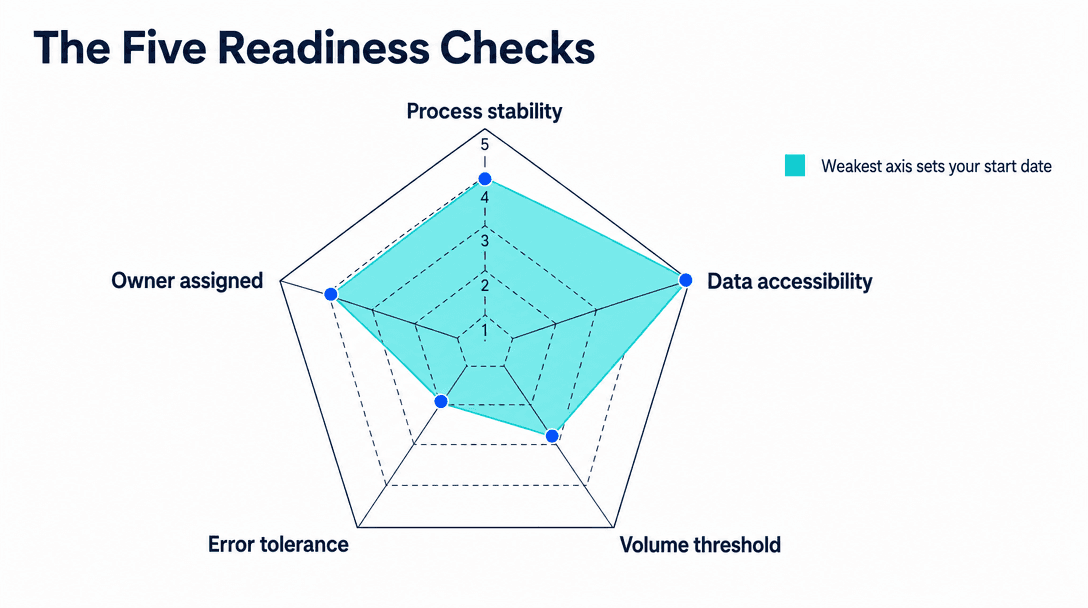
- Five checks: process stability, data accessibility, volume, error tolerance, and a named owner.
- Score each 1 to 3. Your weakest score sets the start date, not your average.
- The most common killer is process instability: work that looks repetitive from outside but is handled differently every time.
- Reachable data matters more than clean data. Retrieval tolerates mess; it does not tolerate a system with no API.
Free scoping call
Turn your AI idea into a written plan
Tell us what you want AI to do. In 30 minutes we tell you plainly whether it will pay for itself, and what it would take to build.
Book a scoping call →The short answer
Run five checks against one process, scoring each 1 to 3. Process stability: do most cases follow the same steps? Data accessibility: can a system reach what the AI needs to know? Volume: does it run often enough for automation to matter? Error tolerance: what does a wrong answer cost? Ownership: is one named person accountable after launch? A total of 13-15 means build now. 8-12 means fix the weakest gap first, then build. Below 8 means the problem is the process, and an AI project will encode the mess rather than remove it. Your lowest single score matters more than the total.
Check 1: Is the process stable?
Write the process down, end to end, as if you were handing it to a new employee. Count how many times you write "it depends."
Once or twice is normal. Every step is a warning. Work that looks repetitive from the outside is often held together by judgment that two long-serving people apply without noticing, and a build that encodes the written version produces something nobody uses because it does not match how the work is done.
Score 3 if you can describe the process in a page and most cases follow it. Score 2 if there is a clear main path with a handful of known exceptions. Score 1 if every case is different, or if the only complete description of the process is a person.
The fix for a score of 1 is not an AI project. It is a week of writing the process down with the people who do it, which is worth doing whether or not you ever automate it.
Check 2: Can a system reach the data?
The AI needs to know things. The question is whether software can get to them.
Reachable means there is an API, a database connection, an export, or a set of documents in a system that supports search. Unreachable means the information lives in institutional memory, in a tool with no integration path, or across spreadsheets that three people maintain inconsistently.
Score 3 if everything the process needs sits behind a documented API or in maintained documents. Score 2 if most of it does and one source needs work. Score 1 if the important knowledge is in someone's head or in a system nobody can get data out of.
Note that this asks about accessibility, not quality. Imperfect records are workable when a system can read them and you know where the contradictions are. Perfect records in a tool with no API are worth nothing to a build.
Check 3: Does it run often enough?
Automation returns hours. Hours only add up if the work repeats.
A process that runs 400 times a month at four minutes each is 26 hours, which is worth automating. The same process at 20 times a month is 80 minutes, which is not worth a build no matter how annoying it is.
Score 3 if the task runs daily or several hundred times a month. Score 2 if it runs weekly with meaningful volume. Score 1 if it is occasional.
This check kills more candidate projects than any other, and it should. The workflow that annoys the founder most is frequently not the one that costs the most, because irritation and volume are different things. Count before you choose.
Check 4: What does an error cost?
Every AI system will be wrong sometimes. The question is what happens next.
Low cost means the error is visible and reversible: a mis-scored lead that a human re-scores, a draft summary someone edits. High cost means the error is invisible until it compounds, or it reaches a customer as a commitment, or it triggers something irreversible.
Score 3 if a wrong answer is caught quickly and fixed cheaply. Score 2 if errors are recoverable but need a review step. Score 1 if a wrong answer is expensive, regulated, or hard to detect.
A score of 1 does not disqualify a project. It changes the design: tighter constraints, a human approval step, more testing, and a longer timeline. What it disqualifies is a cheap fast build, and knowing that before you get a quote is the point of asking.
Check 5: Who owns it after launch?
The check nobody runs, and the one that predicts whether the project still works in six months.
An AI system needs an owner: someone who reviews escalations, notices when accuracy drifts, updates the content when the business changes, and decides when the thresholds move. Without one, the system degrades quietly over about two quarters and then gets switched off.
Score 3 if a named person has this in their objectives with time allocated. Score 2 if someone is willing but it is not formalized. Score 1 if the answer is "we will figure that out after launch."
The signal to take seriously
If nobody will put their name against the outcome before the build starts, nobody will own it afterwards. This is the cheapest failure to predict and the most common one to ignore, because assigning an owner feels like a detail next to choosing a vendor.
Scoring it
| Total | What it means | What to do |
|---|---|---|
| 13-15 | Ready | Scope the build now |
| 8-12 | One or two real gaps | Fix the weakest, then build |
| Below 8 | Process problem, not an AI problem | Do not build yet |
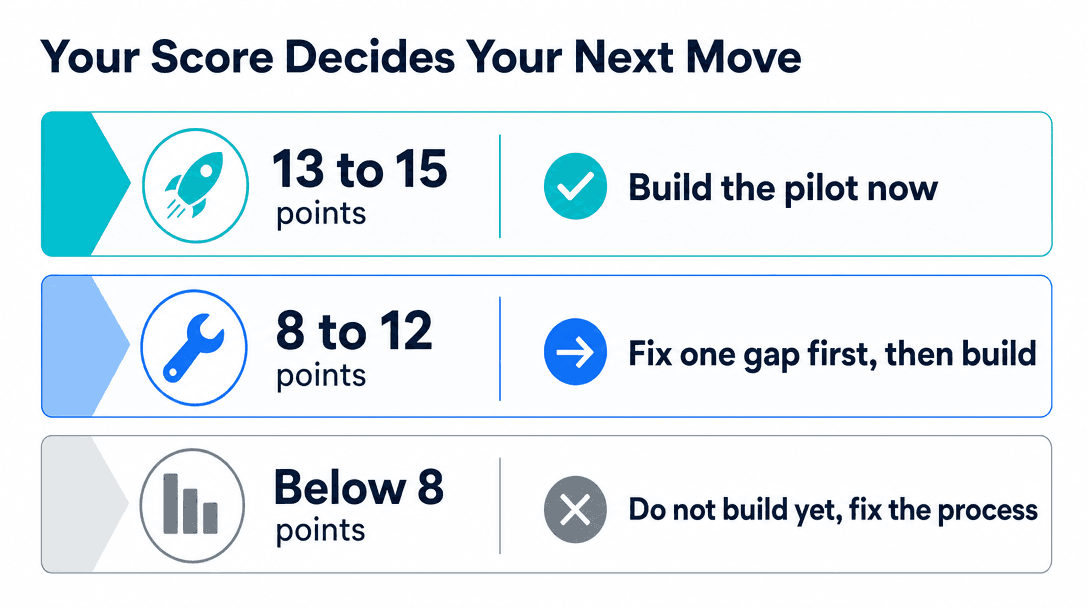
The total is less informative than the minimum. A process scoring 3-3-3-3-1 adds up to 13, which looks ready, but a 1 on ownership means it will work for a quarter and then rot. Read the lowest number first.
What most people get wrong
Treating readiness as a company-wide score. Consultancies sell maturity assessments that rate the whole organization on a five-level scale, and the output is a slide rather than a decision. Nobody builds AI for a company; they build it for a process. A business that scores badly overall may still have one workflow that is perfectly ready, and that workflow is where to start.
Assuming data quality is the blocker. It usually is not. Retrieval-based systems work with messy records as long as they are reachable and the contradictions are known. Teams delay for months on a data-cleaning project that was never on the critical path, while the real blocker (a legacy system with no API) goes unaddressed.
Picking the process by irritation. The task that makes the founder groan is not reliably the task that costs the most hours. Volume decides that, and volume is countable.
Skipping the baseline. If you do not measure the current cost of the process before you build, you cannot prove the build worked. Two weeks of counting is enough, and it is the difference between an ROI number and an opinion.
How to run this in an afternoon
Pick the three processes you suspect are candidates. For each one, sit with the person who does the work and write the steps down. Score the five checks together, because they will disagree with you on at least one and they will be right.
Rank by lowest score rather than by total. Then take the highest-ranked process and fix its weakest check before scoping anything. If the weakest check is process stability, that means documenting; if it is accessibility, that means confirming API access; if it is ownership, that means a conversation with whoever will carry it. If you want an outside read on the scores, AI consulting for small businesses is built around finding where AI pays off.
This costs an afternoon and it routinely saves a five-figure build from being spent on the wrong workflow. For a longer view on what happens after this, the 30-day first automation plan covers the rollout sequence, and build vs buy AI covers the decision that follows.
Free scoping call
Turn your AI idea into a written plan
Tell us what you want AI to do. In 30 minutes we tell you plainly whether it will pay for itself, and what it would take to build.
Book a scoping call →The bottom line
AI readiness is not a maturity level and it is not about your company. It is five questions asked about one process, and the answers are usually available in an afternoon from the person who does the work. Stability, accessibility, volume, error cost, ownership. Score each honestly, read the lowest number rather than the total, and fix that gap before anyone writes a proposal. Most failed AI projects would have been caught by this, which is a slightly uncomfortable thing to know and a cheap thing to act on.
Next step: A 20-minute scoping call is a good place to talk through your scores and which process to start with. Or read is AI consulting worth it if you are deciding whether to bring in help at all.
What is an AI readiness assessment?+
An AI readiness assessment checks whether a specific business process can support an AI build before anyone commits budget to it. It is not a company-wide maturity score. The useful version looks at one process and scores five things: whether the process is stable enough to encode, whether the data it needs is reachable, whether it runs often enough to be worth automating, how expensive a mistake is, and whether a named person owns the outcome. The weakest of the five sets your timeline.
What should you check before starting an AI project?+
Five things, in this order. Process stability: does the work follow the same steps most of the time, or does every case get handled differently? Data accessibility: can a system reach the information the AI needs, or does it live in someone's head? Volume: does this run often enough that automating it saves meaningful hours? Error tolerance: what happens when the AI gets it wrong? Ownership: is there a named person accountable for the result after launch? A gap in any one of these predicts a stalled project.
How do you know if your business is ready for AI?+
Ask whether you can describe one process end to end, in writing, without saying 'it depends' more than once or twice. If you can, that process is probably ready. If every step comes with exceptions that only a specific person knows how to handle, the AI will encode the exceptions badly, and the right first move is documenting the process rather than automating it. Readiness is a property of a specific workflow, not of the company.
What is the most common reason AI projects fail?+
The process was never stable enough to automate. Teams pick a workflow that looks repetitive from the outside, then discover during the build that every case is handled slightly differently and the rules live in the heads of two long-serving employees. The AI ends up encoding a version of the process that nobody follows, and adoption dies. This is a scoping failure, and a readiness check catches it before the budget is committed.
Do you need clean data before using AI?+
You need reachable data more than clean data. A retrieval-based system can work with imperfect records as long as a system can get to them and the contradictions are known. What stops projects is data that is unreachable: a legacy tool with no API, knowledge that exists only as institutional memory, or records spread across spreadsheets that nobody maintains. Fixing accessibility is a prerequisite; polishing every field is usually not.
Free scoping call
Turn your AI idea into a written plan
Tell us what you want AI to do. In 30 minutes we tell you plainly whether it will pay for itself, and what it would take to build.
Book a scoping call →About the author

- Tags
- ai strategy
Subscribe to Our Newsletter
The AI Build Brief: practical playbooks on how to build, price and ship AI features, in one short email every other week.