
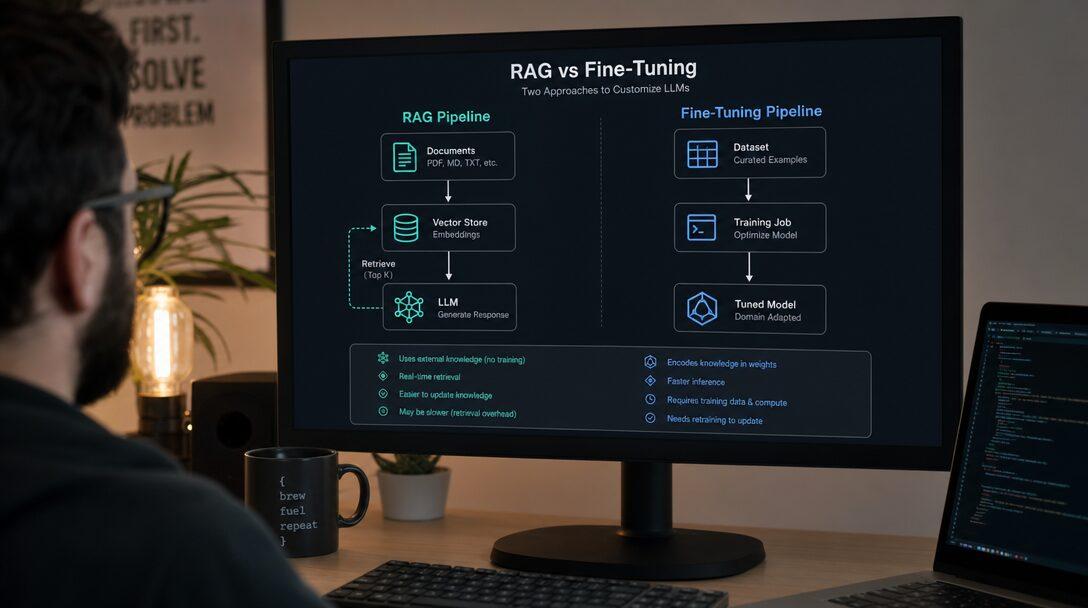
This question comes up in almost every AI project we scope. Teams frame it as a technical decision, but it's really a product decision. The right answer depends on what you're trying to accomplish, not on which technique sounds more impressive.
Start with RAG. Fine-tune only when you've hit a specific wall that RAG can't solve. Most teams that jump to fine-tuning do it too early and waste months of effort.
TL;DR
- Start with RAG: it solves knowledge retrieval problems and ships in weeks, not months.
- Fine-tune only when you have a specific behavior problem: consistent output format, domain classification, or tone/style.
- Fine-tuning to inject knowledge (facts, documents) is the most common and most expensive AI mistake.
- Naive RAG fails in production: invest in smart chunking, hybrid search, and a reranker before concluding it doesn't work.
- The best production systems combine both: fine-tune for behavior, RAG for knowledge.
What RAG actually solves
RAG (Retrieval-Augmented Generation) solves a retrieval problem, not a reasoning problem. The fundamental idea: instead of baking your knowledge into model weights, you retrieve the relevant pieces at query time and give them to the model in context.
This is the right architecture when:
- Your knowledge base changes (documents update, products change, new content gets added)
- You need citations: users or compliance teams want to know where answers came from
- Your dataset is large: more knowledge than fits in a context window, even a 200K one
- You're dealing with private or sensitive data that shouldn't go to a fine-tuning pipeline
- You want to ship fast: RAG can be production-ready in 1-2 weeks
A well-built RAG system with proper reranking and prompt engineering will outperform a fine-tuned model on knowledge tasks in most real-world scenarios. It also costs a fraction of the engineering effort.
What fine-tuning actually solves
Fine-tuning solves a behavior problem, not a knowledge problem. You're teaching the model to respond in a specific way (a specific format, tone, domain vocabulary, reasoning pattern), not to know specific facts.
Fine-tuning wins when:
- You need consistent output format that prompt engineering alone can't reliably achieve (e.g., structured JSON with specific field semantics, specific code patterns)
- You're doing domain-specific classification at scale: medical coding, legal clause identification, product category tagging
- You have thousands of high-quality labeled examples of the exact task
- Latency or cost requires a smaller, specialized model instead of GPT-4o
- The behavior you want is implicit: hard to describe in a prompt but easy to demonstrate in examples
The classic case: you want a model that writes in your company's exact tone, follows your specific code conventions, or outputs a proprietary data structure. That's a behavior problem. RAG won't help. Fine-tuning will.
The decision matrix
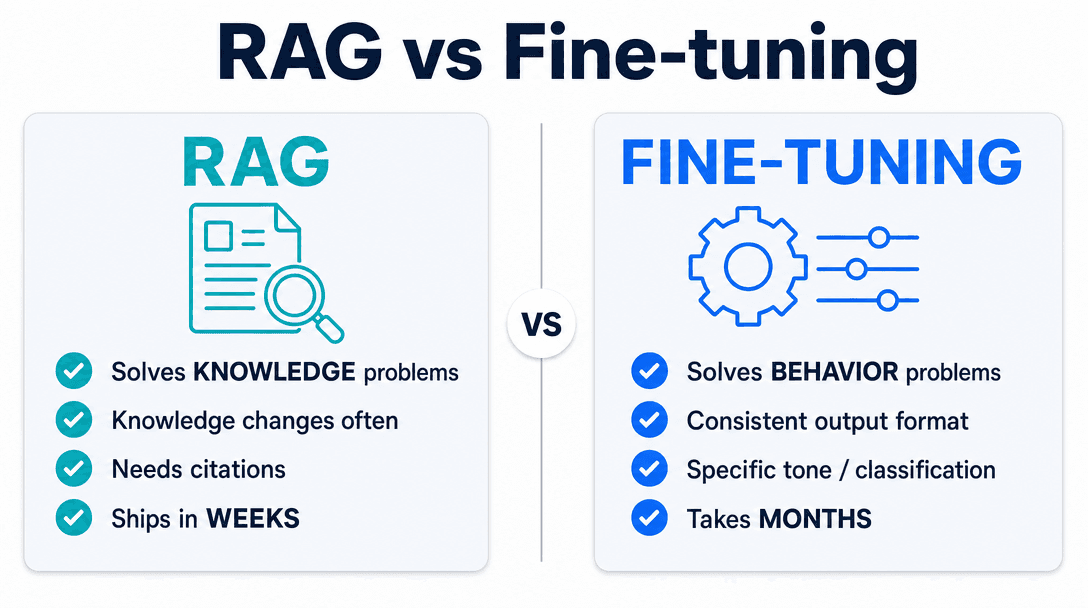
| Situation | RAG | Fine-Tuning |
|---|---|---|
| Knowledge from documents | ✅ | ❌ |
| Knowledge changes frequently | ✅ | ❌ |
| Need citations/sources | ✅ | ❌ |
| Consistent output format | ❌ | ✅ |
| Specific tone/style | Partial | ✅ |
| Domain classification | Partial | ✅ |
| Cost efficiency at scale | ✅ | ✅ |
| Speed to production | ✅ (weeks) | ❌ (months) |
| Small specialized task | ❌ | ✅ |
What most teams get wrong
Fine-tuning to inject knowledge
This is the most common and most expensive mistake. Teams spend 2-3 months collecting training data, running fine-tuning jobs, and evaluating outputs, trying to teach the model facts that should just be in a RAG system. Fine-tuned models hallucinate knowledge. They also go stale the moment your knowledge base updates.
If you have a product catalog, a knowledge base, or any document set, use RAG.
Skipping chunking and reranking
A naive RAG system (embed everything, top-K retrieval, stuff in prompt) works fine in demos and fails in production. The retrieval quality is the bottleneck. Investing in:
- Smart chunking (semantic, not fixed-size)
- Hybrid search (vector + BM25 keyword)
- A reranker (Cohere, cross-encoder) before passing to the LLM
...can improve answer quality by 40-60% over naive RAG. Most teams skip this and conclude "RAG doesn't work" when what actually doesn't work is their retrieval pipeline.
No evals
You can't improve what you can't measure. The teams shipping reliable AI in 2026 have eval pipelines: automated tests that check answer quality, relevance, and hallucination rate. Without evals, you're guessing. With them, you're iterating.
When to combine both
The highest-performing AI systems often use both. Fine-tune for behavior first: teach the model your output format, domain vocabulary, reasoning style. Then layer RAG on top to retrieve the relevant facts at query time and feed them to the fine-tuned model.
This is more complex to build and maintain, but for production systems serving specific domains at scale, the quality gains justify it.
A practical example: a legal AI assistant fine-tuned on contract analysis reasoning patterns + RAG over your specific contract library. The fine-tuned model knows how to analyze; the RAG system knows your specific contracts.
The 2026 context shift
Context windows keep growing. GPT-4o handles 128K tokens. Gemini 1.5 handles 1M. Does this make RAG obsolete?
No, but it shifts when you need it.
For small datasets (< 500 documents), you can now sometimes skip RAG entirely and stuff everything in context. For larger datasets, for latency-sensitive applications, and for systems that need citations, RAG is still the right architecture.
Fine-tuning gets cheaper every year, but the data collection and evaluation problem stays expensive. Expect fine-tuning to remain a later-stage optimization rather than a first approach.
Where to start
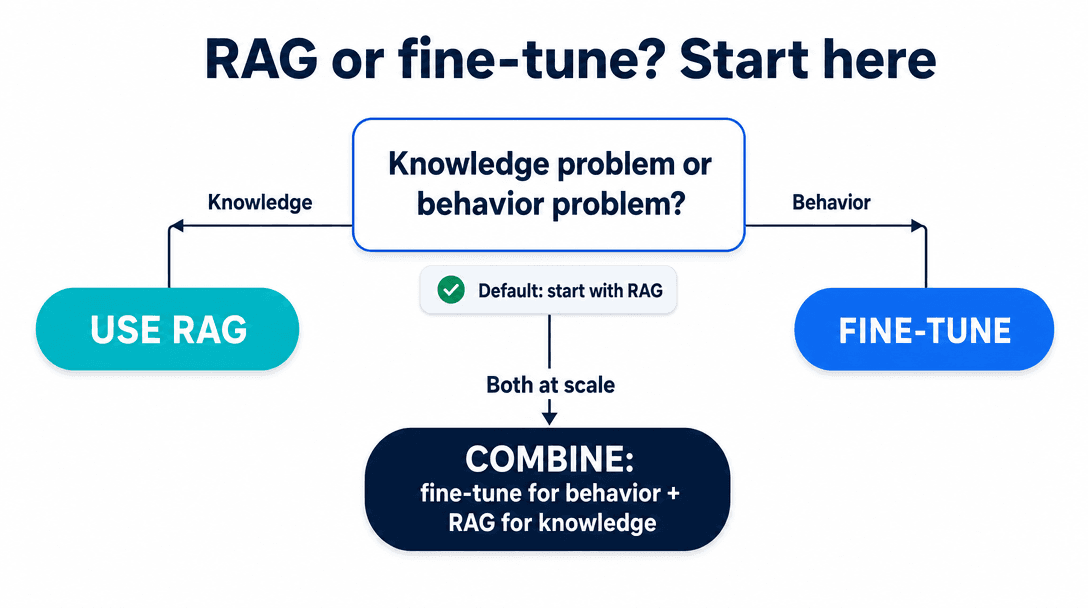
Start with a well-architected RAG system. Get it to production. Measure the quality gaps. If there's a specific behavior problem (format consistency, domain reasoning, cost at scale), add fine-tuning on top.
The teams that try to skip RAG and start with fine-tuning almost always end up building RAG later anyway, after realizing their fine-tuned model can't handle knowledge updates.
If you're trying to decide what's right for your specific use case, we do 1-week Discovery Sprints that answer exactly this question, and produce a working prototype you can evaluate before committing to a full build.
Free PDF
The 2026 AI Development Rate Sheet
Build, agent, RAG and consulting rates by tier, in one PDF, so you can check a quote before you sign it.

Written by
Pankaj Kumar
Founder · Metageeks Technologies
Metageeks builds software and AI products for growing businesses. Every build is scoped in writing before it starts, and you see progress every week. We write about what holds up once it reaches production.
Connect on LinkedInThe AI Build Brief
Ship AI that holds up in production.
Practical playbooks on how to build, price and ship AI features, in one short email every other week.