

Retainer, fixed project, or hourly is usually presented as a budgeting question. It is not. Each structure quietly pays your consultant to behave in a particular way, and the right choice is the one whose built-in incentive you can live with, because you will not out-negotiate the structure once the work starts.
TL;DR
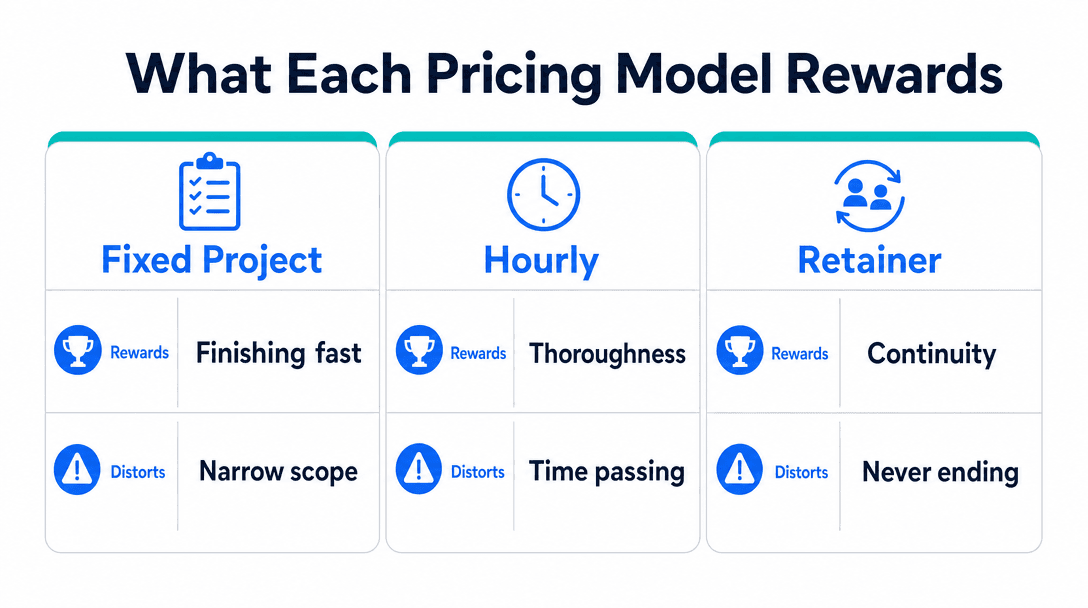
- Every pricing model creates a distortion. Fixed price rewards scope-cutting, hourly rewards slowness, retainers reward dependency.
- Pick the distortion you can manage and put the specific counterweight in the contract.
- Project fee when the outcome is definable. Retainer when you need ongoing judgment. Hourly when scope cannot be defined yet.
- Retainers commonly run $3,000-$15,000/month. What it entitles you to matters far more than the number.
- Retainer drift is prevented by three clauses: monthly deliverable, 90-day active-renewal review, written handover.
- Contract terms beat pricing model. Named people, deliverable ownership, and a defined handover matter more than the structure.
The short answer
Definable outcome → fixed-price project. Ongoing access to judgment → retainer, with a review date. Unclear scope → hourly, capped, and short. The most common expensive mistake is a retainer funding undefined work, because nothing forces it to conclude.
If you are weighing structures for a specific piece of work, describe it to us and we will reply with a written scope and estimate under the model that suits it.
Every model pays for something different
The useful way to compare these is to ask what each one rewards when the engagement gets difficult.
| Model | You are buying | Consultant is rewarded for | Fails when |
|---|---|---|---|
| Fixed project | A defined outcome | Finishing efficiently | Scope was vague, so "done" is contested |
| Hourly | Time and flexibility | Thoroughness, and time passing | Work is long; no cap on drift |
| Retainer | Availability and continuity | Staying engaged | Nobody defined what a month buys |
None of these is dishonest. They are structural pressures that operate on good consultants as well as bad ones, and they show up in exactly the moments where you have least leverage.
Fixed-price projects
What it is: an agreed deliverable for an agreed number.
The incentive: finish efficiently. The consultant carries the estimation risk, so they are paid to be fast and correct, and they price that risk into the number. This alignment is good when the outcome is definable.
The distortion: pressure to interpret scope narrowly. When a project runs long, a fixed price rewards arguing that a given request is out of scope. This is not bad faith, it is the model working as designed, and it is why fixed-price work with a vague scope document goes badly for both sides.
Use it when you can describe the deliverable in a paragraph: an assessment, a roadmap, a working prototype, an integration.
The counterweight: a written definition of completion, plus one named change-request process agreed before work starts. Most fixed-price disputes are definition disputes, not money disputes.
Hourly
What it is: time and materials, usually $150 to $500 an hour depending on specialism. The rate landscape is broken down in AI consultant hourly rates.
The incentive: thoroughness. You are paying for effort, so effort is what you get, and there is no structural reward for finishing.
The distortion: the obvious one. Nobody deliberately pads, and also nobody is paid to be quick. Over a long engagement that asymmetry compounds.
Use it when scope cannot be defined yet: a second opinion on a vendor decision, a short exploratory review, an ad-hoc technical question. In these cases hourly protects you from paying a fixed-price risk premium for something that might take two days.
The counterweight: a cap, and a short horizon. "Up to 20 hours, then we reassess" keeps the flexibility and removes the open end.
Retainers
What it is: a recurring monthly fee for ongoing access, typically $3,000 to $15,000 for small and mid-sized businesses.
The incentive: stay engaged and stay useful. At its best this is valuable, because you get someone who knows your systems, your history, and your constraints, and does not need re-briefing every time.
The distortion: continuation is the default. A project ends because it is finished. A retainer ends only when someone actively decides to end it, and that decision is uncomfortable, so it gets postponed. Twelve months later you are paying for a relationship rather than a result.
Use it when something is already live and needs ongoing iteration, when you need genuine on-call access, or when you want continuity of context more than you want a specific deliverable.
Do not use it to fund work you have not defined yet. That is the single most common way consulting budgets disappear without a visible outcome.
The three clauses that stop retainer drift
If you use a retainer, these turn it from an open-ended relationship into a managed one.
1. Define the monthly deliverable, not just the hours. "20 hours of availability" buys availability. "A monthly written review of system performance, a prioritised backlog, and up to 20 hours of implementation" buys something you can evaluate. The hours can stay; they should not be the whole definition.
2. Set a 90-day active review. The engagement continues only if both sides affirmatively decide to continue at day 90. Not a notice period, a decision point. This converts continuation from the path of least resistance into a choice someone has to make, which is the entire mechanism.
3. Require rolling handover. Documentation, credentials, repositories, and written process delivered as you go, not at the end. This removes the quiet lock-in where ending the retainer means losing access to how everything works, and it is the clause vendors most often resist. That resistance is informative.
What does a 20-hour AI consulting retainer cost in India?
A retainer is usually priced as a block of hours, so the monthly figure follows the hourly rate. Clutch's directory of AI consultants in India lists most of its top firms at $25-$49 an hour and some specialists at $50-$99. At those bands, and at the US rates quoted above, a 20-hour month works out to:
| Hourly band | 20 hours a month (USD) | In rupees (approx.) |
|---|---|---|
| $25-$49 (India, common) | $500-$980 | ₹48,000-₹94,000 |
| $50-$99 (India, specialist) | $1,000-$1,980 | ₹96,000-₹1.9 lakh |
| $150-$500 (US) | $3,000-$10,000 | ₹2.9 lakh-₹9.6 lakh |
Rupee figures use ₹95.74 to the US dollar, the Wise mid-market rate on 14 September 2026.
Two cautions. The same firms list minimum projects of $10,000 or $25,000, so ask whether a small monthly block is something they take at all. And the three clauses above matter as much at ₹50,000 a month as at $10,000. A cheaper retainer still drifts if nobody defines what the month produces.
What matters more than the pricing model
The structure is second-order. These terms are first-order, and they are the ones most often missing from a first draft:
- Named individuals. Who specifically does the work? "Our team" is not an answer, and the gap between who sells and who delivers is where most disappointment lives. Advice on where AI pays off is only as good as the person giving it.
- Deliverable ownership. Code, prompts, configurations, documentation, and evaluation suites assigned to you explicitly.
- Defined handover. What you receive at the end, listed. Repositories, credentials, environment docs, written process.
- Two-way termination. Notice periods that work in both directions, with a clear statement of what is owed at that point.
- What "done" means. For a project, in writing. For a retainer, what a satisfactory month looks like.
A fixed-price contract missing these is worse than a retainer that includes them. The pricing model gets the attention; the terms determine the outcome.
Choosing in practice
You do not yet know what to build. Short, capped hourly, or a fixed-price assessment. Do not open a retainer to figure out what you need. If you want that scoped independently before committing to a vendor's roadmap, a 20-minute scoping call is built for exactly that step.
You know what to build. Fixed-price project, with a written completion definition.
It is built and needs ongoing work. Retainer, with the three clauses.
You need occasional expert access, not delivery. Small hourly arrangement or a low-tier retainer with a defined response time.
Someone is proposing a large retainer to a business with no live AI system yet. Ask what specifically it produces in month one. If the answer is a discovery process, that is a fixed-price project wearing a retainer's clothes, and pricing it as a project protects you.
The bottom line
There is no cleanest pricing model. Fixed price aligns on finishing and distorts on scope. Hourly aligns on flexibility and distorts on duration. Retainers align on continuity and distort toward permanence.
Pick the distortion that matches your situation, then write the specific counterweight into the contract: a completion definition for fixed price, a cap for hourly, a review date for a retainer. And spend more attention on named people, ownership, and handover than on the pricing structure itself, because those are what determine whether you end the engagement with an asset or with an invoice history.
Next step: For price ranges by engagement type, see what AI consulting costs. For deciding who to hire in the first place, see consultant vs agency vs dev company.
Frequently asked questions
Should I pay an AI consultant a retainer or a project fee?+
Pay a project fee when the outcome is definable, and a retainer, commonly $3,000 to $15,000 a month for small and mid-sized businesses, when you need ongoing access to judgment rather than a deliverable. A project fee suits a roadmap, a working prototype or an integration: work you can describe in a paragraph and want finished. A retainer suits the period after something is already live and needs iteration, genuine on-call access, or continuity of context. The failure case is a retainer used to fund undefined work, which is how engagements drift for a year without producing anything you can point at. If you cannot describe what the retainer buys in one sentence, you want a project. If you do choose a retainer, write a monthly deliverable and a 90-day review into the contract, so continuing is a decision rather than a default.
What is a typical AI consulting retainer?+
Monthly retainers commonly run $3,000 to $15,000 for small and mid-sized businesses, usually structured as a block of hours or a defined scope of ongoing responsibilities. The monthly figure tracks the hourly rate: 20 hours at US consulting rates of $150 to $500 an hour is $3,000 to $10,000, while the same block with an India-based firm listing $25 to $49 an hour on Clutch is $500 to $980, or about ₹48,000 to ₹94,000. The number matters less than what it entitles you to. A retainer specifying response times, named people, and monthly deliverables is a different product from one specifying only an amount of money, even when the amount is identical. Before signing, ask what a satisfactory month looks like in writing, who does the work, and what you receive if the retainer ends.
Which pricing model is cheapest for AI consulting?+
Fixed-price projects are usually cheapest per unit of outcome, even when the headline number, often $5,000 to $50,000, looks larger than an hourly rate of $150 to $500. The consultant carries the estimation risk and prices efficiency into their own margin, so a project that runs long costs them rather than you. Hourly is cheapest when the work is small or exploratory and you want to stop at any point: a capped block of up to 20 hours for a second opinion costs less than any fixed-price risk premium. Retainers are rarely cheapest, and they are not supposed to be, since you are buying availability and continuity rather than a discount. Compare on cost per outcome rather than on rate. Divide each quote by what it actually delivers, and the ranking often reverses.
How do I stop an AI consulting retainer from drifting?+
Three clauses. Define the deliverable each month rather than only the hours. Set a review date, typically 90 days, where the engagement continues only by active decision rather than by default. And require a written handover of everything produced, so ending the retainer does not mean losing the work. Drift happens by inertia, so the fix is making continuation a deliberate choice instead of the path of least resistance.
Is hourly billing bad for AI consulting?+
Hourly billing, usually $150 to $500 an hour for AI consulting, suits some work well and other work badly. It carries no risk transfer: you pay for time, whatever the outcome. That makes it a good fit for short, exploratory work where the scope cannot be defined yet, such as a second opinion on a vendor decision or an ad-hoc technical question, and it protects you from paying a fixed-price premium for something that might take two days. It is a poor fit for delivery work of any length, because it pays for time rather than completion and gives you no protection against an estimate doubling. If you do use hourly, add a cap and a short horizon, for example up to 20 hours and then a reassessment. That keeps the flexibility and removes the open end.
What should be in an AI consulting contract regardless of pricing model?+
Named individuals doing the work, not just a company. Explicit ownership of all deliverables including code, prompts, and documentation. A defined handover at the end covering credentials, repositories, and written process. Clear termination terms with notice periods that work both ways. And a written definition of what completion means. These matter more than the pricing model, and they are the terms most commonly missing from a first draft.
Free PDF
The 2026 AI Development Rate Sheet
Build, agent, RAG and consulting rates by tier, in one PDF, so you can check a quote before you sign it.

Written by
Pankaj Kumar
Founder · Metageeks Technologies
Metageeks builds software and AI products for growing businesses. Every build is scoped in writing before it starts, and you see progress every week. We write about what holds up once it reaches production.
Connect on LinkedInThe AI Build Brief
Ship AI that holds up in production.
Practical playbooks on how to build, price and ship AI features, in one short email every other week.