

Most advice about hiring chatbot developers compares hourly rates, which is the least useful comparison available. Rates are broadly knowable and broadly similar within a channel. What differs is what each channel hides: who actually does the work, what happens when the person disappears, and whether you own what you paid for.
TL;DR
- Choose the channel by which failure mode you can survive, not by rate. Rates are covered in what chatbot developers cost.
- The single highest-signal vetting step is a paid trial task on your real data. Almost nobody does it.
- Offshore is a location decision, not a category. It cuts across freelance and agency.
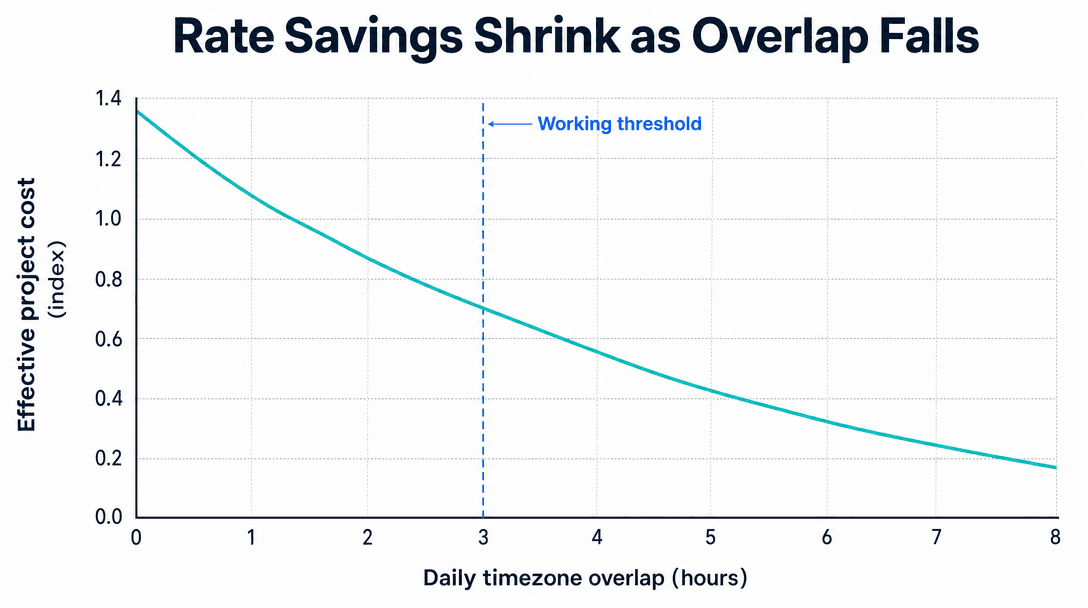
- Three to four hours of daily overlap is the working threshold. Below it, every question costs a day.
- Get explicit IP assignment plus governing law in writing before work starts. Many default contracts are silent.
- Biggest red flag: a fixed price quoted before anyone has looked at your data.
Disclosure
Metageeks is an India-based development company, so we are one of the offshore options this post discusses. We have tried to write the version we would want to read as a buyer, including the parts that argue against hiring a team like ours. Where you should be sceptical of us, we have said so.
The three channels, honestly
Freelance
What you are buying: one person's time, usually sourced through Upwork, Toptal, or a referral.
Good at: narrow, well-specified builds. If you can write the spec yourself and the work is a known shape, a good freelancer is the most cost-effective route by a clear margin, with no agency overhead.
The hidden cost: continuity. A freelancer can take another contract, get ill, or simply stop replying, and there is no bench behind them. On a six-week build this is a manageable risk. On something your operations will depend on for three years, you are one person's availability away from an unmaintainable system.
Buy this when: the scope is clear, you can specify it, and you could tolerate a restart.
Agency
What you are buying: delivery accountability and continuity, at a markup.
Good at: projects where you do not want to own the specification, where several skills are needed, and where someone else should be responsible for hitting a date.
The hidden cost: the person who sells is rarely the person who builds. Agency margins also mean you pay for account management you may not need on a small project.
Buy this when: you need the project to happen without you managing it, or the scope will move.
Offshore
Not a third category. Offshore cuts across the other two: there are offshore freelancers and offshore agencies, and the comparison that matters is against onshore equivalents of the same type.
Good at: rate. The saving is real, frequently 40 to 70 percent against US rates for comparable skill, and the talent depth in India, Eastern Europe, and Latin America is genuine.
The hidden costs are the subject of the next section, because they are the ones buyers systematically underestimate.
Buy this when: you have enough overlap, a written IP arrangement, and a specification stable enough to survive slower feedback loops.
What offshore actually costs beyond the rate
Communication overhead. With thin overlap, each question becomes a day. A question at 5pm your time is answered while you sleep, your follow-up goes back the next evening, and a five-minute clarification has consumed 48 hours. On projects with genuine ambiguity, this typically adds 10 to 25 percent to effective duration.
The overlap threshold. Three to four hours of daily overlap is where projects run normally.
| Route | Natural overlap | Practical reality |
|---|---|---|
| India → US East | Minimal | One side shifts hours; usually the vendor |
| India → US West | Effectively none | Requires committed shifted hours |
| India → UK / Europe | Good | Works comfortably |
| Latin America → US | Excellent | Strongest option for US buyers |
| Eastern Europe → US East | Partial | Workable with an early-start arrangement |
Ask which hours the team will actually be available, in writing, not which hours they could be. This is the question that most predicts whether an offshore engagement feels smooth or exhausting.
Specification burden. Slower feedback raises the cost of ambiguity, so offshore rewards better-written specs. If your requirements are still forming, the rate saving gets eaten by rework.
IP and enforceability. Covered below, and it is the one with lasting consequences.
The vetting test that actually works
Portfolios show finished work of unknown authorship. Interviews show how well someone interviews. Neither predicts delivery.
Pay for a small scoped task on your real data before you commit to anything. One to three days, priced fairly, building something narrow against your actual messy inputs.
What it reveals that nothing else does:
- How they handle your data, which is never as clean as the sample in their portfolio
- The questions they ask, and whether they ask any. Silence is the loudest signal available.
- Communication under friction, specifically what happens when they get blocked at 11pm your time
- What the code and documentation actually look like
- Whether the person you spoke to is the person building
Refusal to do a paid trial is close to disqualifying. Good developers are usually happy to be paid to demonstrate competence, and the ones who object tend to object because the demonstration would not go well.
For a chatbot build specifically, a good trial task is: ingest a small slice of our real documentation, answer ten questions we supply, show us where it fails and why. That surfaces retrieval quality, honesty about limitations, and engineering judgment in three days.
The IP clause most contracts get wrong
This is the part that causes real damage, and it surfaces years later during a raise or a sale.
Many default freelance and offshore contracts are silent on IP assignment, or assign it in terms that are ambiguous across jurisdictions. Requirements:
- Explicit assignment of all work product to your company, on payment, covering code, prompts, configurations, evaluation suites, and documentation.
- Governing law and jurisdiction named specifically. A clause you cannot practically enforce is decoration.
- Subcontractor flow-down, so anyone the vendor brings in is bound by the same terms. Agencies subcontract more than they advertise.
- Confidentiality covering your data, including whether any of it may be used to train models or improve the vendor's own tooling.
- Handover obligations: repository access, deployment credentials, environment documentation, delivered at project end rather than on request.
Settle this before work starts. Retroactive assignment is far harder to obtain once you have already paid, and the leverage runs the wrong way.
Red flags across every channel
No willingness to do a paid trial. A fixed price quoted before anyone examined your data. No questions about your existing systems. A portfolio with no contactable references. Vagueness about who specifically will build it. And a promise of a production chatbot wired into your live systems in under two weeks, which means the testing is not in the plan.
Choosing in practice
Scope is clear, budget is tight, you can specify it yourself: freelance, onshore or offshore. Run the trial task. Accept the continuity risk consciously.
Scope will move, you need a date, you do not want to manage it: agency. Ask specifically who builds, not who sells.
Budget is the binding constraint and your spec is solid: offshore, and treat overlap hours as a hard selection criterion rather than a detail.
It will run your operations for years: weight maintainability and handover far above rate. The cheapest build that nobody can maintain is the most expensive option on a three-year view.
For what each channel actually charges, the rate breakdown is in what it costs to hire a chatbot developer. For whether you should be hiring a developer at all rather than buying a platform, chatbot pricing models covers the alternative.
The bottom line
The channel decision is a risk decision wearing a price tag. Freelance trades continuity for cost. Agencies trade cost for accountability. Offshore trades communication bandwidth for rate, and that trade is good when overlap is sufficient and the specification is stable, and poor when either is missing.
Whatever you choose, do the paid trial task and fix the IP clause before work starts. Those two steps cost a few hundred dollars and a lawyer's hour, and they prevent most of the outcomes that make people say hiring a developer went badly.
Next step: For rates by channel, see chatbot developer cost. For choosing a company rather than an individual, see how to choose an AI development company.
Frequently asked questions
Should I hire a freelance, agency, or offshore chatbot developer?+
Match the channel to the risk rather than to the rate. Freelancers suit narrow, well-specified builds where you can write the spec yourself and absorb the risk of one person disappearing. Agencies suit projects needing continuity, accountability, and someone else owning delivery. Offshore teams, whether individual or agency, are a location choice rather than a separate category, and they suit either model when you have enough timezone overlap and a written IP arrangement. The wrong question is which is cheapest; the right one is which failure mode you can survive.
What is the real cost of hiring offshore chatbot developers?+
The hourly rate is the visible part and usually the smaller consideration. The real costs are communication overhead, which typically adds 10 to 25 percent to effective project time when overlap is thin, review cycles that take a day each because questions queue overnight, and the risk of ambiguous IP ownership if the contract does not specify governing law and assignment explicitly. Offshore rates are genuinely lower and the savings are real, but they compress substantially if you have under three hours of daily overlap.
How do I vet a chatbot developer before hiring them?+
Pay for a small scoped task on your actual data before committing to a project. Not a portfolio review, not an interview, a paid trial of one to three days building something narrow against real inputs. Portfolios show finished work with unknown authorship. A trial shows how someone handles your messy data, whether they ask good questions, how they communicate when blocked, and what their code looks like. It is the single highest-signal step available and almost nobody does it.
How many hours of timezone overlap do I need with an offshore team?+
Three to four hours of daily overlap is the practical threshold for a build project with active decision-making. Below that, each question costs a full day and a two-week project stretches toward three. Above four hours you can run normal daily communication. India to US East gives limited natural overlap and usually requires one side to shift hours; India to UK and Europe works comfortably. Latin America to US is the strongest overlap available to US buyers. Ask directly which hours the team will actually be available, not which hours they could be.
Who owns the code when you hire an offshore developer?+
Whoever the contract says, and only if the contract is enforceable where the developer is. Many default freelance and offshore agreements are silent on IP assignment or assign it ambiguously, which becomes a serious problem if you later raise investment or sell. Require an explicit assignment of all work product, specify governing law and jurisdiction, and confirm the same terms bind any subcontractors. Get this settled before work starts, because retroactive assignment is much harder to obtain once you have paid.
What are the red flags when hiring a chatbot developer?+
Unwillingness to do a paid trial task. A portfolio without references you can actually contact. Quoting a fixed price before understanding your data. No questions about your existing systems or edge cases. Vague answers on who specifically will do the work, which often means the person selling is not the person building. And promising a production chatbot integrated with your live systems in under two weeks, which means they intend to skip testing.
Free PDF
The 2026 AI Development Rate Sheet
Build, agent, RAG and consulting rates by tier, in one PDF, so you can check a quote before you sign it.

Written by
Pankaj Kumar
Founder · Metageeks Technologies
Metageeks builds software and AI products for growing businesses. Every build is scoped in writing before it starts, and you see progress every week. We write about what holds up once it reaches production.
Connect on LinkedInThe AI Build Brief
Ship AI that holds up in production.
Practical playbooks on how to build, price and ship AI features, in one short email every other week.