

The reason automated follow-up reads like automated follow-up is not the technology. It is that most sequences personalise identity, which anyone can look up, instead of context, which only you observed. A message that knows your name signals a database. A message that knows which page you read for four minutes signals attention.
TL;DR
- Personalise context, not identity. First name and company are automation signals now, not personal touches.
- Speed matters more than copy. Under five minutes for high-intent inbound; the hour at worst.
- Best pattern: human writes the voice once, AI fills in the specific details it knows.
- Four to six touches over two to three weeks. Each needs a new reason to exist, not a reminder of the last one.
- Fully generated sequences drift to the generic register everyone recognises. Fully static ones miss the detail that lands.
- Check CAN-SPAM, and GDPR or local consent rules based on where your prospects are, not where you are.
The test
Read your follow-up message and ask: could this have been sent to a hundred other people? If yes, the personalisation is decorative regardless of how many merge fields it contains. One sentence that could only have been written to this person outperforms five paragraphs of tokens.
Why the standard approach stopped working
Merge-field personalisation worked when it was rare. "Hi , I noticed is growing" read as attention in 2015. In 2026 every prospect has received thousands of these, and pattern recognition is immediate and unconscious.
Worse, generated outreach has converged on a recognisable register: a compliment about their work, a pivot to a problem they did not mention, a soft ask. Prospects now identify that shape within a sentence, and once they do, everything after it is discounted.
The failure is not that a machine wrote it. It is that the message contains no information the sender could only have obtained by paying attention.
Three things that read as human:
Specific behaviour. "You spent a while on the pricing page and then opened the comparison post" is true, particular, and impossible to mass-produce.
Their own words. Quoting what they typed into your form or chat, rather than paraphrasing it into marketing language.
Useful asymmetry. Answering the actual question rather than offering a call. Being helpful before being interested is the strongest differentiator available, and almost nobody does it in message one.
Speed beats copy
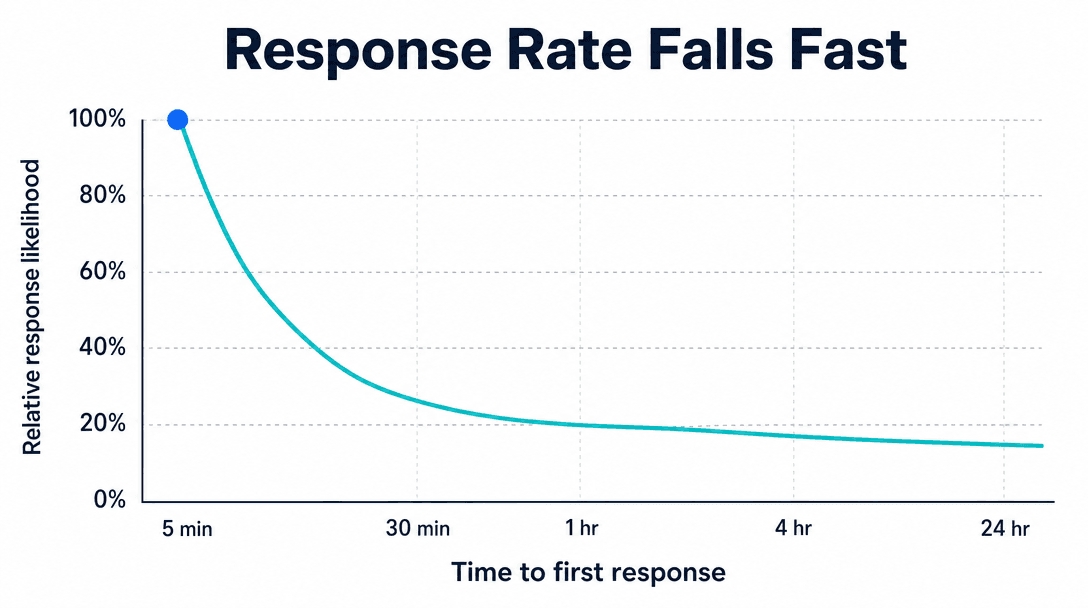
Before improving the writing, fix the timing, because the timing is a larger lever.
Inbound intent decays fast. Someone filling in a form at 9pm is comparing three vendors that evening, and the one who replies first has a structural advantage that better copy rarely overcomes.
This is where automation wins, and it is not a copywriting problem. A system responds in 90 seconds at 11pm on a Sunday. A person does not.
Practical targets:
| Lead type | Target first response |
|---|---|
| High-intent inbound (demo, pricing, contact form) | Under 5 minutes |
| Content download or newsletter signup | Under 1 hour |
| Cold or partially qualified | Same business day |
If your current first response is measured in hours, that is your project. Rewriting sequence copy while leads wait overnight is optimising the wrong variable, and it is the most common misallocation in this whole area. Getting a reply out in minutes is a job for automated lead workflows, not a better template.
The hybrid that works
Two failure modes sit at either end.
Fully static templates are consistent and in your voice, and they cannot reference anything specific, so they read as broadcast.
Fully generated messages can reference everything and drift toward the generic register, because that is the average of what they learned from.
The version that works is neither:
- Write the sequence once, properly, in your own voice. Four to six messages. Spend real time on this, because it is the asset.
- Define the specific slots where genuine context goes. Not name and company. The page they were on, the question they asked, the service they selected, the thing they downloaded.
- Let the system fill only those slots, using information it has. If a slot has no real data, the message ships without it rather than inventing something.
- Review the first fifty, then spot-check monthly.
That last rule is the important one. Most fake-sounding personalisation is a system filling a slot it had no data for, producing a plausible guess. A message that guesses wrong is worse than one that says nothing, because it proves you were not paying attention while claiming you were.
A sequence that holds up
Four to six touches over two to three weeks, each with a distinct reason to exist.
Touch 1: immediate (under 5 min). Answer their actual question if they asked one. Reference the specific thing they did. Short. No call push. This is where most of your reply rate is won or lost.
Touch 2: day 2. Send something useful and relevant to their specific situation: a relevant post, a rough number, a comparable example. Still no hard ask.
Touch 3: day 5. Now make the ask, plainly, with a reason it makes sense for them specifically.
Touch 4: day 10. A different angle. Address the objection most likely to be blocking someone in their position rather than repeating the offer.
Touch 5: day 16, close-out. "I'll stop here unless you'd like me to follow up." This message reliably outperforms everything before it, because it removes pressure and gives a clean reason to reply.
What kills a sequence
Manufactured urgency about a deadline that does not exist. False familiarity, including "just circling back" and "as promised" when nothing was promised. Guessing at a pain point they never mentioned. And messages two through five existing only to note that message one was sent, which is what most templates default to.
Compliance, briefly
Not legal advice, and worth checking properly for your situation.
US email is governed by CAN-SPAM: accurate headers and subject lines, a physical postal address, a working opt-out honoured promptly, and no misleading identification of the sender.
EU and UK prospects fall under GDPR, which requires a lawful basis for processing and contacting individuals. Several jurisdictions require prior consent rather than opt-out for commercial messages.
SMS carries separate and generally tighter consent requirements almost everywhere, and automated texting to prospects who did not explicitly opt in is a meaningfully higher-risk activity than email.
The rule that keeps you safe in practice: apply the standard of wherever your prospect is, not wherever you are. Automation scales volume, and volume converts a small compliance error into a large one quickly.
What to measure
- Time to first response, median and 90th percentile. The single most actionable number.
- Reply rate by touch. If touch one underperforms, the problem is speed or relevance. If later touches underperform, they lack a distinct reason to exist.
- Positive reply rate, not raw replies. "Please stop" is a reply.
- Unsubscribe rate by touch. A spike identifies the message that overreached.
- Meetings booked per hundred leads. The only number that matters at the end.
Track reply rate per touch specifically. It tells you which message to rewrite, and most teams only look at sequence-level totals, which hide the one broken message.
The bottom line
The complaint that AI follow-up sounds robotic is really a complaint about generic follow-up, and generic predates AI by decades. What changed is that generating volume became free, so the average message got worse while the average recipient got better at spotting it.
The fix is not more sophisticated generation. It is using automation for what it is better at, which is responding in 90 seconds at midnight and never forgetting touch four, while keeping the writing human and the personalisation limited to things you observed.
Write the sequence once, properly. Fill only the slots you have real data for. Fix your response time before you touch the copy.
Next step: For the qualification and routing layer that feeds these sequences, see AI lead qualification automation. For capturing the leads in the first place, see the best AI chatbots for lead generation.
Frequently asked questions
Why do AI follow-up emails sound fake?+
Because they personalise identity instead of context. Inserting a first name, a company name, and a scraped detail produces a message that is technically about the recipient and reads as generated, since everyone has now received thousands of them. What reads as human is referencing the specific thing the person did, such as the page they were on or the question they asked, in a sentence that could not have been sent to anyone else. Detail beats tokens.
How fast should you follow up with an inbound lead?+
Within five minutes for a high-intent inbound lead, and inside the hour at worst. Response speed is consistently one of the strongest predictors of whether an inbound lead converts, because intent decays quickly and most prospects are contacting several vendors at once. This is also the part AI fixes, since a system can respond at 11pm on a Sunday and a person cannot. Speed is a larger lever than message quality.
How many follow-up messages should a sequence have?+
Four to six touches over two to three weeks works for most B2B services, spaced with decreasing frequency: fast first response, then day two, day five, day ten, and a final close-out. What matters more than count is that each message carries a new reason to exist. Sequences fail when messages two through five are simply reminders that message one was sent, which is what most templates produce.
Should AI write the follow-up emails or just send them?+
The best pattern is AI assembling context and a human writing the voice. Write your sequence once, properly, in your own voice, then let the system fill in the specific details it knows: which page they visited, what they asked, which service they enquired about. Fully generated messages drift toward the generic register everyone now recognises. Fully static templates miss the detail that makes a message land. The hybrid captures both.
What are the rules for automated sales follow-up emails?+
In the US, commercial email is governed by CAN-SPAM, which requires accurate header and subject information, a physical postal address, and a working opt-out honoured promptly. Other jurisdictions are stricter: GDPR requires a lawful basis for contacting EU individuals, and several countries require prior consent rather than opt-out. Automated SMS carries separate and generally tighter consent requirements. Check what applies to where your prospects are, not where you are.
Does personalisation actually improve reply rates?+
Specific, verifiable personalisation does. Token-based personalisation has largely stopped working because recipients have learned to recognise it, and in some cases it now signals automation and reduces response. The distinction is between personalisation that proves you noticed something particular and personalisation that proves you have a database. Referencing what someone did outperforms referencing who they are.
Free PDF
The 2026 AI Development Rate Sheet
Build, agent, RAG and consulting rates by tier, in one PDF, so you can check a quote before you sign it.

Written by
Pankaj Kumar
Founder · Metageeks Technologies
Metageeks builds software and AI products for growing businesses. Every build is scoped in writing before it starts, and you see progress every week. We write about what holds up once it reaches production.
Connect on LinkedInThe AI Build Brief
Ship AI that holds up in production.
Practical playbooks on how to build, price and ship AI features, in one short email every other week.