

Ask which AI chatbot is best for lead generation and you will get a list of features nobody chooses on. The decision that matters is much narrower: where do your leads need to end up, and how fast can a human get to them? Answer those two and the tool shortlist usually reduces to one obvious option.
TL;DR
- Pick the chatbot closest to your CRM, not the one with the best answers. Routing and attribution beat conversation quality.
- Chatbots reliably raise captured leads. Whether that helps depends entirely on qualification.
- Speed to first human response predicts conversion more strongly than any tool choice. Fix routing first.
- Drift is closed to new customers after its March 2026 sunset announcement. Any list still recommending it is stale.
- Starting prices as of September 2026: HubSpot chatbot free, ManyChat $14/mo, Tidio $29/mo, Chatbase $40/mo, Intercom $29/seat + $0.99 per outcome, custom build $15K-$40K.
- Build custom only for specific qualification logic, not to fix a routing problem.
The 8 tools compared
Every fact in this table was checked on the vendor's own site on September 15, 2026. Prices are the lowest plan that includes the capability described; follow the link for the current page.
| Tool | Best for | Lead routing / CRM sync | AI capability | Starting price (Sept 2026) | Watch out for |
|---|---|---|---|---|---|
| HubSpot | Teams already on HubSpot CRM | Native: chats sync to CRM records, bots qualify leads and book meetings | Customer Agent on Service Hub Professional and Enterprise | Chatbot builder free; AI agent from $90/seat/mo annual + $0.50 per resolution (pricing) | $1,500 onboarding on Professional; credits expire monthly |
| Intercom Fin | Sites where support and sales share pages | Salesforce app creates leads; Fin qualifies and routes prospects | Fin answers, qualifies and disqualifies | $29/seat/mo annual + $0.99 per outcome (pricing) | A qualified lead is billed at $9.99; handoffs count as outcomes |
| Zendesk | Support-led teams already on Zendesk | Routes to agents inside Zendesk; built around tickets, not leads | AI agents on every Suite and Support plan | Suite Team $55/agent/mo annual, 5 automated resolutions per agent (pricing) | $1.50-$2.00 per resolution past the allowance |
| Tidio | Small stores and Shopify sites | HubSpot integration on every plan, including free: creates contacts, saves transcripts | Lyro AI agent, sold as a quota | Starter $29/mo; Lyro from $39/mo for 50 AI conversations (pricing) | Conversation caps on each tier; Shopify actions need Growth |
| Landbot | Guided, form-like qualification flows | HubSpot, Salesforce, Pipedrive, Zoho and webhooks on Professional and up | AI chats metered: 100 on Starter, 300 on Professional | Starter 40 euros/mo; CRM integrations from 100 euros/mo (pricing) | 0.10 euros per extra AI chat; Starter lacks CRM integrations |
| Botpress | Teams that want to design their own agent logic | HubSpot integration creates contacts, leads, deals and tickets | LLM agents; model usage billed at cost past the included allowance | Free for 25 conversations; Plus $189/mo for 250 (pricing) | $65 per extra 100 conversations on Plus; you build the flows |
| ManyChat | Instagram, WhatsApp and Messenger lead capture | Native HubSpot integration creates or updates contacts | Manychat AI on all paid plans | Essential $14/mo billed annually, 250 active contacts (pricing) | No website chat widget; priced by active contacts |
| Chatbase | Answering pre-sales questions from your content | Collects leads in chat; CRM sync through Zapier | Agent trained on your site and documents | Hobby $40/mo, 700 message credits (pricing) | Advanced integrations start on Standard ($150/mo) |
Drift is not on the list. It's covered in the warning below.
The selection rule
Buy the chatbot that lives closest to your system of record. A bot that answers slightly worse but writes a clean, attributed, routed lead into the CRM your sales team already uses will outperform a better conversationalist that drops leads into a separate inbox. Integration quality beats answer quality for lead gen, which is the reverse of how you would choose a support bot.
The categories, and who each one is for
CRM-native chatbots: HubSpot
HubSpot, and the native bots in Salesforce and Zoho. If your CRM is your operating system, its native chatbot is usually the correct answer regardless of how it compares on AI capability. Leads land as proper records with source attribution intact, routing uses rules your team already maintains, and reporting works on day one without an integration project.
HubSpot's rule-based chatbot builder is free and syncs conversations to the CRM. The AI Customer Agent is the paid part: it needs Service Hub Professional ($90 a seat a month on an annual commitment) and uses 50 credits, or $0.50, per resolved conversation.
Best for: teams already committed to a CRM, especially where attribution reporting matters. Weak spot: conversational quality generally trails the specialists, and you are buying into further lock-in.
Support-first platforms with lead flows: Intercom and Zendesk
Intercom (Fin), Zendesk. Built for support and extended into lead capture. Strong at conversation, strong at handoff, and a good fit if you want one tool answering both customer questions and prospect questions on the same site.
Intercom seats start at $29 a month billed annually, and Fin bills $0.99 per outcome, with a qualified prospect billed at $9.99. Zendesk includes a small monthly allowance of automated resolutions per agent and charges $1.50-$2.00 for each one after that. Both behave very differently at scale. We modelled that in Intercom Fin pricing and compared the platforms in chatbot platform pricing.
Best for: businesses where support and sales conversations overlap on the same pages. Weak spot: lead routing and sales attribution are secondary features here, and it shows. Zendesk in particular is built around tickets.
SMB and e-commerce tools: Tidio
Tidio and similar. Fast to deploy, inexpensive, good enough for capture and simple qualification, with solid Shopify integrations. Tidio's HubSpot integration works on every plan, including the free one, so small teams on HubSpot's free CRM still get leads into a real record.
Starter is $29 a month; the Lyro AI agent is priced separately from $39 a month for 50 AI conversations.
Best for: small teams and stores that need capture working this week rather than a project. Weak spot: qualification logic gets shallow quickly, and the conversation caps arrive sooner than you expect.
Flow builders: Landbot and Botpress
Landbot is the tool for structured, form-like qualification: a guided conversation that asks the same four questions every time and pushes the answers into HubSpot, Salesforce, Pipedrive or Zoho. Those CRM integrations start on the Professional plan (100 euros a month, 80 billed annually); Starter is 40 euros.
Botpress sits closer to a developer platform. You design the agent's logic yourself, its HubSpot integration can create contacts, leads, deals and tickets, and model usage past the included allowance is billed at cost. The Plus plan is $189 a month ($150 billed annually) for 250 conversations.
Best for: Landbot when qualification is a fixed script; Botpress when you want custom logic without a full custom build. Weak spot: both put the design work on you. A badly designed flow in a good tool still loses leads.
Social DM tools: ManyChat
ManyChat is where lead generation happens in Instagram, WhatsApp, Messenger and TikTok DMs rather than on your website. It has no website chat widget. What it does well is turning comments and DMs into contacts, with a native HubSpot integration that creates or updates the contact. Paid plans start at $14 a month billed annually and are priced by active contacts.
Best for: brands whose leads start on social, not on the site. Weak spot: it doesn't solve website lead capture at all, so it's usually a second tool, not the only one.
Quick RAG-style bots: Chatbase
Chatbase and similar document-trained tools. Point them at your site or docs and they answer questions about your business within an hour. Useful and limited: they answer well and route poorly. Chatbase collects leads in chat and pushes them to a CRM through Zapier.
Hobby is $40 a month for 700 message credits; Standard is $150 for 4,000.
Best for: answering pre-sales questions on a content-heavy site. Weak spot: lead capture is an afterthought; expect to wire routing yourself.
Custom builds
A custom build is the honest answer in three situations: your qualification logic is specific to your business (a signal a lead form can't capture), you need the bot writing into systems with no usable integration, or per-resolution pricing has outgrown a fixed build at your volume. If none of those apply, buy one of the tools above. If one does, custom AI chatbot development is the route, typically $15,000 to $40,000 plus $150 to $600 a month to run. Mechanism and cost breakdown in AI lead qualification automation and custom AI agent cost.
Drift is not a 2026 option
On March 6, 2026, Clari + Salesloft announced the gradual sunset of Drift and named 1mind as the successor for its customers. It should not be selected for a new deployment, and existing users should be planning a migration. The migration guide covers the options. Any current "best chatbot" list still recommending Drift has not been updated.
Comparison by category
| CRM-native | Support-first | SMB tools | Flow builders | RAG bots | Custom | |
|---|---|---|---|---|---|---|
| Examples | HubSpot | Intercom, Zendesk | Tidio | Landbot, Botpress | Chatbase | Your build |
| Typical cost | Free bot; AI from $90/seat + $0.50/res | $0.99-$2.00/res + seats | $29-$59/mo + AI quota | 40 euros-$189/mo | $40-$150/mo | $15K-$40K + run |
| Lead routing | Excellent | Fair | Basic | Good | Weak | Whatever you build |
| Attribution | Excellent | Fair | Basic | Fair | Weak | Yours |
| Answer quality | Fair | Excellent | Fair | Depends on design | Good | Depends |
| Time to live | Days | Under a day | Hours | Days | Under an hour | 4-8 weeks |
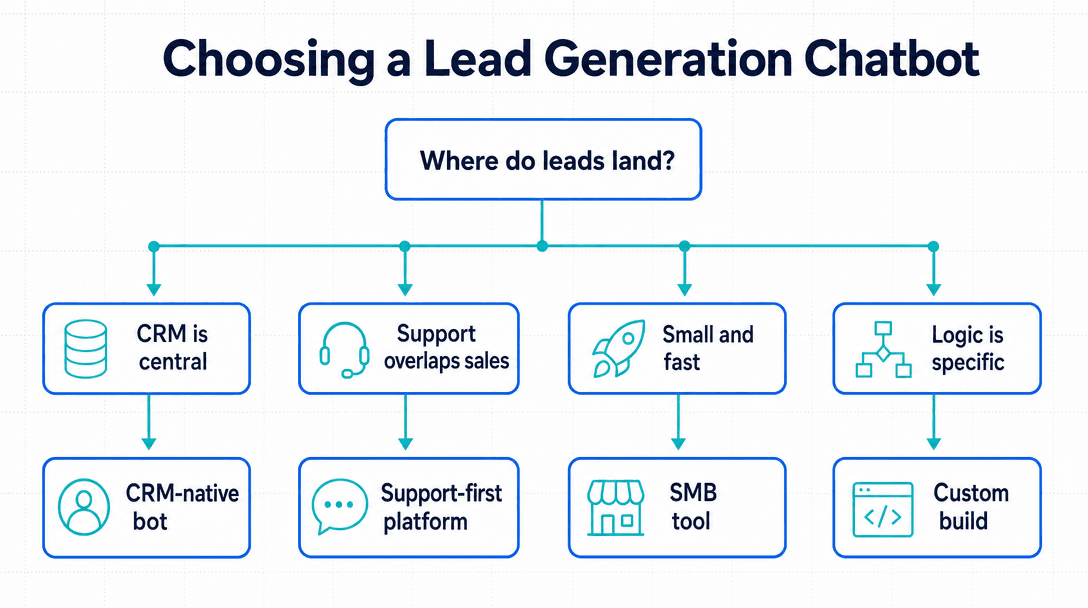
| Best when | CRM is central | Support overlaps sales | Small and fast | Qualification is a script | Content-heavy site | Logic is specific |
ManyChat sits outside this table because it works in social DMs, not on your website.
What actually moves lead volume
Three things, none of which is the tool.
1. Speed to first human response. The single strongest predictor of whether a captured lead converts. A chatbot capturing a lead at 2pm that nobody contacts until tomorrow has produced a record, not an opportunity. If your current follow-up is measured in hours, fix that before changing tools, because it will dominate whatever gain the new bot delivers.
2. Qualification depth. Capture rate is easy to raise and easy to misread. A bot that triples captured conversations while tripling unqualified ones has created sales work, not revenue. Decide the three or four questions that separate a real prospect from a browser, and make the bot ask them before it hands anything over.
3. Where the bot appears. A single site-wide bot underperforms targeted triggers. Pricing page, high-intent service pages, and exit intent on comparison content behave completely differently from a blog post. Most teams deploy once, globally, and never revisit placement.
What most businesses get wrong
They optimise capture instead of qualification. More leads is not the goal; more qualified conversations that reach a human quickly is.
They choose on conversation quality. For support bots this is right. For lead gen, a slightly worse conversation that lands cleanly in the CRM beats a great conversation that lands in an inbox.
They skip the handoff design. The moment the bot passes to a human is where leads are lost. Define what triggers it, who receives it, how fast, and what happens outside business hours.
They let the bot promise things. A bot quoting a price or committing to a timeline creates an expectation your sales team inherits. Constrain it explicitly.
They never review transcripts. The first month of conversations is the most valuable qualification research you will get. Read them.
How to choose in fifteen minutes
- Where do leads need to land? If there is a clear CRM answer, start with its native bot and only move if it fails you.
- Do support and sales share pages? If yes, a support-first platform handling both is usually less friction than two tools.
- Where do leads start? If most conversations begin in Instagram or WhatsApp DMs, add a social tool like ManyChat; a website bot won't see them.
- How specific is qualification? If three or four standard questions cover it, buy. If it needs your own logic across your own data, price a build.
- What is your follow-up speed today? Under 15 minutes, a better bot will help. Over a day, fix routing first.
- What is your volume? Under a few hundred conversations a month, take the cheapest thing that integrates. Above a couple of thousand, model per-resolution pricing over 24 months using the payback math.
The bottom line
The best AI chatbot for lead generation in 2026 is the one that puts a qualified, attributed lead in front of a human fastest. That is a routing and integration question far more than an AI question, which is why "best chatbot" lists ranked on features consistently mislead.
Pick the tool closest to your CRM, spend your effort on the three qualification questions and the handoff, and measure speed to first human response rather than captured lead count.
Next step: For the mechanism behind qualification and routing, see AI lead qualification automation. To price the build option, see custom AI agent cost.
Frequently asked questions
What is the best AI chatbot for website lead generation?+
There is no single best one, and the honest selection rule is to pick the chatbot that lives closest to where your leads end up. If your CRM is HubSpot, HubSpot's chatbot wins on routing and attribution even if another tool answers better. If you run support and sales in Intercom, Fin plus its lead flows is the least friction. If you are an e-commerce store on Shopify, Tidio and similar SMB tools fit better. Custom builds win when qualification logic is specific to your business.
Do AI chatbots actually generate more leads?+
They generate more captured leads and not necessarily more qualified ones, which is an important distinction. Chatbots reliably increase capture rate because they engage visitors who would not fill in a form. Whether that helps depends on qualification, since a pile of unqualified conversations creates sales work rather than revenue. The businesses that see real gains use the bot to qualify and route quickly, not simply to collect more contact details.
How much do lead generation chatbots cost?+
As of September 2026, HubSpot's chatbot builder is free and its AI Customer Agent needs Service Hub Professional from $90 a seat plus $0.50 per resolution. Intercom starts at $29 a seat plus $0.99 per Fin outcome. Tidio starts at $29 a month, Landbot at 40 euros, Botpress Plus at $189 and Chatbase at $40, with ManyChat from $14 a month billed annually. A custom lead qualification agent runs $15,000 to $40,000 to build plus $150 to $600 a month. Check vendor pages before you buy, since this category reprices often.
Is Drift still a good option for lead generation in 2026?+
No. On March 6, 2026, Clari + Salesloft announced the gradual sunset of Drift and named 1mind as the successor for its customers, so it should not be selected for a new deployment. Existing Drift users should be planning a migration rather than optimising the current setup. Any list still recommending Drift for new implementations in 2026 has not been updated.
What matters more, the chatbot or the follow-up?+
The follow-up, by a wide margin. Speed to first human response is consistently the strongest predictor of whether a captured lead converts, and it is determined by your routing and your team rather than by which chatbot captured the conversation. A mediocre chatbot with a five-minute human follow-up beats an excellent chatbot with next-day follow-up. Fix routing before you change tools.
Should I build a custom lead generation chatbot?+
Only when your qualification logic is specific to your business, when you need it writing into systems with no usable integration, or when platform pricing has outgrown a fixed cost at your volume. Most businesses should buy first. The common failure is building a custom bot to solve a routing problem, which is a configuration issue that no amount of custom development fixes.
Free PDF
The 2026 AI Development Rate Sheet
Build, agent, RAG and consulting rates by tier, in one PDF, so you can check a quote before you sign it.

Written by
Pankaj Kumar
Founder · Metageeks Technologies
Metageeks builds software and AI products for growing businesses. Every build is scoped in writing before it starts, and you see progress every week. We write about what holds up once it reaches production.
Connect on LinkedInThe AI Build Brief
Ship AI that holds up in production.
Practical playbooks on how to build, price and ship AI features, in one short email every other week.