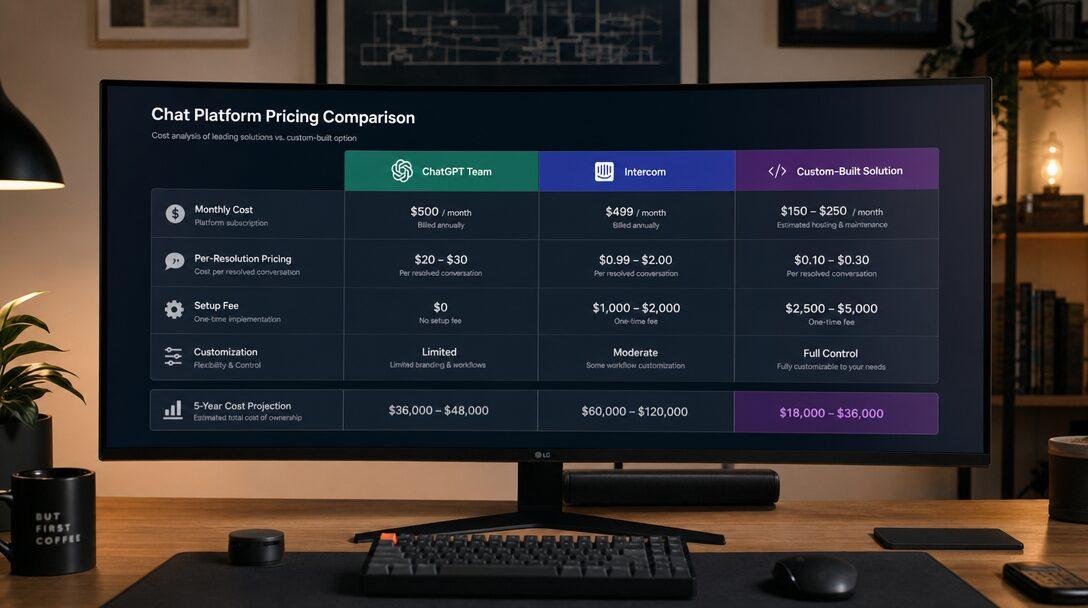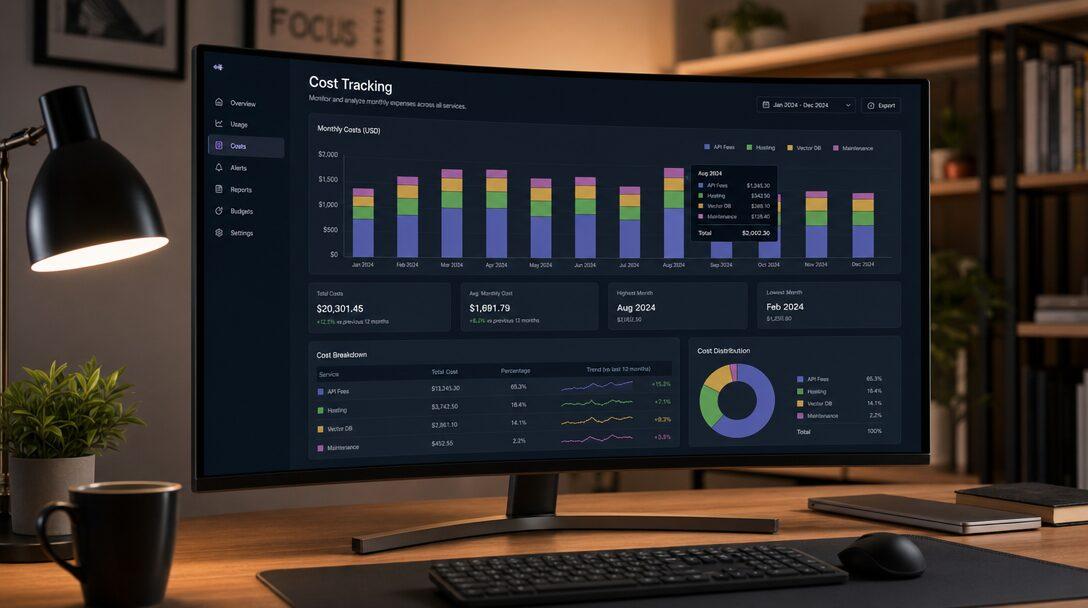

Every chatbot vendor has an ROI calculator, and every one of them is built to produce a number that closes the deal. The formula is not complicated and you can run it yourself in ten minutes. What makes the difference is knowing which two inputs are always inflated, and where the crossover sits between paying per resolution and paying once.
TL;DR
- Net monthly gain = (conversations x resolution rate x fully loaded cost per conversation) - monthly chatbot cost.
- Fully loaded cost per conversation is usually $2-$8 for small teams. Vendors assume higher; that is where the inflation is.
- Resolution rate is a function of your documentation, not the model. Assume 40% until you have measured your own.
- Build your case on absorbed growth, not headcount removal. Teams rarely shrink; they handle more.
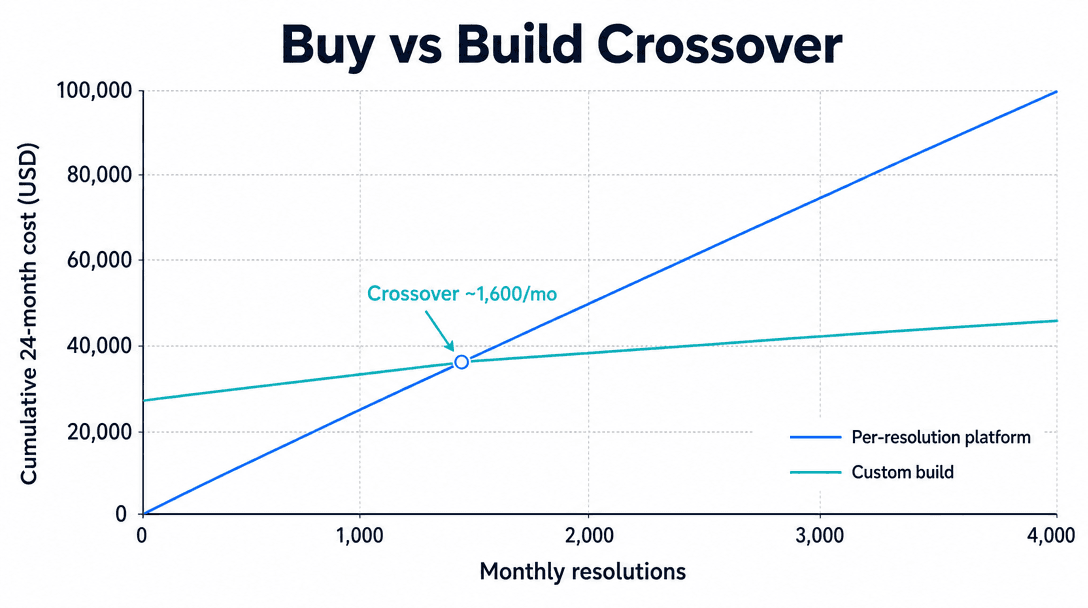
- Crossover: at ~$0.99/resolution vs a $25K build over 24 months, buying wins under roughly 1,600 resolutions/month.
- Four costs the calculators skip: content work, maintenance, failed-conversation cost, and pricing that scales with success.
The formula
Monthly savings = conversations/month × resolution rate × fully loaded cost per conversation
Net monthly gain = monthly savings - monthly chatbot cost
Payback (months) = build cost ÷ net monthly gain
That is the whole model. Everything below is about getting the three inputs honest.
Input 1: fully loaded cost per conversation
This is the multiplier on your entire business case, so getting it wrong scales the error through everything.
Take the total monthly cost of your support function: salaries, payroll taxes, benefits, helpdesk licences, and a fair share of the manager's time. Divide by conversations handled that month.
For most small in-house teams this lands between $2 and $8 per conversation. Outsourced support quoted per ticket usually sits lower, sometimes $1 to $3.
Two ways this gets inflated. Vendors sometimes use a loaded hourly rate multiplied by average handle time without accounting for the fact that agents are not handling conversations 100 percent of the time. And businesses sometimes include the full manager salary rather than the share actually spent on frontline support.
Use your real number. If your team of two costs $9,000 a month all-in and handles 2,500 conversations, your figure is $3.60. That is the number, not the $12 in the vendor's slide.
Input 2: resolution rate
The share of conversations the bot closes without a human.
Assume 40 percent until you have measured your own, and understand that this number is driven by your documentation rather than by the vendor's model. Teams with thorough, current help centres reach 45 to 60 percent. Teams with thin docs sit under 25 percent regardless of which product they buy. We covered the mechanism in the Intercom Fin review, and it applies to every vendor in the category.
You can predict yours cheaply. Take 200 recent conversations and tag each as answerable from existing documentation or not. That percentage is roughly your ceiling. It takes an afternoon and it is far more reliable than any vendor benchmark.
Resolution rate is not deflection rate
Some vendors count a conversation as deflected if the customer did not immediately escalate, which includes customers who gave up and left. Ask specifically how resolution is defined and billed, because with per-resolution pricing that definition is also your invoice.
Input 3: the chatbot's monthly cost
Three pricing shapes, with different behaviour as you grow:
| Model | Typical 2026 pricing | Behaviour at scale |
|---|---|---|
| Per resolution | ~$0.99 per resolution | Scales linearly forever, no ceiling |
| Per seat | $29-$139 per seat/month | Flat regardless of volume, pay whether or not it works |
| Custom build | $15K-$40K once + $150-$600/mo | Fixed; unit cost falls as volume rises |
The full comparison of how each behaves is in chatbot pricing models, and the per-resolution model specifically in Intercom Fin pricing.
Worked at three volumes
Holding fully loaded cost at $4 per conversation and resolution rate at 40 percent, against a per-resolution platform at $0.99 and a custom build at $25,000 with $300/month running costs.
Small: 500 conversations/month
- Resolved by bot: 200
- Gross savings: 200 × $4 = $800/mo
- Platform cost: 200 × $0.99 = $198 → net +$602/mo
- Custom build: $300/mo running → net +$500/mo, payback 50 months
Buying wins decisively. A build makes no sense here.
Medium: 2,500 conversations/month
- Resolved by bot: 1,000
- Gross savings: $4,000/mo
- Platform cost: $990 → net +$3,010/mo
- Custom build: $300/mo → net +$3,700/mo, payback 6.8 months
The build now pays back inside a year and wins from month seven onward. Either choice is defensible; the build is better if you expect to still be doing this in two years.
Large: 8,000 conversations/month
- Resolved by bot: 3,200
- Gross savings: $12,800/mo
- Platform cost: 3,200 × $0.99 = $3,168 → net +$9,632/mo
- Custom build: $400/mo → net +$12,400/mo, payback 2 months
The build wins clearly, and the gap compounds: roughly $33,000 a year in platform fees against a one-off $25,000 plus a few thousand annually.
Where the crossover sits
At $0.99 per resolution against a $25,000 build with $300/month running costs, over a 24-month horizon:
Crossover ≈ 1,600 resolutions per month.
Below that, buy. Above it, build. The exact figure moves with your build cost and horizon, but the shape holds: platform cost is a straight line through the origin, build cost is a high intercept with a shallow slope, and they cross.
Two adjustments worth making. Use a 24 or 36 month horizon rather than 12, because switching costs mean you will live with this decision longer than a year. And model at twice your current volume, since the whole premise is that the business grows.
The four costs every calculator omits
Content work. Your resolution rate depends on documentation somebody writes and maintains. Budget 20 to 40 hours upfront and a few hours monthly. Skip it and your resolution rate is half what you modelled, which halves the entire business case.
Ongoing maintenance. Products change, policies change, integrations break. A few hours a month, or a small retainer.
Failed conversations. A bot that frustrates a customer before handing off makes the human conversation longer, not shorter, and occasionally costs you the customer. Nobody models this and it is real. Track escalation satisfaction, not just deflection.
Success scales the bill. Under per-resolution pricing, improving performance increases cost. Doubling your resolution rate doubles that line item. This is the opposite of how automation normally behaves and it belongs in any multi-year projection.
The headcount assumption that breaks most cases
The most common failure in chatbot ROI is assuming saved conversation volume converts into removed salary.
It usually does not. A chatbot resolving 40 percent of conversations takes the easy 40 percent. What remains is harder, longer, and more emotionally loaded, so average handle time on human conversations goes up. The team does not shrink; it absorbs growth without hiring.
That is a real and valuable outcome, and it is a different business case. Build your projection on avoided future hiring: "this lets us handle 2x volume with the current team" rather than "this replaces one agent." The first survives a year of scrutiny. The second gets audited in month nine and quietly abandoned.
The bottom line
The math is three inputs and two lines of arithmetic. The discipline is refusing to inflate any of them.
Use your real fully loaded cost per conversation, not a vendor's. Predict your resolution rate from your own documentation before you buy anything. Model over 24 months at twice your current volume. And frame the benefit as absorbed growth rather than removed headcount.
Do that and the decision usually makes itself: under about 1,600 resolutions a month, buy the platform and invest in your help centre instead. Above it, price a build. How we build production chatbots sets out what that involves.
Next step: To price the build side properly, see what a custom AI agent costs or AI chatbot development cost. To understand how each pricing model behaves, see chatbot pricing models.
Frequently asked questions
How do you calculate AI chatbot ROI?+
Start with monthly savings: conversations per month, multiplied by the share the bot resolves, multiplied by your fully loaded cost per conversation. Subtract the monthly cost of the chatbot itself. That is your net monthly gain. For a platform with no build cost, the ROI is immediate or negative from month one. For a custom build, divide the build cost by the net monthly gain to get payback in months. The number people get wrong is fully loaded cost per conversation, which is usually lower than they assume.
What is a realistic payback period for an AI chatbot?+
Off-the-shelf platforms have no meaningful payback period because there is no upfront cost, so the question is only whether monthly savings exceed monthly fees. Custom builds typically pay back in 8 to 18 months at moderate volume, and considerably faster above a few thousand conversations a month. If a vendor projects payback under three months on a custom build, check whether they are counting labour you would not remove, which is the most common way these projections get inflated.
What is a fully loaded cost per support conversation?+
Take the total cost of your support function for a month, including salary, payroll taxes, benefits, tooling, and a share of management time, then divide by conversations handled. For most small teams this lands between $2 and $8 per conversation. Outsourced support is often quoted per ticket and sits lower. The figure matters because every ROI calculation multiplies by it, so an inflated estimate inflates the entire business case proportionally.
When does building a chatbot beat paying per resolution?+
The crossover is where cumulative per-resolution fees exceed build cost plus running costs over your planning horizon. At around $0.99 per resolution and a $25,000 build with $300 a month running costs, the crossover over 24 months lands near 1,600 resolutions a month. Below that, buying wins. Above it, building wins and the gap widens, since platform costs scale linearly while a build's costs are largely fixed.
Do AI chatbots actually save money on support headcount?+
Rarely by removing people, and commonly by absorbing growth. A chatbot resolving 40 percent of conversations usually means the same team handles a larger volume rather than the team shrinking, because the remaining conversations are harder and take longer. Build your business case on avoided future hiring rather than on current salary reduction. Projections assuming immediate headcount cuts are the single most common reason chatbot ROI cases fail to survive a year.
What costs do chatbot ROI calculations usually miss?+
Four recurring omissions. Content work, since resolution rate depends on documentation someone has to write and maintain. Ongoing maintenance as your product and policies change. The cost of failed conversations, where a poor bot experience makes the human interaction longer or costs you the customer. And the fact that per-resolution pricing scales with success, so improving performance increases the bill. Vendor calculators include none of these.
Free PDF
The 2026 AI Development Rate Sheet
Build, agent, RAG and consulting rates by tier, in one PDF, so you can check a quote before you sign it.

Written by
Pankaj Kumar
Founder · Metageeks Technologies
Metageeks builds software and AI products for growing businesses. Every build is scoped in writing before it starts, and you see progress every week. We write about what holds up once it reaches production.
Connect on LinkedInThe AI Build Brief
Ship AI that holds up in production.
Practical playbooks on how to build, price and ship AI features, in one short email every other week.