

Multi-agent architecture diagrams are the most persuasive slide in AI consulting. Boxes with names like Researcher and Validator, arrows between them, an Orchestrator on top. They look like engineering. For most business workloads they describe a system that costs three times as much, fails in three times as many places, and answers the same question a single agent would have answered.
TL;DR
- A single agent with good tools handles most SMB workloads better than several agents passing messages.
- Multi-agent earns its cost on three conditions: parallel work, contradictory instructions between steps, or a step that must be checked independently.
- Every handoff is another model call. Cost and latency multiply; so does the surface area you have to debug.
- Build the single agent first. Split only the step that measurably fails, not the architecture you imagined.
- Single agent: $15K-$30K. Coordinated multi-agent: $40K-$80K, plus more evaluation work.
Free scoping call
Turn your AI idea into a written plan
Tell us what you want AI to do. In 30 minutes we tell you plainly whether it will pay for itself, and what it would take to build.
Book a scoping call →The short answer
Use one agent with tools when the work is sequential and each step depends on what the last one found. That covers most business workflows. Use multiple agents only when at least one of three conditions holds: parts of the job can run in parallel and the time saving matters; different steps need contradictory instructions that cannot coexist in one prompt; or one step must be checked by something that did not produce it. Each handoff adds a model call, latency, and a place to lose context, so a three-agent system carries roughly triple the testing and monitoring load. Build single, measure, then split the one step that fails.
What the two architectures are
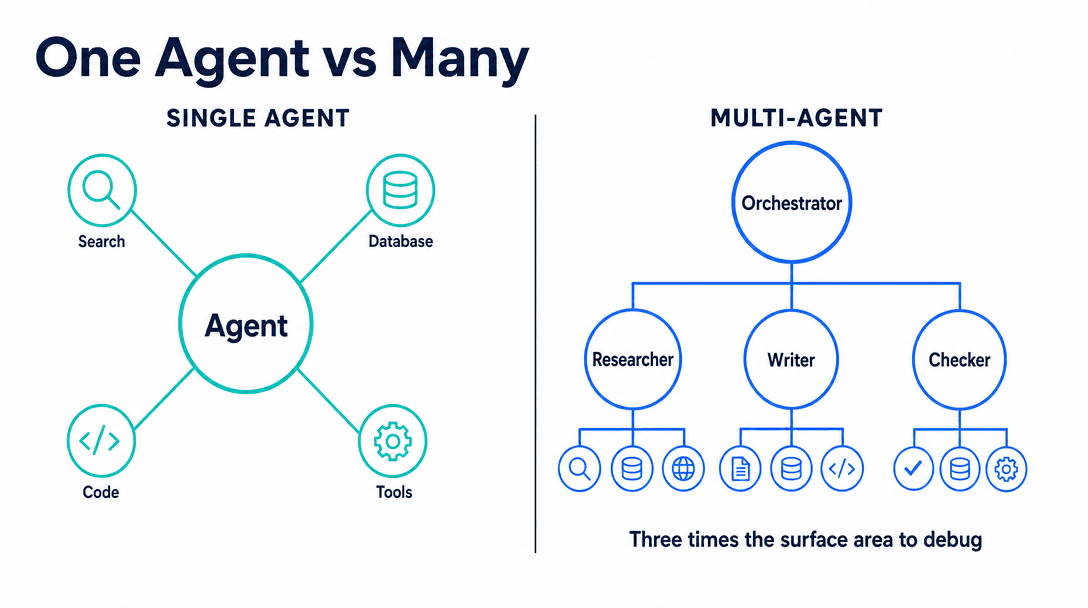
A single agent is one model with a set of instructions and access to tools: search a knowledge base, query a database, call an API, send an email. Given a task, it decides which tool to reach for, looks at what came back, and decides again. All the context stays in one place.
A multi-agent system splits that into specialists. An orchestrator receives the task and delegates. One agent gathers information and hands its findings on. Another produces the output. Another reviews it. Each has its own instructions and its own narrower tool set, and they communicate by passing messages.
The second one is not more intelligent. Both run on the same models with the same tools available. What differs is where the decisions happen and how many times information gets summarized and passed along.
That last part is where the trouble starts. Every handoff is a compression. The researcher agent decides what is worth telling the writer agent, and whatever it leaves out is gone. A single agent holding the full context never has to make that call.
The three conditions that justify splitting
Splitting is worth its cost when one of these is true. If none of them are, the architecture is decoration.
Parallelism with a payoff. Parts of the job are independent and can run at the same time, and the time saved matters to someone. Analyzing forty documents is a real example: forty agents working simultaneously finish in the time one takes to do a single document. If the job is sequential, parallelism has nothing to offer.
Contradictory instructions. One step needs the model to be expansive and generative; another needs it to be conservative and skeptical. A single prompt asking for both produces something that is mediocre at each. Splitting lets each agent have instructions that would undermine the other.
Independent checking. A model reviewing its own output is a weak check, because the reasoning that produced the error also evaluates it. When correctness matters enough to justify the cost, a separate agent with different instructions and no memory of how the output was produced catches things the author misses.
That third condition is the most commonly valid one in business settings, and it usually only justifies two agents rather than five.
What splitting costs you
Money. Each agent makes its own model calls. A three-agent pipeline typically runs two to four times the token cost of a single agent doing the same job, because context gets re-sent at every handoff.
Latency. Sequential handoffs add up. A single agent answering in four seconds becomes a chain answering in twelve. For a batch job overnight, nobody cares. For anything a customer waits on, twelve seconds is a different product.
Debuggability. This is the one that hurts in month three. The output is wrong. Which agent introduced the error? Was it the writer, or the researcher's summary that the writer worked from, or the orchestrator's framing of the task? You now need traces at every boundary, and a test set per agent plus one for the whole system.
Failure modes you did not have before. Agents can loop, passing work back and forth. An orchestrator can mis-route. A downstream agent can confidently build on an upstream mistake. None of these exist in a single-agent design.
Where SMB workloads sit
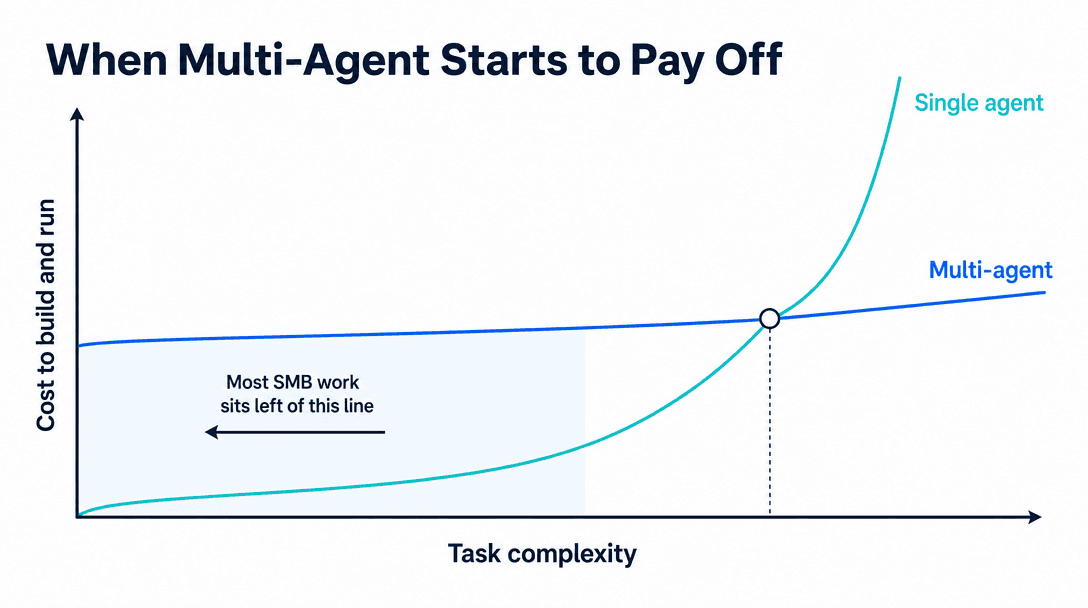
Look at what businesses between $1M and $15M ask to have built. Qualify an inbound lead. Answer a support question from documentation. Extract fields from an invoice and file it. Summarize a call and update the CRM. Draft a follow-up sequence.
Every one of those is a single job with several steps, where each step depends on what the previous step found. That is the exact shape a single agent with tools handles well, and the exact shape multi-agent architectures handle worse.
The workloads that benefit are narrower: bulk document analysis where parallelism pays, research tasks that fan out across many sources, and pipelines where a compliance or accuracy check needs to be structurally independent of the thing being checked.
If a proposal recommends multi-agent for lead qualification, ask which of the three conditions applies. There is usually an answer about future scale, which is a different claim from a current requirement.
A cheaper way to get most of the benefit
Before splitting into agents, try splitting into tools. A single agent with a well-designed set of tools (a retrieval tool, a validation tool, a lookup tool) gets a lot of the modularity people want from multi-agent designs, with one context, one set of traces, and one bill. Most requirements that sound like they need multiple agents are satisfied by better tool design.
What most people get wrong
Choosing the architecture before the requirement exists. Multi-agent is the default recommendation in a lot of AI proposals because it demos well and it justifies a larger number. The decision should run the other way: build the simplest thing that could work, measure where it fails, then split the specific step that failed.
Confusing "steps" with "agents." A workflow with five stages does not need five agents. A single agent moving through five stages holds context across all of them, which is usually an advantage rather than a limitation.
Underestimating evaluation cost. Each agent needs its own test set, and the system needs an end-to-end set on top. Teams that budget the build cost of multi-agent and not the evaluation cost end up with a system nobody can safely change.
Treating the orchestrator as free. It is another model call, another prompt to maintain, and a new single point of failure. A mis-routing orchestrator produces a system that is confidently wrong in ways that are hard to see, because each individual agent did its job correctly.
How to decide in practice
Start by writing the workflow as a sequence of steps in plain language. Then ask three questions about it.
Can any of these steps run at the same time as another, and would that save time anyone cares about? Do any two steps need instructions that would contradict each other in a single prompt? Does any step need to be checked by something that did not produce the output?
No to all three means build one agent with the tools it needs. That is the answer for most workflows, and it is also the cheapest thing to change later if you turn out to be wrong.
One yes usually means two agents, not five. Split at exactly the boundary that answered yes and leave the rest in one place.
Two or three yeses means a real multi-agent design, and you should budget for the evaluation work alongside the build. For background on what an agent is doing in the first place, see what is an AI agent, and for cost ranges by build type, how much a custom AI agent costs.
Free scoping call
Turn your AI idea into a written plan
Tell us what you want AI to do. In 30 minutes we tell you plainly whether it will pay for itself, and what it would take to build.
Book a scoping call →The bottom line
Multi-agent systems are a legitimate design for a narrow set of problems and an expensive default for everything else. The test is short: parallelism worth having, instructions that cannot coexist, or a check that must be independent. If none of those apply to your workflow, one agent with well-designed tools will be cheaper to build, faster to answer, and vastly easier to fix when it breaks. Build that first. Split the step that fails, when it fails, and only that step.
Next step: For what an agent build costs by type and complexity, see custom AI agent cost. If you want an architecture recommendation grounded in your actual workflow rather than a reference diagram, a 20-minute scoping call produces one.
What is a multi-agent system?+
A multi-agent system splits work across several AI agents that each handle part of a task and pass results between them, usually coordinated by an orchestrator. One agent might gather information, another draft an output, another check it. Each has its own instructions and its own tools. The alternative is a single agent with access to all the same tools, deciding for itself which one to reach for at each step.
Does a small business need a multi-agent system?+
Usually not. Most SMB workloads are one job with several steps, which a single agent with good tools handles more reliably and at lower cost. Multi-agent architectures earn their complexity when parts of the work can run in parallel, when different steps need contradictory instructions, or when one step must be independently checked by something that did not produce it. Below that, splitting adds failure points without adding capability.
What are the downsides of multi-agent systems?+
Cost, latency and debuggability. Every handoff between agents means another model call, so both the bill and the response time multiply. More importantly, failures become hard to trace: when the final output is wrong, you have to work out which agent introduced the error and whether it was the agent or the message passed to it. A three-agent system has roughly three times the surface area to test and monitor.
When is one AI agent with tools better than multiple agents?+
When the work is sequential, when each step depends on what the previous step found, and when a single set of instructions can cover the whole job without contradicting itself. That describes most business workflows: qualify this lead, answer this question, process this document. A single agent keeps the full context in one place, which means fewer handoffs, fewer chances to lose information, and a much simpler thing to debug at 2am.
How much more does a multi-agent system cost to build?+
Typically two to three times a comparable single-agent build, and the running cost rises by a similar factor because each agent makes its own model calls. A single-agent workflow that costs $15K to $30K to build becomes $40K to $80K as a coordinated multi-agent system, with more ongoing evaluation work because each agent needs its own test set plus one for the system as a whole.
Free scoping call
Turn your AI idea into a written plan
Tell us what you want AI to do. In 30 minutes we tell you plainly whether it will pay for itself, and what it would take to build.
Book a scoping call →About the author

- Tags
- ai agents
- architecture
Subscribe to Our Newsletter
The AI Build Brief: practical playbooks on how to build, price and ship AI features, in one short email every other week.