"ERPNext is free, so why are the quotes lakhs apart?" The answer is short. The ERPNext licence is free and the implementation is not, and each vendor is pricing a different amount of work. This guide sets out the published ERPNext implementation cost in India for a 10-50 user manufacturing plant, with a source for every figure.
TL;DR
- Published Indian guides put ERPNext implementation for a manufacturing unit at roughly ₹1-3 lakh, with the spread running from ₹75,000 for a small setup to ₹5 lakh and above for 50+ users. Sources disagree, and this post shows where.
- The biggest cost drivers are the modules you switch on (manufacturing most of all), data migration from Tally or spreadsheets, and how much you customise.
- Hosting and support recur. Frappe Cloud is listed from about ₹410 a month for a shared site and about ₹3,600 for a server; annual support quotes run ₹30,000 to ₹1.2 lakh.
- To compare quotes, write the scope first and ask every vendor to price that same document.
What you pay for when the software is free
ERPNext is open source under the GPL-3.0 licence. There is no licence fee and no charge per user, so a 40-person plant does not pay more than a 10-person one for the software itself.
Five other things cost money:
- Implementation. Configuring the company, chart of accounts, GST templates, items, warehouses, bills of materials and workflows, and testing them. This is the largest line.
- Data migration. Moving item masters, customers, suppliers, opening stock and opening balances out of Tally or Excel, cleaning them and reconciling them. If you are moving off Tally, one Indian implementer lists this as a distinct cost driver.
- Customisation. Custom fields, print formats and workflows are configuration. A custom Frappe app is development, and priced by the hour.
- Training. Stores, production, purchase, sales and accounts each use different screens.
- Hosting and support. These recur every month or year, and first quotes often leave them out.
Market ranges in India
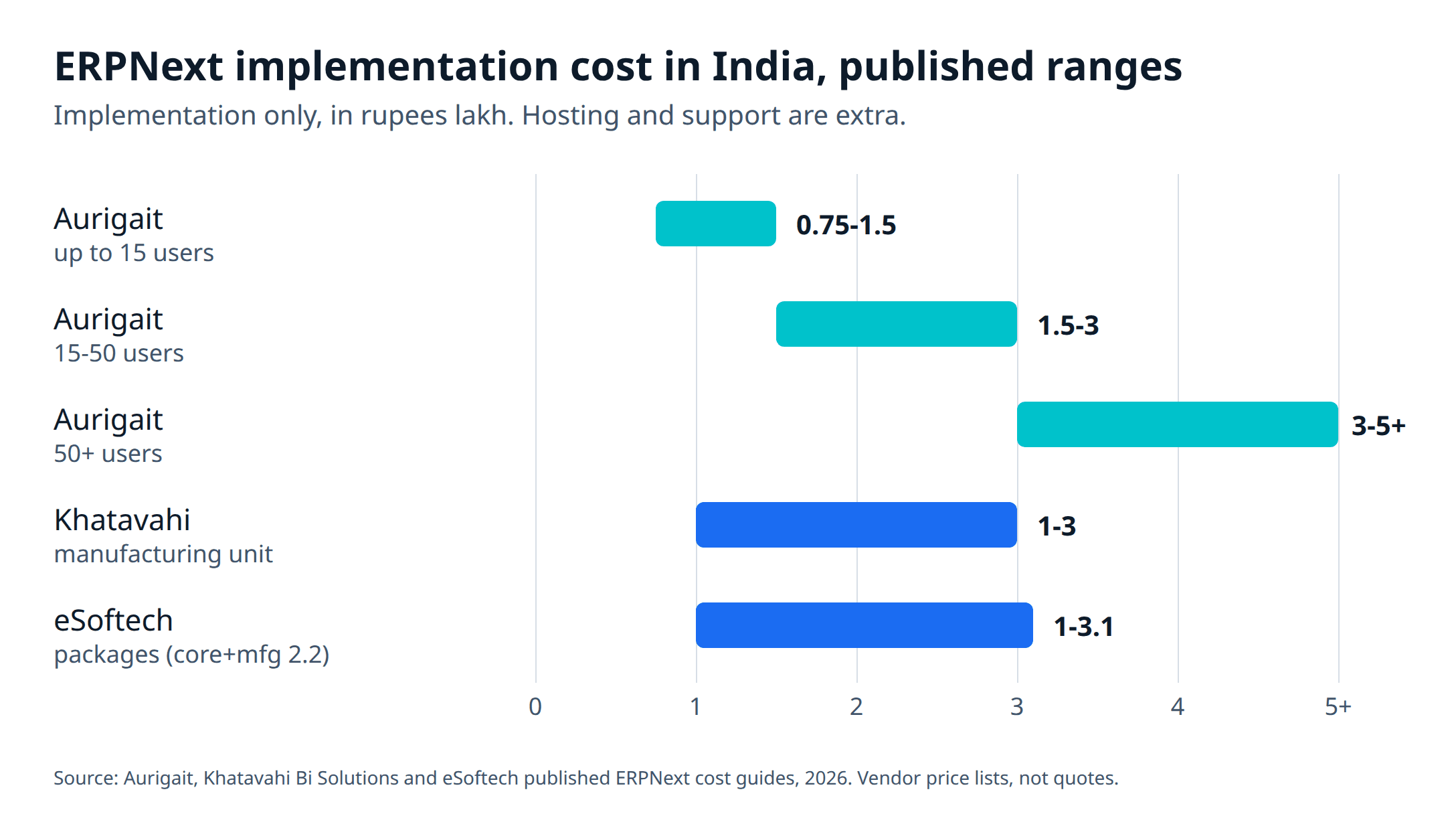
We read three published guides from Indian ERPNext implementers. They are marketing pages, not audited surveys, so treat each figure as one vendor's price list. They do not all slice by headcount, so the table maps each to the closest plant size.
| Plant size | Aurigait | Khatavahi | eSoftech |
|---|---|---|---|
| About 10 users | ₹75,000-1.5 lakh (up to 15 users, 2-3 modules) | ₹1-3 lakh (manufacturing unit, any size) | ₹1.5 lakh (core) to ₹2.2 lakh (core plus manufacturing) |
| About 25 users | ₹1.5-3 lakh (15-50 users, 4-6 modules) | ₹1-3 lakh | ₹2.2 lakh (core plus manufacturing), ₹3.1 lakh with HR and payroll |
| About 50 users | ₹1.5-3 lakh, or ₹3-5 lakh and above at 50+ users with integrations | ₹3 lakh and above if multi-location or complex | No range by size; packages top out at ₹3.1 lakh |
The same plant lands anywhere from about ₹1 lakh to ₹3 lakh depending on whom you ask, and none of these figures is a quote for your plant. The eSoftech packages are built around fixed hours (70 hours for core plus manufacturing), so the price there is plainly hours multiplied by a rate.
Timelines in the same guides: Aurigait gives 4-8 weeks for a standard two or three module deployment and 3-5 months for a mid-sized multi-module one; eSoftech gives a few weeks for core up to 8-10 weeks for core plus manufacturing plus HR.
A typical 30-person plant
To make this concrete, take a single-plant food or plastics unit with these assumptions: 30 users, core accounting, stock, buying, selling and manufacturing modules, data coming from Tally and Excel, no custom Frappe app, and a basic-to-standard support plan. Combining the published figures:
- Implementation: ₹1.5-3 lakh (Aurigait's 15-50 user band).
- Hosting: ₹410 to ₹3,600 a month on Frappe Cloud, so about ₹5,000 to ₹43,000 a year.
- Annual support: ₹30,000 to ₹1 lakh (Aurigait's basic and standard tiers).
- Year one in total: roughly ₹1.9-4.4 lakh.
That sits close to the year-one examples the guides themselves give: Khatavahi shows a small manufacturer at about ₹1.9 lakh, and Aurigait shows a 40-user manufacturer at ₹3.5-5.5 lakh. It is an illustration built from other people's price lists, not a quote.
The six things that move the price
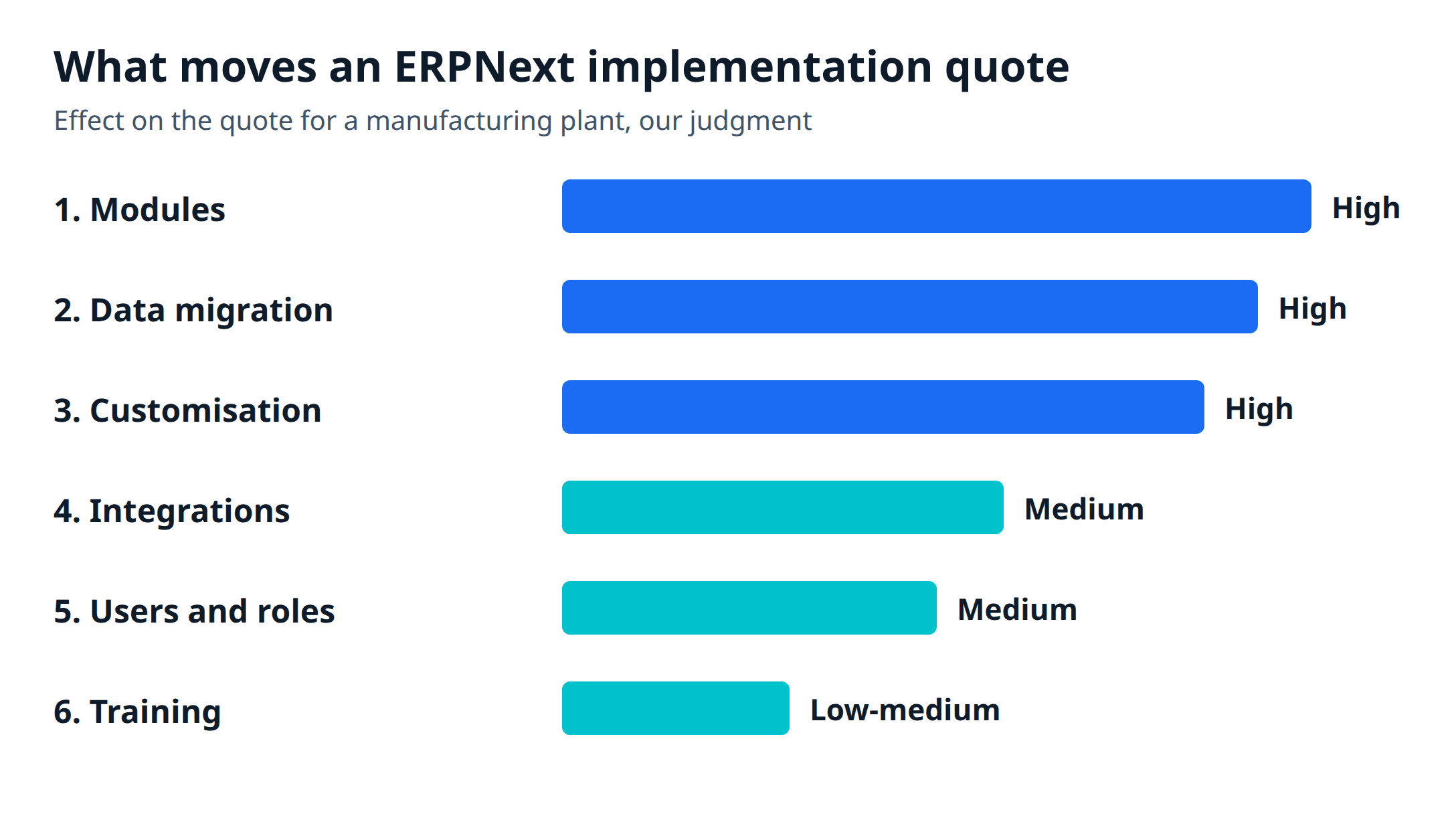
Our ranking, by how much each usually moves a manufacturing quote. It follows how the guides above describe their pricing and is a judgment, not a measurement.
- Modules. Manufacturing is the expensive one. Aurigait prices manufacturing and bill-of-materials setup at ₹40,000-80,000 on top of core accounting at ₹25,000-60,000. Every module you add is more configuration, more testing and more training.
- Data migration from Tally. Item masters with duplicate names, customers with three spellings, opening stock that does not match the books. Cleaning it takes hours, and hours are what you pay for. This is the most common item missing from a first quote.
- Customisation against configuration. A custom print format or workflow is cheap. A custom Frappe app is Aurigait's ₹50,000-2 lakh line, and development hours run ₹500-2,000 an hour in the same guide. Ask what is configuration and what is code.
- Integrations. GST e-invoicing, e-way bills, a biometric attendance machine, a weighbridge, a payment gateway. Each adds authentication, error handling and testing.
- Users and roles. The software does not charge per user, but each role needs permissions set up, screens tested and people trained.
- Training. Role by role is better than one group session, and it costs more up front. It is also the step that decides whether the system is used after go-live.
Hosting: Frappe Cloud or your own server
At the time of writing, Frappe Cloud's pricing page lists:
- Sites plan: from $5 a month, or ₹410 a month in rupees. A shared site.
- Servers plan: from $40 a month, or ₹3,600 a month. Dedicated or shared instances, unlimited sites.
- Both have a 14-day free trial, and billing is by compute, not by user.
The pricing page shows the "from" price. A 30-user plant running manufacturing will likely sit above the entry shared plan, so ask for a sized estimate rather than reading the first number.
Self-hosting is the other route. Aurigait quotes ₹2,000-15,000 a month plus admin time, and Khatavahi quotes ₹3,000-10,000 on AWS or DigitalOcean. The server is cheap, but someone has to patch it, test the backups and run version upgrades, and that time costs more. For that reason a small plant can reasonably start on Frappe Cloud and move later if it needs to. Whichever you pick, make sure the site and its backups are in an account you own.
Support after go-live
Implementation ends at go-live; the plant keeps running. Aurigait lists annual support at ₹30,000-60,000 (basic), ₹60,000-1 lakh (standard) and ₹1-1.2 lakh and above (premium). eSoftech notes that post-launch support is handled as ongoing support, not as part of the original scope.
What support buys is fixes, version upgrades, new reports and workflows as the plant changes, and someone to call when month-end closing goes wrong. Ask what is included, the response time, and whether new work is billed by the hour or covered by a retainer. Also ask where the code lives. Metageeks, an independent ERPNext implementer, builds everything inside the client's own account for that reason.
How to get quotes you can compare
Calling five vendors and comparing five numbers tells you little. Write the scope down first, then ask each of them to price it.
A usable scope names: the plants and warehouses, the modules, the roles and rough user count, what comes from Tally or Excel and how many records, the integrations, what you expect to customise, and the training. A written ERPNext scope is the first thing a serious implementer should hand back after discovery, with hours by milestone and a go-live date.
Then ask each vendor the same questions:
- How many hours, by milestone, and at what rate?
- What is configuration and what is custom code?
- Is data migration included, and how is it reconciled against Tally?
- What does hosting cost per month, and who owns the account?
- What does support cost after go-live, and what does it cover?
Quotes built on one document and shown in hours can be compared. A single number with no scope behind it cannot. ERPNext implementation for manufacturers explains how we scope a plant.
Frequently asked questions
Is ERPNext free?+
The software is free. ERPNext is open source under the GPL-3.0 licence, with no fee per user. What you pay for is the work around it: implementation, data migration, customisation, training, and hosting and support. Hosting on Frappe Cloud is listed from about 410 rupees a month for a shared site and from about 3,600 rupees a month for a server (at the time of writing), billed by compute rather than by user.
How much does ERPNext implementation cost in India?+
Indian implementers publish ranges that overlap but do not agree. One guide puts a business of up to 15 users at 75,000 to 1.5 lakh rupees and a 15-50 user business at 1.5 to 3 lakh. Another puts a manufacturing unit at 1 to 3 lakh. A third prices a core plus manufacturing package at 2.2 lakh. Most of the gap comes from modules, data migration and customisation, not from the software. A written scope is what makes quotes comparable. Add hosting and annual support on top.
How long does an ERPNext implementation take?+
For a single plant on the core modules, usually weeks to a few months. Published guides range from 4-8 weeks for a standard deployment of two or three modules to 3-5 months for a mid-sized, multi-module rollout. Your own data is the biggest variable: clean item masters and bills of materials shorten the timeline, a decade of messy Tally and spreadsheet records lengthens it. A good discovery phase ends with a written plan and dates before any configuration starts.
What does ERPNext hosting cost?+
Frappe Cloud lists shared-site plans from 5 US dollars (about 410 rupees) a month and server plans from 40 US dollars (about 3,600 rupees) a month, at the time of writing. Self-hosting on a VPS is quoted by Indian implementers at roughly 3,000 to 10,000 rupees a month on AWS or DigitalOcean, plus someone's time to patch, back up and upgrade it. Frappe Cloud bills by compute, not by user, so adding staff does not raise the bill on its own.
Related reading
- ERPNext vs Tally for manufacturers: where Tally stops being enough.
- Moving from Tally to ERPNext: what data moves, what stays behind and how to run the cut-over.
Free PDF
The 2026 AI Development Rate Sheet
Build, agent, RAG and consulting rates by tier, in one PDF, so you can check a quote before you sign it.

Written by
Pankaj Kumar
Founder · Metageeks Technologies
Metageeks builds software and AI products for growing businesses. Every build is scoped in writing before it starts, and you see progress every week. We write about what holds up once it reaches production.
Connect on LinkedInThe AI Build Brief
Ship AI that holds up in production.
Practical playbooks on how to build, price and ship AI features, in one short email every other week.