
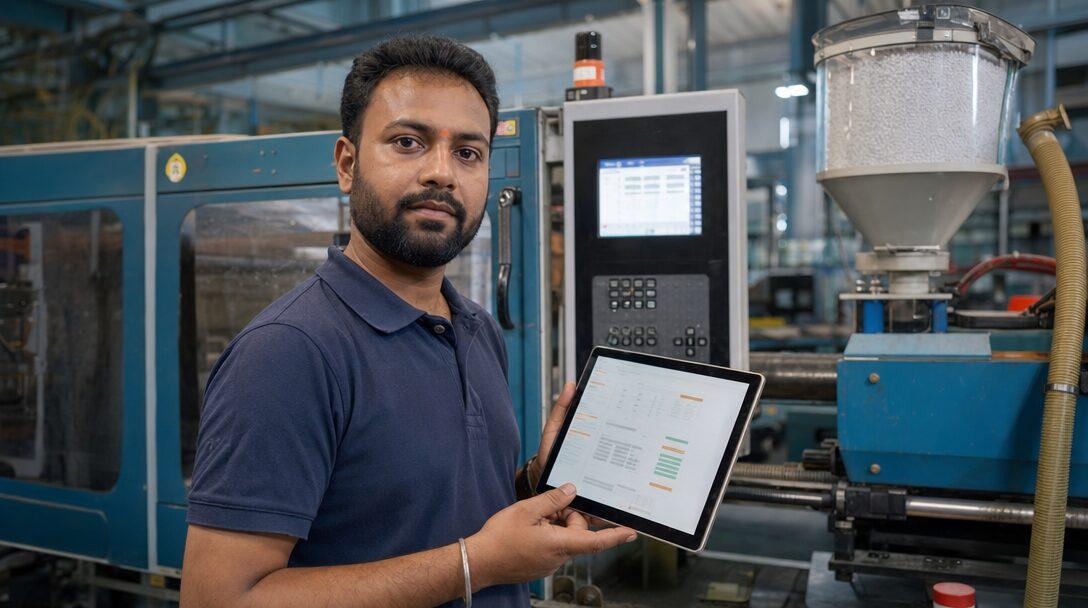
Picture a plant where the stores keeper says the resin has run out, the production head says the last job ran fine, and the owner learns three weeks later that the customer was quoted on a weight the machine never used. A tray of moulds is still at a job worker, and nobody can find the challan. This guide covers what an ERP for plastics manufacturers does about gaps like those, using ERPNext, for the owner or production head of a 20-60 person plant doing injection moulding, blow moulding, film or flexible packaging.
TL;DR
- A plastics plant buys by weight, sells by piece or by roll, and loses material as runners, rejects and start-up purge. An ERP earns its place by recording each of those movements, not by adding screens.
- ERPNext documents alternate units with a conversion factor, batches, Bills of Materials with scrap and process loss, Job Cards per workstation, and subcontracting with a Send to Subcontractor stock entry and a Subcontracting Receipt.
- Section 143 of the CGST Act lets you send inputs for job work without paying tax, but the inputs must come back within one year and capital goods within three. Moulds, dies, jigs, fixtures and tools are excluded from the return rule. Your system has to show what is out and since when.
- Regrind going back into production is the part to prove on a test site before you rely on it.
Why plastics breaks generic inventory
A trader sells what it buys. A plastics plant buys resin, masterbatch and film by the kilo, and sells caps, crates or packs by the piece, or reels by the metre. Between the two sits a machine that makes something different from what went in.
Four things follow that a generic stock module handles poorly.
- Two units for one product. Purchase is in kg, the customer's order is in numbers, and the weight of one piece decides your margin.
- Material that returns. Runners, sprues, trimmed film and start-up purge can be ground and reused. Some of it cannot, depending on the grade and the customer's specification.
- Machines as the unit of capacity. A job runs on machine 4, with mould 17, on the night shift.
- Work that leaves the building. Printing, metallising, assembly and mould repair can go to a job worker, with your material and sometimes your tooling.
If you are still choosing a system, start with our ERPNext vs Tally comparison and the ERPNext implementation page. A plant with batch and expiry needs rather than machines and scrap may want our guide to ERP for food manufacturing instead.
Granules, masterbatch and finished goods in two units
ERPNext's Item documentation says the default unit of measure is the one you use for the product, "Nos, Kgs, Meters, etc." It also says you can add alternate units: if you sell in numbers but receive in kilos, you can add a unit with a conversion factor. Its own example is 500 screws to 1 kilogram, with the factor set to 500. Purchase and sales units are separate defaults on the same page.
The conversion factor does not tell you how much resin goes into one cap. That lives in the Bill of Materials, and it is the number that matters. The BOM documentation lets you list raw materials with quantities for a stated output. For a moulded part, the quantity of resin per piece is the shot weight divided by the number of cavities, and you should take it from weighing real shots, not from the mould drawing. Masterbatch is a second row, usually a small percentage of the resin weight, so its cost shows separately.
Resin grades are not always available when the job is due. The same BOM page has an Allow Alternative Item option, and its example is plastic beads used instead of plastic crystals. The Item Alternative page describes an alternative as an item that can be used instead of the original in manufacturing, with an optional two-way replacement. Which grades may stand in for each other is a quality decision for you and your customer.
Some customers ask which resin lot went into a delivery. ERPNext's Item master has a Has Batch No option, and the Serial and Batch Bundle documentation says each stock transaction needs its own bundle, with batches picked by FIFO, LIFO or expiry. If nobody asks, stock by item and supplier is simpler to run.
Scrap and regrind back into the process
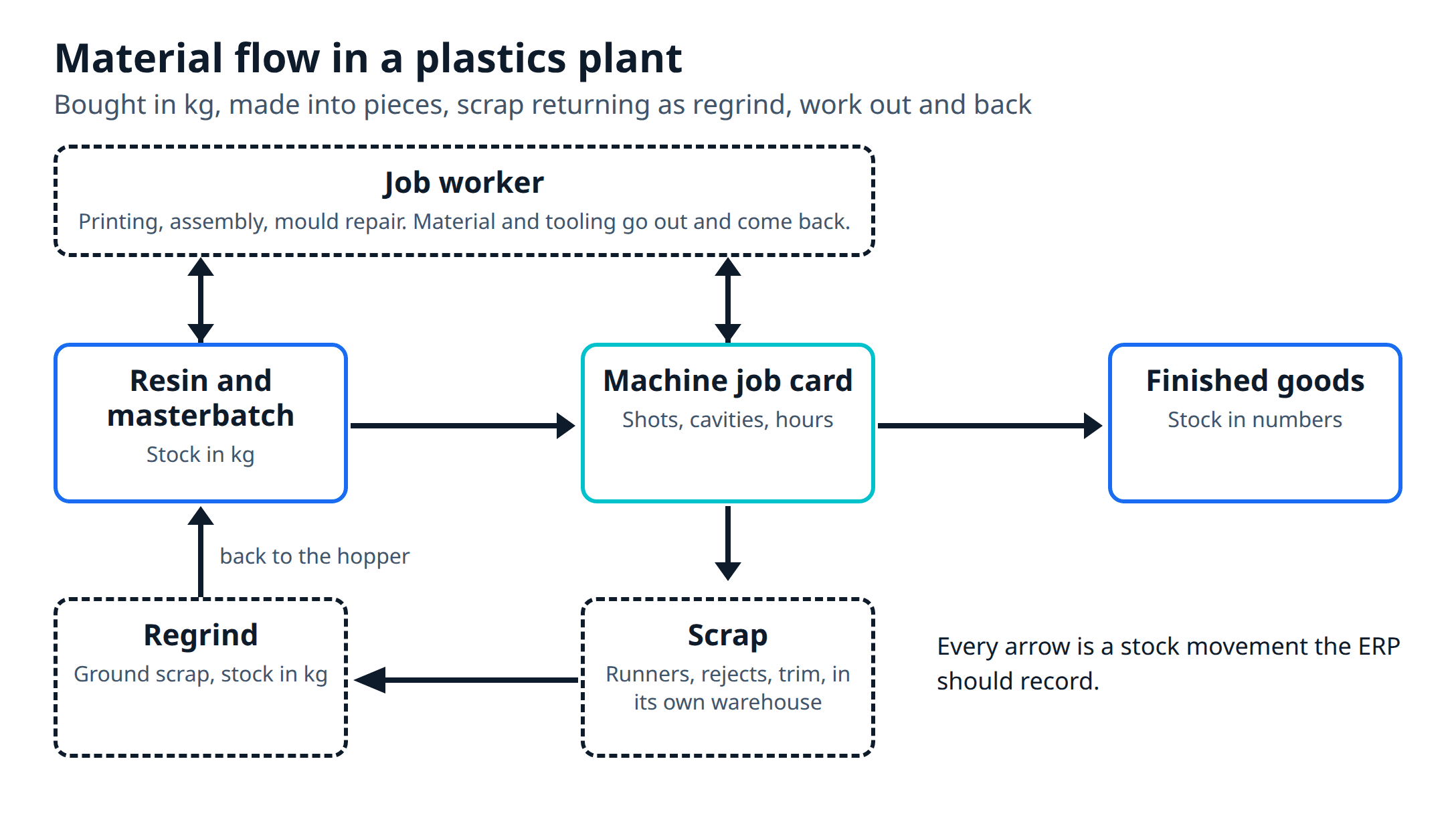
The BOM documentation says you can select the scrap item created when manufacturing and its quantity, and that scrap items can carry a rate if they are a by-product and not waste. If the scrap item is the same as the item being manufactured, it becomes a Process Loss item and its quantity is subtracted from the manufactured quantity. Each raw material row also takes a scrap percentage, described as the scrap that remains after the material is used, which suits a resin row with a known purge or runner loss. The Work Order documentation says that if the BOM includes scrap material you must select a scrap warehouse when creating the Work Order. The Job Card documentation adds that scrap produced while completing operations needs to be added to inventory, and that operators can log rejected or damaged material separately.
So the building blocks exist: a scrap item and scrap percentage on the BOM, a scrap warehouse on the Work Order, and a place on the Job Card to record what came out as scrap.
We found no page that describes regrind. One way to model it, which is our inference and not a documented flow, is to treat regrind as its own item in kg. It enters stock as scrap from the moulding BOM, and goes out again as a raw material row on a BOM that allows a stated percentage. The Stock Entry documentation lists a Repack purpose for converting original items into new items, which is a candidate for the grinding step itself. Try both on a test site with one real product before you commit.
Two decisions sit outside the software:
- How much regrind is allowed. The customer's specification and the resin grade decide it, not the ERP. Write the percentage into the BOM so the system follows the rule.
- Who weighs scrap and when. A scrap figure entered once a month from a rough estimate is not data. Weigh per shift or per job.
Your own machines and parts set the scrap rate, and it may only become visible once scrap is weighed and entered.
Job cards per machine and shift
ERPNext's Workstation documentation says an Operation takes place at a Workstation, where the operation is the work and the workstation is the place or machine where it is performed. In a plastics plant a workstation can be a machine, or a machine and mould pair if you want separate cost rates. The page says a Working Hours table holds start and end times, that you can also specify working hours based on shifts, that a Holiday List can exclude non-working days, and that production capacity is the number of jobs that can run at the same time on that workstation. It does not say more about how shifts are configured.
The Job Card documentation says a Job Card is created from the Work Order and given to each workstation on the floor to start production, and that drafts are generated when the Work Order is submitted. Operators use Start Job and Complete Job buttons, or enter time intervals manually, and a Completed Quantity field records what was produced. It also records the employee against the time. The page we read has no shift field, so test per-shift output reporting on a trial site with real job cards before you promise it to the floor.
Operations on a BOM carry a workstation, an hourly rate, an operation time and a batch size, and the operating cost is calculated from those, per the BOM documentation. The machine-hour cost is only as good as the hourly rate you put in, so build it from power, labour and depreciation for that machine. For how Work Orders, Job Cards and capacity settings fit together, see our guide to production planning, BOM and MRP in ERPNext.
Job work out and in, with GST challans
Printing and lamination can go to a specialist, assembly to a small unit, and a mould out for repair. The tax provision is Section 143 of the CGST Act. The text is short enough to read in full in the consolidated CGST Act on CBIC's site. Check later amendments with your tax adviser, since that file is a point-in-time consolidation.
The essentials of the section:
- A registered person, the principal, may under intimation and subject to prescribed conditions send inputs or capital goods without payment of tax to a job worker.
- Inputs must come back within one year and capital goods within three, or be supplied from the job worker's place on payment of tax. Moulds and dies, jigs and fixtures, and tools are excluded from the capital goods period.
- The Commissioner can extend the periods, on sufficient cause, by up to one year and two years respectively.
- If inputs are not back within a year, they are deemed supplied by the principal to the job worker on the day they were sent out. Capital goods, other than moulds, dies, jigs, fixtures and tools, are treated the same way after three years.
- Waste and scrap from job work may be supplied by the job worker directly on payment of tax if registered, or by the principal if the job worker is not registered.
The Act leaves the conditions to the rules. TaxGuru's summary of the section says Rule 55 of the CGST Rules requires a delivery challan rather than an invoice for goods sent for job work. Check the current rule text with your tax adviser.
On the ERPNext side, the Subcontracting documentation describes this flow. You create a Purchase Order marked as subcontracted. The Subcontracting Order lists the raw materials to supply from the BOM. A Send to Subcontractor stock entry moves material to the supplier. A Subcontracting Receipt takes in the finished goods and any scrap items fetched from the BOM. Raw material consumption can be backflushed either by the BOM or by what was actually transferred. The page also asks for a Supplier Warehouse from which the raw materials are taken, and offers a Reserve Warehouse for materials reserved for subcontracting.
Packaging and printing lines
Flexible packaging and film run as a chain of stages: extrusion, printing, lamination, slitting, pouch making. Each stage takes the previous stage's output as its input, often in kg for the film and in metres or numbers for the finished roll or pouch.
The BOM documentation says ERPNext supports multi-level BOMs, where each sub-assembly can have its own BOM and form a tree. That fits a chain where printed film is an item with its own BOM, and the laminated roll uses it as an input.
Keep the roll or batch number against each stage so a complaint on a pouch can be walked back to a film lot. Trim is scrap again and follows the same rules as above. Where printing is done by a job worker, the Section 143 flow applies to the film you send.
What to settle before you buy
Whichever system you shortlist, ask the vendor to show these on live data, not a slide.
- Show me resin in kg and the finished part in numbers, with the shot weight in the BOM.
- Show me scrap from a job card landing in a scrap warehouse, and regrind going back into the next job.
- Show me machine hours and cost on one work order, and output per shift from the job cards.
- Show me material sent to a job worker, what it became, and what is still out, with the delivery challan your India compliance setup produces and how it matches Rule 55.
- Show me how you would flag material that has been out nearly a year, and which mould is at which job worker.
- Show me a multi-stage film job traced from a finished roll back to a film lot.
If a vendor says all of this works out of the box, ask them to do it on your own part, with your own scrap figures. A written scope that names these tests is your best protection, and our cost guide explains why that document should come before any quote.
Metageeks is an independent ERPNext implementer. If you run a moulding, blow moulding or packaging plant and want to know what ERPNext covers on your floor and what you will run by hand, tell us what you make and how material moves today, and we will tell you.
Frequently asked questions
Can ERPNext track resin in kilograms and finished goods in pieces?+
Yes. ERPNext's Item documentation says you can add alternate units of measure with a conversion factor, for example receiving in kilos what you sell in numbers. The weight of resin that goes into one piece is a separate figure: it lives in the Bill of Materials as the quantity of resin per unit produced, and it should come from weighing real shots.
How does ERPNext handle regrind and scrap?+
A Bill of Materials can list scrap items, and ERPNext's documentation says the Work Order needs a scrap warehouse when the BOM has scrap. If the scrap item is the same as the item being made, it is treated as process loss and subtracted from the output quantity. Putting regrind back into the next run as a raw material is a setup choice, not a documented ready-made flow, so test it on your own process.
Does ERPNext support GST job work challans?+
ERPNext has a Subcontracting Order, a Send to Subcontractor stock entry and a Subcontracting Receipt, which cover material going out and coming back. The documentation pages we reviewed do not describe the GST delivery challan format or the one-year and three-year limits in Section 143 of the CGST Act. Check how your India compliance setup produces the challan, and keep your own record of what is out and since when.
Do I need an ERP for a small moulding or packaging unit?+
If one person can still say from memory how much resin is in the store, which job is on which machine and what is out at job workers, Tally plus a disciplined register may be enough. An ERP starts to pay when resin cost, scrap and job work are argued about monthly and nobody can settle it from records. Our comparison of ERPNext and Tally sets out the line.
Free PDF
The 2026 AI Development Rate Sheet
Build, agent, RAG and consulting rates by tier, in one PDF, so you can check a quote before you sign it.

Written by
Pankaj Kumar
Founder · Metageeks Technologies
Metageeks builds software and AI products for growing businesses. Every build is scoped in writing before it starts, and you see progress every week. We write about what holds up once it reaches production.
Connect on LinkedInThe AI Build Brief
Ship AI that holds up in production.
Practical playbooks on how to build, price and ship AI features, in one short email every other week.