
ERPNext pricing confuses buyers because the licence line is zero. The software costs nothing for any number of users, yet a plant still pays every month to run it: for the server, for support, and for the upgrades that keep it current. This post covers that running cost, the bill you get each year after go-live. The one-time project is covered in our guide to ERPNext implementation cost in India.
TL;DR
- ERPNext is open source under GPL-3.0. There is no licence fee and no per-user fee, for commercial use too.
- The yearly bill is hosting, support and upgrades. Frappe Cloud starts at ₹410 a month for a shared site and ₹3,600 for a server; one Indian implementer's published support plans run ₹30,000 to ₹1.2 lakh a year.
- Over three years at list prices, ERPNext's software and hosting cost stays flat as users grow. Odoo's licence grows with every user: about ₹6 lakh for 25 users on Standard and ₹11 lakh on Custom.
- Tally Prime Gold costs less on paper (₹94,500 over three years), but it is accounting and inventory software, not a manufacturing ERP.
- The costs that hurt arrive later: edits to the core code, skipped upgrades and a server nobody looks after.
Free ERPNext fit check
Will ERPNext fit your factory?
Answer a few quick questions. On a short call we tell you whether ERPNext fits how you make, stock and sell, and what the rollout looks like.
Check my fit →What you pay for ERPNext each year
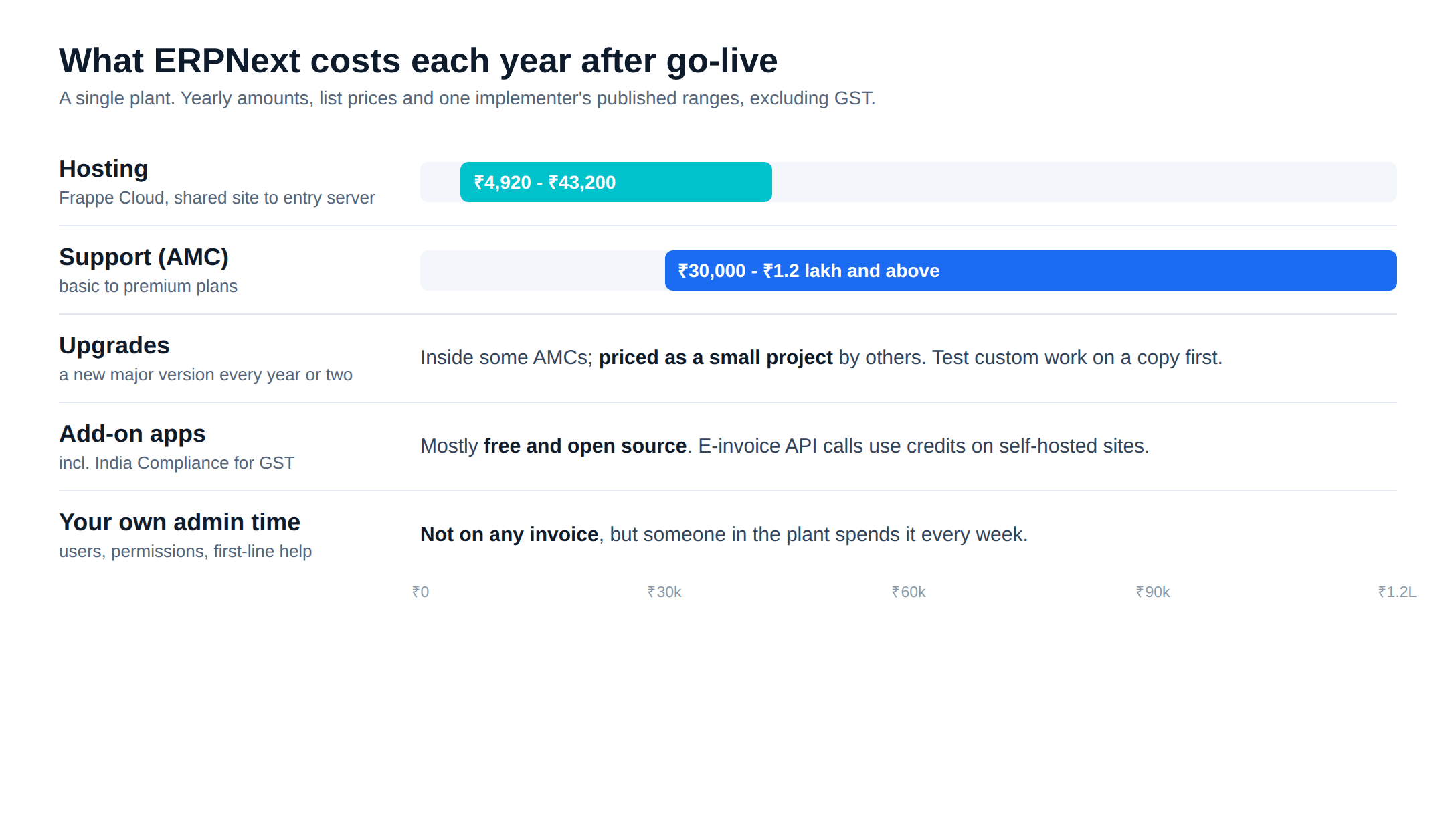
ERPNext is published under the GPL-3.0 licence. You can run it for 5 users or 500 without a licence fee. Once the plant is live, the recurring bill has five lines:
- Hosting: a Frappe Cloud plan, your own cloud server, or a machine in the plant. This is the only line with a fixed monthly price.
- Support: an annual maintenance contract (AMC) or a retainer with an implementer, covering fixes, user questions, new reports and small changes.
- Upgrades: ERPNext ships a new major version every year or two (v16 is current). Moving to it means testing your custom work on a copy of the site first. Some AMCs include this; others price it as a small project.
- Add-on apps: most apps in the Frappe ecosystem are open source and free, including the India Compliance app for GST. A few paid apps sell through the Frappe Cloud Marketplace, and e-invoice API calls use credits (more on that below).
- Your own people's time: someone inside the plant creates users, resets permissions and answers first-line questions. This cost does not appear on any invoice.
Hosting: three ways to run ERPNext
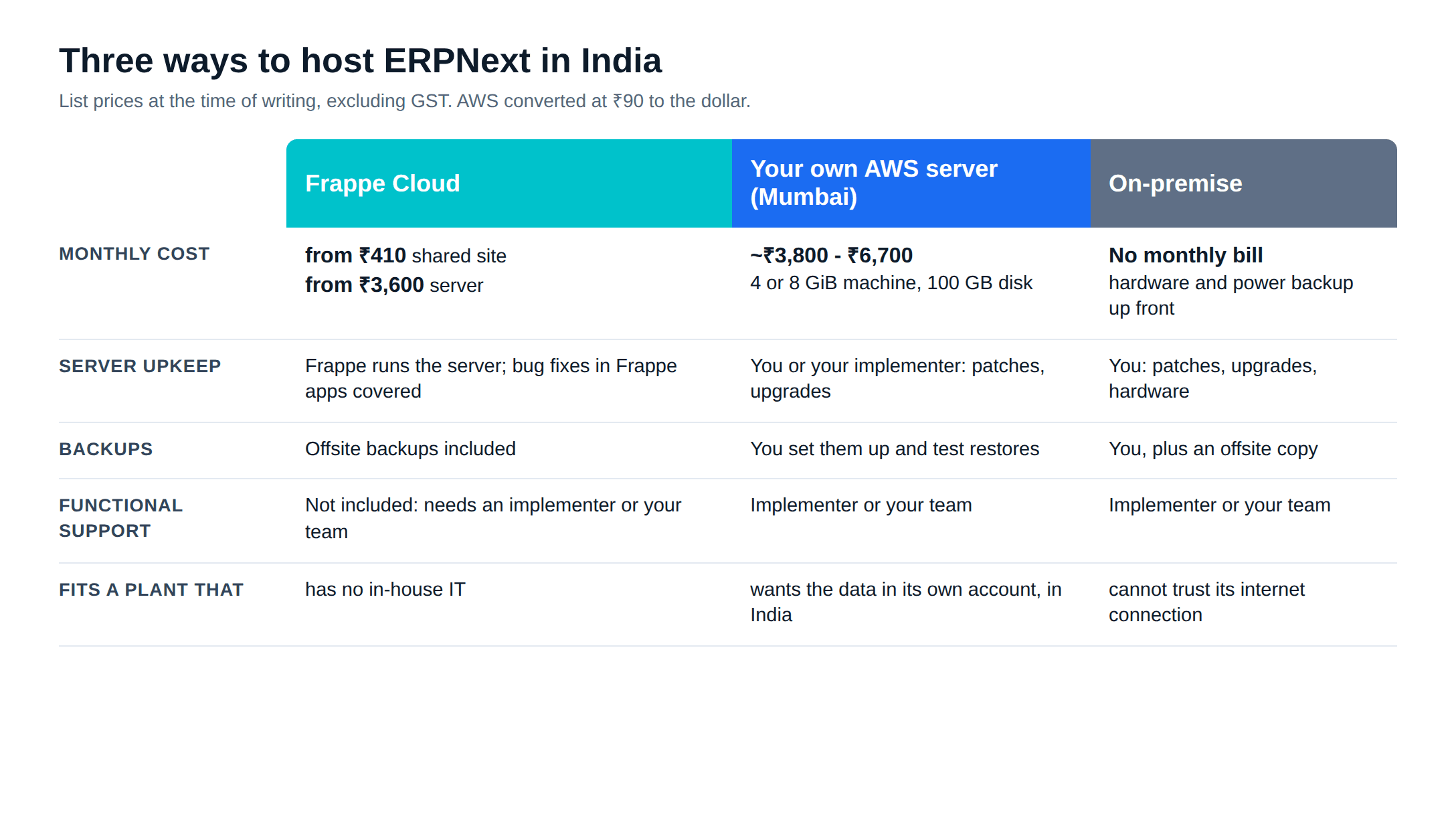
Hosting is the line you choose first, and it decides who looks after the server.
Frappe Cloud
Frappe Cloud is Frappe's own hosting service. At the time of writing, its pricing page lists shared sites from $5 a month (₹410) and servers from $40 a month (₹3,600), with a 14-day free trial. Site plans are compute-based, not per user. The page lists offsite backups, monitoring, easy upgrades and SSH access, and a Product Warranty that covers bug fixes in Frappe apps but, in its own words, "does not include functional support". You still need someone to answer "why did this stock entry fail?"
Your own AWS server in Mumbai
At AWS on-demand list prices for the Mumbai region (ap-south-1), a t3.medium with 2 vCPUs and 4 GiB of memory costs $0.0448 an hour, about $33 a month, and a t3.large with 8 GiB costs about $65 a month. A 100 GB gp3 disk adds about $9. Converted at ₹90 to the dollar, the rate Frappe Cloud's own rupee prices imply, that is roughly ₹3,800 to ₹6,700 a month. The data sits in an AWS account you own, in India. Someone has to patch the server, test backups and run each upgrade, and that person's time costs more than the machine.
On-premise
A server in the plant's office. There is no monthly hosting bill, but there is hardware, power backup, offsite backup copies and the same patching work. It makes sense mainly where the plant's internet connection cannot be trusted.
ERPNext vs Tally vs Odoo: three years of software cost
Per-user pricing is where ERPNext's licence pays off. Here is the software and hosting cost over three years, for the same plant at 10, 25 and 50 users.
Assumptions: list prices excluding GST; software and hosting only, so no implementation, training or support. ERPNext uses Frappe Cloud's entry server plan. TallyPrime uses the Gold licence from Tally's own cost guide: ₹67,500, with the first year of Tally Software Services (TSS) included and ₹13,500 a year to renew. Odoo uses the yearly-billing prices on Odoo's India pricing page as recorded in our ERPNext vs Odoo vs Zoho comparison: Standard at ₹580 per user per month for the first 12 months and ₹725 after, and Custom at ₹1,080 and then ₹1,350.
| Three years, software and hosting | 10 users | 25 users | 50 users |
|---|---|---|---|
| ERPNext on Frappe Cloud (entry server) | ₹1.30 lakh | ₹1.30 lakh | ₹1.30 lakh |
| TallyPrime Gold | ₹94,500 | ₹94,500 | ₹94,500 |
| Odoo Standard | ₹2.44 lakh | ₹6.09 lakh | ₹12.18 lakh |
| Odoo Custom (Odoo.sh hosting extra) | ₹4.54 lakh | ₹11.34 lakh | ₹22.68 lakh |
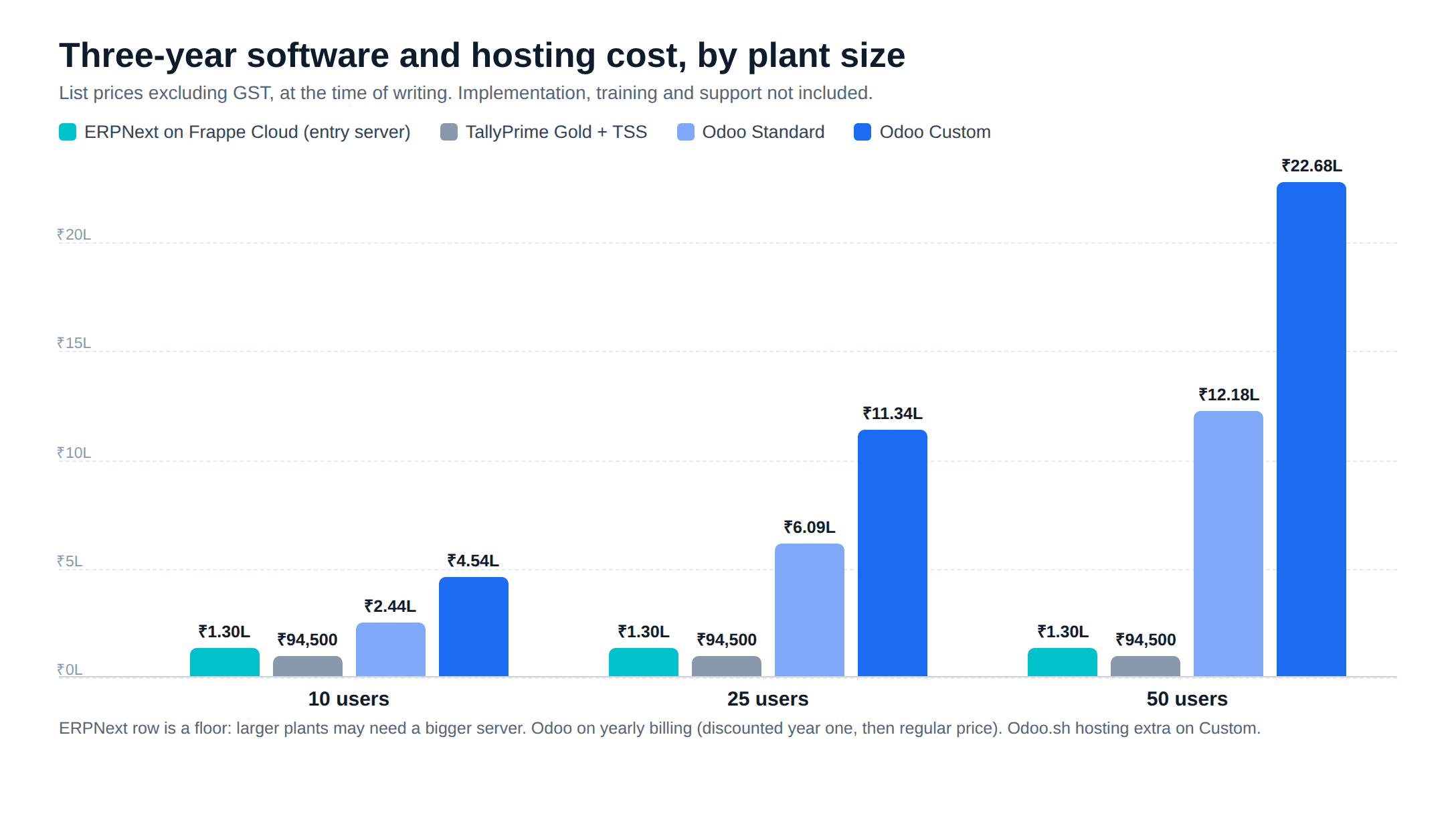
Read the ERPNext row as a floor. A 50-user plant running manufacturing will likely need a larger server than the entry plan, so ask Frappe Cloud or your implementer for a sized estimate. Even at three times the entry price, ERPNext stays below Odoo Standard at 25 users.
Tally Gold is the cheapest line, and it covers unlimited users on a local network for one fixed price. Remote users need TallyPrime Cloud Access, a separate subscription. The bigger difference is scope. Tally is accounting and inventory software; it does not plan production from sales orders, issue work orders or track job cards. Our ERPNext vs Tally comparison shows where that line falls for a plant.
Odoo's Standard plan does not include Studio or custom modules, which our comparison covers in detail. A plant that wants its own fields and screens without writing code needs Studio, and Studio sits on Custom, the most expensive row.
Three-year cost of ownership for a 30-user plant
The licence comparison leaves out the people costs. To see the whole bill, take a hypothetical single-plant food or plastics unit with 30 users, the core modules plus manufacturing, data coming from Tally, and no custom Frappe app. Using the market ranges in our implementation cost guide:
- Implementation, once: ₹1.5-3 lakh.
- Hosting for three years: ₹15,000 (shared site) to ₹1.3 lakh (entry server).
- Support for three years: ₹90,000 (basic plan) to ₹3 lakh (standard plan).
- Three years in total: roughly ₹2.5-7.3 lakh, excluding GST.
For scale, the Odoo Standard licence alone for 30 users over the same three years comes to about ₹7.3 lakh before any implementation work. This is an illustration built from published price lists, not a quote.
The hidden costs
None of these four costs shows up in a quote, and each can be avoided.
Edits to the core code
A developer who changes ERPNext's own files makes the next upgrade a repair job, because the update overwrites the change or collides with it. The same change built as a custom Frappe app survives upgrades. When you take a quote, ask which of the two you are getting.
Skipped upgrades
Each major version you skip makes the next jump bigger, and an old version eventually stops getting fixes. Upgrading one version at a time, on a test copy first, keeps each step small.
E-invoice API credits
The free India Compliance app handles GST e-invoicing, e-way bills and returns, but the government API calls behind them use credits. Each successful API request uses one credit, per the Frappe forum. India Compliance's account page gives new accounts 500 free credits for three months, and sells credits from 1,000 a year in multiples of 1,000. Frappe announced in 2023 that Frappe Cloud sites come with e-invoicing bundled; check the current terms for your plan.
A server nobody owns
A self-hosted site with no one checking backups costs nothing until the day the disk fails. If no one in the plant will own that job, managed hosting is the cheaper choice.
How to keep ERPNext cheap to run
- Start with the standard modules, and configure before you code. Custom fields, print formats and workflows are configuration, not development.
- Put every custom feature in a custom app in your own Git repository, never in ERPNext's core files.
- Keep the hosting account, the backups and the code in your company's name.
- Upgrade every major version, on a copy of the site first.
- Buy support against a written list of what it covers, so you know when hourly billing starts.
If you are weighing these costs for your own plant, ERPNext implementation for manufacturers explains how we scope a plant and what the written plan covers before any setup starts.
Frequently asked questions
Is ERPNext free for commercial use?+
Yes. ERPNext is released under the GPL-3.0 licence, which lets a business install it, use it for any number of users and change it without paying a licence fee. The licence applies conditions when you distribute modified code to others, not when you run it inside your own company. What costs money is running it: hosting, support, upgrades and your own admin time.
Does ERPNext charge per user?+
No. There is no per-user fee in the software. Frappe Cloud, Frappe's own hosting service, describes its site plans as compute-based, so the bill depends on the server size you need, not on the number of people who log in. Adding users can still cost money indirectly, if a larger plant needs a larger server or more training.
How much does ERPNext hosting cost in India?+
At the time of writing, Frappe Cloud lists shared sites from 410 rupees a month and servers from 3,600 rupees a month, with a 14-day free trial. Running it on your own AWS server in the Mumbai region costs roughly 3,800 to 6,700 rupees a month for a 4 GB or 8 GB machine with 100 GB of storage, at AWS on-demand list prices, plus the time someone spends patching and backing it up.
Is GST e-invoicing included in ERPNext?+
The India Compliance app, which is free and open source, adds GST e-invoicing, e-way bills and GST returns to ERPNext. The government API calls behind e-invoices and e-way bills use API credits. Self-hosted sites buy them from the India Compliance account page, and new accounts get 500 free credits for three months. Frappe announced in 2023 that Frappe Cloud sites come with e-invoicing bundled, so check the current terms for your plan.
What does ERPNext support cost a year?+
One Indian implementer's published guide lists annual support at about 30,000 to 60,000 rupees for a basic plan, 60,000 rupees to 1 lakh for a standard plan and 1 to 1.2 lakh rupees and above for premium cover. Ask what each plan includes: response times, version upgrades, new reports and how much change work is covered before hourly billing starts.
Related reading
- ERPNext implementation cost in India: the one-time project cost, with sources.
- ERPNext vs Odoo vs Zoho: licences, manufacturing depth and GST side by side.
- ERPNext vs Tally for manufacturers: where Tally stops being enough.
- ERPNext vs Odoo for Indian manufacturers: the two-way comparison, with a five-year cost table.
- E-invoicing from your ERP: IRN, e-way bills and what a plant should automate.
Free ERPNext fit check
Will ERPNext fit your factory?
Answer a few quick questions. On a short call we tell you whether ERPNext fits how you make, stock and sell, and what the rollout looks like.
Check my fit →About the author

- Tags
- erpnext
- erp
- manufacturing
- india
- pricing
Subscribe to Our Newsletter
The AI Build Brief: practical playbooks on how to build, price and ship AI features, in one short email every other week.