
ERPNext vs Odoo is the choice left once an Indian plant has narrowed its ERP shortlist to two open-source names. Both handle BOMs, work orders and GST. The main difference is the licence: ERPNext has no per-user fee at any size, while the Odoo features a plant tends to need sit in the paid Enterprise edition. We implement ERPNext at Metageeks, so read this with that in mind. Every Odoo claim below links to Odoo's own pricing, editions or documentation pages, and prices are as shown at the time of writing.
TL;DR
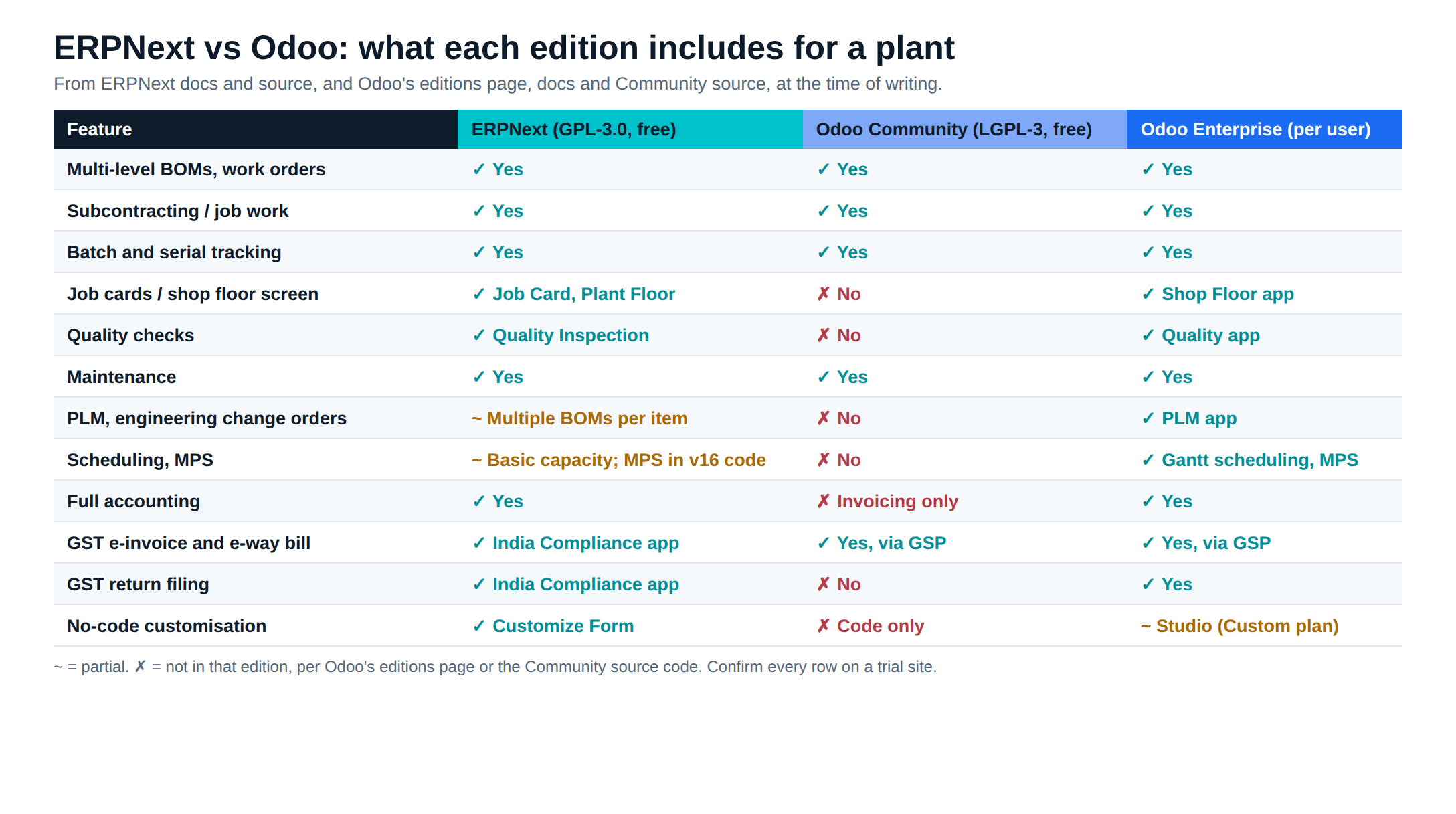
- ERPNext is GPL-3.0 with no licence fee. Odoo Community is LGPL-3 and free, but Odoo's editions page puts full Accounting, Quality, PLM, Barcode and the shop floor and scheduling tools in Enterprise.
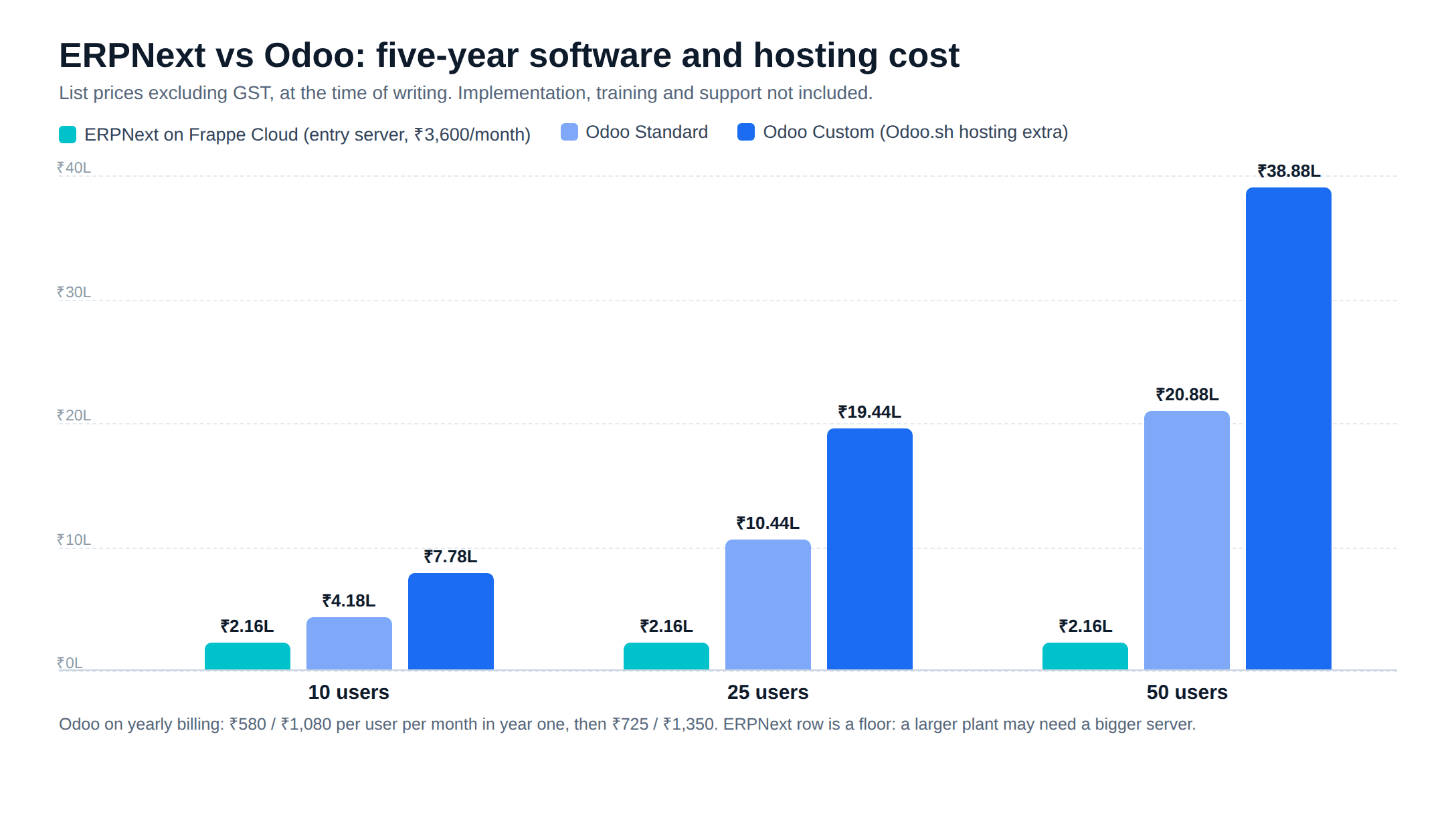
- Over five years at list prices, Odoo Standard costs about ₹4.18 lakh for 10 users, ₹10.44 lakh for 25 and ₹20.88 lakh for 50. ERPNext on Frappe Cloud's entry server is about ₹2.16 lakh at any of those sizes.
- Odoo Enterprise documents more advanced planning: finite-capacity scheduling on a Gantt chart, PLM with engineering changes, and a tablet shop floor. ERPNext covers BOMs, job cards, subcontracting, batches and quality inspection in the free product.
- GST e-invoicing and e-way bills work on both. ERPNext uses the free India Compliance app; Odoo uses its own modules through a GSP that its documentation names.
- Pick Odoo if you want its planning depth or one vendor for ERP, website and point of sale, and the per-user bill fits. Otherwise ERPNext costs less in licence and hosting at every size we modelled.
Free ERPNext fit check
Will ERPNext fit your factory?
Answer a few quick questions. On a short call we tell you whether ERPNext fits how you make, stock and sell, and what the rollout looks like.
Check my fit →ERPNext or Odoo for manufacturing: the short answer by plant type
These picks come from reading each product's documentation against common plant set-ups. They are a starting point for a trial, not a verdict.
| Your plant | Better fit | Why |
|---|---|---|
| Job shop or make-to-order plant, 10-50 users, sends work out to job workers | ERPNext | Job cards, routings and subcontracting in the free product; no per-user fee as headcount grows |
| Process plant (food, plastics, chemicals) that needs batch tracking and quality checks on a tight budget | ERPNext | Batches, expiry and quality inspection are in the open-source product |
| Plant that needs finite-capacity scheduling, PLM with engineering change orders or a tablet shop floor today | Odoo Enterprise | Odoo documents these more fully, and they are Enterprise features |
| Business that also runs a website, online store or retail counters and wants one vendor | Odoo | A wider app catalogue under one subscription |
| Group with several companies or GSTINs that needs custom code | ERPNext, or Odoo Custom | Multi-company and custom modules need Odoo's Custom plan; ERPNext has them at no extra fee |
Licensing: Odoo Community vs ERPNext, and Odoo Enterprise
ERPNext is published under GPL-3.0. Every module, including manufacturing, accounting, quality and HR, is in that one open-source product. There is no paid edition.
Odoo has two editions. Odoo's licence page says Odoo 19 Community is licensed under LGPL version 3, and that Enterprise is under the Odoo Enterprise Edition License, which allows use only with an active Enterprise subscription covering the number of users.
The split matters for a plant because of where the manufacturing extras sit. Odoo's editions page lists these at the time of writing:
- In both editions: Inventory, Manufacturing (MRP), Purchase, Maintenance and Invoicing.
- Enterprise only: Accounting (the full module, beyond invoicing), Barcode, PLM, Quality, Studio, the mobile apps, version upgrades, and the Manufacturing line "Shopfloor, Control Panel, Scheduling".
Two more come from Odoo's open-source code on GitHub. The Master Production Schedule module (mrp_mps) and the India GST return module (l10n_in_reports) are not in the Community source, so they ship with Enterprise. The subcontracting module (mrp_subcontracting) and the India e-invoice and e-way bill modules are in Community, under LGPL-3.
Five-year cost at 10, 25 and 50 users
Assumptions: list prices excluding GST, software and hosting only, so no implementation, training or support. Odoo uses yearly billing from Odoo's India pricing page: Standard at ₹580 per user per month for the first 12 months and ₹725 after, Custom at ₹1,080 and then ₹1,350. Those are the same figures recorded in our ERPNext vs Odoo vs Zoho comparison. ERPNext uses the entry server plan on Frappe Cloud, $40 a month (₹3,600).
| Five years, software and hosting | 10 users | 25 users | 50 users |
|---|---|---|---|
| ERPNext on Frappe Cloud (entry server) | ₹2.16 lakh | ₹2.16 lakh | ₹2.16 lakh |
| Odoo Community, self-hosted | ₹0 licence, plus your server | same | same |
| Odoo Standard (Odoo Online included) | ₹4.18 lakh | ₹10.44 lakh | ₹20.88 lakh |
| Odoo Custom (Odoo.sh hosting extra) | ₹7.78 lakh | ₹19.44 lakh | ₹38.88 lakh |
Three caveats. The ERPNext row is a floor: a 50-user plant with heavy stock transactions may need a bigger Frappe Cloud server or its own machine. Odoo's pricing page also lists a Light User at ₹195 a month, so if many of your logins only view or approve, ask Odoo what that tier allows. And the Odoo row with ₹0 licence is not a like-for-like option, because Community lacks full Accounting, Quality and GST returns.
The plan choice inside Odoo matters too. On the pricing page, Standard runs only on Odoo Online. Multi-company, the external API, Studio, Odoo.sh and on-premise hosting all sit on Custom. Odoo's own Odoo Online documentation says Odoo Online "is incompatible with custom modules", so a plant that needs code changes is pricing Custom, not Standard.
Licence and hosting are the smaller part of the bill. For the rest, see ERPNext pricing in India for running costs and ERPNext implementation cost in India for the one-time project.
Manufacturing depth
BOMs and work orders
Both handle multi-level BOMs, operations and work centres. ERPNext's Work Order creates a Job Card per operation, which, in the docs' words, "stores actual production information about a particular Operation performed on a particular Workstation", with time logs and an in-process quality inspection. ERPNext's Plant Floor view shows workstation status and processes job cards from one screen. Odoo's manufacturing documentation covers BOMs, work centres, work orders, by-products and scrap; its Shop Floor app is Enterprise.
Planning
Odoo Enterprise is ahead here. Its manufacturing page describes finite-capacity planning on Gantt charts, and its docs cover a Master Production Schedule. ERPNext's capacity planning allocates operations onto workstations against their working hours when a work order is submitted, with no optimiser that resequences jobs. ERPNext v16's source code adds Master Production Schedule and Sales Forecast doctypes, though the user manual does not document them yet. We cover the ERPNext chain in production planning, BOM and MRP in ERPNext.
Subcontracting
ERPNext's subcontracting docs run a Subcontracting Order, a stock transfer into the supplier's warehouse and a Subcontracting Receipt that the docs describe as "like a backflush for subcontracting", with scrap recorded from the BOM. Odoo's subcontracting docs describe three types: the subcontractor supplies the parts, you resupply them on each purchase order, or a vendor ships them straight to the subcontractor. Both look sound on paper. If you send work to job workers, run one of your own cases on each.
Batch, serial and quality
ERPNext tracks batches with expiry and serial numbers, grouped per transaction in a Serial and Batch Bundle, and runs quality inspections at receipt, in process and at delivery. Odoo tracks lots and serial numbers in Inventory, which is in both editions; its Quality app, with control points and alerts, is Enterprise only.
GST, e-invoicing and e-way bills
E-invoicing applies to taxpayers whose aggregate turnover crossed ₹5 crore in any year from 2017-18, from 1 August 2023 under Notification 10/2023-Central Tax. The parent notification exempts some sectors, such as banking and insurance, and a Goa State Tax circular clarifies that the exemption applies to the entity as a whole. Invoices are reported through the government e-invoice portal, and e-way bills through the e-way bill system.
ERPNext handles this through the free, open-source India Compliance app: its README lists e-invoice and e-way bill integration with the NIC portal, GSTR-1 preparation and purchase reconciliation against GSTR-2B and GSTR-2A. The government API calls use credits bought from an India Compliance account, as our ERPNext pricing guide sets out.
Odoo ships India localization modules for e-invoicing, e-way bills (including from the Inventory app), GSTR-1, GSTR-2B matching and GSTR-3B, plus TDS and TCS. The documentation says to configure BVM IT Consulting Services India Private Limited as the GSP and create API users on the NIC portals. In the Community source, these modules send requests through an Odoo in-app purchase service counted in credits, so ask Odoo what those cost for your invoice volume. GST return filing runs from the Accounting dashboard, which is Enterprise.
Both products cover compliance, so ask a different question: who holds the GSP credentials, and who do you call when the portal rejects an invoice?
Customisation and the cost of upgrades
ERPNext changes most things in the browser: Customize Form and custom fields add fields, print formats and workflows without code, at no extra fee. Deeper changes go into a custom app in Python. Odoo's equivalent no-code tool is Studio, which is Enterprise and sits on the Custom plan; Community is extended in Python modules.
Upgrades are where the bills diverge later.
- Odoo Enterprise: Odoo's upgrade documentation says upgrading to the latest version is free with Enterprise and covers all standard apps. It also says "it is the responsibility of the maintainer of your custom module to make it compatible with the new version", and that each major version is supported for three years. The editions page lists no upgrade service for Community.
- ERPNext: there is no paid upgrade service to buy. Frappe Cloud lists easy upgrades on its pricing page, and a self-hosted site runs them itself. Frappe's supported versions page shows v14 reached end of life on 31 January 2026, with v15 planned to end in 2027 and v16 in 2029. Custom apps need testing on a copy of the site before each move.
On both, the expensive part is your custom code, not the core. Keep customisations in a separate app or module, write each one down and budget implementer time for every major version.
Implementers in India and who owns the data
Both products have many implementers in India, and no directory tells you whether a firm knows your kind of plant. Ask for a reference plant with a similar process and a named consultant.
On data, ERPNext's database is yours on any host: Frappe Cloud provides backups, and a self-hosted site keeps a full MariaDB copy on your own server. Odoo Online lets you download a backup from the database manager, and Community can be self-hosted. On the Odoo side, the limit is the licence: once an Enterprise subscription ends, the Enterprise apps can no longer be used under Odoo's licence, so the data stays but the screens built on it go.
When Odoo is the better choice
Odoo is the better pick in these cases:
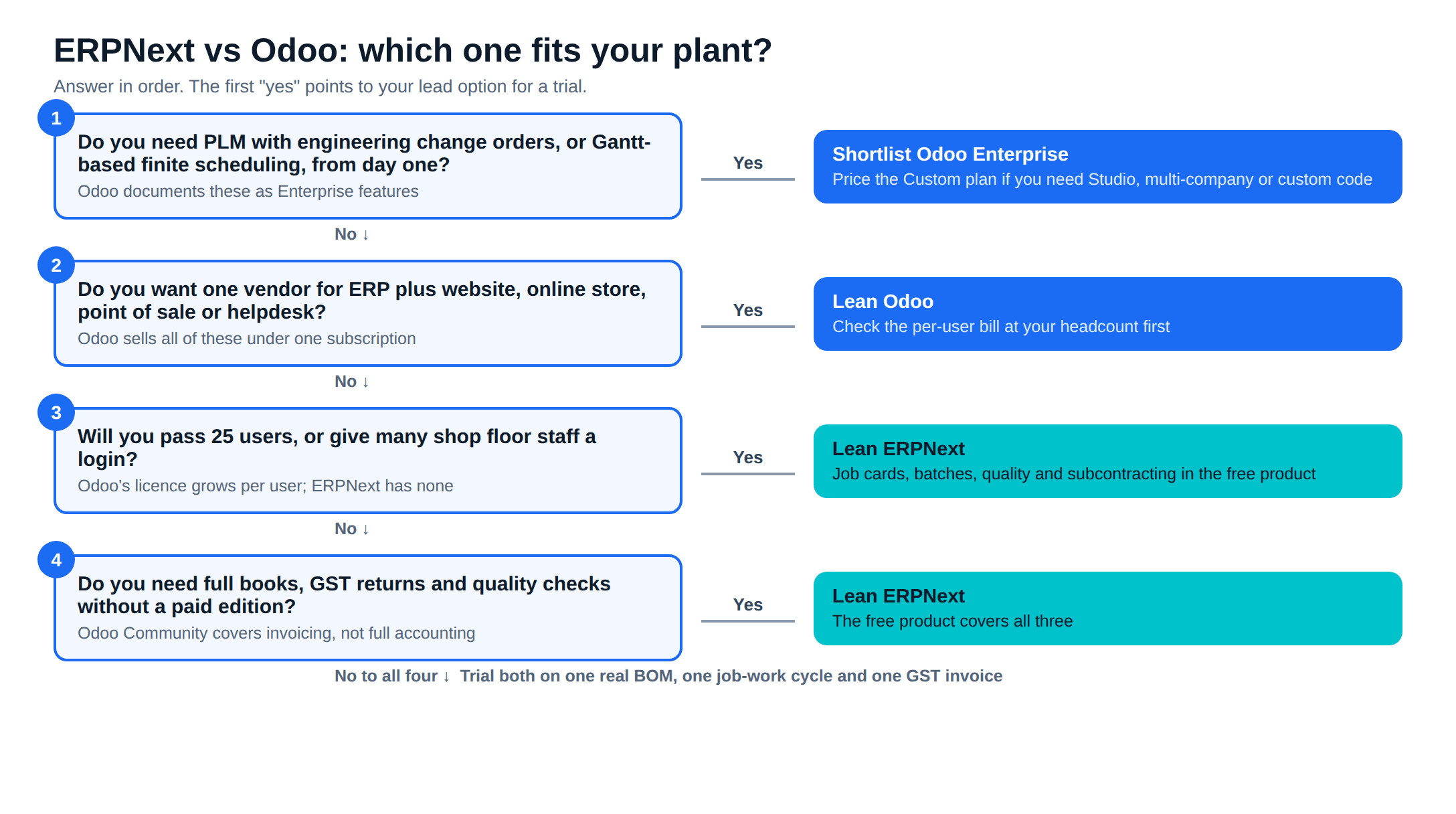
- You need finite-capacity scheduling on a Gantt chart, a documented Master Production Schedule or PLM with engineering change orders from day one.
- Your operators will work from a tablet shop floor app, and you want the one Odoo builds and supports.
- You also run eCommerce, a website, point of sale or a helpdesk and want one vendor and one login for all of it.
- You prefer a vendor-run subscription where hosting, support and upgrades of standard apps are on one invoice, and the per-user cost at your headcount is acceptable.
- A good Odoo implementer near your plant knows your industry, and no ERPNext firm you have met does.
How to decide in two weeks
- Write down your five hardest processes: BOM levels, job work, batch or serial rules, quality checkpoints and how you schedule the floor.
- Run each on a trial of both products with one real BOM, one subcontracting cycle and one GST invoice through to e-invoice.
- Get a written five-year quote for your user count from each implementer, with hosting, support and upgrades listed.
- Ask each in writing who holds the GSP credentials and what export you get if you leave.
If ERPNext comes out ahead for your plant, ERPNext implementation for manufacturers explains how Metageeks, an ERPNext implementation company, scopes a plant and what the written plan covers. If Odoo fits better, we will say so.
Frequently asked questions
Is Odoo Community enough for a manufacturing plant in India?+
For a small plant, it can cover BOMs, manufacturing orders, subcontracting, lots and serial numbers, and maintenance. Odoo's own editions page lists Accounting (beyond invoicing), Quality, PLM, Barcode, and the Shopfloor, Control Panel and Scheduling features as Enterprise-only, and the GST return module is not in the Community source code. A plant that wants GST returns and full books inside Odoo needs Enterprise.
Is ERPNext cheaper than Odoo over five years?+
On software and hosting, yes, once you pass about five users. At list prices on yearly billing, Odoo Standard comes to about 10.44 lakh rupees for 25 users over five years, while ERPNext on Frappe Cloud's entry server plan is about 2.16 lakh rupees at any user count. Implementation and support cost money on both, so compare full quotes for the same written scope.
Which is better for job work and subcontracting?+
Both document it. ERPNext v16 uses a Subcontracting Order, a stock transfer to the supplier's warehouse and a Subcontracting Receipt that backflushes the raw materials. Odoo documents three types: the subcontractor buys the parts, you resupply them, or a vendor ships them straight to the subcontractor. Odoo's subcontracting module is in the open-source Community code.
Can I move from Odoo to ERPNext later, or the other way?+
Yes, but plan it as a migration project. Masters, open balances and open orders move with import templates. Decide early whether transaction history moves too or stays in the old system as a read-only archive. Moving off Odoo Enterprise also means the Enterprise apps stop being usable once the subscription ends, since Odoo's Enterprise licence requires an active subscription.
Related reading
- ERPNext vs Odoo vs Zoho: the three-way view, with Zoho's plans.
- ERPNext pricing in India: hosting, support and upgrade costs after go-live.
- ERPNext implementation cost in India: the one-time project, with sources.
- Open source ERP for Indian manufacturers: what GPL, LGPL and AGPL allow, and six projects compared.
Free ERPNext fit check
Will ERPNext fit your factory?
Answer a few quick questions. On a short call we tell you whether ERPNext fits how you make, stock and sell, and what the rollout looks like.
Check my fit →About the author

- Tags
- erpnext
- erp
- manufacturing
- india
- comparison
Subscribe to Our Newsletter
The AI Build Brief: practical playbooks on how to build, price and ship AI features, in one short email every other week.