
Open source ERP appeals to Indian manufacturers for one reason: no per-user licence fee, however many people log in. That part is real. What the word "free" does not cover is the server, the implementation, the support contract, and in some products, the manufacturing features you actually need. This guide explains what the licences allow, compares six projects on manufacturing depth and India GST support, and shows where the money goes once the software is installed.
TL;DR
- Open source means the licence lets you run, study and change the code. GPL, LGPL and AGPL all allow internal use and internal changes without publishing them; they differ on what happens when you share the software.
- ERPNext (GPL-3.0) and Odoo Community (LGPL-3.0) are the two projects here with India GST and e-invoicing modules in their own repositories and an implementer network in India.
- Dolibarr, iDempiere, Tryton and Apache OFBiz are active open-source projects with manufacturing features, but we found no packaged India e-invoicing module for any of them.
- Open core is the trap to check for: Odoo keeps shop floor, scheduling, PLM and quality in its paid Enterprise edition.
- The licence line is zero; hosting, implementation, support and upgrades are not.
Free ERPNext fit check
Will ERPNext fit your factory?
Answer a few quick questions. On a short call we tell you whether ERPNext fits how you make, stock and sell, and what the rollout looks like.
Check my fit →What "open source" means for an ERP
An ERP is open source when its code ships under a licence approved by the Open Source Initiative. Those licences let anyone use the software for any purpose, read the code and change it. They differ in one place: what you owe others when you pass the software on.
Five licences cover the projects in this guide:
- GPL-3.0 (ERPNext, Dolibarr, Tryton): if you distribute the program or a modified version, you must share the source under the same licence.
- GPL-2.0 (iDempiere): the older version of the same idea.
- LGPL-3.0 (Odoo Community): a weaker copyleft: the library itself stays open, but software that only uses it can carry a different licence. This is what lets Odoo sell proprietary Enterprise modules on top of an open core.
- AGPL-3.0 (Axelor): the GPL plus a network clause: section 13 says that if you modify the program, users who interact with it remotely over a network must be offered the source of your version.
- Apache-2.0 (Apache OFBiz): permissive. You can change it and keep your changes closed, with attribution and patent terms.
For a plant that runs its ERP for its own staff, the practical answer is the same under all five. The GNU GPL FAQ says "an organization can make a modified version and use it internally without ever releasing it outside the organization." Two exceptions matter. The same FAQ treats giving copies to contractors for use off-site as distribution. And under the AGPL, a supplier or dealer portal built on a modified version brings the network clause into play.
Six open source ERPs, side by side
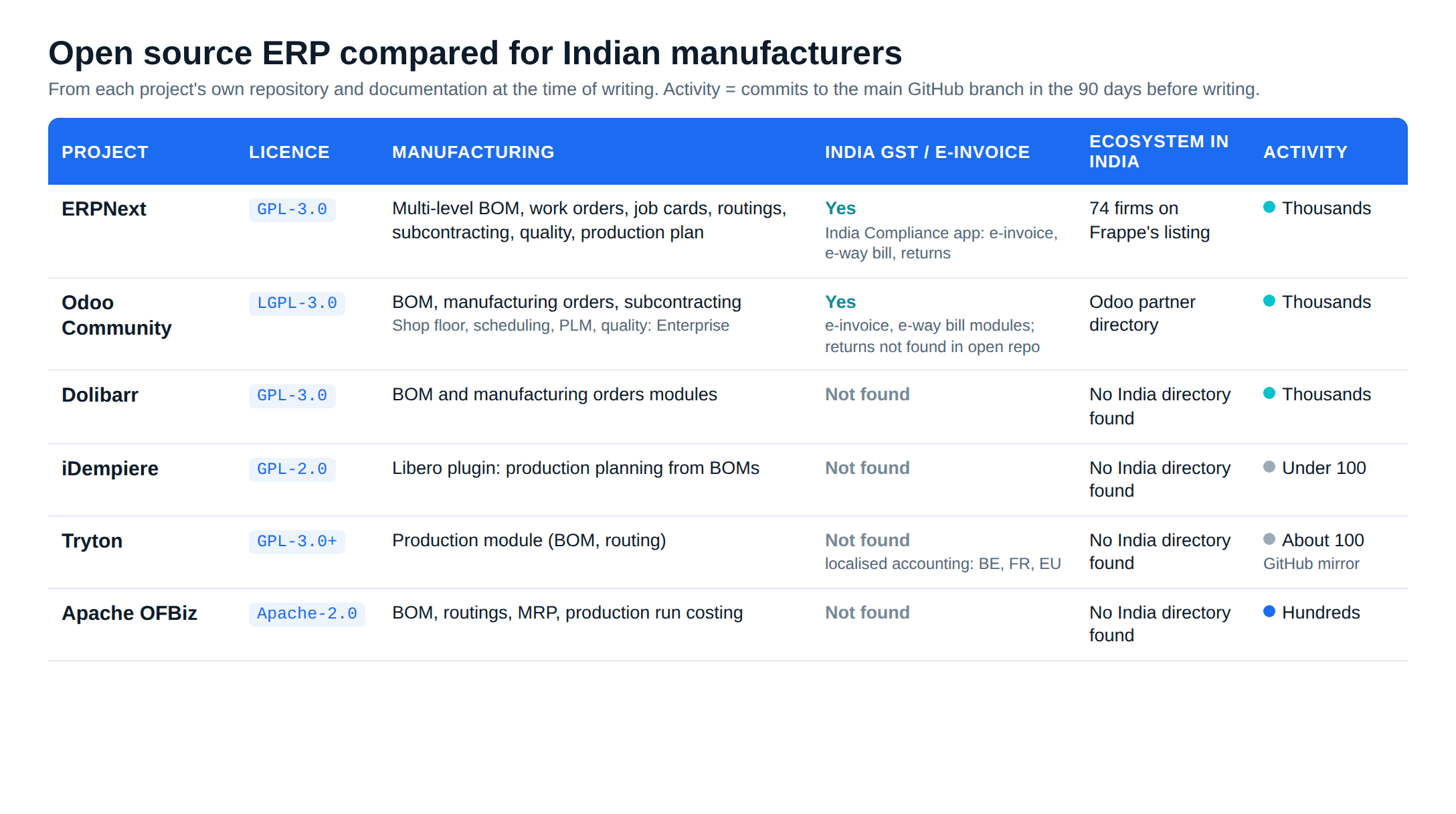
We read each project's own site, documentation and code repository. Activity levels come from the number of commits to each project's main GitHub branch in the 90 days before writing.
ERPNext
ERPNext is GPL-3.0, built by Frappe on its Frappe Framework, and is on major version 16. The manufacturing documentation covers multi-level BOMs, Work Orders, Job Cards, routings, subcontracting, quality inspection and Production Plans that turn sales orders into material requests. We walk through that chain in production planning, BOM and MRP in ERPNext.
GST runs through the India Compliance app, also GPL-3.0, which adds e-invoicing, e-way bills and GST return tools. Its government API calls use paid credits. The main repository saw thousands of commits in the 90-day window.
Odoo Community
Odoo's source repository is published under LGPL-3.0, per its LICENSE file. It contains the manufacturing app (mrp), subcontracting modules and a basic maintenance module. It also contains India modules: accounting (l10n_in), e-invoicing (l10n_in_edi) and e-way bills (l10n_in_ewaybill). Both manifests name Tera Software Limited as the GSP, and the e-way bill manifest marks itself as a paid Odoo IAP service. We did not find GST return modules in the open repository.
The catch is on Odoo's editions page: shop floor, scheduling, PLM, quality and Studio sit in Enterprise, which is licensed per user. The open repository is as busy as ERPNext's, with thousands of commits in the window.
Dolibarr
Dolibarr is GPL-3.0, written in PHP, and released 24.0.1 at the time of writing. Its wiki documents a BOM module and a Manufacturing Orders module, both bundled with the standard download. Development is brisk, with thousands of commits in the window, but we found no India e-invoicing module in its repository or wiki.
iDempiere (and ADempiere)
iDempiere is GPL-2.0, a Java ERP that grew out of ADempiere and Compiere. Manufacturing comes from the Libero Manufacturing plugin, which the wiki describes as basic production schedule planning from bills of material. We found no India GST module. Under 100 commits in the window: steady, not fast.
Tryton
Tryton is a Python ERP under GPL-3.0-or-later, per its PyPI listing. Its documentation lists a Production module that "transforms raw materials into finished products". Its localised accounting modules in the main repository are for Belgium, France and the EU; we found none for India. Development happens on Tryton's own code host, mirrored to GitHub, where the mirror showed about 100 commits in the window.
Apache OFBiz
Apache OFBiz is Apache-2.0. Its business page lists BOMs, routings with tasks, production planning and MRP, and production run costing. The page does not mention tax localisation for India, and we found no GST module. The project is active, with hundreds of commits in the window.
Axelor Open Suite (AGPL-3.0) also has a production module. Axelor has published an article on adapting it for India that mentions a Tally bridge and payroll. It does not name GST, and we found no India implementer network for it, so it stays off the main shortlist.
The open-core trap
Some ERPs are fully open: every module in the product is under the open licence. Others are open core: a free base edition, with features held back for a paid edition.
Odoo is the clearest open-core case on this list. The Community code is LGPL and usable on its own, but a plant that needs shop-floor tablets, finite scheduling or a quality module crosses into Enterprise, where pricing is per user per month. Our ERPNext vs Odoo vs Zoho comparison sets out those per-user prices for India.
Open core is a legitimate model. The risk is planning around the free edition, building your processes on it, and then discovering a feature you need is in the paid tier. Before you commit, list your must-have features and check each one against the vendor's editions page, not its marketing page.
ERPNext, Dolibarr, Tryton, iDempiere and OFBiz do not sell a separate enterprise edition of the core product. ERPNext's commercial side is hosting (Frappe Cloud) and a small number of paid apps on its marketplace.
What you pay for when the licence is free
The licence removes one line from the budget. The rest stays.
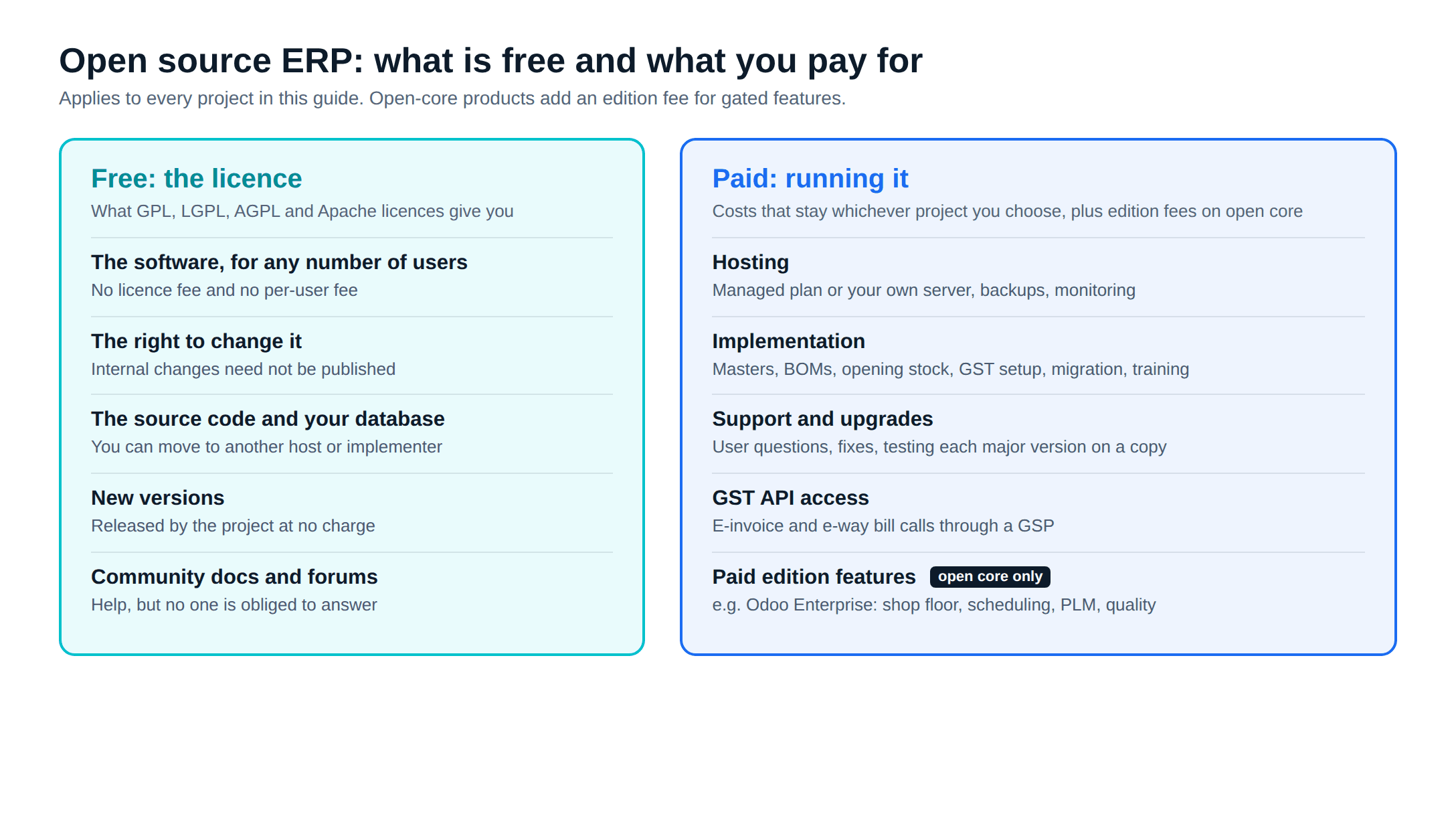
- Hosting: a server you run, or a managed plan. At the time of writing, Frappe Cloud lists shared ERPNext sites from ₹410 a month and dedicated servers from ₹3,600. For the other projects, check whether any managed host serves India; if not, you run your own server.
- Implementation: masters, opening stock, BOMs, GST setup, data migration, training. This is the largest one-time cost and depends on the plant, not the licence. Our ERPNext implementation cost guide gives published market ranges by plant size.
- Support and upgrades: someone has to answer user questions, fix failed postings and test each major version on a copy of your data. Our ERPNext pricing guide covers the yearly running cost, including support contracts.
- GST API access: e-invoices and e-way bills go to the government portal through a GSP. In ERPNext the calls use paid India Compliance credits, and Odoo's e-way bill module is flagged as a paid IAP service.
- Edition fees on open-core products: only if the features you need are in the paid tier.
Picture a 40-person plant choosing between ERPNext and a less common project with no Indian implementers. The licence cost is zero in both cases. The difference is that with the second, the plant pays someone to build GST e-invoicing first, and has a much smaller pool of people to call when it breaks.
Who will implement and support it in India
For a plant, who answers the phone when an e-invoice fails matters as much as the code.
ERPNext and Odoo both have many implementers in India. Frappe runs a public community forum where you can see which firms answer questions in detail, and Odoo has its own community forum. Odoo's India modules come from Odoo S.A. itself; ERPNext's come from the open-source India Compliance app.
For Dolibarr, iDempiere, Tryton, OFBiz and Axelor, we found no India-specific implementer directory on their project sites. Indian firms may still work with them; you will have to find and vet them yourself, and GST e-invoicing would be a custom build unless you find a maintained add-on.
This also matters for the exit route. With an open-source ERP, the code and the database are yours, so you can change implementers without changing software. That only helps if there is another implementer to change to.
How to evaluate an open source ERP
Use this checklist before you sign a scope. Test each point against the project's own documentation and repository, not a sales deck.
- Name the licence and confirm it from the repository's LICENSE file. Note whether you plan to distribute changes or expose a portal (AGPL).
- List your must-have manufacturing features (BOM levels, job work, batch or serial tracking, quality, scheduling) and check each against the free edition, not the paid one.
- Confirm GST e-invoicing, e-way bills and GST returns are a maintained module, and find out which GSP it uses and what API calls cost.
- Check activity: recent commits, a release in the last year, and an open issue tracker with replies.
- Find at least two implementers in India who have run the project in a plant, and ask each for a written scope and support terms.
- Ask who holds the hosting account, the backups and the custom code. All three should be in your company's name.
- Run one real BOM, one purchase-to-pay cycle and one GST invoice through to e-invoice on a trial site before you commit.
If ERPNext comes out ahead on that list, ERPNext implementation for Indian plants covers how Metageeks, an ERPNext implementation company, scopes a plant and what the written plan includes before any setup starts.
Frequently asked questions
Is open source ERP really free for a business?+
The licence is free. Every project in this guide lets a company download, install and run the software for any number of users without a licence fee, and change it for internal use. Running it is not free: you pay for a server or hosted plan, for implementation, for support and for upgrades. Open-core products such as Odoo also keep some features in a paid edition.
Can I modify GPL-licensed ERP software without publishing my changes?+
Yes, for internal use. The GNU GPL FAQ says an organisation can make a modified version and use it internally without ever releasing it. The obligation to share source starts when you distribute the modified program to someone outside the company, and the FAQ counts giving copies to off-site contractors as distribution. Under the AGPL, users who interact with a modified version over a network must also be offered its source.
Which open source ERP has the best India GST support?+
Of the projects compared here, ERPNext and Odoo are the two with India modules in their own repositories. ERPNext uses the free India Compliance app for e-invoicing, e-way bills and GST return tools. Odoo's open-source repository has India accounting, e-invoicing and e-way bill modules. For Dolibarr, iDempiere, Tryton and Apache OFBiz we found no packaged India e-invoicing module in the project's own repository or documentation.
Is Odoo Community enough for a manufacturing plant?+
It covers the basics. The open-source Odoo repository includes the manufacturing app with bills of materials and manufacturing orders, subcontracting and a basic maintenance module. Odoo's editions page lists shop floor, scheduling, PLM and quality as Enterprise features, so a plant that needs those pays Odoo's per-user Enterprise licence.
How do I find an implementer for an open source ERP in India?+
ERPNext and Odoo both have many implementers in India, and both run public community forums where you can see who answers questions in detail. For the smaller projects we found no India-specific implementer directory on their sites, so check who would support you before you choose the software. Whoever you shortlist, ask for a reference plant with a similar process.
Related reading
- ERPNext vs Odoo vs Zoho: licences, per-user prices, manufacturing depth and GST side by side.
- ERPNext pricing in India: the yearly cost of running ERPNext.
- ERPNext implementation cost in India: the one-time project cost, with sources.
- ERPNext vs Odoo for Indian manufacturers: the two-way comparison, with a five-year cost table.
Free ERPNext fit check
Will ERPNext fit your factory?
Answer a few quick questions. On a short call we tell you whether ERPNext fits how you make, stock and sell, and what the rollout looks like.
Check my fit →About the author

- Tags
- erpnext
- erp
- manufacturing
- india
- guide
Subscribe to Our Newsletter
The AI Build Brief: practical playbooks on how to build, price and ship AI features, in one short email every other week.