A 20-100 person Indian plant asks different questions about ERP than a multinational does. Is it big enough to need one? What will it cost in rupees? Will it cope with GST, job work and Tally history? This guide to ERP for manufacturing in India answers them in order and links to a deeper post on each, for the owner, plant head or accountant who is weighing an ERP.
TL;DR
- A manufacturing ERP puts orders, stock, bills of materials, production, purchasing and accounts in one database. Its value is that each department sees the same figures.
- You probably need one when simple questions, such as where an order is or what a job cost, take phone calls and spreadsheets. If they do not, stay on your books software.
- Cost is licence plus implementation plus hosting and support. ERPNext has no licence fee, so its cost is mostly the work. Published Indian guides put a manufacturing implementation at roughly 1-3 lakh rupees, or 3-5 lakh and above at 50+ users with integrations or in multi-location plants.
- Choose on your process, your support options and a trial on your own data, not on a feature list.
- Plan the data first: clean masters, accurate stock and a cut-over date at the start of a month or financial year.
What manufacturing ERP software does
ERP stands for enterprise resource planning. In a plant it means one piece of software that replaces the separate registers, spreadsheets and accounting entries that a plant without one runs side by side. Vendor guides to manufacturing ERP, such as NetSuite's overview of manufacturing ERP modules and Tipalti's, list roughly the same building blocks:
- Inventory. Raw material, work in progress and finished goods, by warehouse.
- Bills of materials (BOM). What goes into one unit of a product, and in what quantity.
- Production. Work orders, operations and the material used against each job.
- Planning. Working out what to make and what to buy from open orders, often called MRP.
- Purchasing and sales. Orders from suppliers and to customers, tied to stock.
- Quality. Checks at receipt, during production and at dispatch.
- Accounts. Invoices, payments, GST and the ledger, fed by the movements above.
What matters is that the modules share one database. When a sales order is saved, the system can propose a production plan, list the raw material that is short, raise a purchase request and, later, post the cost to the books. When those jobs live in separate tools, someone retypes the same numbers and the copies drift apart.
The top results we read for this topic are mostly vendor rankings and module lists. The ones we saw say little about what an Indian plant of this size deals with day to day: GST e-invoicing and e-way bills, job work challans and Tally history. This guide covers those.
Signs your plant needs one
The question is whether your plant has outgrown its current tools. Watch for these:
- A spreadsheet sits beside Tally for production orders, and it is the one people trust.
- The owner cannot see what is in progress without calling the floor.
- You have more than one godown or plant and stock does not tie.
- A customer or auditor has asked for batch traceability that takes a day to produce.
- Different people need different access and the books software cannot give it.
- The accountant is the bottleneck for every operational question.
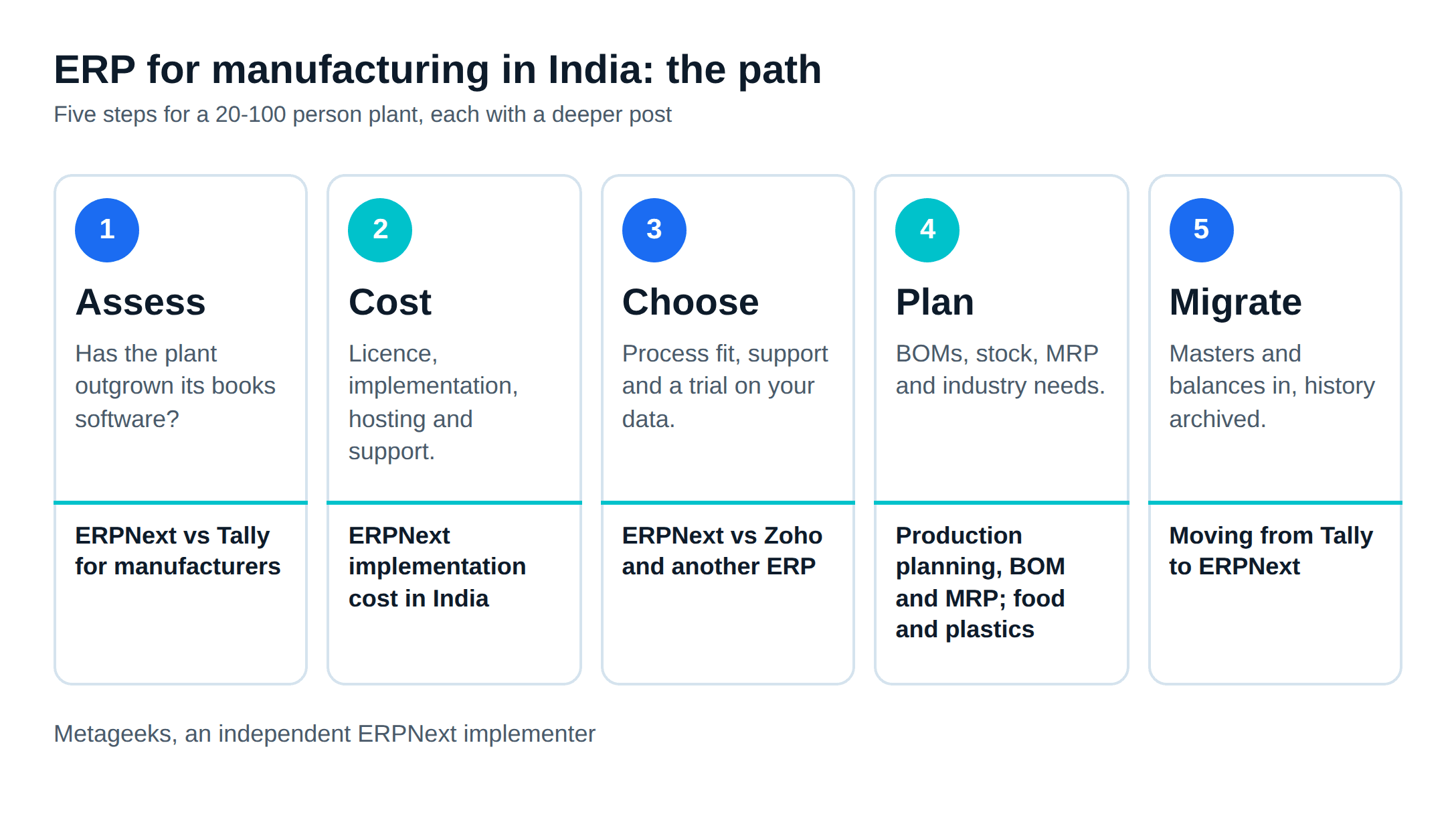
If none of these is true, stay where you are. A switch costs money and weeks of disruption, so it should fix a problem you can name. Our comparison, ERPNext vs Tally for manufacturers, sets out what Tally's own help pages describe, where a growing plant outgrows them and a test for when to move.
What it costs
Four lines make up the bill: the licence, the implementation, hosting, and support after go-live. Products priced per user add a licence cost that rises with headcount. ERPNext, which is open source, has none, so what you pay for is the work around it: configuring the system, moving data, training and running it.
Published Indian implementer guides, which are marketing pages and not audited surveys, put an ERPNext implementation for a manufacturing unit at roughly 1-3 lakh rupees. They disagree at the edges. One guide prices up to 15 users at 75,000 to 1.5 lakh, and 15-50 users at 1.5 to 3 lakh, with 3-5 lakh and above at 50+ users with integrations. Another guide puts a manufacturing unit at 3 lakh and above if it is multi-location or complex. Hosting on Frappe Cloud is listed from about 410 rupees a month for a shared site and from about 3,600 rupees for a server, at the time of writing, and annual support quotes run from 30,000 rupees upward.
Most of the gap between quotes comes from the modules you switch on, how much data has to move out of Tally, and how much you customise. That is why the useful move is to write your scope down and ask every vendor to price the same document. The full ranges, the sources and a worked example for a 30-person plant are in what ERPNext implementation costs in India.
Choosing a system
We implement ERPNext, so weigh our view accordingly. Our comparison, how ERPNext compares with Zoho and another widely used ERP for Indian plants, draws only on each vendor's own pricing, help and documentation pages. The differences sit in licence model, manufacturing depth, how GST e-invoicing is handled, and who can host and support the system.
Large international suites exist as well; we have not covered them here.
Before you shortlist, do three things:
- List your real processes: BOM levels, job work, batch tracking, quality checks and scheduling needs. Mark what is essential and what is nice to have.
- Ask in writing what data export you get and who holds the GST credentials, so you can leave later if you need to.
- Ask who will support the system after go-live and what that costs. Keep the site and its backups in an account you own, so a system you can host yourself keeps your options open.
A good implementer will tell you if another product fits your plant better.
GST, job work and Tally history
Three Indian specifics decide whether a system suits the plant. Each has its own post.
On GST, ERPNext covers e-invoicing and e-way bills through the open-source India Compliance app, and some automation needs paid GST API access, according to our comparison. The same comparison finds that GST compliance does not separate the products it covers. What differs is who holds the credentials and who you call when the portal rejects an invoice.
On job work, Section 143 of the CGST Act lets you send inputs for job work without paying tax, but inputs must come back within one year and capital goods within three. The Commissioner can extend both periods, and goods not back in time are treated as supplied. Moulds, dies, jigs, fixtures and tools are excluded from the return rule. Your system has to show what is out and since when, and the plastics guide shows how to test that.
Tally's own help pages describe BOMs, manufacturing journals and job work, but not work orders, routings or quality inspection. Its licensing page says online e-invoice and e-way bill generation needs a valid annual TSS subscription. ERPNext vs Tally sets out the detail, and the migration steps come under implementation below.
Food and plastics plants
What a plant must track depends on its industry. Two examples follow.
A food plant deals in lots, expiry dates and recipes with process loss, and needs a recall list quickly. FSSAI's recall guidelines ask covered operators to keep distribution records, including batch code, lot number and traceability from raw material to finished good. They name no software. Our guide to ERP for food manufacturing covers batch and expiry control, percentage-based recipes, quality checks and how to run a mock recall on a test site.
A plastics or packaging plant buys by the kilo and sells by the piece, loses material as runners and purge, runs jobs per machine and sends work out to job workers. Our guide to ERP for plastics manufacturers covers two units of measure, scrap and regrind, job cards, and GST job work challans with their time limits.
If your plant is neither, the pattern still applies. Name the three or four things your industry cannot afford to get wrong, then test each on a trial site with your own data.
Planning and MRP
A planning module is only as good as the bills of materials and stock records feeding it. If the BOM says 100 grams and the machine uses 112, every downstream number is wrong.
ERPNext's chain runs from Sales Order to Production Plan, Material Request, Work Order, Job Card and Stock Entry. The Production Plan turns demand into a make list and a buy list, and can net off projected stock. Its capacity planning is basic: workstation hours, holidays and a capacity figure, with no optimiser that sequences jobs. A plant that needs finite-capacity scheduling should check that before it commits, and our production planning, BOM and MRP walkthrough explains where the line sits.
A sensible order for a small plant is item master and opening stock first, BOMs for the top products second, a Work Order per job third, and the Production Plan once the planner trusts the numbers.
Implementation and migration
An implementation is a project with a start, a plan and an end. A usable one runs in this order:
- Discovery and a written scope. Plants, warehouses, modules, roles, what moves from Tally, integrations and training, with hours by milestone and a go-live date.
- Clean the masters. Duplicate items, three spellings of one customer and opening stock that does not match the books are the usual time sinks.
- Configure and test on your own data, with your own BOMs, GST setup and print formats.
- Train by role. Stores, production, purchase, sales and accounts use different screens.
- Run in parallel briefly, then cut over at the start of a month or financial year.
Published timelines are in the FAQ below. Your own data is the biggest variable.
If you are leaving Tally, most voucher history stays behind in a read-only company file, and what moves is masters, closing balances, unpaid invoices and opening stock. Our checklist, moving from Tally to ERPNext, covers what moves, the GST ledgers and a cut-over weekend, step by step.
Before you sign anything, ask the vendor for a trial site loaded with one real BOM, one purchase-to-pay cycle and one GST invoice taken through to e-invoice. Check the result against your own books. Metageeks is an independent ERPNext implementer, and our approach to ERPNext implementation starts with discovery and a written scope.
Where to start this week
You do not have to decide on a system today. Three small tasks make every later step cheaper:
- Write down the five questions you cannot answer quickly today, such as where a given order is or what last month's job cost.
- Export your item list and count the duplicates.
- Pick a candidate cut-over date at the start of a month or financial year and work back from it.
If you want a second opinion on whether the plant needs an ERP at all, tell us what it runs on today and we will tell you whether ERPNext is worth it or your current setup is still enough.
Frequently asked questions
What is ERP software for manufacturing?+
It is one system that holds a plant's orders, stock, bills of materials, production, purchasing and accounts in a single database, so each department works from the same figures. A sales order can become a production plan, a purchase request and a work order without anyone retyping it.
Does a small Indian plant need an ERP?+
Not always. If one person can still say from memory what is in stores, what is on the floor and what a job costs, books software and a disciplined register may be enough. An ERP earns its place when those questions take phone calls, and when the same data is kept in three places that disagree.
How much does manufacturing ERP cost in India?+
It depends on the product and the scope. For ERPNext, which has no licence fee, published Indian implementer guides put a manufacturing implementation at roughly 1 to 3 lakh rupees, or 3-5 lakh and above at 50+ users with integrations or in multi-location plants, plus hosting and annual support. Products priced per user add a licence line that grows with headcount. Compare quotes for the same written scope.
How long does an ERP implementation take?+
One published implementer guide gives 4-8 weeks for a standard deployment of two or three modules and 3-5 months for a mid-sized, multi-module rollout. Your own data is the biggest variable, because clean item masters and bills of materials shorten the timeline.
Can I keep Tally after moving to an ERP?+
Yes, as a read-only archive. One option is to move stock, production, buying and selling to the new system at the start of a month or financial year and keep the old Tally company file for past years and audits.
Free PDF
The 2026 AI Development Rate Sheet
Build, agent, RAG and consulting rates by tier, in one PDF, so you can check a quote before you sign it.

Written by
Pankaj Kumar
Founder · Metageeks Technologies
Metageeks builds software and AI products for growing businesses. Every build is scoped in writing before it starts, and you see progress every week. We write about what holds up once it reaches production.
Connect on LinkedInThe AI Build Brief
Ship AI that holds up in production.
Practical playbooks on how to build, price and ship AI features, in one short email every other week.