
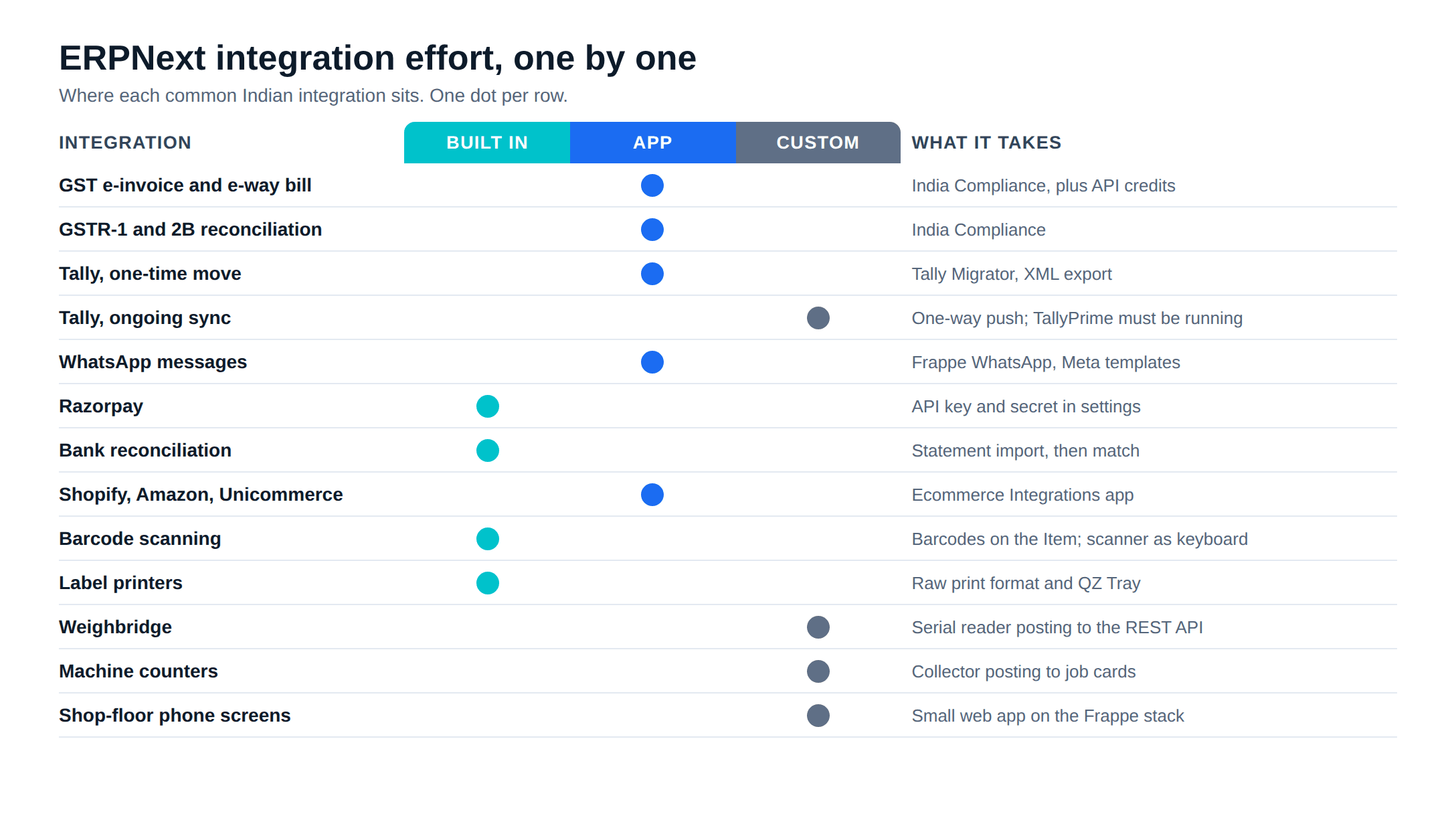
The ERPNext integration question comes up before a plant signs off: will it talk to Tally, the GST portal, WhatsApp, the payment gateway and the weighbridge at the gate? For most of that list the answer is yes, and the cost depends on which of three levels each connection sits at. This guide sorts the common Indian integrations into those levels so you can see what comes free and what needs a developer.
TL;DR
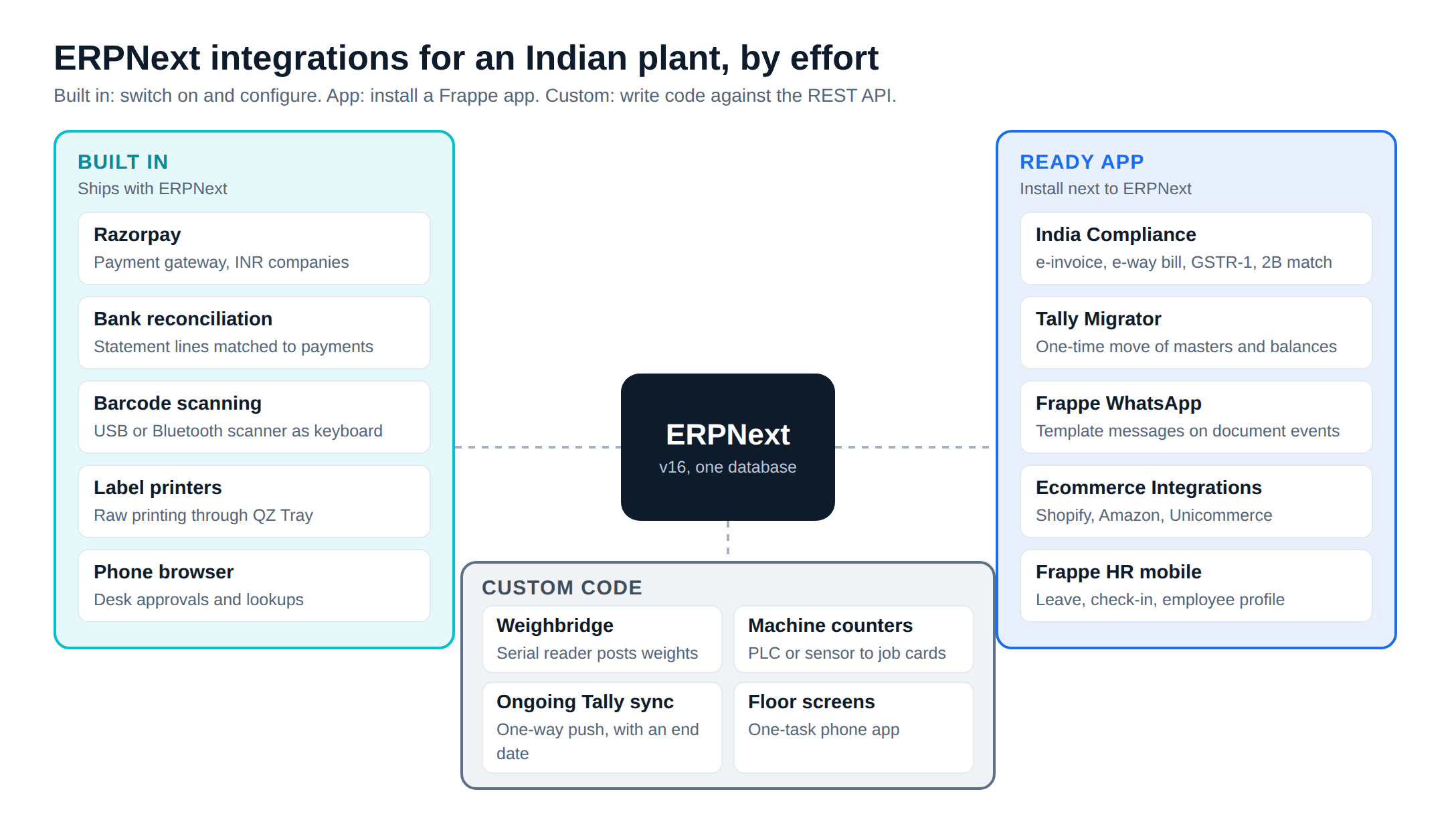
- Every ERPNext integration falls into one of three levels: built into ERPNext, a ready Frappe app you install, or custom code. Price each one at its level.
- GST e-invoicing, e-way bills, GSTR-1 and purchase reconciliation come from the free India Compliance app. The government API calls use credits, bundled on Frappe Cloud.
- Razorpay, barcode scanning and label printing are built in. Shopify, Amazon, Unicommerce and WhatsApp are free apps from Frappe or the community.
- Weighbridges, machine counters and any ongoing sync back to Tally are custom work. Each one needs a written spec before anyone quotes it.
Free ERPNext fit check
Will ERPNext fit your factory?
Answer a few quick questions. On a short call we tell you whether ERPNext fits how you make, stock and sell, and what the rollout looks like.
Check my fit →ERPNext integration: built in, app or custom
Any connection you want ERPNext to make lands on one of three levels.
- Built in: the feature ships with ERPNext. You switch it on and fill in settings: API keys, accounts, print formats. Effort is setup and testing.
- A ready app: someone has already written it as a Frappe app, and you install it next to ERPNext. Frappe maintains some; others are community or paid apps on the Frappe Cloud Marketplace. Effort is installing, configuring and checking that the app supports your ERPNext version.
- Custom: nothing exists, so a developer writes it, usually as a small Frappe app using ERPNext's REST API and webhooks, which send an HTTP request to another system when a document event fires. Effort is design, code, error handling and upkeep at every upgrade.
The level matters more than the brand name on the other end. A WhatsApp message on order submit is an app plus a template. A weighbridge that writes the net weight onto a Purchase Receipt is custom, however simple it sounds.
GST compliance through the India Compliance app
GST is the integration every Indian plant needs, and it does not ship in ERPNext core. It comes from India Compliance, a free GPL-3.0 app. Its README lists GSTR-1 preparation, invoice management for GSTR-3B, purchase reconciliation against GSTR-2A and GSTR-2B, e-invoice and e-way bill generation through the government portals, and GSTIN verification.
E-invoice in ERPNext
The India Compliance e-invoice guide says the e-invoice is generated automatically when you submit a Sales Invoice, if e-invoicing applies to you, and the IRN and QR code are written back to the invoice. Whether it applies depends on turnover. Since 1 August 2023, e-invoicing covers businesses whose aggregate turnover exceeded ₹5 crore in any financial year from 2017-18, under Notification 10/2023-Central Tax, with exemptions for SEZ units, banks, insurers, government departments and a few others (EY summary of the notification). There is also a time limit: a GSTN advisory says that from 1 April 2025, taxpayers with an annual aggregate turnover of ₹10 crore or more cannot report an invoice, credit note or debit note on the IRP more than 30 days after its date. Below ₹10 crore, the advisory sets no limit for now.
E-way bill
The e-way bill guide says an e-way bill can be generated automatically when a Sales Invoice is submitted, if that option is on in GST Settings. From a Delivery Note it is generated by hand from the e-Waybill menu, and vehicle details can be updated later. Under Rule 138 of the CGST Rules, a registered person moving goods worth more than ₹50,000 must furnish an e-way bill, with the value including tax, and nothing stops you generating one below that (GST Council flyer on e-way bills). Ask your accountant about the exceptions for your goods and routes.
API credits
The government API calls cost money. The India Compliance Account page says one credit equals one API request, new users get 500 free credits valid for three months, and purchases start at 1,000 requests a year, sold in multiples of 1,000 and valid for a year. Sites hosted on Frappe Cloud get the API features bundled, with no purchase needed. Our post on ERPNext pricing in India puts this next to the other running costs.
Effort level: an app, and the most important one to set up early, because it changes the tax templates, party masters and print formats used by every other integration.
ERPNext and Tally: living with both during the move
There is no standard, maintained live sync between ERPNext and Tally, so treat Tally as two separate jobs.
The one-time move is an app. The Tally Migrator imports masters and opening balances from a Tally XML export. Our Tally to ERPNext migration guide covers what it moves, what stays behind and how to run the cut-over weekend.
An ongoing bridge is custom. A plant may want the accountant to keep filing from Tally for a quarter while stores and production move to ERPNext. That means a one-way push of invoices and payments from ERPNext into Tally. TallyPrime accepts data through its XML interface, but its integration prerequisites say TallyPrime must be running on a port with at least one company loaded. So the bridge depends on a desktop being switched on, and every ledger and voucher type needs a mapping. Keep it one-way, ERPNext to Tally, so there is one source of truth, and give it an end date tied to the first closing cycle that agrees.
ERPNext WhatsApp integration for orders and reminders
Order confirmations, dispatch notices with the invoice PDF, and payment reminders are the common asks. Frappe WhatsApp is a free, MIT-licensed app on the Frappe Cloud Marketplace, listed for versions 14, 15 and 16. Its repository says it uses Meta's WhatsApp Cloud API directly, manages templates, and sends notifications on document events such as submit or save, on a schedule or by date, with print PDFs attached.
Two things sit outside the app. First, Meta approves every template before you can use it, and business-initiated messages must use a template. Second, Meta charges for each delivered message, by category (marketing, utility, authentication, service) and by the recipient's country, per its pricing page. Which categories are free inside a customer service window has changed more than once, so check the current rate card before you budget for reminders.
Effort level: an app, plus template design and a Meta business account in your company's name.
Payments: Razorpay and bank reconciliation
Razorpay is built in. The ERPNext Razorpay guide says you enter the API key and secret in RazorPay Settings, and ERPNext creates a Payment Gateway record and a bank-type account for it. A Payment Request can then carry a payment link to the customer. It works only for companies whose currency is INR. The gateway code lives in Frappe's Payments app, which also holds Stripe, PayPal, Braintree and PayTM.
Bank reconciliation is built in too. The Bank Transaction page says statement lines can come in from a supported integration, a statement import, Data Import or the API. The Bank Reconciliation tool then matches each line to a Payment Entry or Journal Entry. The simple setup for a plant is a weekly or monthly statement file from the bank, imported and matched. The documentation names no ready feed for Indian banks, so a live feed is custom work.
Both are built in, so the work here is setup and a few test payments.
ERPNext Shopify integration and marketplaces
The Shopify connector moved out of ERPNext core into Frappe's Ecommerce Integrations app, which also covers Unicommerce, Amazon and Zenoti. At the time of writing the repository has version-15 and version-16 branches and recent commits. The Shopify guide says the connector pulls Shopify orders in as Sales Orders, creates missing customers and items, pushes stock levels from ERPNext to Shopify every hour, and treats ERPNext as the source of truth for inventory. Shopify does not support fractional quantities, so ERPNext rounds them down.
For marketplaces, the Unicommerce guide describes a two-way integration: items both ways, stock from ERPNext, orders and cancellations in, returns as draft credit notes, and shipping manifests. The Amazon guide says orders come in as Sales Orders, matched on ASIN or SKU, but cancellations are not handled, so you cancel those by hand in ERPNext.
Effort level: an app. Check that your ERPNext version has a supported branch before you plan around it.
The shop floor: weighbridges, barcodes, printers and machines
Barcode scanners
Barcode scanning is built in. The barcode guide says you store barcodes on the Item, including different barcodes per unit of measure (a single piece and a box), and that scanning works in Delivery Note, Sales Invoice, Purchase Receipt and Stock Reconciliation. A USB or Bluetooth scanner acts like a keyboard, so it needs no driver work.
Label printers
Label printing is built in too. ERPNext's raw printing sends commands straight to a printer in its own language through QZ Tray, a small program installed on the computer the printer is plugged into. Any string-based printer language works, so a thermal label printer is a print format written with the maker's command manual. The printer mapping is stored on each computer, so set it up at every station.
Weighbridges
A weighbridge link is custom. We found no maintained open-source weighbridge app for ERPNext. One workable design is a small program on the weighbridge PC that reads the indicator's serial output and posts gross, tare and net weight to ERPNext over the REST API, against a gate entry or Purchase Receipt. Picture a plastics plant buying granules by the truck: the spec has to say which document the weight lands on, who can override it, and what happens when the network drops mid-weighment.
Machine counters
Machine counters are custom as well. ERPNext's Plant Floor view shows workstation status and gives a visual way to process job cards. Feeding it counts from a PLC or a sensor is the same pattern as the weighbridge: a small collector on the floor that posts to the API. Our production planning guide explains the work orders and job cards those counts would update.
ERPNext mobile app: what exists and what is custom
ERPNext's desk runs in a phone browser. For a manager approving a purchase order or checking a customer's balance, that is often enough, with nothing to install.
Frappe HR, Frappe's separate HR app, lists a mobile app for applying for and approving leave, check-in and check-out, and the employee profile. Its source builds it as a progressive web app, which you add to the phone's home screen from the browser.
For stores and the shop floor, the full desk shows too much on a phone. A screen built for one task (scan, count, submit) is custom: a small web app on the same Frappe stack, installed to the home screen in the same way. Paid third-party options exist too. Appe, for example, is listed on the Frappe Cloud Marketplace as a paid app for building Android and iOS apps on Frappe. We have not tested it, so check it against your own screens.
How to scope an integration
A quote can only price what the spec describes. Before anyone prices an integration, write down:
- The trigger: which document and which event (submit, save, a schedule) starts it.
- The direction: one-way or two-way, and which system wins when the two disagree.
- The fields: what maps to what, including GSTIN, HSN code, unit of measure and warehouse.
- The level: built in, an existing app (with its repository and supported versions), or custom.
- Failure handling: what happens when the other side is down, who gets alerted, and how a failed record is retried.
- Volumes: records a day, and the peak (month-end, festive season).
- Ownership: API keys, Meta and payment accounts in your company's name, and custom code in your own Git repository.
- Upgrades: who tests the integration when ERPNext moves to the next major version.
- A trial: run each integration on a test site with real sample data before go-live.
Integrations are one of the six things that move an ERPNext quote, as our implementation cost guide explains. Our ERPNext implementation for manufacturers starts with a written scope that lists each integration at its level, so you know what is configuration and what is code before setup begins.
Frequently asked questions
Does ERPNext integrate with Tally?+
There is no standard live sync between the two. For the move itself, the open-source Tally Migrator app imports masters and opening balances from a Tally XML export. If accounts must keep working in Tally for a while, a one-way push from ERPNext to Tally is custom work: TallyPrime accepts data over its XML interface, but its developer documentation says TallyPrime must be running on a port with a company loaded. Keep any such bridge short-lived and give it an end date.
Can ERPNext generate GST e-invoices and e-way bills?+
Yes, through the free India Compliance app. Its documentation says an e-invoice is generated automatically when you submit an invoice, with the IRN and QR code written back to it, and an e-way bill can be generated on submit if you turn that on in GST Settings. The government API calls use credits: sites on Frappe Cloud get them bundled, and self-hosted sites buy them from an India Compliance Account.
Is there a WhatsApp integration for ERPNext?+
Yes. Frappe WhatsApp is a free, MIT-licensed app listed on the Frappe Cloud Marketplace for versions 14, 15 and 16. It connects to Meta's WhatsApp Cloud API directly and can send template messages on document events, such as an order confirmation when a Sales Order is submitted. You need your own Meta business account, and Meta approves each template and charges per delivered message.
Does ERPNext have a mobile app?+
ERPNext itself runs in a phone browser, so a manager can approve or look up a document without installing anything. Frappe HR, the separate HR app, ships a mobile app for leave, check-in and the employee profile, built as a web app you add to the home screen. For stores or the shop floor, a small screen built for one task is custom work, or you can look at paid third-party apps on the Frappe Cloud Marketplace.
Related reading
- Moving from Tally to ERPNext: masters, GST ledgers and the cut-over weekend.
- ERPNext pricing in India: hosting, support and e-invoice credits after go-live.
- ERPNext production planning: BOMs, MRP, work orders and job cards.
- E-invoicing from your ERP: IRN, e-way bills and what a plant should automate.
Free ERPNext fit check
Will ERPNext fit your factory?
Answer a few quick questions. On a short call we tell you whether ERPNext fits how you make, stock and sell, and what the rollout looks like.
Check my fit →About the author

- Tags
- erpnext
- erp
- manufacturing
- india
- integrations
Subscribe to Our Newsletter
The AI Build Brief: practical playbooks on how to build, price and ship AI features, in one short email every other week.