

ITC-04 is the GST form that shows where your material is while a job worker has it. Job work under GST lets a registered manufacturer send inputs and capital goods to a printer, moulder, plater or machine shop without paying tax, provided the goods come back, or are sold from the job worker's premises, within set time limits and the challans are reported. Miss either part and the law treats the material as sold to the job worker on the day it left. This is general information, not tax advice: confirm your own case with your chartered accountant.
TL;DR
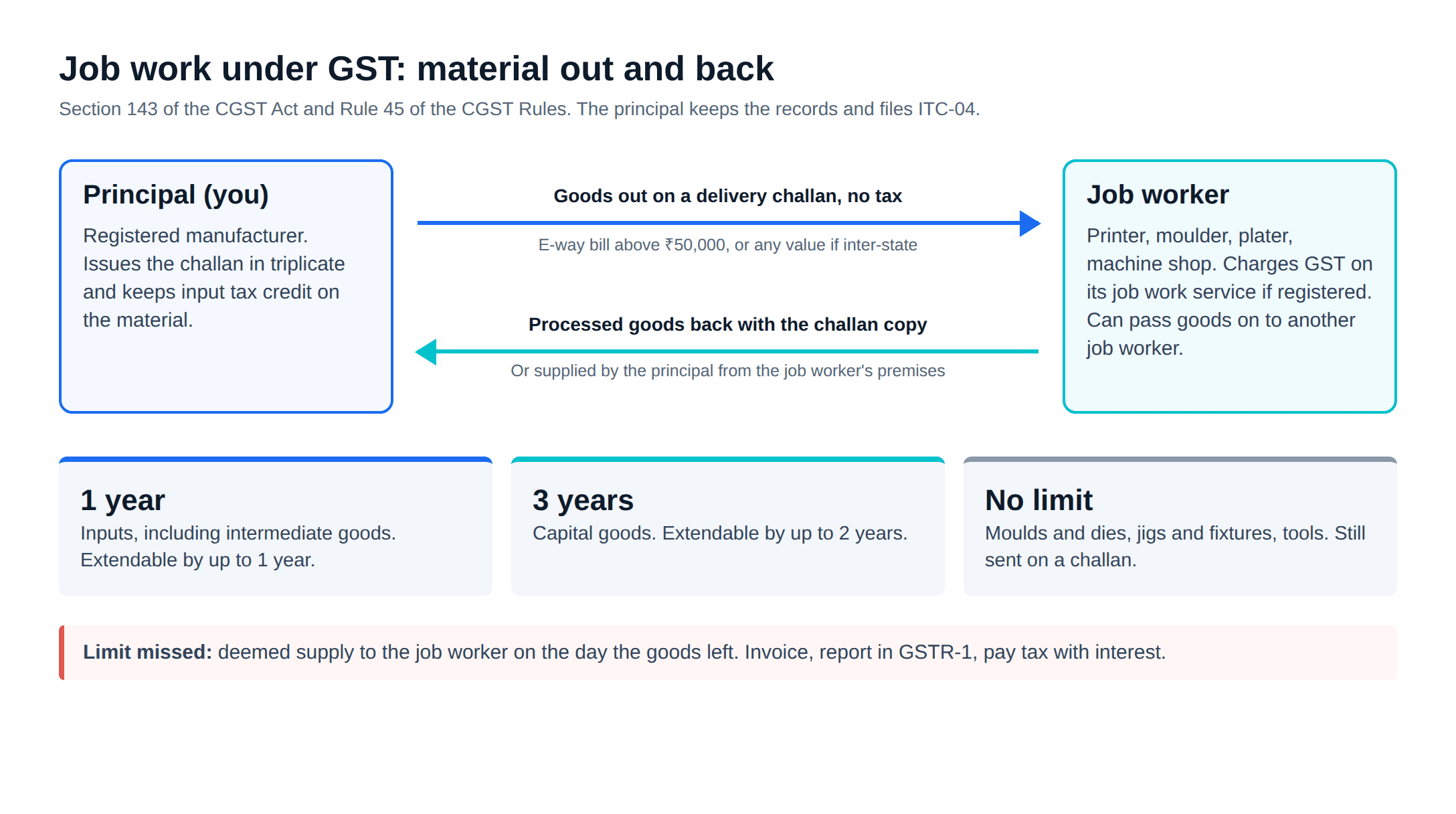
- Section 143 of the CGST Act lets a registered principal send inputs and capital goods to a job worker without tax, on a delivery challan issued under Rule 45 of the CGST Rules.
- Inputs must come back, or be supplied from the job worker's premises, within one year; capital goods within three. Moulds, dies, jigs, fixtures and tools have no limit. Miss the limit and it is a deemed supply from the day the goods left, with interest.
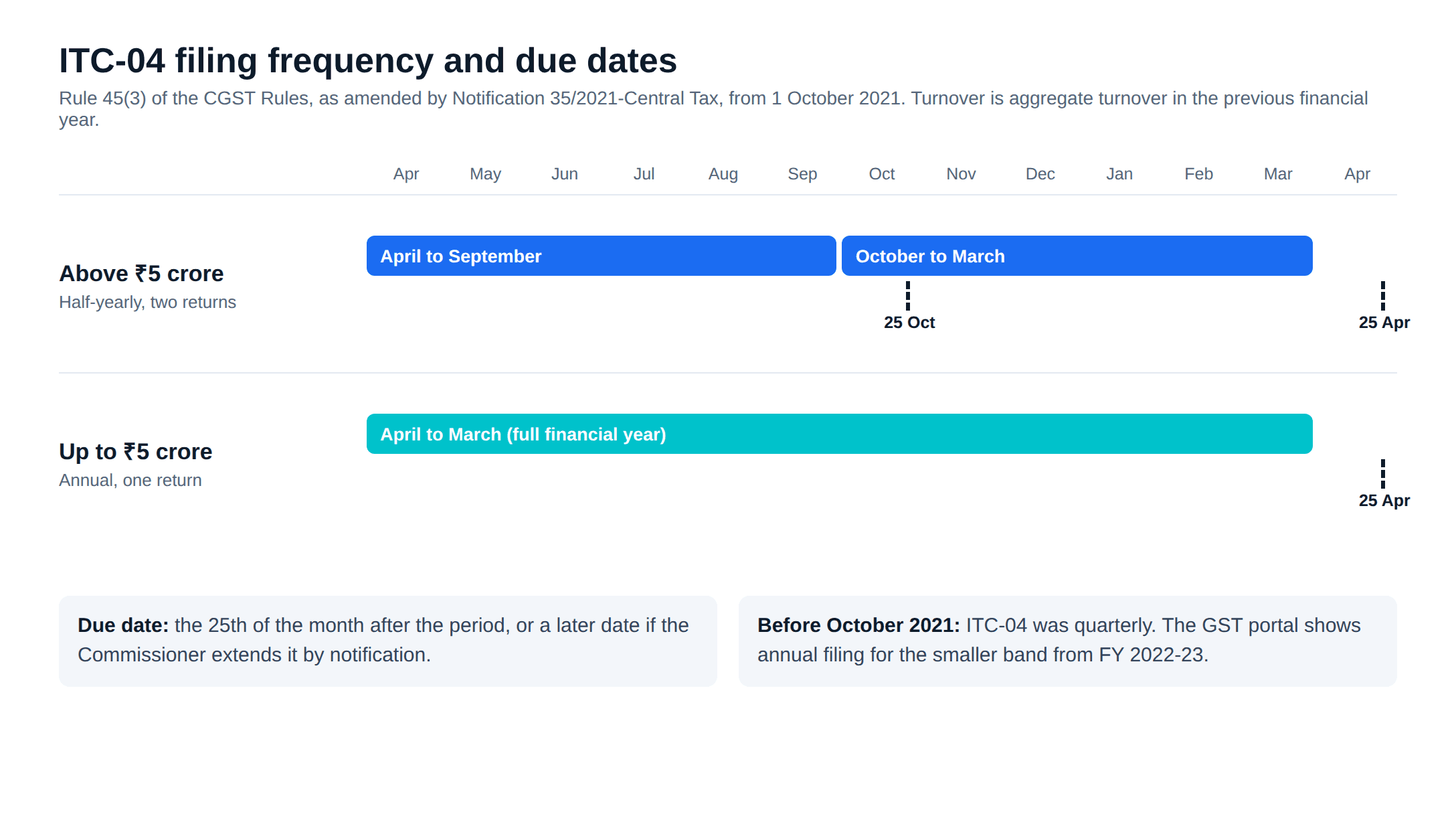
- Since 1 October 2021, ITC-04 is half-yearly (due 25 October and 25 April) if your previous year's aggregate turnover was above ₹5 crore, and annual (due 25 April) otherwise.
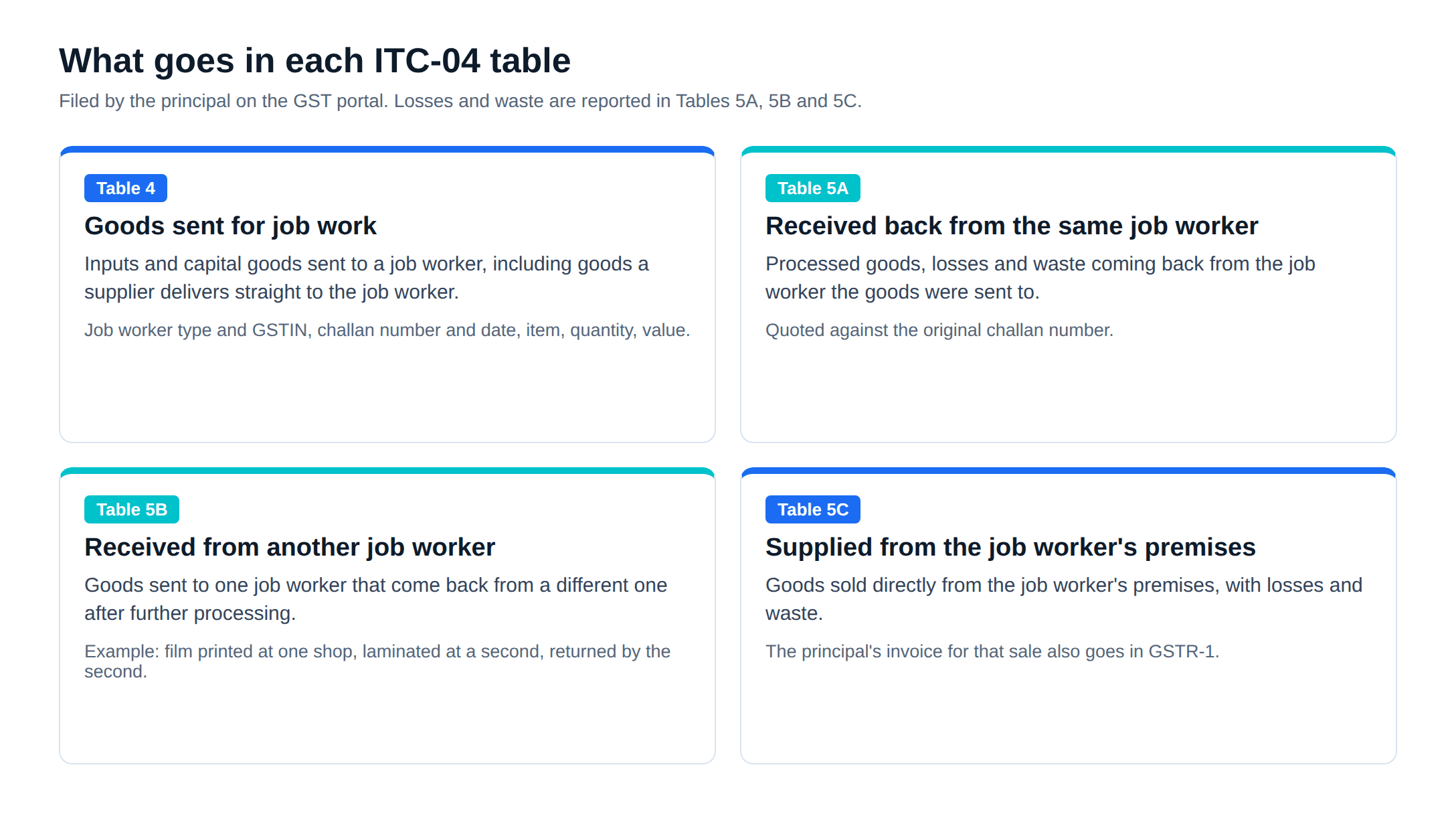
- The return has four tables: goods sent (4), received back from the same job worker (5A), received from another job worker (5B) and supplied from the job worker's premises (5C).
- ERPNext tracks job work with Subcontracting Orders and Receipts; the free India Compliance app exports Tables 4 and 5A as ITC-04 JSON. TallyPrime uses Material Out and Material In vouchers.
Free ERPNext fit check
Will ERPNext fit your factory?
Answer a few quick questions. On a short call we tell you whether ERPNext fits how you make, stock and sell, and what the rollout looks like.
Check my fit →What counts as job work under GST
Section 2(68) of the CGST Act defines job work as "any treatment or process undertaken by a person on goods belonging to another registered person". The owner of the goods is the principal. Printing your film, moulding your granules or plating your machined parts all count, as long as the goods stay yours.
CBIC's job work circular 38/12/2018-GST adds three points:
- Only a registered person can use the Section 143 procedure, and using it is optional.
- The job worker can add its own materials, such as ink or plating chemicals, and it can still be job work, depending on the facts.
- The job worker charges GST on its service if it is liable to register, which depends on the normal turnover threshold, even when the principal is in another state.
Sending material out: the challan and the e-way bill
Material goes to the job worker on a delivery challan, not an invoice. Rule 45(1) of the CGST Rules says inputs, semi-finished goods and capital goods move "under the cover of a challan issued by the principal", including when a supplier ships straight to the job worker. Rule 55 lists what the challan must carry: a serial number of up to 16 characters, the date, both parties' names, addresses and GSTINs, HSN code and description, quantity, taxable value, place of supply for inter-state movement, and a signature.
The circular sets out how the paper moves:
- Principal to job worker: prepare the challan in triplicate and send two copies with the goods. The job worker returns one copy with the processed goods.
- Job worker to another job worker: the goods can move on a fresh challan from either party, or on the principal's challan endorsed with the quantity and description.
- Piecemeal returns: when the job worker sends goods back in lots, the original challan cannot be endorsed and the job worker issues a fresh challan for each lot.
- Supplier ships straight to the job worker: the supplier's invoice is in the principal's name with the job worker as consignee, and the principal still issues its own Rule 45 challan to the job worker.
Per the circular's reading of Rule 138, an e-way bill is needed above ₹50,000 of consignment value, and for inter-state job work at any value. Under Section 19, the principal keeps its input tax credit on material sent for job work, including material delivered straight to the job worker.
The one-year and three-year limits
Section 143(1) gives the principal two ways to close out a challan: bring the goods back to any of its places of business, or supply them from the job worker's premises (on payment of tax, or for export). It has one year to do this for inputs, including intermediate goods made from them, and three years for capital goods.
Moulds and dies, jigs and fixtures, and tools are carved out of both limits, so a plant can leave its mould at a moulder's shop for as long as the work runs. The Commissioner can also extend the limits, "on sufficient cause being shown", by up to one year for inputs and two years for capital goods. Where inputs or capital goods go directly from the supplier to the job worker, Section 19 starts the clock on the date the job worker receives them.
When the limit passes, Section 143(3) and (4) deem the goods to have been supplied by the principal to the job worker on the day they were sent out. Rule 45(4) and the circular spell out what follows: the principal raises an invoice, declares it in GSTR-1 for the month the limit expired, and pays the tax with interest from the original dispatch date. If the job worker returns the goods after that, the circular treats the return as a fresh supply by the job worker to the principal.
Who files the ITC-04 return, and how often
The principal files ITC-04, not the job worker. Rule 45(3) requires it to report the challans for goods sent to a job worker, received back, or moved between job workers. The circular calls ITC-04 the "intimation" Section 143 asks for.
The frequency changed in 2021. Notification 35/2021-Central Tax replaced "quarter" with "specified period" in Rule 45(3) from 1 October 2021, and defined it by turnover:
| Aggregate turnover in the previous financial year | Period | Due date |
|---|---|---|
| Above ₹5 crore | April to September | 25 October |
| Above ₹5 crore | October to March | 25 April |
| Up to ₹5 crore | April to March (full year) | 25 April |
The due date is the 25th of the month after the period, "or within such further period as may be extended by the Commissioner". The GST portal's ITC-04 guide says the form was quarterly until September 2021, with annual filing for the smaller band from FY 2022-23. Older articles, and the 2018 circular, still say quarterly.
Late filing: Section 47's late fee covers the returns under Sections 37, 38, 39, 44 and 45, and ITC-04 is not among them. Section 125 sets a general penalty of up to ₹25,000 for breaches with no penalty of their own. The bigger risk is the deemed supply on goods you cannot show coming back.
What goes in each ITC-04 table
Per the GST portal guide, the form has four tables you fill:
- Table 4: inputs and capital goods sent for job work, including goods sent directly to the job worker. You pick whether the job worker is registered and give its GSTIN if it is, then the challan number, date, item, quantity and value.
- Table 5A: goods received back from the job worker they were sent to, including losses and waste, against the original challan.
- Table 5B: goods received back from a job worker other than the one they were first sent to, again with losses and waste.
- Table 5C: goods supplied from the job worker's premises, with losses and waste. The portal notes that the principal's invoice for that supply also has to go in GSTR-1.
Filing is online on the GST portal. An offline tool takes uploads when you have more than 500 challans.
Common job work and ITC-04 mistakes
Where job work records go wrong
- Scrap sold by an unregistered job worker. Section 143(5) lets only a registered job worker supply waste and scrap from its own premises, on payment of tax. If the job worker has no GSTIN, the principal supplies the scrap.
- Selling straight from an unregistered job worker's shop. The proviso to Section 143(1)(b) says you can supply from the job worker's premises only if the job worker is registered, you declare those premises as your additional place of business, or the goods are of a notified kind.
- Challans that do not match. A return quoted against the wrong challan number, a lot returned on an endorsed challan when it needed a fresh one, or a quantity in kilograms out and pieces back will not reconcile in Tables 4 and 5A.
- Process loss left off. Losses and waste belong in Tables 5A to 5C. Without them the challan never closes, and the open balance looks like material still at the job worker.
- Nobody watching the clock. Slow-moving material passes the one-year mark quietly, and the deemed supply dates back to the day it left.
How a plant tracks job work in practice
The law puts record-keeping on the principal: Section 143(2) says "the responsibility for keeping proper accounts for the inputs or capital goods shall lie with the principal." In practice that means a register, by job worker and challan, showing what went out, what came back (as product, scrap or loss), what is still out, and when each open challan hits its limit.
Issue the challan
Keep stock by job worker
Receive against the challan
Age the open challans
File from the register
Picture a packaging plant that sends printed film to a laminator and on to a slitter: three movements, a process loss at each step, and a final return from a job worker other than the first (Table 5B). A spreadsheet can carry that for a handful of jobs, but not for dozens of open challans across several job workers.
Job work (subcontracting) in ERPNext
ERPNext calls job work subcontracting. The ERPNext subcontracting guide describes the flow for v16:
- A Subcontracted Purchase Order for the service, priced at the job charge rather than the material.
- A Subcontracting Order created from it, which fills in the raw materials to supply from the item's BOM. In v16, one purchase order can be split across several subcontracting orders, and the raw materials can be reserved.
- A Stock Entry of type "Send to Subcontractor", which moves the material from your store to a warehouse kept for that supplier. That warehouse balance is your stock at the job worker.
- A Subcontracting Receipt, which brings the processed goods in and records the material consumed at the supplier's warehouse. Scrap items from the BOM appear on the receipt with their quantity and rate.
The free, open-source India Compliance app adds the GST layer: GST details and e-way bills on these stock entries and receipts, and a GST Job Work Stock Movement report with two views, "Sent for Job Work (Table 4)" and "Received back from Job Worker (Table 5A)". Its "Export JSON" button downloads the data in ITC-04 format, and warns you that it will skip any Table 5A row missing its original challan number. Tables 5B and 5C are not in the report, so those entries go in on the portal.
The subcontracting flow sits on the same BOMs that drive production planning, which our posts on ERP for plastics manufacturers and ERPNext production planning with BOM and MRP cover.
Job work in Tally Prime
TallyPrime also handles job work. Per Tally's setup guide, you turn on "Enable Job Order Processing" under company features (F11) and activate the Material Out and Material In voucher types. Its principal manufacturer guide then describes:
- a Job Work Out Order for the work given to the job worker, with items, quantities and a due date;
- a Material Out voucher for material sent against the order, and a Material In voucher for goods received back, with the job worker's challan number;
- reports including Stock With Job Worker, Material Movement Register (with columns for scrap, by-products and wastage) and Stock Ageing Analysis.
The Tally job work pages we read do not describe an ITC-04 export or a warning tied to the one-year limit, so ask how your version produces the return. As our ERPNext vs Tally comparison explains, Tally records job work as inventory vouchers, while ERPNext ties it to the BOM, the purchase order and the production plan.
Getting job work under control
A quick check for any system: can you list every open challan by job worker, with its age, in under a minute? If you want that list to come from the same records as your stock and production, ERPNext implementation for manufacturers explains how we set up subcontracting, supplier warehouses and the India Compliance reports for a plant, starting with a written scope.
Frequently asked questions
Who has to file ITC-04?+
The principal: the registered manufacturer that sends inputs or capital goods to a job worker under Section 143 of the CGST Act. The job worker does not file it. Rule 45(3) of the CGST Rules requires the principal to report the challans for goods sent out, received back or moved between job workers in each period, and CBIC's job work circular says ITC-04 serves as the intimation Section 143 asks for.
What is the due date for ITC-04?+
Since 1 October 2021, a principal whose aggregate turnover in the previous financial year was above 5 crore rupees files twice a year: April to September by 25 October, and October to March by 25 April. Everyone else files once a year, for April to March, by 25 April. The Commissioner can extend these dates by notification, so check the GST portal for the period you are filing.
What happens if job work goods are not returned within one year?+
Under Section 143(3), inputs that are neither brought back nor supplied from the job worker's premises within one year are deemed to have been supplied by the principal to the job worker on the day they were sent out. The principal raises an invoice, reports it in GSTR-1 and pays the tax with interest from the original date. Capital goods get three years. Moulds, dies, jigs, fixtures and tools have no time limit, and the Commissioner can extend the limits by up to one and two years on sufficient cause.
Can the job worker sell the scrap?+
Yes, if the job worker is registered. Section 143(5) lets a registered job worker supply waste and scrap generated during the job work directly from its own premises on payment of tax. If the job worker is not registered, the principal must supply it. Either way, record the scrap and process loss against the challan so the quantities in ITC-04 still add up.
Related reading
- ERPNext vs Tally for manufacturers: where Tally stops being enough.
- ERP for plastics manufacturers: resin, regrind, machines and job work.
- ERPNext production planning with BOM and MRP: the BOMs subcontracting runs on.
- E-invoicing from your ERP: IRN, e-way bills and what a plant should automate.
Free ERPNext fit check
Will ERPNext fit your factory?
Answer a few quick questions. On a short call we tell you whether ERPNext fits how you make, stock and sell, and what the rollout looks like.
Check my fit →About the author

- Tags
- erpnext
- erp
- manufacturing
- india
- gst
Subscribe to Our Newsletter
The AI Build Brief: practical playbooks on how to build, price and ship AI features, in one short email every other week.