
Picture a 60-person plant in Rajkot or Pune that has outgrown Tally and three spreadsheets, and now has six ERP names on a whiteboard. Which is the best ERP for manufacturing at that size? This post compares ERPNext, Odoo, SAP Business One, Microsoft Dynamics 365 Business Central, Zoho ERP and TallyPrime on what a 10-200 person Indian plant needs: BOMs, work orders, job work, batches, GST and a licence bill that does not grow out of control with headcount. Metageeks implements ERPNext, so weigh our view with that in mind. We do not sell the other five. Every claim about them links to the vendor's own pricing or documentation page, and prices are list prices at the time of writing.
TL;DR
- For a plant that needs BOMs, job cards, subcontracting, batches and GST without a per-user fee, ERPNext is the default we would start a trial with. Its cost is hosting, implementation and support.
- Odoo Enterprise documents the deepest planning tools here, such as finite-capacity scheduling, but full Accounting, Quality and GST returns sit in its paid edition, priced per user.
- Business Central puts manufacturing in its Premium plan at ₹9,150 per user per month billed yearly, and its India e-invoice feature exports a JSON file rather than filing with the portal. SAP does not publish a Business One price for India that we could find.
- Zoho ERP, launched in India in January 2026, lists manufacturing orders, work centres and quality inspections from ₹999 per user per month. Zoho Books alone has no manufacturing module.
- TallyPrime is accounting with inventory, not an ERP. Keep it if your stock and production already fit inside it.
Free ERPNext fit check
Will ERPNext fit your factory?
Answer a few quick questions. On a short call we tell you whether ERPNext fits how you make, stock and sell, and what the rollout looks like.
Check my fit →Best manufacturing ERP software for Indian plants, at a glance
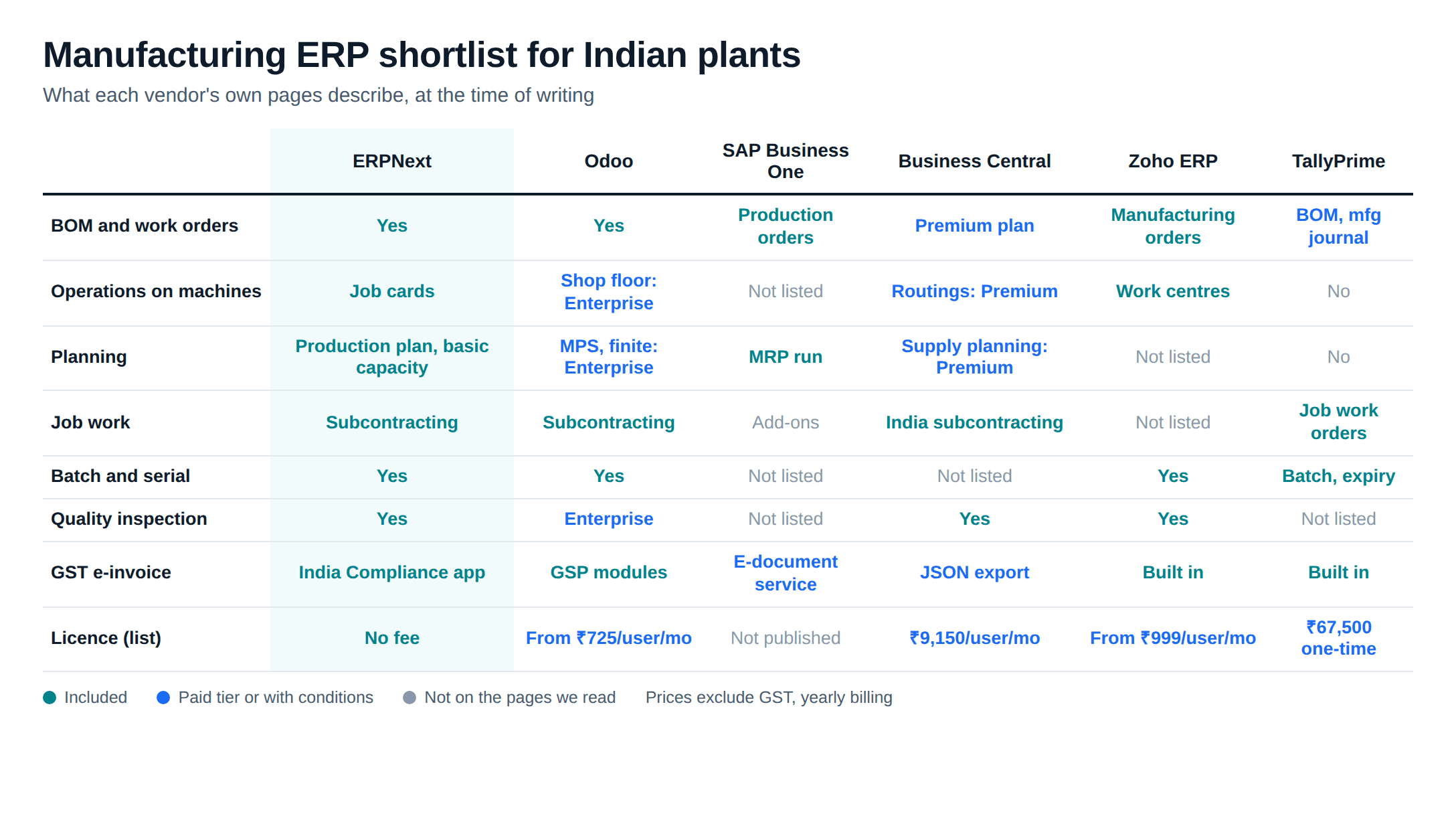
This table reads each product's own pages against a typical 10-200 person plant, the size where manufacturing software for a small business starts to need more than accounting. Treat it as the starting point for a trial, not a verdict.
| Product | What it is | Manufacturing depth | Licence model (list price) | Best fit |
|---|---|---|---|---|
| ERPNext | Open-source ERP, GPL-3.0 | BOMs, work orders, job cards, subcontracting, batches, quality inspection | No licence fee; hosting from ₹410 a month | Job shops and process plants that want to own the system and the data |
| Odoo | Open core: free Community, paid Enterprise | Deepest documented planning; Quality, PLM and shop floor are Enterprise | ₹725 per user per month (Standard, yearly, after year one) | Plants that need finite scheduling or one vendor for ERP, web store and POS |
| SAP Business One | SAP's ERP for smaller firms | Production orders from BOMs, MRP run | No India list price published | Groups that already run SAP, or whose customers expect it |
| Business Central | Microsoft cloud ERP | BOMs, routings, production orders, planning, subcontracting (Premium) | ₹9,150 per user per month (Premium, yearly) | Companies on Microsoft 365 with budget for per-user licences |
| Zoho ERP | Zoho's ERP, India launch January 2026 | Manufacturing orders, work centres, shop floor, quality inspections | ₹999 or ₹2,499 per user per month (yearly), minimum 5 users | Zoho users who want manufacturing in the same suite |
| TallyPrime | Accounting with inventory | BOM, manufacturing journal, job work orders, batches | ₹67,500 one-time (Gold, multi-user) | Plants whose production is still simple |
If you are still deciding whether the plant needs an ERP at all, start with our guide to ERP for manufacturing in India.
ERPNext: full manufacturing with no licence fee
ERPNext is published under GPL-3.0, with no paid edition. A Work Order releases a BOM to the floor, Job Cards record each operation, and a Production Plan turns sales orders into work orders and material requests. Subcontracting covers job work, with stock sent to the supplier's warehouse and backflushed on receipt. Batches carry expiry dates, and quality inspections run at receipt, in process and at delivery.
GST e-invoices, e-way bills and return preparation come through the free India Compliance app, whose government API calls use credits. Hosting on Frappe Cloud starts at ₹410 a month for a shared site and ₹3,600 for a server, or you run it on your own machine.
The weak spot is planning. ERPNext's capacity planning places operations on workstations against their working hours, with no optimiser that resequences jobs. Our production planning walkthrough shows the chain end to end, and ERPNext pricing in India sets out the running costs.
Odoo has the deepest planning, mostly in the paid edition
Odoo has a free Community edition under LGPL-3 and a paid Enterprise edition. Odoo's editions page lists Manufacturing, Inventory, Purchase and Maintenance in both, and puts full Accounting, Quality, PLM, Barcode and the "Shopfloor, Control Panel, Scheduling" line in Enterprise only. Its manufacturing page describes finite-capacity planning on Gantt charts, which no other product on this list documents as clearly.
At the time of writing, Odoo's India pricing page lists Standard at ₹580 per user per month for the first 12 months and ₹725 after, billed yearly, and Custom at ₹1,080 and then ₹1,350. Custom is the plan with Studio, multi-company and custom modules. India e-invoicing and e-way bills run through Odoo's own localisation modules and a GSP that the documentation names.
We compared the two open-source options head to head, with a five-year cost table, in ERPNext vs Odoo for Indian manufacturers.
SAP Business One is sold through resellers
SAP's learning course on production describes production orders that copy the BOM and track material and cost, and an MRP run that recommends what to make and buy. For India, SAP's knowledge base article 3318208 collects the localisation documents on GST, TDS, TCS, the e-way bill and electronic billing, and SAP's e-billing guide says the feature depends on the Electronic Document Service being installed and set up.
We did not find a native job work feature in SAP's Business One help. Third-party add-ons such as ProcessForce document their own subcontracting flows, so ask the reseller whether your job work needs one. SAP publishes no Business One price for India that we could find, so ask the reseller to quote licence, add-ons and services as separate lines.
Microsoft Dynamics 365 Business Central keeps manufacturing in Premium
Microsoft's manufacturing overview covers production BOMs, routings, work and machine centres, production orders, supply planning and subcontracting, and says these features "are available only if you have the Premium experience". The India pricing page lists Premium at ₹9,150 per user per month and Essentials, which has no manufacturing, at ₹6,655, both paid yearly with GST extra. Team Members, for light users, is ₹665.
The India localisation is broad: GST, TDS, TCS, gate entry and a subcontracting module with GST liability. E-invoicing is narrower. Microsoft's e-invoice page says you export the invoice as a JSON file and that "exporting the file doesn't submit the invoice to the tax authority". Filing with the portal needs an extension or a separate process, so budget for one. Custom changes are built as extensions in Microsoft's AL language.
Zoho ERP is new, and it is not Zoho Books
Zoho Books is accounting software, and its India pricing page lists no BOMs or work orders. In January 2026 Zoho introduced Zoho ERP in India, a separate product with a manufacturing vertical covering bills of materials and shop-floor execution.
Zoho ERP's pricing page lists Standard at ₹999 per user per month and Premium at ₹2,499, billed annually and excluding GST, with a minimum of five users and a lower ₹249 rate for employee seats. Both plans tick manufacturing orders, shop floor production, work centres, quality inspections, batch and serial tracking, and e-way bills. The page does not name job work, subcontracting or MRP. The product is months old, so ask Zoho to show a job work cycle and a planning run on a trial before you count on either.
TallyPrime is accounting with inventory, not an ERP
Tally's help pages describe bills of materials, manufacturing journals, job work orders, godowns, and batch and expiry tracking, with GST e-invoices and e-way bills built in. The buy page lists Gold, the multi-user licence, at ₹67,500 one-time.
What Tally does not do is run a work order through operations on machines, plan capacity, or turn sales orders into a production plan and a purchase list. If your plant needs those, look at a manufacturing ERP. If it does not, stay. Our Tally alternatives for manufacturers post covers the accounting-first options too, such as Busy and Marg.
What the licence costs at 25 users
Assumptions: 25 full users, list prices at the time of writing, yearly billing, regular price (no first-year discount), GST excluded. Licence only, so no implementation, training or support.
| Product and plan | Per user per month | Licence per year, 25 users |
|---|---|---|
| ERPNext | No licence fee | ₹0 (Frappe Cloud server ₹43,200 a year) |
| Odoo Standard | ₹725 | ₹2.18 lakh |
| Zoho ERP Standard | ₹999 | ₹3.00 lakh |
| Odoo Custom | ₹1,350 | ₹4.05 lakh |
| Zoho ERP Premium | ₹2,499 | ₹7.50 lakh |
| Business Central Premium | ₹9,150 | ₹27.45 lakh |
| SAP Business One | Not published | Reseller quote |
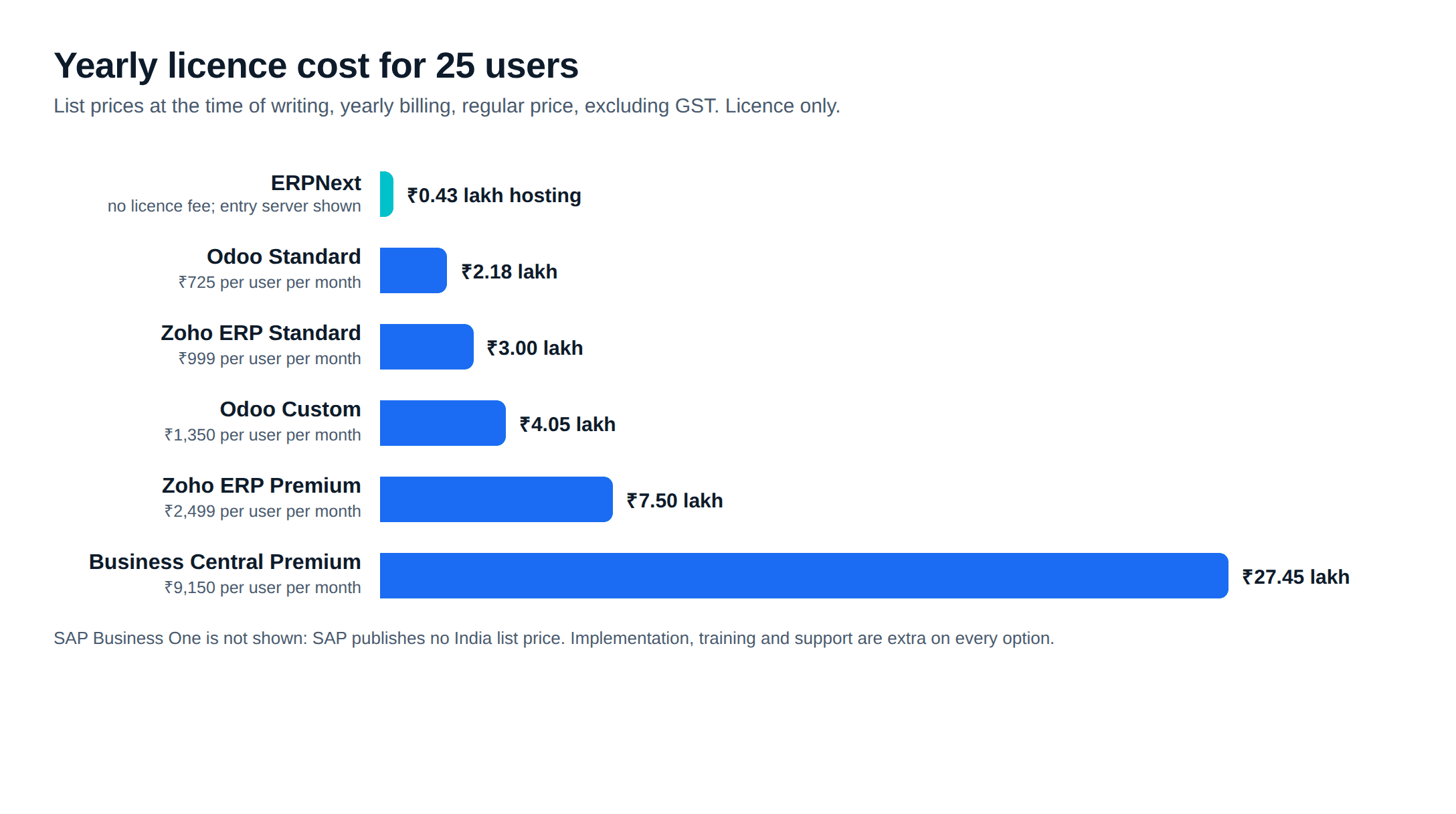
Two things change this arithmetic. Business Central's Team Members plan and Odoo's Light User cost far less, so count who only views or approves. And for ERPNext, the work is the cost, which ERPNext implementation cost in India sets out with sources.
GST, e-invoicing and e-way bills
E-invoicing applies to businesses whose aggregate turnover crossed ₹5 crore in any year from 2017-18, from 1 August 2023 under Notification 10/2023-Central Tax, with some sectors exempt. Every product here handles GST invoices. The difference is the last step:
- Files with the portal from inside the product: ERPNext through India Compliance, Odoo through its GSP, Zoho and TallyPrime built in, per their own pages.
- Exports a file for upload: Business Central's standard India feature, per Microsoft's own page.
- Depends on setup: SAP Business One, through the Electronic Document Service.
Whichever you pick, ask who holds the GSP credentials and who you call when the portal rejects an invoice. Our e-invoicing from your ERP post covers what to automate first.
Implementers, upgrades and who owns the data
Whatever you pick, ask the implementer for a reference plant with a similar process and the name of the consultant who will run yours.
Upgrades cost money wherever there is custom code. Odoo's upgrade documentation says making custom modules compatible with a new version is the maintainer's job. ERPNext has no upgrade fee, but Frappe's supported versions page shows each major version has an end-of-life date, and custom apps need testing before each move. Keep changes in a separate app or extension and budget for them at every major version.
On data, self-hosted ERPNext and Odoo Community give you the full database on your own server. With hosted subscriptions, ask in writing what export you get when you leave, and in what format. With Odoo Enterprise, the licence also ends the Enterprise apps when the subscription ends, per Odoo's licence page.
When ERPNext is not the right pick
Because we implement ERPNext, these are the cases where we would point a plant elsewhere. Pick something else if:
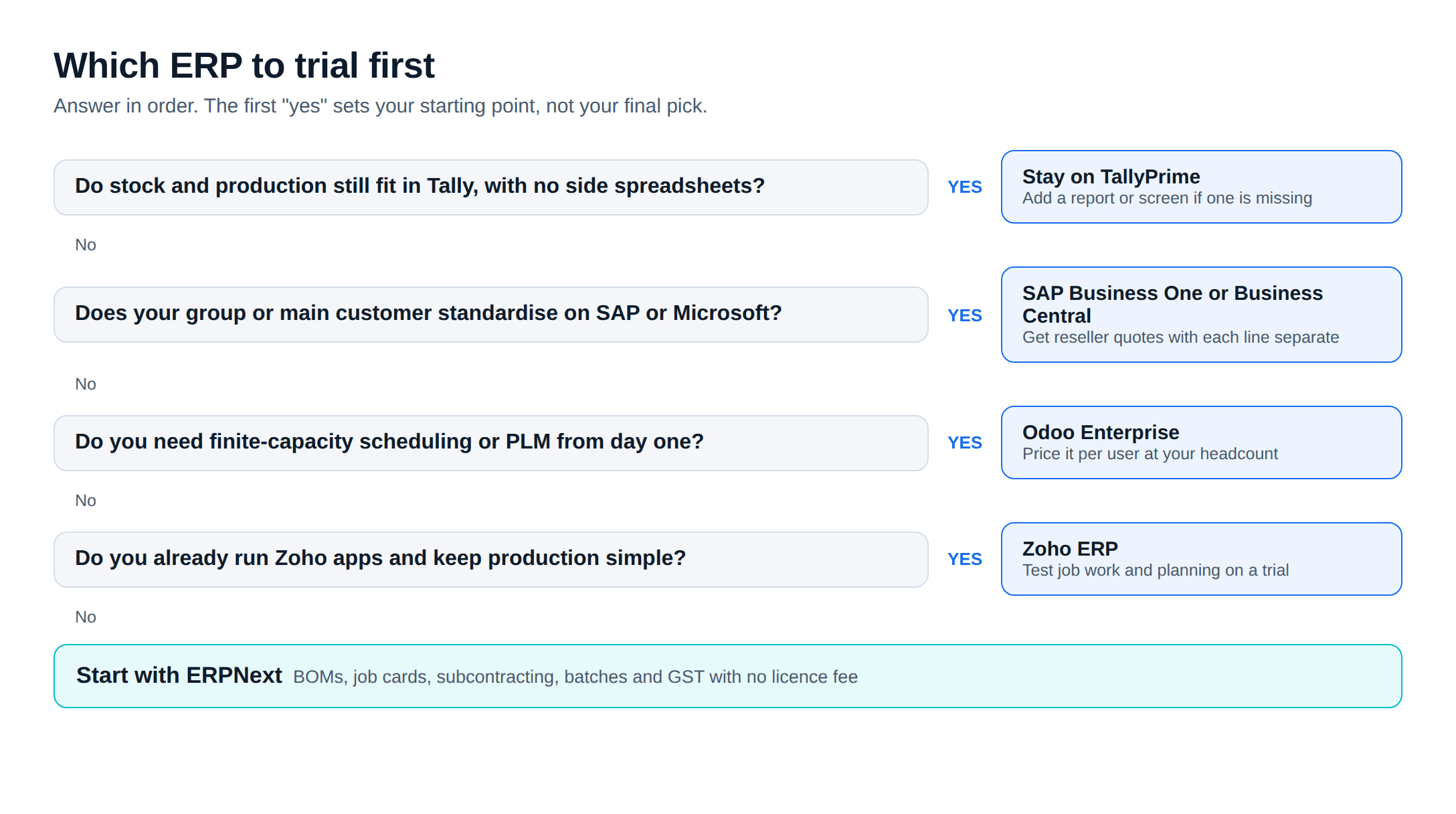
- You need finite-capacity scheduling now. If your floor runs on a resequencing scheduler, Odoo Enterprise documents one and ERPNext does not.
- Your group or customers standardise on SAP or Microsoft. A parent company on SAP, or IT running everything on Microsoft 365 and Azure, can outweigh the licence saving.
- Nobody will own the system after go-live. ERPNext rewards a plant with one person who learns it. If no one in the plant will, a vendor-run subscription with support on one invoice may serve you better.
- Tally still fits. One godown, short BOMs through a manufacturing journal and no side spreadsheets: a new ERP will cost more than it returns.
- The only good implementer near you sells something else. A strong local Odoo or Business Central firm that knows your industry beats a weak ERPNext one.
How to test your shortlist in two weeks
- Write down your five hardest processes: BOM levels, job work, batch or serial rules, quality checkpoints and how you schedule the floor.
- Pick two products, not six. The table and the flow above should get you there.
- Run each on a trial site with your own data: one real BOM, one job work cycle, one month of purchases and one GST invoice through to e-invoice.
- Get a written five-year quote from each implementer for your user count, with licence, hosting, support and upgrades on separate lines.
- Ask in writing who holds the GSP credentials and what data export you get if you leave.
If ERPNext comes out ahead, ERPNext implementation for manufacturers explains how Metageeks, an independent ERPNext implementer, scopes a plant before setup starts. For custom screens, reports and integrations, see ERPNext development, and for help after go-live, ERPNext support. If another product fits your plant better, we will say so.
Frequently asked questions
Which is the best ERP for a small manufacturing company in India?+
It depends on your process and budget. For a 10-200 person plant that needs BOMs, work orders, job work, batches and GST without a per-user fee, ERPNext is a strong fit. Odoo Enterprise suits plants that need finite-capacity scheduling now, and Business Central or SAP Business One suit groups already committed to Microsoft or SAP. Run a trial on your own BOM before you decide.
Does Zoho have a manufacturing ERP in India?+
Yes, since January 2026. Zoho ERP launched in India, and its pricing page lists manufacturing orders, work centres, shop floor production and quality inspections on both the Standard and Premium plans. Zoho Books on its own has no manufacturing module. The pricing page we read does not name job work, subcontracting or MRP, so ask Zoho how it handles those.
Is TallyPrime an ERP for manufacturing?+
TallyPrime is accounting software with inventory. Its help pages describe bills of materials, manufacturing journals, job work orders, godowns and batch tracking, which is enough for simple production. It does not run work orders through operations, plan capacity or turn sales orders into a production plan, which is what a manufacturing ERP adds.
How much does manufacturing ERP software cost per user in India?+
At list prices at the time of writing, billed yearly: Odoo Standard is 725 rupees per user per month after the first-year discount, Zoho ERP Standard is 999 rupees, Zoho ERP Premium is 2,499 rupees and Business Central Premium, the plan with manufacturing, is 9,150 rupees. SAP does not publish a Business One price for India that we could find. ERPNext has no licence fee; you pay for hosting, implementation and support.
Can I switch ERP later if I pick the wrong one?+
Yes, but it is a migration project. Masters, open balances and open orders move with import templates, and old transactions can stay in the previous system as a read-only archive. With a subscription product, ask in writing what export you get before you sign.
Related reading
- ERPNext vs Odoo for Indian manufacturers: the two open-source options, with five-year costs.
- ERPNext vs Odoo vs Zoho: the three-way view, with Zoho Books and Inventory plans.
- Tally alternatives for manufacturers: accounting-first options alongside the ERPs.
- ERP for manufacturing in India: what an ERP does in a plant and how to implement one.
Free ERPNext fit check
Will ERPNext fit your factory?
Answer a few quick questions. On a short call we tell you whether ERPNext fits how you make, stock and sell, and what the rollout looks like.
Check my fit →About the author

- Tags
- erpnext
- erp
- manufacturing
- india
- comparison
Subscribe to Our Newsletter
The AI Build Brief: practical playbooks on how to build, price and ship AI features, in one short email every other week.