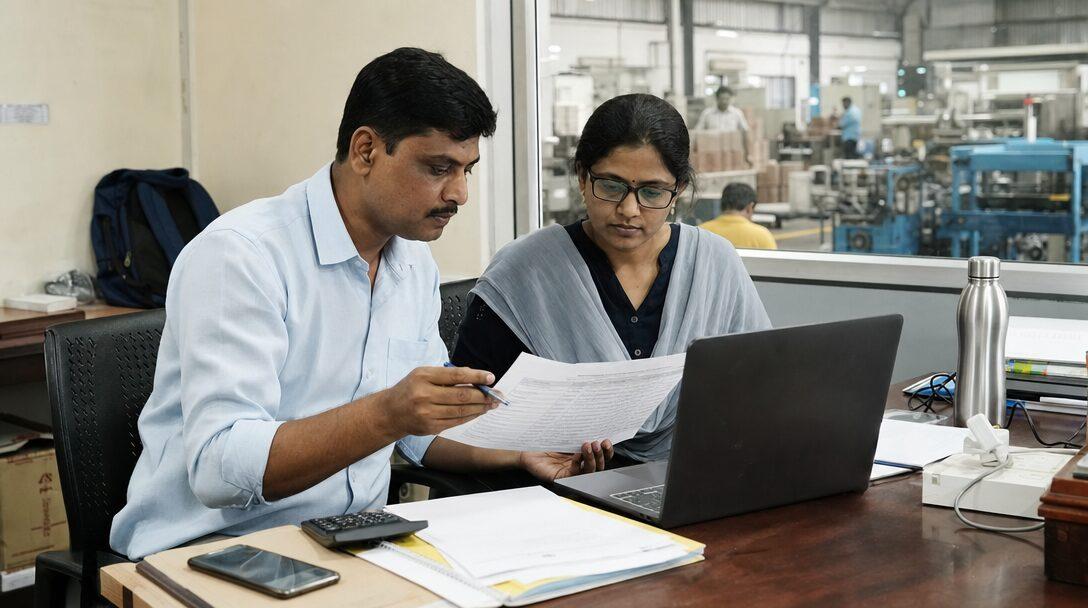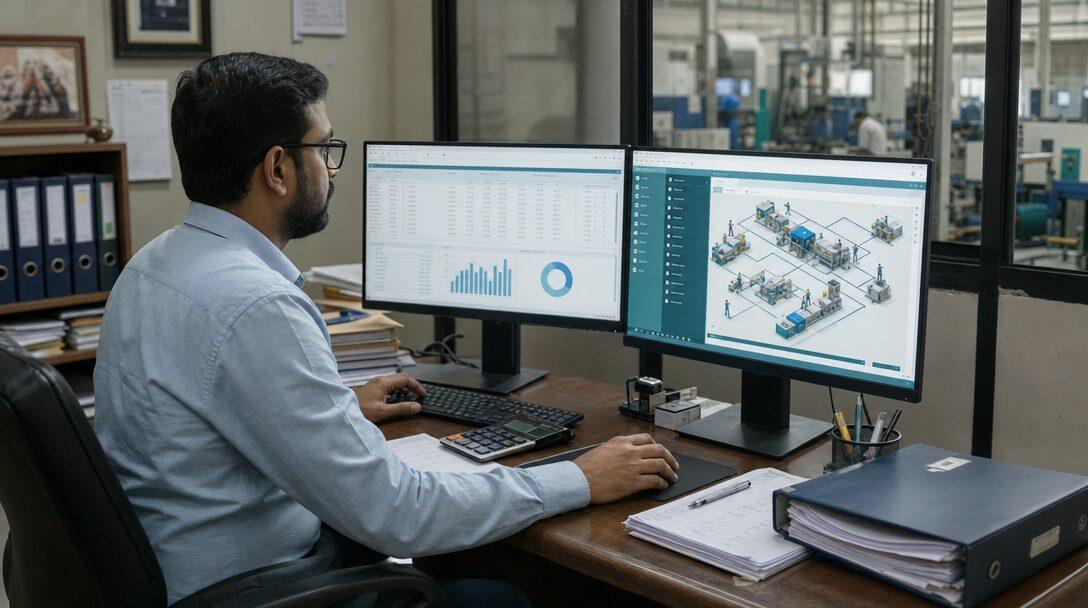

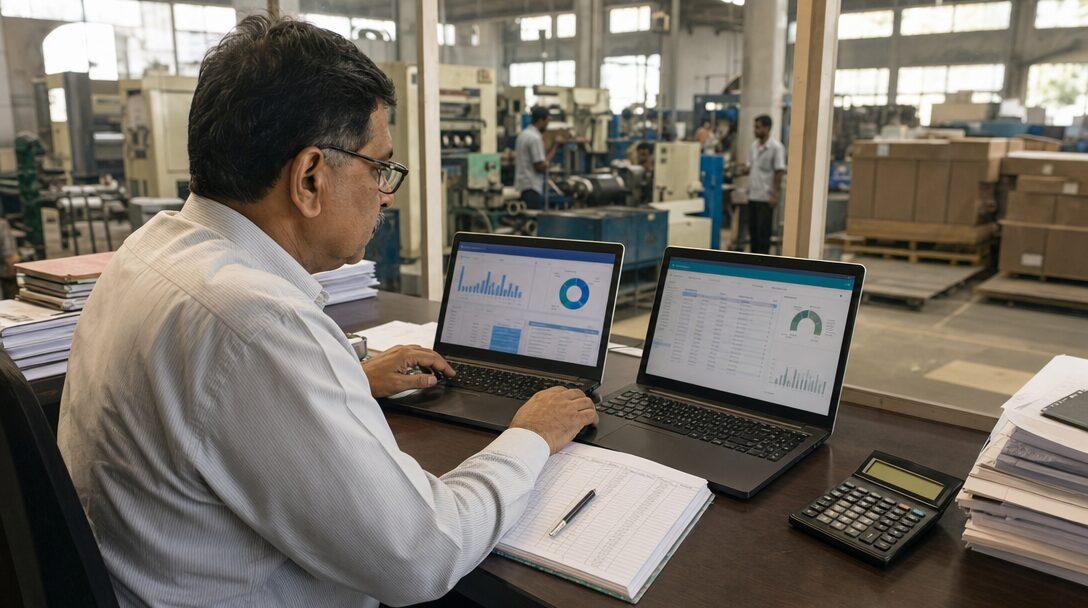
If you are looking for a Tally alternative, start by naming what Tally is failing to do, because the answer decides which kind of software you need. TallyPrime is excellent accounting software. Picture a plant where it keeps the books well, while the stores register, the production plan and the purchase follow-up live in three spreadsheets around it. Swapping Tally for another accounting product will not fix that plant. This post sets out the wider shortlist, what each option is for, and what each one costs at its vendor's own India price list.
TL;DR
- Tally alternatives fall into three groups: accounting-first products (Zoho Books, Busy, Marg), manufacturing ERPs (ERPNext, Odoo, SAP Business One), and Tally itself with add-ons written in TDL.
- If the books are the problem, stay in the first group. If stock, production and purchase are the problem, look at the second.
- At the time of writing, TallyPrime Gold lists at ₹67,500 for a lifetime multi-user licence. Busy and Marg list one-time licences from ₹10,300 to ₹26,000. Zoho Books and Odoo charge monthly. ERPNext has no licence fee. SAP does not publish a Business One price for India that we could find.
- Moving off Tally means moving masters and opening balances, not ten years of vouchers.
- Stay on Tally if your stock and production fit in it today. A migration should buy you something the plant will feel.
Free ERPNext fit check
Will ERPNext fit your factory?
Answer a few quick questions. On a short call we tell you whether ERPNext fits how you make, stock and sell, and what the rollout looks like.
Check my fit →Signs a plant has outgrown Tally
Tally does a lot for a small manufacturer. Its help pages describe bills of materials, manufacturing journals, job work orders, multiple godowns, and batch and expiry tracking. GST returns, e-invoices and e-way bills come from inside the product. For a plant with one godown, simple recipes and an accountant who also keeps the stock, that is enough.
The strain shows up away from the ledger. Watch for these:
- Production orders, the purchase follow-up or the stores register live in a spreadsheet, and that spreadsheet is the one people trust.
- Nobody can see which jobs are in progress, late or waiting for material without walking the floor.
- Stock in Tally and stock in the stores do not agree, and the month-end adjustment keeps growing.
- Material is bought on someone's memory, because there is no plan that turns sales orders into purchase needs.
- A customer or auditor asks for batch traceability and it takes a day to put together.
- The accountant answers every operational question, because Tally is the only system anyone has.
Each of these points to work happening outside Tally's accounting. The plant needs software built around operations, with the accounts inside it. Our ERPNext vs Tally comparison walks through that gap feature by feature. This post looks at the whole shortlist.
Three kinds of Tally alternative
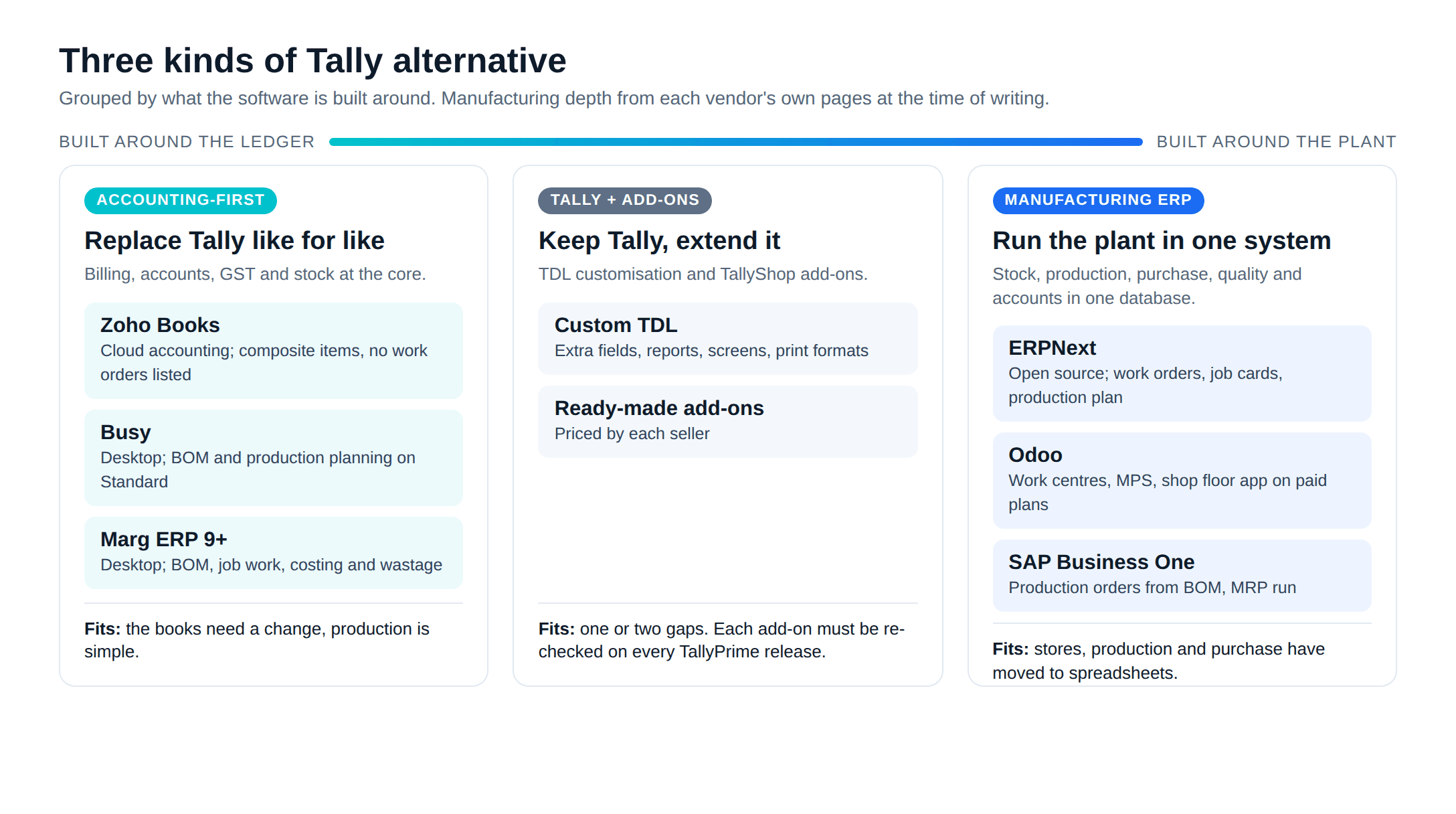
Search for "software like Tally" and you get products that do quite different jobs. They sort into three groups.
Accounting-first: Zoho Books, Busy, Marg
These replace Tally like for like. Billing, accounts, GST and inventory are the core, and each adds something Tally users ask for.
- Zoho Books is cloud-only accounting with GST e-invoicing on every paid plan, per Zoho's e-invoicing page. Its India pricing page lists composite items from the Elite plan and does not mention bills of materials or work orders. Pair it with Zoho Inventory for stock. It suits a trading-heavy business or a plant whose production is simple assembly.
- Busy is desktop accounting software with inventory and production features. Its pricing page lists BOM and production planning, a production variance report and batch-wise inventory with manufacturing and expiry dates on the Standard plan. On the newer BUSY Magic subscription, production and job work appear under "upcoming features".
- Marg ERP 9+ sells editions for pharma, textile, food and other trades. Its manufacturing page lists BOM management, production planning, job work tracking, and production costing and wastage. Its price list notes that customisation is extra.
The trade-off is the same for all three: they are built around the invoice and the ledger. Production is a feature added to that core.
Manufacturing ERP: ERPNext, Odoo, SAP Business One
These put stock, production, purchase, quality and accounts in one database, so a sales order can drive the production plan and the purchase list.
- ERPNext is open source under GPL-3.0, with no licence fee. A Work Order releases a BOM to the floor, Job Cards track each operation, and a Production Plan turns sales orders into work orders and material requests. GST e-invoicing and e-way bills come through the free India Compliance app.
- Odoo documents the deepest planning tools of the three, including a Master Production Schedule and work centres, in its manufacturing documentation. Its editions page shows that Shop Floor, planning, Quality and Maintenance are missing from the free Community edition, so most of that depth comes with a paid plan priced per user.
- SAP Business One is SAP's product for smaller companies. SAP's own learning course describes production orders that copy the BOM and track material and cost, and an MRP run that recommends what to make and buy. It is sold and set up through resellers.
The trade-off: an ERP asks more of the plant. Stores, production and purchase staff all enter data, so setup and training take longer than a like-for-like accounting swap.
Tally with add-ons
The third route keeps Tally and extends it. Tally's customisation language, TDL, lets a developer add fields, reports and screens, and Tally's help pages explain how to deploy TDLs and add-ons, including ready-made ones from TallyShop, Tally's marketplace. Tally's developer reference covers the language.
This works well for one or two gaps: a custom print format, a stock report, a production register screen. It gets harder as add-ons pile up, because each new TallyPrime release has to be checked against all of them, and the developer who wrote them has to stay reachable. Add-on prices are set by each seller, so there is no single figure to quote.
Tally alternatives compared: price and manufacturing depth
The table below uses each vendor's own India pricing page at the time of writing. Prices exclude GST. Licence models differ, so read the "pricing model" column before comparing numbers.
| Option | Type | Pricing model and list price | Manufacturing depth (vendor's own pages) |
|---|---|---|---|
| TallyPrime (buy page) | Accounting with inventory | Silver lifetime ₹22,500 (single user), Gold lifetime ₹67,500 (multi-user). Rental from ₹750 a month (Silver) or ₹2,250 a month (Gold). Gold renewal ₹13,500 a year per Tally's cost guide | BOM, manufacturing journal, job work, godowns, batches |
| Zoho Books (pricing) | Accounting, cloud | Per organisation, monthly: ₹749 (Standard, 3 users) to ₹7,999 (Ultimate, 25 users) on annual billing; extra users ₹150 a month | Composite items from Elite plan; no BOM or work orders listed |
| Busy (pricing) | Accounting with inventory | One-time: Standard ₹16,500, Enterprise ₹22,000. Or BUSY Magic subscription: ₹8,000 to ₹50,000 per 360 days | BOM and production planning, production variance report (Standard and Enterprise) |
| Marg ERP 9+ (price list) | Accounting with inventory | One-time: Basic ₹10,300, Silver ₹13,900, Gold ₹26,000 (unlimited users). Gold annual renewal ₹9,550 (up to 25 users) | BOM, production planning, job work, costing and wastage |
| ERPNext (Frappe Cloud pricing) | Manufacturing ERP, open source | No licence fee. Frappe Cloud hosting from ₹410 a month (shared site) or ₹3,600 a month (server) | Work orders, routings, job cards, production plan, quality inspection |
| Odoo (pricing) | Manufacturing ERP | Per user per month, billed yearly: Standard ₹580 for 12 months then ₹725; Custom ₹1,080 then ₹1,350 | Work centres, Master Production Schedule, shop floor app (paid editions) |
| SAP Business One | Manufacturing ERP | No India price published on SAP's site that we could find; quoted by resellers | Production orders from BOM, MRP run |
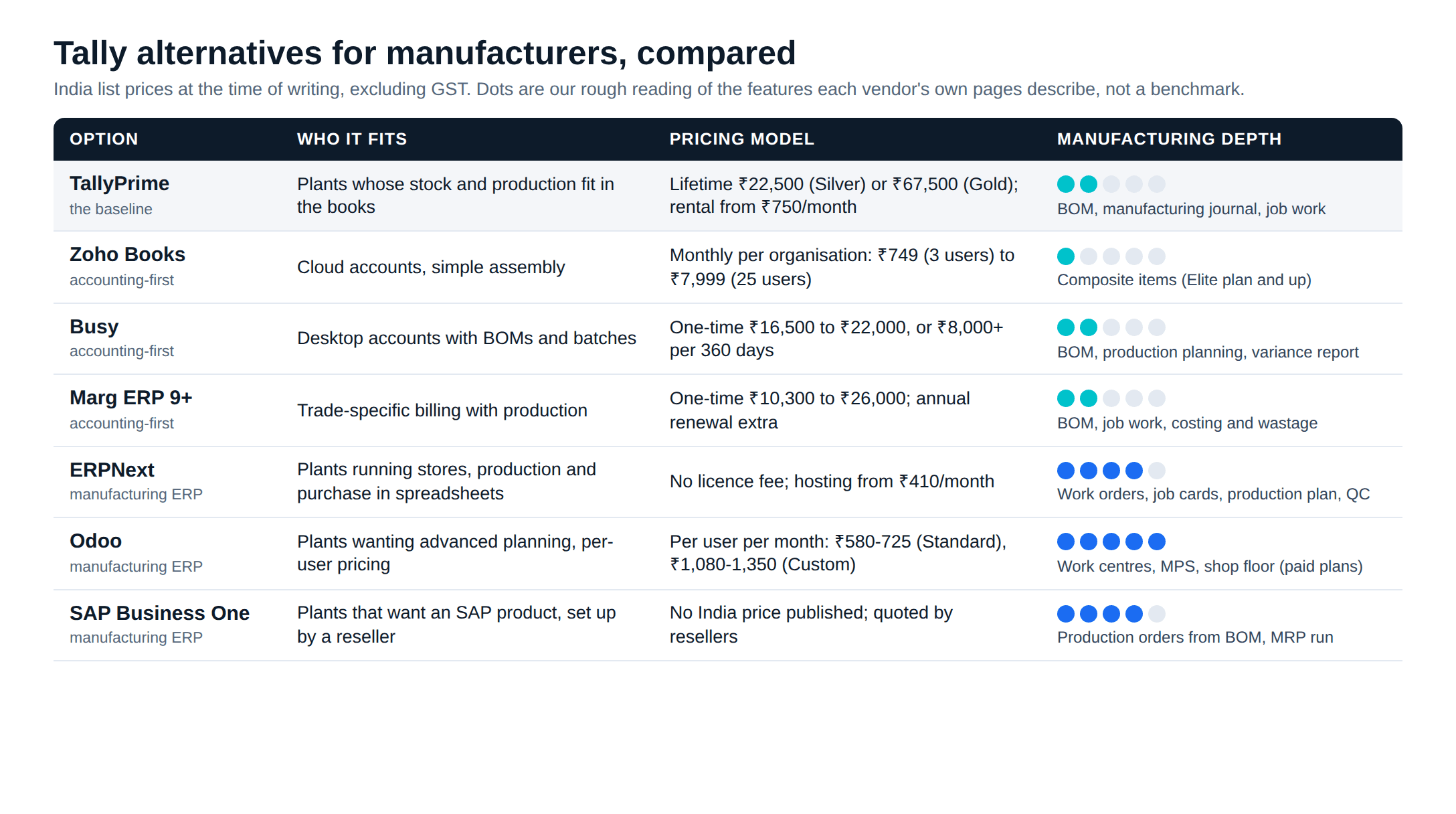
The accounting-first products cost less than Tally on paper. Marg Gold and Busy Enterprise both list below ₹30,000 one-time, against ₹67,500 for Tally Gold. If the plant's problem is the price of Tally or the wish for a different interface, this is the group to look at.
User count changes the arithmetic. Tally Gold and Marg Gold both cover multiple users for one price. Odoo grows with every user: at the regular Standard price of ₹725, 25 users come to ₹2.18 lakh a year in licences alone. ERPNext has no per-user fee; its cost sits in hosting, setup and support, which our ERPNext pricing guide sets out over three years.
Setup, data migration and training sit on top of every line in the table, and for an ERP they can cost more than the licence. Compare quotes for the same written scope, not list prices.
Which group fits your plant
Accounting-first
Your books need a change, but production is simple: assemble, pack, sell. One godown or two. Zoho Books if you want cloud access; Busy or Marg if you want desktop software with BOMs and batches.
Manufacturing ERP
Orders flow through several operations or machines, stock sits in more than one store, purchase depends on what production needs, and quality checks matter to your customers.
Tally with add-ons
Tally covers almost everything you need, the team knows it well, and the missing piece is one report or one screen that a TDL developer can build.
If you land in the ERP column, ERPNext is the option we work with. ERPNext implementation for manufacturers explains how we scope a plant before any setup starts. We do not sell Odoo, SAP or the accounting products, so read our view of ERPNext with that in mind.
What moving off Tally involves
Leaving Tally is a data project as much as a software one. The pieces are the same whichever product you choose:
Write the scope
Plants, stores, modules, user roles, reports and integrations. A written scope is what makes two quotes comparable.
Clean the masters
Items, customers, suppliers and ledgers. Duplicate items and three spellings of one customer are where the hours go.
Rehearse on a copy
Load opening balances and opening stock into a test site, then check the trial balance, stock value and party balances against Tally.
Cut over
Go live at the start of a month or financial year. Keep the old Tally company file as a read-only archive.
Voucher history can stay behind in a read-only Tally file. What moves is what you need to run the business from the cut-over date: masters, closing balances, unpaid invoices and opening stock. For ERPNext specifically, our guide to moving from Tally to ERPNext covers the Tally Migrator app, GST ledgers, batches and the cut-over weekend.
Before you commit to any product on the shortlist, test it on a trial site with your own data: one real BOM, one month of purchases, your GST setup and the three reports your owner reads every week. A demo on the vendor's sample company tells you little about your plant.
Stay on Tally if...
A migration costs money, management time and a month or two of disruption. It is not worth it unless the plant feels the result. Stay on Tally if:
- Stock and production fit in Tally today, and nobody keeps a side spreadsheet for them.
- You run one godown, or a few that reconcile without trouble.
- Production is a single step, or a short BOM booked through a manufacturing journal.
- Your pain is one missing report or screen that a TDL add-on can cover.
- The real issue is remote access, which TallyPrime Cloud Access, sold as an add-on, can address without a new system.
Change the software when the plant's work has moved outside it, not when the software looks old.
If two or three of the signs at the top of this post describe your plant, the cost of staying is already showing up, in stock adjustments, late orders and an accountant who never gets to the accounts.
Frequently asked questions
What is the best Tally alternative for a manufacturer?+
It depends on where the problem sits. If the books are fine and you want cloud access or a different interface, an accounting product such as Zoho Books, Busy or Marg is the like-for-like swap. If the problem is on the shop floor (work orders, stock across stores, production planning, quality checks), you need a manufacturing ERP such as ERPNext, Odoo or SAP Business One. Busy and Marg sit in between: both list BOM and production features, but they are built around billing and accounts.
Is there free software like Tally?+
There are free options with limits. Busy lists an Express edition at no cost for billing and accounting, Zoho Books lists a Free plan for one user and one accountant, and Odoo lists a free One App plan. ERPNext has no licence fee at all, for any number of users, but you still pay to host it and to set it up. None of the free accounting options covers manufacturing in depth.
Can I keep Tally and add an ERP for production?+
Yes. In that setup, stores, production and purchase run in the ERP and Tally keeps the books, with a link or a regular export between the two. It works, but every master (items, parties, ledgers) then lives in two places, and someone has to keep them in step. If the link breaks, stock value in the ERP and in Tally will drift apart, so budget for that upkeep before you choose it.
How long does it take to move off Tally?+
For a single plant, plan for a cut-over at the start of a month or a financial year, after at least one rehearsal on a test copy. The data move itself is masters, opening balances, unpaid invoices and opening stock; voucher history can stay in a read-only Tally company file. Our Tally to ERPNext migration guide sets out the steps and the checks.
Related reading
- ERPNext vs Tally for manufacturers: the two-way comparison, feature by feature.
- Moving from Tally to ERPNext: masters, GST ledgers and the cut-over.
- ERPNext pricing in India: what it costs to run each year.
- ERPNext vs Odoo vs Zoho: the ERP shortlist in more depth.
- Where Tally inventory breaks for a plant: WIP, job cards, QC holds and traceability.
- ERPNext vs Odoo for Indian manufacturers: the two-way comparison, with a five-year cost table.
Free ERPNext fit check
Will ERPNext fit your factory?
Answer a few quick questions. On a short call we tell you whether ERPNext fits how you make, stock and sell, and what the rollout looks like.
Check my fit →About the author

- Tags
- erpnext
- erp
- manufacturing
- india
- tally
Subscribe to Our Newsletter
The AI Build Brief: practical playbooks on how to build, price and ship AI features, in one short email every other week.